I’ve been intrigued by ghost towns going back to watching early westerns as a kid. In almost every shoot-em-up episode, weary cowboys wearing black Stetson hats—packing Colt six-shooters—slowly rode down Main Street surveying the scene.
Howling wind had window shutters constantly banging, creating an eerie atmosphere unlike any other. Of course, tumbleweeds always made their grand appearance. Generally, the first place these thirsty saddle tramps headed was an abandoned saloon expecting to enjoy a frothy beer.
I suppose being out in the heat for extended periods of time made them somewhat delirious. It’d be like you and me stopping at a long deserted Stuckey’s in Kansas, expecting to still find ice cold soda. For those folks not remembering Stuckey’s convenience stores, they dotted the main roads at one point.
In these Hollywood ghost town saloons, tables were turned upside down and of course no bottles of booze left behind. A dusty piano generally remained, undoubtedly because it was much too heavy to cart away.
I’d give anything to be one of those cowboys, because before leaving town I’d be packing a slew of collectibles into my leather saddlebags.
Little did I know back then that these ghost town scenes were more fantasy than anything; eye tantalizing visions put together by creative writers.
Research shows me there are 47 ghost towns in Mohave County—four of them within striking distance of Lake Havasu City, although the remains are nothing like those seen on the giant screen. Nevertheless, they’re still very interesting places to visit.
With the Parker Dam turnoff located approximately 33 miles from LHC, driving across the dam into California, and then some 11 miles south up the Parker Dam Scenic Byway Road, lies the ghost town of Cross Roads.
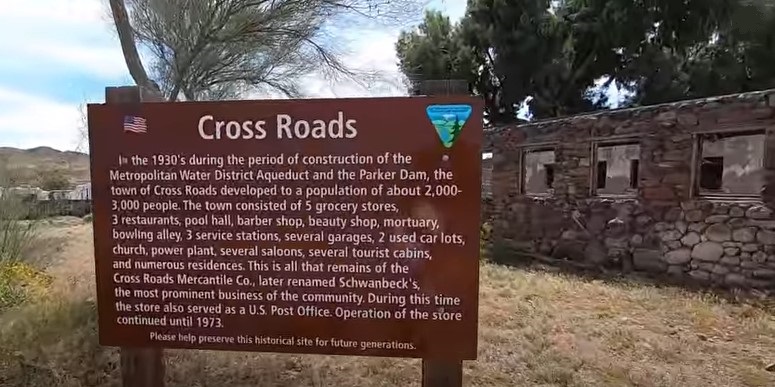
There’s nothing left other than a stone shell of the former Cross Roads Merchantile Company store and post office. A sign out front tells the history saying that up to 3000 residents lived there at one time.
There were three restaurants, a pool hall, barber shop, several garages, two used car lots, church, power plant, several saloons, tourist cabins, and a mortuary. They’re all gone now.
Driving to Cross Roads soon after crossing the dam, is a large fenced off area on the right with neighborhood roads still visible and palm trees. This was formerly government housing for dam employees until the homes were all torn down. Burros have since taken over this property.
Cross Roads was a booming place during construction, but after completion in 1931, and things became automated in the 1960s, dam workers were laid off, and the town basically ceased to exist. Most of what comprised the place is now storage units or parking for RV’s. It’s not really my idea of a western ghost town, but still an interesting place to stop and look around, especially with the abundant burros.
Swansea, Arizona, approximately 71 miles from LHC is more of a ghost town than Cross Road. Located some 20 miles on the south side of Parker, folks traveling there had better have a high clearance vehicle. There are several deep rocky ruts just waiting to puncture oil or transmission pans.
The directions on how to get there are best Googled and then written down or use a GPS. I’d hate to advise anyone and have them get lost like what happened to me the first time. Only because my wife was along and accurately deciphered my writing were we able to find the place.
In a nutshell, you travel approximately 39.8 miles on US95 south to Shea Road on the opposite side of Parker. Drive 13.3 miles on Shea Road before turning right on Swansea Mine Rd for 10.4 miles, and then another 7 miles on Swansea Rd.
My first trip there, I was somewhat confused by vocal directions given to me by a friend, but on later excursions, I had the exact route drawn out on paper.
There’s plenty to still see in Swansea. A former mining town, a good number of concrete foundations still exist along with a bunkhouse of sorts. There’s even covered tables for picnicking. One distraction we encountered on our last trip was aggressive, thirsty bees, making it somewhat hard to enjoy our sandwiches. Of course, that can happen just about anywhere.
Oatman is my favorite Arizona, ghost town. Located some 54 miles out of Havasu, I’ve been there numerous yet never spent the night. I’ve ate lunch, bought ice cream, purchased numerous t-shirts, including feed the burros special food sold by vendors.
It’s a ghost town atmosphere unlike any other, complete with Main Street shootout at certain times between the good guys and bad. I highly recommend visiting Oatman because it’s well worth the trip. The drive from Oatman taking you through the ghost town of Gold Road, over Seagraves Pass, and into Kingman via old Route 66 is spectacular.
All that’s left of the ghost town of Gold Road is an operating mine with “No Trespassing” signs everywhere. Some concrete and stone foundations can still be seen on hills to the right. I own a brass Gold Road Bakery token found many years ago with a metal detector along one of these stone walls.
More time was spent by me in Alaskan ghost towns than those in Arizona and California. Camping in old Iditarod for over a week one summer with friends, the one thing this ghost town offers exactly like its western counterparts back in the day, was an alarming amount of biting flies and mosquitoes. We had to wear protective netting, gloves, and use duct tape for securing pants to boots in keeping them away.
While exploring Iditarod, Jeff, Doug, and I came across several empty “FLYTOX” bottles. This was a liquid that could be sprayed on horses and cattle to keep horseflies, gnats, and mosquitoes away. FLYTOX was made up of dichlorodiphenyltrichloroethane. I can’t say the word either.
The name we best know it for is DDT, which was eventually banned in 1972 for being extremely toxic to wildlife and humans.
Horse and cattle still attract these biting insects like magnets. For logical reason, Hollywood chose to ignore showing them in the movies, highlighting on dangerous gunslingers, rattlesnakes, and dancehall girls instead.
I’d bet that residents living in Arizona in the 1880s dreaded these pests more than anything, besides scorpions. Undoubtedly, more flyswatters and bug poison was sold than Colt revolvers or Winchester rifles. Several articles I read on early western life, said that horseflies and gnats were especially bad in towns and cities because of the livestock.
For western movie addicts and ghost town lovers like me, that’s not the kind of historical authenticity I want to see on the big screen. It just wouldn’t look right for macho, cigar smoking saddle tramps, to be riding into town swatting, slapping, and scratching all at the same time.


 I like to write junk...