
Last Friday night, on YouTube for free, I watched a 1962 episode of the television series, “Route 66” filmed in Lake Havasu City. To be honest, things have changed so much around town that I didn’t recognize a lot of the landscape, especially buildings. I would’ve been 8 years old at this point.
The storyline centers on an upcoming endurance outboard race on the Colorado River, a distant and unaffectionate father, and his love-lost daughter. It also has a philosophical ending that my simple mind still can’t grasp.
I suppose some old-timers will remember when Martin Milner and his movie crew came to visit. Milner played the part of Tod Stiles in “Route 66” — going on to “Adam-12” fame as Los Angeles, police officer, Pete Malloy.
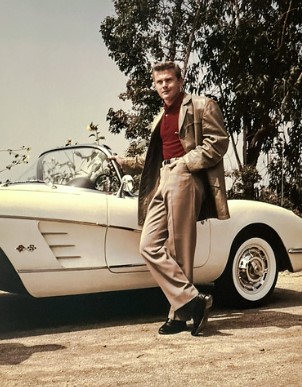
Dad was an avid “Route 66” fan and tuned in regularly. My father was seriously injured near Victorville, California, on Route 66 in 1957, when a Corvette he was a passenger in left the road on a curve and crashed. That might be why this show meant so much to him? I recall nothing of the series except for the cool ‘vette and theme music. My ears perk up whenever I hear it playing.
The episode filmed in our city is titled, “Go Read the River.” An opening scene shows Tod Stiles boarding a vintage Beechcraft 18 airplane in Los Angeles bound for Havasu. Quickly jotting down the FAA identification number on this plane, N44N, and after checking things out, I discovered it once belonged to the McCulloch Corporation.
That was no surprise since the plot involves testing of a McCulloch outboard-powered race boat. The episode was an excellent, hour-long subliminal pitch for Robert McCulloch Sr.’s outboard motors.
It was during this time, 1962, that I saw another movie connected with water— more like underneath it. Walt Disney’s, “20,000 Leagues Under The Sea” was playing at the Sel-Mont Drive In Theatre in Selma, Alabama. My family loaded in the car one evening and headed for the giant screen located on Highway 80.
Undoubtedly, Mom brought along sufficient food and drink for us, because snack bar items were deemed too costly by my folks. The re-released movie, starring actor Kirk Douglas, first came out in 1954, this being the year I was born.
I remember more about “20,000 Leagues Under The Sea” than any movie during my childhood, except perhaps, “Bambi.” The book written by, Frenchman, Jules Verne, is about a mysterious submarine named the Nautilus, along with a vengeful man in command of it, Captain Nemo.
Three men on a voyage to look for a monster fish, accidentally end up on the Nautilus as prisoners after their ship is attacked and sunk. In 1869, Jules Verne put all of his creative juices to work when he put pen to paper for this captivating science-fiction tale.
In the beginning, Ned Lamb (Kirk Douglas), sings a very unusual song about being a sailor and having to date strange women. Over 63 years, I still remember several of the lines.
“Got a whale of a tale to tell ya, lads.
A whale of a tale or two.
‘Bout the flapping fish and girls I’ve loved.
On nights like this with the moon above.
A whale of a tale and it’s all true,
I swear by my tattoo.
There was Mermaid Minnie, met her down in Madagascar.
She would kiss me, any time that I would ask her.
Then one evening her flame of love blew out.
Blow me down and pick me up!
She swapped me for a trout.”
One of the most memorable scenes has Ned and the other two survivors having dinner with Captain Nemo. Food prepared for them by Nemo’s chef never escaped my brain. Filet of sea snake. Biscuit of blowfish with sea squid dressing basted in barnacles. Fruit preserves were made from sea cucumbers grown in an underwater garden. Succulent pudding composed of Sautéed unborn octopus was served for dessert. And to top things off, milk or cream from giant sperm whales. How could a young guy forget such delicacies?
At the end of this meal, one of the prisoners, Professor Aronnax, accepts a large cigar handed to him by Captain Nemo. This act of generosity takes place within the tight confines of a submarine. What I remember most about this, was that Captain Nemo said the cigars weren’t made of tobacco but consisted of nicotine-laced seaweed.
If all of the sailors took part in this vice, without question, when the Nautilus surfaced and a hatch was opened, more smoke rolled out of it than Willie Nelson’s bus.
In the “Route 66” episode I just recently viewed, there’s one thing that hasn’t changed in Lake Havasu City, and that involves cars. Although it might’ve been unusual to see a 1962 Corvette driving around town in the early 60s, it isn’t today.
At the end of the story, Tod Stiles’s partner, Buz Murdock, played by actor George Maharis, drives their infamous ‘vette to Havasu from LA to watch his friend race. Of course, Buz brought along a couple of beautiful girls for company. There were always gorgeous women in “Route 66.”
I spotted a ’61 or ’62 Corvette just the other morning cruising down McCulloch Boulevard. An older gentleman sat behind the wheel with a nice-looking lady perched beside him. Stretching things just a bit here by using Jules Verne’s wild imagination, perhaps Tod Stiles loved Lake Havasu City so much back then, that he never left town!

 I like to write junk...