It was either 1985 or 1986, that I was driving my family to Lake Havasu City, from Wickenburg, Arizona, on a much-needed vacation. We’d left Phoenix late in the afternoon, and then spent the night in Wickenburg after a giant thunderstorm hit. I didn’t want to take any chances with flooded roads in the area. Never in my life had I seen or heard so much fury from a storm—not even in Kansas.
Driving through Salome the next morning, I noticed a sign painted on side of a building saying, “Salome, Where She Danced.” Not having a clue what that meant, and not knowing who “she” referred to, I too was at the point of dancing after consuming several cups of coffee.
Researching the town of Salome, when we returned home to Alaska, I found the historical information quite interesting. It was a gas and watering stop for travelers back in the day. Another name for this place was Drinkmens Wells. That fictitious namesake came from a 1945 movie titled, “Salome, Where She Danced,” starring Yvonne DeCarlo.
Salome was factually named after one of the founder’s wives, Grace Salome Pratt. Supposedly, she danced after trying to walk across hot sand in bare feet. I know that feeling as well from a popular beach in Florida.
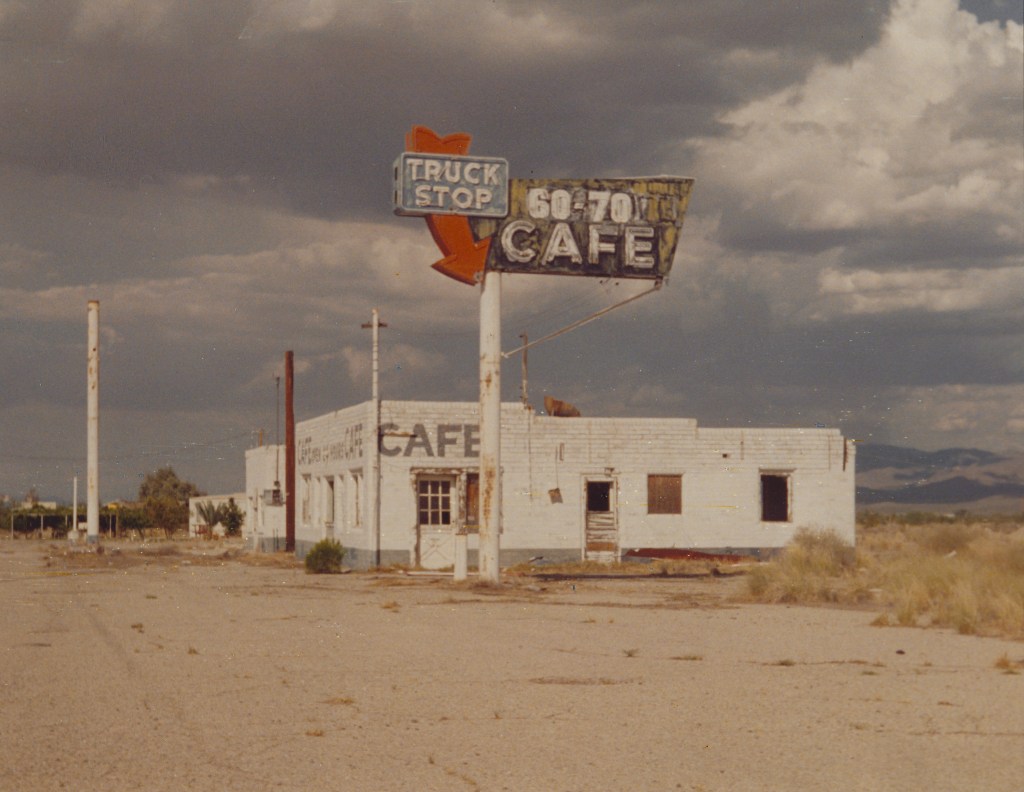
Just a few miles west of Salome, we came to the US 60-70 Café and Truckstop. Stopping to take some photos of the now boarded up place, a door was unlocked. I cautiously walked in with camera in hand. The exterior and interior hadn’t been graffitied up like so many other abandoned dwellings in and around Phoenix. Not considering it to be trespassing, although I was, my intent was to simply document things for posterity’s sake. I’m glad I did.
Slowly taking in the surroundings while on the lookout for snakes and other creepy crawlers, I noticed the counter was totally intact along with some tables still being useable. One of them was turned upside down, and I could see small blobs of ABC gum still dotting the underside of it. ABC gum for those not knowing is: already been chewed gum.
As a child, Mom used to scold me whenever I stuck my hands underneath a restaurant table, knowing better than me what lurked on the dark side of things. I believe this constant lecture on her part all started, when I removed a blob of hardened gum and brought it topside for show-n-tell.
The inside of this café was pretty much intact, and with a good amount of elbow grease and dollars, it could’ve easily been saved. I wrote a poem about the mysterious place and still have it tucked away in a filing cabinet.
Looking the business name up on http://www.newspapers.com, several “help wanted” ads were found as well as a slew of advertisements listing the property for sale. Thirty acres of vacant land went with the building. For a person wanting to work there, one of the ads showed that an apartment was provided.
A 1961 edition of, “The Yuma Daily Sun” newspaper article told a sad story regarding one of the workers. The article started out like this, “Waitress Dies At Salome Café – Eva Edith Momsen, age 58, employee of US 60-70 Café in Salome, died of an apparent heart attack while on the job.”
The following year when we drove back through, with me hoping to snap even more shots, there was nothing left of the place other than concrete where gas and diesel pumps once stood. We actually rolled right on past that morning, and it wasn’t until backtracking that I rediscovered the location.
There’ve been several other buildings I took photos of over the years that are no longer standing. The Riverboat Saloon on the California side of the Colorado is one such establishment. It was loaded with graffiti in the 1990s, and I got the chills just stopping there for a few minutes to take a few pictures.
A former California Highway Patrol officer told me that place was a real haven for criminals back in the day. Judging by location and how this decaying building looked when I last saw it, I understand why.
Quickly darting in this decrepit tavern, I glanced under the shattered remnants of a bar, spotting hardened blobs of gum attached to it like in the US 60-70 Café. Not forgetting any of this, and needing slightly more material for this composition, just recently I decided to research chewing gum as the finishing touch.
In a nutshell, this is what I discovered in an article written from a totally “green” perspective. The information came from an Aspiration newsletter. Aspiration is a climate-change-based, online financial investment company. I didn’t even know there was such an institution until now.
Chewing gum is basically non-biodegradable. A piece of discarded gum can last anywhere from 5 – 1000 years. Most chewing gum products are made from inorganic polyisobutylene, or polyvinyl acetate rubber bases, which are both resistant to biological breakdown processes.
These are the same materials used to make adhesives and tire tubes. They’re designed to be long-lasting for heavy-duty use. That’s why so much chewing gum exists on our sidewalks, benches, and lampposts for months, even years, with very little change in form. In Denmark, a piece of gum chewed some 5700 years ago was discovered during an archaeological dig. The article came to the conclusion that we shouldn’t be chewing gum for health and ecological reasons.
That explains to me why ABC gum in these two businesses remained there years after they’d closed down. According to the same article, 250,000 tons of discarded chewing gum lie in our landfills.
So, what does this all mean to me? I’ve been chewing gum for ages and don’t plan to stop. I chewed gum in school going back to the day when some teachers forbid it. Now, with other more violent things taxing a teacher’s state of mind these days, we don’t hear about gum chewing being condemned anymore.
Offer me some and I’ll take a stick—just make sure it isn’t ABC. I learned not to accept that flavor going back to first grade, perhaps earlier. There are several places to responsibly dispose of chewed gum. Under a restaurant table or on the sidewalk isn’t one of them.
Once all flavor is gone, I generally swallow the remnants. There’s no telling where it will end up after this takes place (pun intended). Getting rid of it this way is more environmentally friendly than sending spent gum to a landfill. Can you see I’m trying to save the planet here?
I didn’t think so!


 I like to write junk...