* The following story was composed strictly so that the history of my musket is never lost. A copy of this manuscript will be attached to the weapon.
As a small boy I dreamed of one day owning a “Brown Bess” musket. I’d read of the legendary gun in stories regarding George Washington, The Revolutionary War, and Daniel Boone. Wikipedia offers a simplistic explanation of what a Brown Bess is:
“Brown Bess” is a nickname of uncertain origin for the British Army’s muzzle-loading, smooth bore, flintlock Land Pattern Musket and its derivatives. This musket was used in the era of the expansion of the British Empire, in battles during the American Revolution, and acquired symbolic importance at least as significant as its physical importance.
It’s believed that Brown Bess is slang for, Queen Elizabeth I, although there’s no definite proof of such. Once again, Wikipedia provides a plausible explanation:
“Brown” came from an anti-rusting agent put on the metal that turned it a brown color. “Bess” came from either the word “Blunderbuss” or “arquebus,” both early types of rifles. “Bess” came from the nickname for Elizabeth I. The “Brown Bess” is just a counterpart to an earlier rifle that was called “Brown Bill.”
I’ve never heard of a “Brown Bill.” There’s something about this name that doesn’t turn me on historically speaking. It sounds more like a nickname for some fellow that easily tans.
To me, a Brown Bess musket is a symbol of this country’s heritage and freedom. A good many of these guns were captured from the British by Continental Army forces, and used against them during the American Revolution.

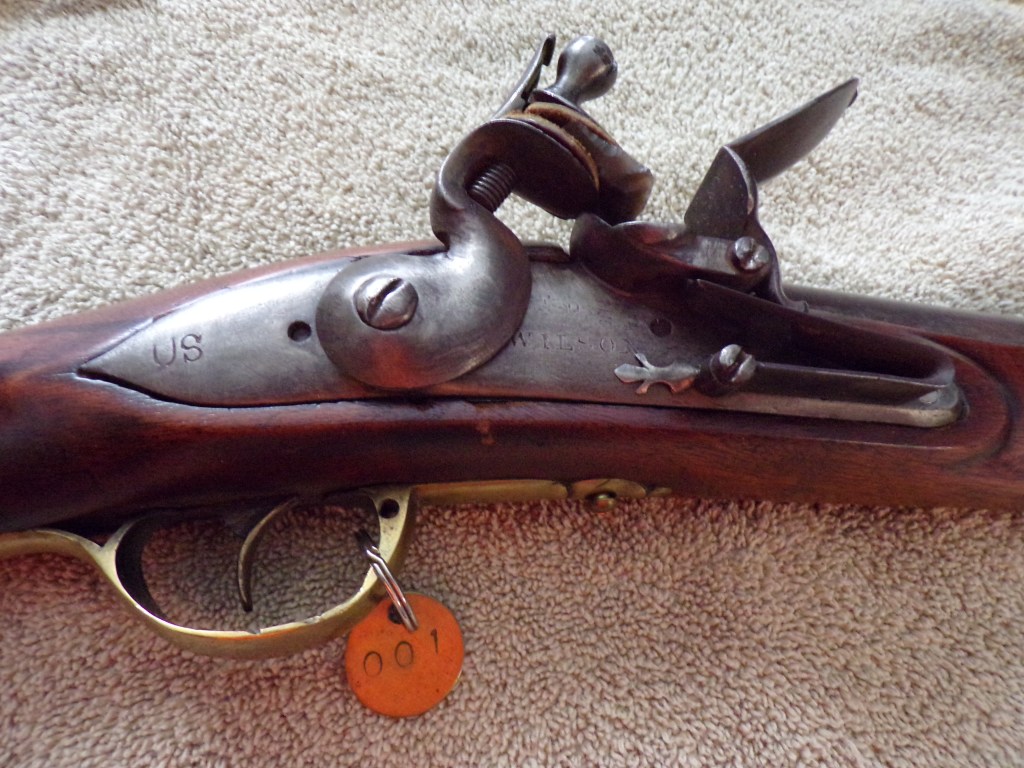
A Brown Bess that I’m in possession of, is a rare US surcharged Type 3 India Pattern version, with 39 inch barrel and original bayonet. It was purchased from a dealer in Old Scottsdale, Arizona in the early 1980s. This businessman acquired it from the late gun expert, Norm Flayderman. The story behind the musket is quite interesting.
According to Norm, a high ranking Army officer owned it up until he passed away. Part of the estate sale stipulated that this person’s name remain anonymous. The family didn’t want to be bothered. Somewhere along the way, an inheritor of the collection lightly inscribed a social security number on all of the antique arms. The number is so light that I had a hard time using a powerful magnifying glass to read it.
Someone having a little pull with government officials should be able to decipher things and figure out exactly who this person is. That might tie it in to the original owner. I tried but incurred too much red tape and failed.
The social security number (578-60-xxxx) is on a portion of the brass trigger guard. The first three numbers (578) signify that he was living in the District of Columbia at the time of SS issue. When I show this to people they shake their heads. It could easily be removed but I personally find it adds uniqueness to the Brown Bess’s overall 200-year plus history. I don’t show the complete number here for obvious reasons.
A New England gunsmith familiar with antique weapons carefully removed the rust, and restored things back to firing condition. All identification marks and numbers would’ve been virtually unreadable had he not done so. Military soldiers are taught that a gun should always be spotless and in proper working order, and the original owner made sure this one was up to that task. Thankfully, it wasn’t converted to percussion like so many were. Weapon is missing the sling swivels as so many are.
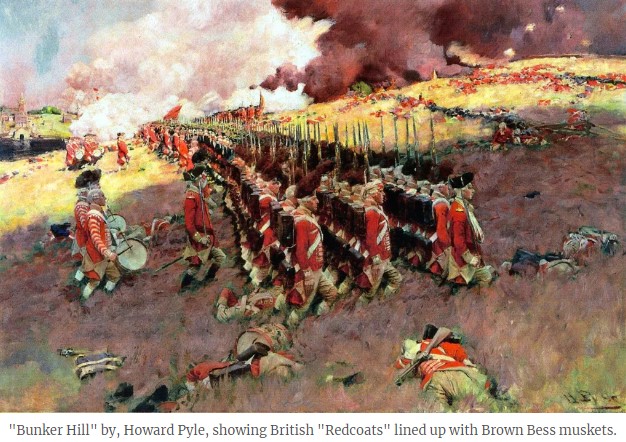
Some original markings were brought back to life in the restoration and I believe some were unable to be salvaged. Most noteworthy: is a somewhat hard to see number 65 on the barrel. I believe this designates it was used by the 65th British Regiment. The renown 65th regiment saw duty at Bunker Hill during the beginning of the American Revolution. If true, this makes the musket exceedingly rare.
According to what Norm told the dealer, this firearm was in poor shape having much surface rust after years of neglect. It was brought back by the military man from England after WWII ended. Before this it was displayed in a London pub for many years. More than likely it was a re-captured weapon by the British. This is purely assumption on my part based upon logic.
Visible is the maker, Wilson. The initials RW (Richard Wilson) is faintly readable, along with other marks that I’m not familiar with. Evidently, the area where the year was located was heavily pitted as nothing appears. A swan type cock shows it to be early manufacture.
This weapon was one of several in the late gentleman’s collection. A brass identification tag attached to the trigger guard has 001 stamped on it. According to the person I purchased it from, all of the estate guns had these ID tags.
Sometime in its early life, after first being captured, the gun became property of the fledgling United States Colonial Army, as two distinctive US surcharge markings are visible. When weapons were confiscated from the British this US mark was stamped on either wood stock or metal components.
The following information on Type 3 Brown Bess muskets came to light during my research:
“Noted historian and collector Dale Anderson states that the Smithsonian Institute is now certain that Third models like this one appeared about 1777, and that the National Park Service has a complete Third model confiscated from the British at Yorktown. There is also some evidence to show that captured Third models might have been stored in Federal armories after the war. It’s known that simplified India pattern type furniture was used on privately made British firearms before and during the Revolution.”
The Third Model Brown Bess served, to a degree in the 1777-1784 conflict but most certainly did so in the War of 1812, when the British tried to burn down the White House. However, its most famous success was as the ‘British Line Musket’ that defeated Napoleon at the Battle of Waterloo in 1815.
I’ve had my Brown Bess for close to 40 years. It was a significant purchase and only through an understanding wife was I able to procure it. Early on, she knew that I had a list of certain old things that I wished to acquire, and this was the foremost item. That list is now complete.
Finding out who the military former owner was would put icing on the cake. Unfortunately, that won’t happen for me. This historical artifact is already on its way to Rock Island Auction Company in Rock Island, Illinois, where a new owner can hopefully complete the mission!

 I like to write junk...