Whenever I see workers standing on the roofs of homes or commercial buildings, in blistering heat, I can’t help but wonder, “How do they do it?”
A seasoned roofer and veteran HVAC repairman whom I met in Havasu, told me summers here are brutal to work in. Gallons of water are consumed in the course of a day, and remarkably, they seldom need to use the restroom. Hot bodies mostly sweat it all out in order to stay cool. Straw hats or other types of head coverings, including bandannas, are pretty much mandatory while toiling in the baking sun.
My neighbor is a residential house builder, hitting his job site running before the sun rises each summer day. The guy’s usually back home a little after noon, having put in 8 hours. He’s not the only Lake Havasu City construction worker out there doing this.
A convenience store by my place is often filled with guys and sometimes gals in neon yellow and safety orange work shirts, or company monogrammed apparel, this before 5:00 a.m. An early riser myself, I see them at the coffee machine and loading up on breakfast or lunch sandwiches to go with their brew.
Tow truck operators in town have crazy jobs in summer. When the outside air is 120 Fahrenheit, black asphalt is easily 160 – 200 degrees. I saw one of these guys lying in a paved parking lot trying to attach a chain to a low-strung sports car. He was basically a human steak on a frying pan at this point.
I’ve performed a few crazy jobs in my life, yet nothing in 125-degree heat. Working as a mechanic at the DOT equipment shop in Anchorage, I had to perform certain tasks outside, in -20 weather, such as working on cars, trucks, or heavy equipment.
Long-john underwear underneath my insulated Carhart coveralls, with facemask and gloves on, including clumsy military-style, white “bunny boots” helped keep soft flesh from freezing, but not always.
Working on a runway sweeper in Bethel, Alaska, the wind was blowing 20 miles per hour, with it being 15 below zero. This made for a minus 40-degree wind chill factor. The sweeper was too long to fit in the small shop because I tried several times and failed. It had to be repaired outside.
Having all of the necessary clothing and boots on, I stayed safe by working a few minutes and then ducking back inside to get warm. A large metal panel covered a drive chain on the sweeper, and it was held on by small countersunk bolts. The only way to get the bolts started was by removing gloves and using exposed fingers.
Not having them off for perhaps a few minutes—both thumbs started burning like they were on fire. Recognizing the effects of frostbite, I immediately ran back inside the building and placed my hands under warm water. By then it was too late.
That took place 40 years ago, and to this day, both thumbs are still extremely sensitive to cold and heat. The nerve damage is severed and permanent.
The craziest job I ever performed was traveling to the North Slope for a geophysical exploration company. My job title was “Juggy,” a no-brain task that consisted of walking for miles picking up seismic monitoring cable. The pay was good yet working conditions were horrible.
Towards the end of one season, with most workers packed and headed home, the outfit employing me received a last-minute assignment. My co-worker and I were driven to a remote area in a track vehicle and dropped off each morning. This driver came back in the afternoon and picked us up.
There were no communication devices given to us. Should something bad have happened, we were on our own until that driver returned. This was in February or March, with sunlight only lasting a few hours each day. Because of the constantly blowing wind, the chill factor was significant, with whiteouts occuring without warning.
For miles in all directions, when the sun was shining, all we could see even with sunglasses on to prevent snow blindness, was huge chunks of ice jutting up in various places. Everything else was windblown untouched snow.
Finding out one morning before heading out that we were a few miles offshore, on the Beaufort Sea, this information didn’t make my partner and me too happy. We’d seen water puddling up in places and wondered why.
Our camp consisted of a series of trailers on skis pulled by a large D-8 Caterpillar. This is where we ate and slept. Eventually, we were told by those working in the kitchen on our “cat train,” that there were polar bears in the vicinity.
After learning this, those large ice chunks in the fading light began to resemble enormous white meat eaters. With my co-worker deciding to suddenly quit, and me about to be out there all alone, I promptly joined him. It took a couple of days before a plane could fly us back to Anchorage.
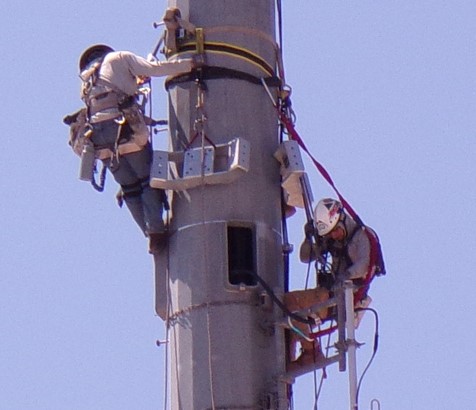
Having to be out in the extreme cold and heat to perform a job is crazy, yet someone has to do it. This afternoon I witnessed something that goes far beyond crazy. Driving back from Bullhead City, and slowly rolling through Golden Shores, three men were working in 125-degree heat, at least 200 feet up a tall metal pole.
They were installing microwave antennas and dishes for communication devices, namely cell phones. The wind was blowing making their job even tougher. One man stood on the platform of a hydraulic lifting device while the other two men had climbed a ladder, approximately 20 feet above him. They were secured to the pole by safety harnesses.
I stopped long enough to hop out of my vehicle and take several photos. Sweltering in the heat myself while trying to get that perfect shot, I couldn’t help but think. “The job these guys are doing isn’t crazy, it’s borderline insanity.”
As my wife sat in the car watching, I told her to think of those brave workers each time she made or received a call. If it wasn’t for folks like them, smartphones, iPhones, and the like would be worthless. I hope those men received lawyer’s wages or better for this task.
I remember years ago while applying for life insurance, the agent said that if I flew airplanes, rode motorcycles, or was a deep sea diver, his company wouldn’t cover me. Strangely enough, there was never any mention of climbing tall poles for a living!


 I like to write junk...