I’ve been on an Arizona ghost town tangent here lately, and was given another assignment related to such. For those who are up to speed on my ghost town writings, I take vintage postcards mailed from these places and attempt to identify who the sender was, as well as the recipient.
I use archived newspapers to do my research, along with genealogical data, including historical records found online. Thus far, I’ve found some interesting tidbits of information, but nothing that’ll touch the latest postcard find. This card was going to be sent from a man calling himself A.M. Cameron, yet for reasons unknown, it was never mailed.
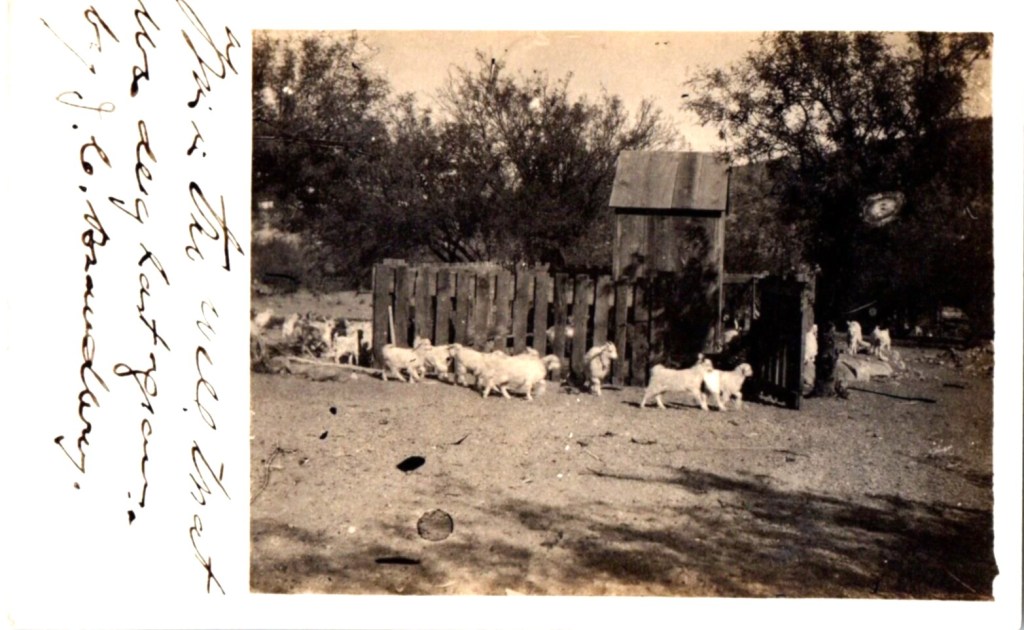
Mr. Cameron had written a name and address on a photo postcard that showed a recently constructed water well in Sayer with a group of goats standing around it. Having water readily available was a big deal back then, as it is now.
Next to the picture is written, “This is the well that was dug last year by J.C. Bradbury.” Water was important to Mr. Bradbury because he had several mining interests in the area. He was also the former county recorder for Yavapai County for several years.
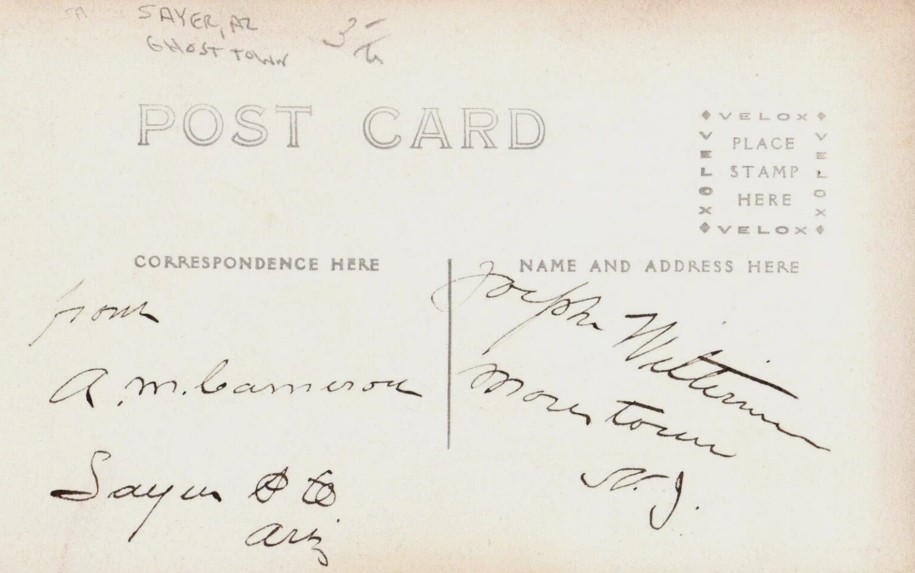
The card is made out to someone named Joseph Witterman in Montrose, New Jersey. It was being sent from the now ghost town of Sayer, Arizona, yet a stamp was never placed on the back.
Sayer, Arizona, or Sayer Springs, as it is often called, was a small supply depot for mines in and around the Wickenburg area. George Sayers had a store there, and thus the town name. On August 11, 1909, a shotgun that George used for protection accidentally discharged, killing him. Sayers is supposedly buried near Sayer Springs, although no tombstone has been located.
Researching A.M. Cameron, his full name is Allen Myers Cameron. Allen’s father, John F. Cameron, was captain of the 154th regiment, Tennessee Zouave Guard, during the American Civil War.
Allen Myers (A.M.) Cameron left Tennessee as a soldier in the Union Army to serve in the Philippines, and for a short time became a US Cavalry pony soldier in Arizona. Leaving the service because of poor health, he quickly recuperated and went in search of gold.
Initially working at Crown Point Mine for Governor Brodie, Cameron found a vein of the precious metal on his own near the Black Rock District of Wickenburg, and then, after staking a claim, he sold his mineral rights to a larger mining outfit for a good price.
Relocating to Sayer, A.M. Cameron accepted a job as caretaker of the Walnut Grove Water Supply dam, while he also began raising goats. His neighbor was a man named Leonard White. Mr. White was a miner, well-liked, and had many influential friends. White’s mining ventures lay all along the dammed-up Hassayampa River.
Leonard and A.M. Cameron didn’t see eye to eye, and newspaper accounts had them arguing over frivolous things. One thing not mentioned is that A.M. Cameron undoubtedly had some control over how much water was released from the dam for mining interests. This would’ve been a hot topic for all miners as it is today.
A practice that Leonard didn’t approve of was Cameron setting poisonous bait throughout the area. This poison had killed more than one of Leonard’s dogs. Undoubtedly, it killed other animals and birds besides the dogs and coyotes.
A lawsuit was filed by a man named Howard Draper after one of his pet dogs died, with A.M. Cameron admitting in court to setting at least 2500 of the traps in a 3-mile radius of Sayer, as a means of killing off coyotes and dogs. He told the court that these coyotes and dogs had been after his goats. Allen Myers Cameron was found guilty and fined $50.
On June 16, 1913, Leonard White unexpedtedly confronted Cameron in front of the Sayer post office and shot him dead. Six witnesses said that A.M. Cameron was unarmed. White was arrested and taken to jail, where he awaited trial. Allen Myers Cameron was 45 years old, while Leonard White was 48.
After the court proceedings ended, and nearly 40 hours of deliberation by the jury behind locked doors, on September 18, 1913, Leonard White was found not guilty. Newspaper accounts of the ruling make it seem as if even White couldn’t believe the outcome.
The Sayer postcard I mentioned was never stamped and mailed. I believe Allen Myers Cameron wrote it right before he was killed. Stretching things a bit here, it might’ve been on him at the time of death, because there appear to be a few spots of blood on the picture.
The card was undoubtedly found in his possessions afterward and packed away by who knows who, only for me to discover it 112 years later on eBay.
I never located the intended recipient, a Joseph Wilterman living in Moorestown, New Jersey, and it’s highly possible, this name is wrongly transcribed. I’ll keep working on the spelling with a high-power magnifying glass.
What I find most intriguing about this card is the picture of the simple water well. Water is still a precious commodity in not only the Sayer and Wickenburg area, but Arizona as a whole, including Lake Havasu City.
In a 1941 song by the Sons of the Pioneers, titled “Cool Water,” the beginning lyrics go like this: “All day I’ve found a barren waste, without the taste of water, cool water.” That tune was written with Arizona in mind because the songwriter, Bob Nolan, composed it in high school, while he was living in Tucson.
Water’s such a valuable resource that the time will soon arrive when it outshines gold. Perhaps we’re already there!

June 21, 1913 – “The Parker Post” – They had Cameron’s age wrong.

 I like to write junk...