
My wife and I sat down the other evening and came across a YouTube video titled, “17 Miners Vanished – The Truth No One Wanted Told.” Further explanation went on to claim, “In 1962, 17 miners walked into the Blackwater coal mine and never came back. The official report said that it was an accident.”
This headline was written strongly enough to draw us in, with the person doing the storytelling supposedly a sheriff in some rural West Virginia town. Sheriff Danny Morrison sounded above board, at least for a few minutes.
The fellow, in an authoritative voice, said that he’d always wanted to dig into the mine disaster, because he had suspicions that there was more to the tale than what he’d been told. Continuing on, he mentioned that while doing research on the accident, he discovered that there was a cover-up.
The miners hadn’t been in an explosion—they’d been murdered! At this point, I told Joleen that this video was BS. “Really?” she replied. Before I go further, my meaning of the acronym BS is bogus stuff and not cowpies, as most would think.
For someone who didn’t look into how this could’ve happened, which I immediately did, they might’ve sat there and come away misinformed. I had it pegged as make-believe when he told viewers that the miners’ families were paid $5000 each by the Blackwater Mining Company as compensation. Going online, I found nothing about 17 miners losing their lives in 1962. The only site that relayed such news was YouTube.
Just for grins, we continued watching until the end. It turned out that Sheriff Morrison’s grandfather had been one of those killed. He, along with 16 others, had been murdered by government henchmen because they saw that there was something far more valuable in that hole besides coal. I won’t tell the ending because, for those wanting to watch the whole video, the entertainment value alone is worth the wasted time.
I’m a skeptic of things seen on television. The other day, a fellow was hawking a device the size of a briefcase that he claimed could cool down a sizable room. Supposedly, the inventors were former NASA engineers who’d come across the idea during their research. I told my wife, “Ching ching!” using that saying quite often to highlight bogus stuff. It’s the sound of coins dropping into a cash register.
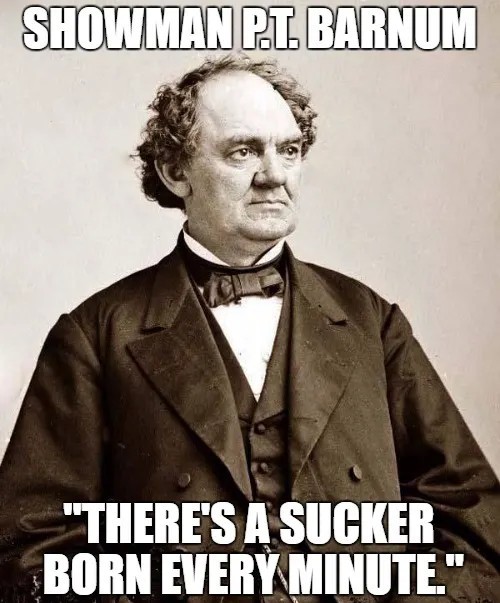
There are many such advertisements, designed to lure in suckers and lighten up their purses and wallets. P.T. Barnum had a description for these folks, claiming that, “A sucker is born every minute.” While many folks believe P.T. Barnum coined the popular phrase, Professor Nicholas DiFonzo of the Rochester Institute of Technology says that it was a cigar manufacturer named David Hannum.
In 1869, the clever Mr. Hannum took a large block of coal and chiseled the petrified corpse of a 10-foot giant man from it. His creation was named, Cardiff Giant, and it was so realistic that folks bought into the hoax. Things haven’t changed in this arena, as there are people out there believing those infomercials claiming that a certain facial cream will erase wrinkles.
I’m perhaps the world’s biggest skeptic about most anything I see on mainstream media. Much of what they say is nothing more than hot air. Sharks are operating within these organizations with one primary motive: to mislead and sway the public with biased reporting and inaccurate facts. For that reason alone, I don’t believe everything I read on Wikipedia or Snopes either.
These two think tanks have been proven to be polluted with leftist philosophy. Even the co-creator of Wikipedia, Larry Sanger, claims that his site has become a propaganda platform for the “left-leaning” establishment and can no longer be trusted. I believe Sanger because I’ve seen this with my own two eyes.
My good friend Jeff Thimsen’s dad, Dean, used a saying that I haven’t forgotten. It’s helped me more than once to wind my way through all of the misinformation and lies out there, “If it sounds too good to be true, it probably is!”
Dean Thimsen had a lot of good advice back then; only Jeff and I were teenagers, believing that we knew much more than our parents. It wasn’t until we became much older that we recognized their wisdom.

 I like to write junk...