One of the neatest places I’ve ever visited is Dawson City in the Yukon Territory, Canada. It’s been several years now, but the memory remains quite strong. My friends, Doug and Jeff, along with me, had to take a ferry boat across the Yukon River to get there, which was exciting all in itself.
Dawson City was a booming place from the start of the Klondike Gold Rush in 1896 until things began to peter out in 1899. At one time, there were close to 17,000 people in the city; today, the population is approximately 1,600.
Some of the original buildings still remain, with Dawson City a major tourist attraction in summer. When the town was at its peak, gamblers, hustlers, copulation experts, and other unscrupulous people came out at night to prey upon those miners having cash or gold in their pockets.
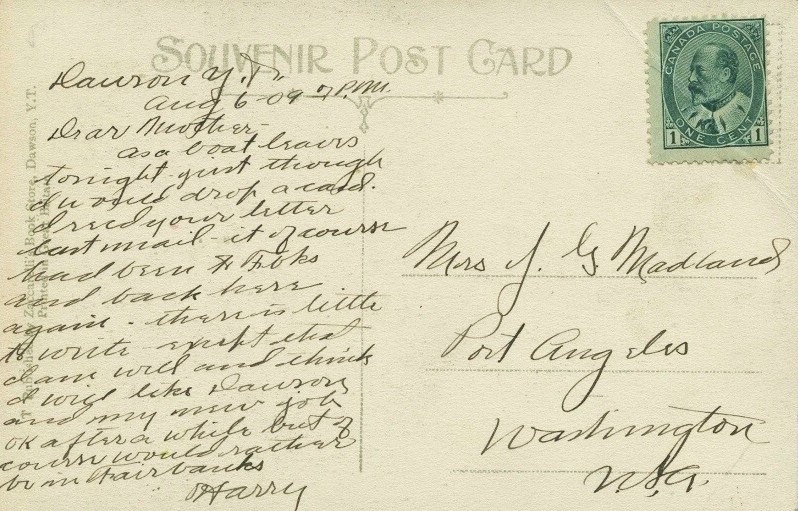
Born in 1892, Harry Madland was in Dawson City on August 6, 1909, as an old postcard proves. He wrote his mother, Mrs. J.G. Madland, in Port Angeles, Washington, informing her of his new job, although he doesn’t go into much detail. Mr. Madland would’ve only been around 17 at this time, quite young to be out on the road all alone, especially in a wild and crazy gold mining town.
“Dawson Y.T.
Aug 6-09 – 7PM
Dear mother –
As a boat travels tonight just thought I would drop a card. I rcvd your letter last mail. It of course had been to Fbks and back here again. There is little to write except that I am well and think that I will like Dawson and my new job ok after a while but of course would rather be in Fairbanks.
Harry”
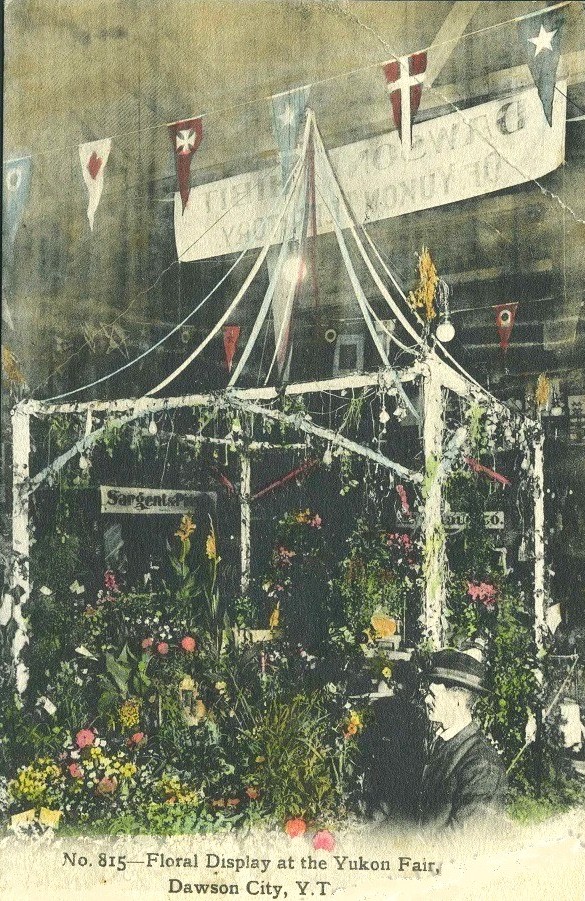
The flip side of the postcard shows a floral display put on by Dawson City, Yukon Territory, at the 1906 Seattle event. A man in a fancy bowler hat is shown looking at flowers.
With the sun staying up close to midnight during the summer months, a boat would’ve been able to navigate the treacherous Yukon 7 PM at night, as Harry indicates. With numerous sandbars and rapids, navigating the river was a difficult and sometimes treacherous task, and would be impossible in the darkness.
My research shows that Jens Gustav Madland was his father, while Harry’s mother was Christine Augusta Madland. He had three sisters and a brother. J.G. Madland evidently had a hard time supporting his family on meager wages, and perhaps lost a sum on a business venture.
The Washington, DC Patent Office patented an invention of Madland’s for a clothes hanger. He’s shown having a partner, J.F. Franck, in a business called Port Angeles Novelty Works. “The Olympic Tribune” headlines an article:
“The Port Angeles Novelty Works is a new infant industry for this place, now being started by J.F. Franck, a well-known citizen, and J.G. Madland, late of Seattle. The first article they are taking up is a tilting and revolving clothes reel of Mr. Madland’s invention.”
Things evidently didn’t work out as planned, as there’s no further information on this company.
After that failure, J.G. Madland sold flowers, tended gardens for people, which involved pruning, spraying, and grafting, along with being hired as a fruit inspector. Records show that he was paid $18 for one of his fruit inspection assignments.
Sadly, in 1913, the elder Madland was found dead in an irrigation ditch, where authorities said that he had committed suicide. That explains his son leaving the nest so early and heading out on his own, as it seems reasonable that he went off to work in order to send money back home to his family.
That wasn’t unusual in the day, as children often helped their parents out. Mrs. Christine Augusta Jackson Madland, Harry’s mother, the one he wrote the card to, died in 1942. Harry, along with the other siblings, most likely helped support her up until the end.
Harry eventually worked for Northern Commercial Company and Seattle Hardware Company, traveling throughout Alaska via dogsled, boat, and eventually airplane, to remote towns like Iditarod, Ophir, Eagle, Circle City, McCarthy, Cordova, and Nome, peddling his wares.
Newspaper records show he visited not only rural towns, but also the larger populations such as Fairbanks, Cordova, Juneau, and Anchorage.
Harry B. Madland married Louise Beaumont on March 19, 1912. Louise is reported to be the first white child born in the Yukon Territory. Her husband was quite successful in his sales ability, as he was employed with both companies for some 28 years.
Eventually, leaving Alaska with Louise, he became sales manager for Pacific Marine and Supply Company. It was while working for this outfit that he died of a heart attack in 1941. Harry was only 59. Louise Beaumont passed away five years later in California.
As far as Jens Gustav Madland’s business partner, J.F. Franck, the well-known Port Angeles resident, died in 1915. Administrators working for the deceased man’s estate successfully won a judgment in court for $326. This was in 1916.
Despite the business failure, it appears that J.F. Franck died a wealthy man and was still making money while his body lay six feet under.


 I like to write junk...