Nestled amid the rolling prairies of southeastern Kansas, Eureka stands as the proud county seat of Greenwood County. Its name—Eureka, a term meaning “I have found it!”—echoes the spirit of discovery and optimism that shaped its beginnings. From the earliest days of settlement to its present role as a vibrant community, Eureka’s history mirrors the broader story of the American Midwest: resilience, growth, and unyielding hope.
The story of Eureka begins in the mid-19th century, a period marked by westward expansion and the promise of new opportunities on the American frontier. Greenwood County itself was officially organized in 1855, during a time when Kansas was still a territory embroiled in debate over slavery and statehood. The townsite of Eureka was platted in 1867, strategically located along the banks of the Fall River, and was chosen as the county seat due to its central location and access to water.
Pioneers drawn by the promise of fertile land and abundant resources arrived in covered wagons, braving the unpredictable Kansas weather and the challenges of frontier life. Life was hard, marked by the struggle to build homes, cultivate the land, and establish a sense of community in an untamed landscape. The early settlers of Eureka built log cabins, dug wells, and planted crops such as corn and wheat—staples that fueled both survival and growth.
As Eureka grew, so did its infrastructure. The first post office was established soon after the town’s founding, and schools, churches, and businesses sprang up to meet the needs of the burgeoning population. Eureka became a vital trading center for the surrounding rural areas, its economy deeply rooted in agriculture and livestock.
The arrival of the railroad in the 1870s marked a turning point in Eureka’s history. The St. Louis & San Francisco Railroad (often known as the “Frisco Line”) connected the town to larger markets and facilitated the transport of goods, people, and ideas. This connection helped Eureka thrive, attracting new residents and businesses. Grain elevators and stockyards became familiar sights, and local merchants supplied everything from hardware to dry goods.
Despite its promise, life in Eureka was not without adversity. The town endured its share of trials—harsh winters, droughts, floods, and grasshopper plagues that threatened crops and livelihoods. The late 19th and early 20th centuries also brought health concerns and epidemics that tested the community’s resilience. But through these struggles, the people of Eureka demonstrated a remarkable spirit of cooperation and perseverance.
Disputes over land and law occasionally arose, as they did in many frontier towns. The establishment of local government, law enforcement, and civic organizations helped to bring stability and order. The Greenwood County Courthouse, constructed in the early 1900s, became a symbol of civic pride and progress.
The twentieth century brought both change and continuity to Eureka. The agricultural foundation remained strong, but new industries and innovations altered the landscape. Oil and natural gas discoveries in Greenwood County contributed to economic diversification, drawing workers and investors to the region. The Great Depression, like elsewhere in America, posed significant challenges, but federal programs and local initiatives helped the community weather the storm.
Education has always been a cornerstone of Eureka’s identity. The town’s schools, from one-room schoolhouses to modern facilities, have produced generations of graduates who have gone on to make their mark both locally and beyond. Civic organizations, churches, and clubs have fostered a strong sense of camaraderie and service.
Eureka’s downtown, with its historic storefronts and welcoming atmosphere, remains a testament to the town’s enduring character. Annual events—county fairs, parades, and community celebrations—bring residents together to honor both tradition and progress.
Today, Eureka is home to approximately 2,500 residents. While agriculture continues to be a mainstay, the town has embraced new opportunities in tourism, recreation, and small business. The surrounding Flint Hills region, with its scenic beauty and ecological significance, attracts visitors for hiking, birdwatching, and exploring Kansas’s unique tallgrass prairie.
Efforts to preserve historic buildings, stories, and legacies are evident throughout the town. Local museums and heritage organizations work diligently to keep the past alive for future generations. The Greenwood County Historical Society, for instance, maintains archives and artifacts that chronicle the area’s evolution.
Eureka has produced its share of notable individuals—educators, business leaders, and civic figures who have contributed to the town and beyond. The stories of ordinary residents, too, form the fabric of Eureka’s legacy: farmers tending their fields, merchants greeting patrons, families gathering for Sunday dinners.
The town’s resilience has been tested by events such as devastating tornadoes, including one in 2018, which required coordinated recovery efforts and showcased the community’s unity in the face of hardship.
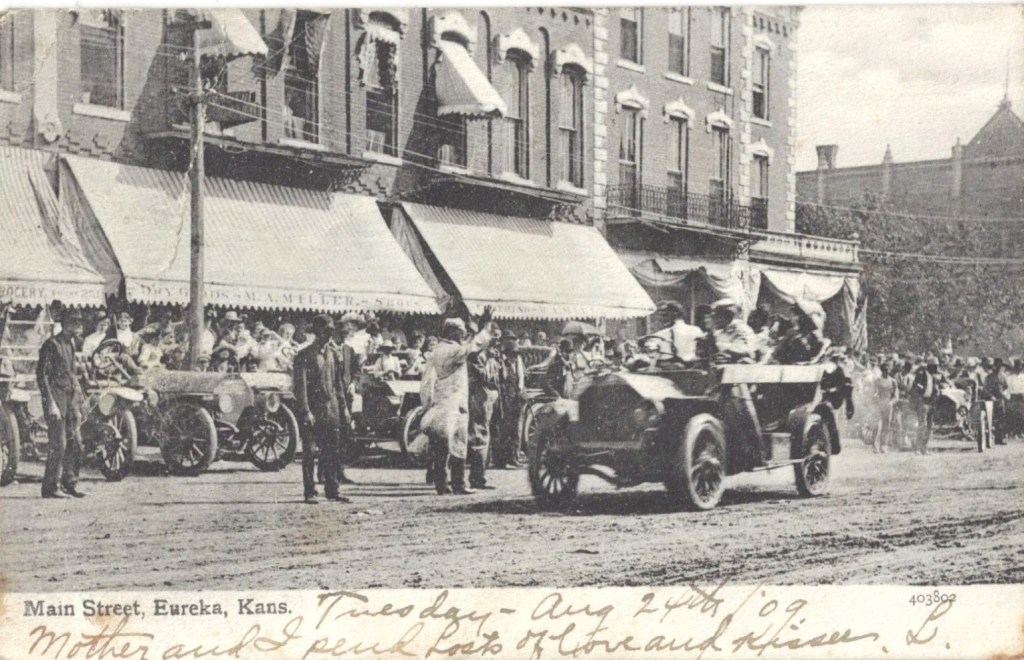
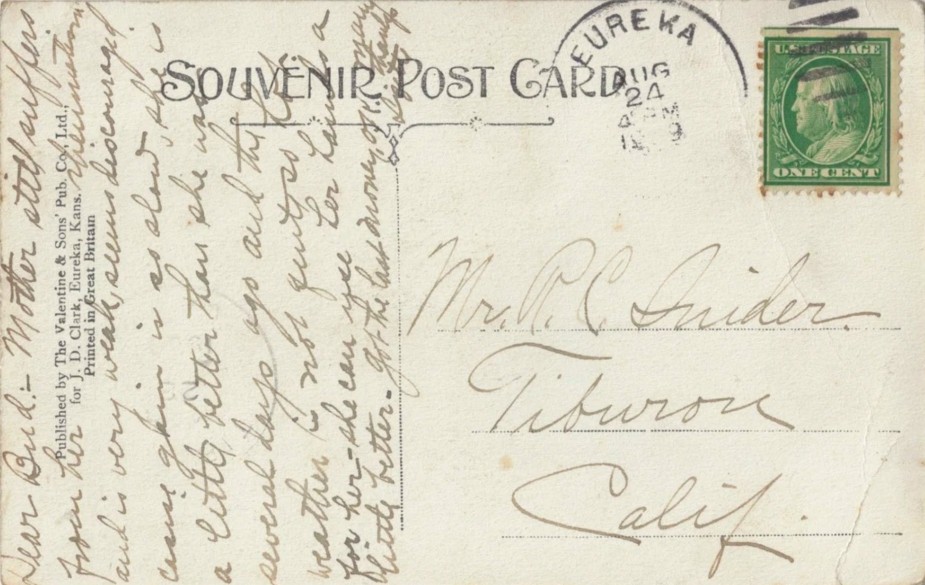
The Sniders were among the earliest settlers of Kansas, traveling there by covered wagon in 1857. An old Eureka postcard I came across mentions members of one of those early Snider families. This 1909 postmarked card was sent to Mr. R.C. Snider in Tiburon, California. The transcribed letter is as follows:
“Dear Bud –
Mother still suffers from her rheumatism and is very weak, seems discouraged because gain is so slow, she is a little better than she was and the weather is not so hot for her – she can use her hands a little better, got the last money, of P. Maury. Thanks. Lisetta”
Bud was a nickname for Randall C. Snider, Lisetta’s brother. The mother she talks about is Esther Arabella Snider. Lisetta, R.C., and Esther had moved to California, specifically to the San Francisco area, sometime in the late 1800s, leaving behind other kin in Eureka and the surrounding areas. They lived together in the same home with Lisetta, 33, and unmarried. Lisetta and Esther were back in Kansas, visiting friends and family, having traveled over on a train.
Esther Arabella Snider passed away in 1916, 7 years after the postcard was sent. She was only 59, having been born in 1857 in Ohio. Her two children, Randall and Lisetta, are also buried in California. Randall worked for the railroad as a painter; thus, he was probably able to get discounted train tickets for his mom and sister. The young man was evidently helping support his ailing mom along with Linetta.
The photo on front of the postcard shows Eureka, Kansas, with some type of celebration going on. Written on the bottom of it is an additional message to R.C. from Linetta, showing how close this family was!
“Tuesday Aug 24th / 09 Mother and I send lots of love and kisses. L.

 I like to write junk...