
When I first saw a couple of strange names on a 1917 postcard from Canyon Diablo, Arizona, my mind immediately conjured up a law firm. Finckel & Wigglesworth has a good ring to it.
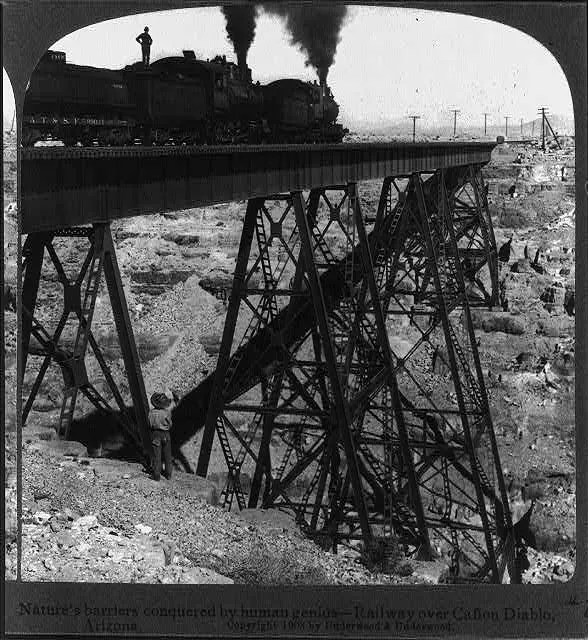
Canyon Diablo is an interesting place in itself. Researching things, the former town was in Coconino County near a canyon called Canyon Diablo. In Spanish, that means “Hells Canyon.” I traced the town’s roots back to a railroad bridge being built over the deep canyon. The railroad community was well and alive in 1880, but died off by the early 20th century. It’s now a ghost town with a few building foundations remaining.
Canyon Diablo is considered one of the most wicked and dangerous Old West communities to ever exist. It had a fair share of saloons, brothels, and gambling houses. Crime was everywhere with no lawmen available, while Main Street was actually named Hell Street.
The first sheriff who put on a tin badge in Canyon Diablo only wore it for perhaps five hours before he was killed. Four others followed him to the grave in a little over two years. It’s claimed that murders were a daily occurrence and that the cemetery quickly filled to capacity. Corpses were then buried wherever open ground could be found.
On April 5, 1905, two bandits, John Shaw and William Evans, held up some gamblers in the Winslow, Arizona, Wigwam Saloon. Shaw and Evans escaped with what’s believed to be around $300 in silver dollars.
Three lawmen, Pete Pemberton, Bob Giles, and Chet Houck, immediately picked up their trail, discovering silver dollars accidentally dropped along the trail. The trio eventually came across the robbers standing outside a trading post in Canyon Diablo.
Telling John Shaw and William Evans that they needed to be searched, the criminals drew their guns first and began firing. The sheriff and his marshals were faster on the draw, with William Evans injured, with John Shaw killed. Sheriff Chet Houck was only slightly injured, with a bullet grazing the outside of his stomach.
William Evans was taken back to Winslow, with John Shaw buried in a wooden coffin in Canyon Diablo. When word reached a group of cowboys about the killing of Shaw, and knowing that he didn’t get to finish his shot of whiskey the night of the robbery, they left Winslow and decided to go to Canyon Diablo and give him one last drink.
Exhuming Shaw’s body from its coffin, the cowboys lifted him out, stood him up, and then proceeded to give the dead man his final shot of liquor. Photos were taken before John Shaw was reburied with the open bottle placed beside him.
There’s much more history to Canyon Diablo, enough so to fill a book. I’ll leave my research at that, moving on to those names written within the old postcard. Before leaving, though, a postmark from the Canyon Diablo post office is quite rare, as it was only open for a few years.
In compiling this story, I picked up the vintage, giant cactus postcard for only $4.29. The person selling it did not know the value of rare postmarks. I only mention this because you, too, can find these bargains by diligently looking at cards on eBay. I don’t mind if you beat me out of one, as it’ll save me a few dollars and make for one less story to write.
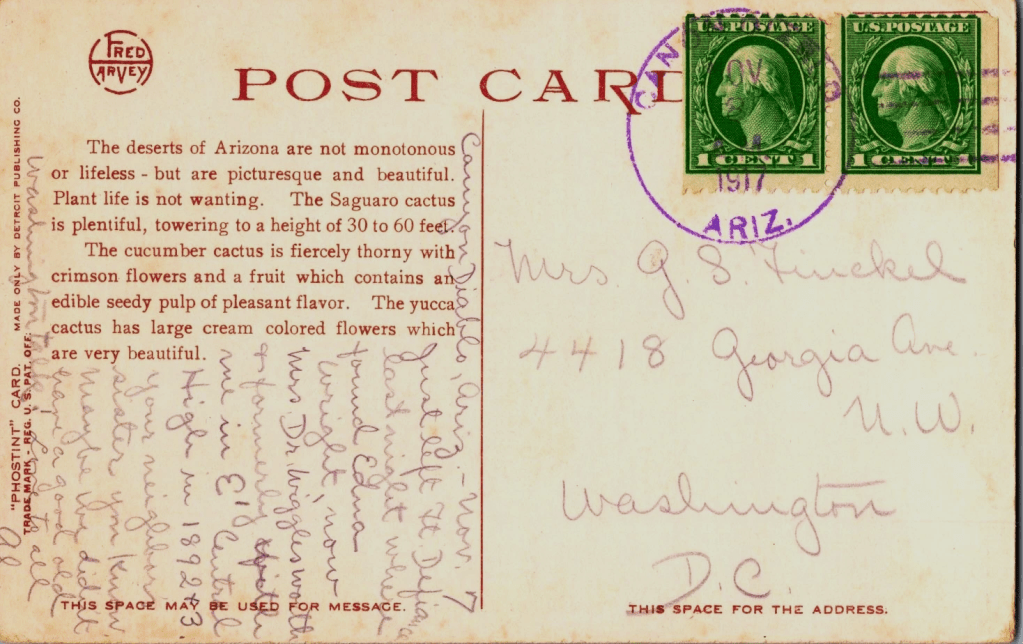
My card was sent to Mrs. G.S. Finckel in Washington, DC. The person mailing it from Canyon Diablo was either named Al or those are their initials. Al mentions meeting up with Mrs. Dr. Wigglesworth in Fort Defiance. Dr. Wigglesworth is a person of unique significance in Arizona history. The letter on the front of the postcard is as follows, with no corrections:
“Canyon Diablo, Ariz – Nov 7
Just left Fort Defiance last night, where found Edna Wright, now Mrs. Dr. Wigglesworth & formerly with me in E’ Central High in 1892 + 3. Your neighbor’s sister you know. Maybe we didn’t have a good old Washington talk. Love to all
Al”
Edna Wright went to Central High School in Washington, DC as did her husband, Matthew Albert Wigglesworth. Mrs. G.S. Finckel (Gertrude Seaver Finckel) went there as well. Gertrude’s husband, Paul Finckel, was a patent attorney in Washington, making my prediction right on target for assumed attorneys, Finckel and Wigglesworth.
Paul Finckel was an esteemed musician as well, with Paul playing the cello in many Washington concerts. His wife, Gertrude, was a social butterfly in the community, knowing many distinguished people.
Dr. Albert Wigglesworth was a pioneer doctor and one of the first to devote his medical knowledge to American Indigenous Indians from 1900 – 1925. In his own words, he said the following: “I was the only physician for some 30,000 Indians on a reservation of 16 million acres—almost double the area of Connecticut and Massachusetts combined.”
Fort Defiance, as mentioned by the postcard writer, was one of the Navajo communities where Dr. Wigglesworth practiced medicine. In 1870, the first government school for Navajo children was established there.
There’s so much more to be found regarding Canyon Diablo, Dr. and Mrs. Wigglesworth, as well as the Finckel family. I’ll leave things at this point, believing I’ve given a brief synopsis on all three. Plans for this winter are to visit Canyon Diablo and bring along my metal detector, of course. Perhaps some of John Shaw and William Evans’ stolen silver dollars still wait to be found!


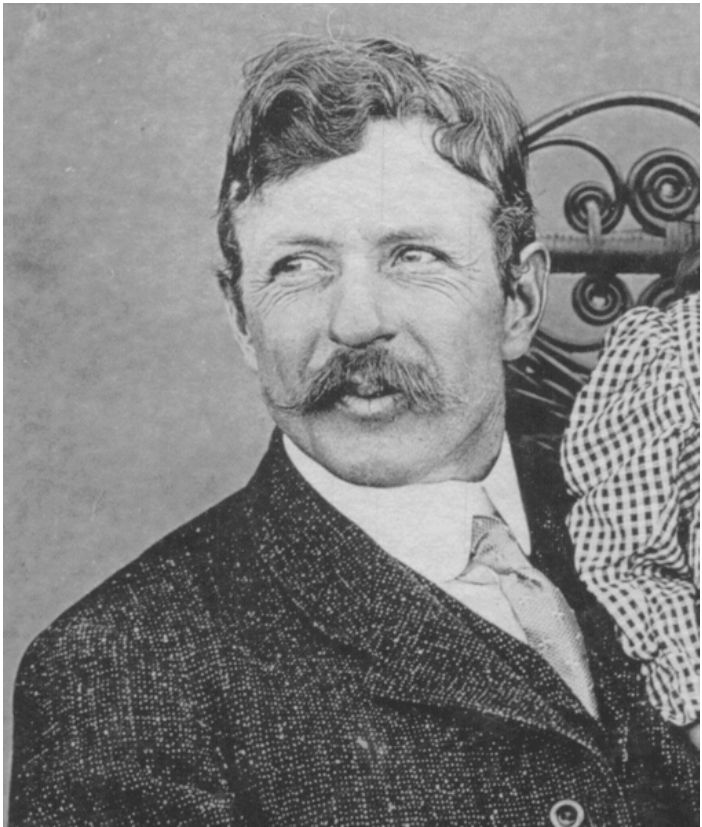

Outlaw John Shaw (middle)

 I like to write junk...