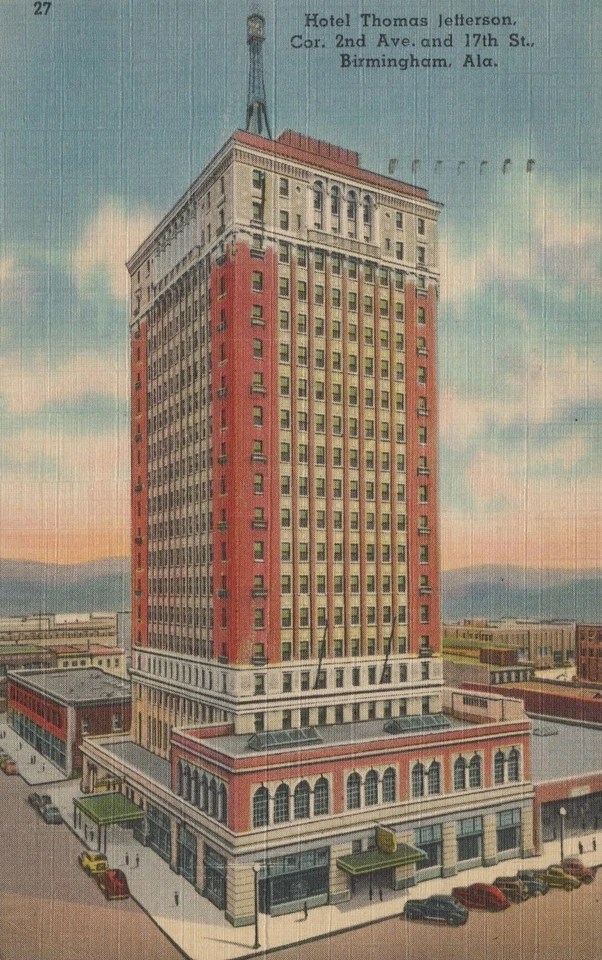
The Thomas Jefferson Hotel, an enduring symbol of Birmingham’s Gilded Age, stands as a testament to the city’s ambitions in the early twentieth century. Located in the heart of downtown Birmingham, Alabama, this grand hotel was envisioned as a premier destination for travelers, dignitaries, and locals alike.
Construction on the Thomas Jefferson Hotel began in 1925, at a time when Birmingham—often dubbed the “Magic City” for its rapid industrial growth—was eager to showcase its prosperity. Designed by the architectural firm Holabird & Root, along with local architect William Lee Stoddart, the hotel was built in the Beaux-Arts style, featuring ornate details, a limestone façade, and elaborate interior spaces. When it opened its doors in 1929, the Thomas Jefferson Hotel soared 19 stories high, making it one of the tallest buildings in Birmingham at that time.
The hotel quickly became the social epicenter of the city. Its luxurious ballrooms, lavish dining facilities, and richly decorated guest rooms attracted celebrities, business leaders, and even United States presidents. It was especially renowned for its vibrant rooftop ballroom and the iconic zeppelin mooring mast, a distinctive architectural feature that crowned the building and became a recognizable part of Birmingham’s skyline.
As the decades passed and the city’s fortunes shifted, the Thomas Jefferson Hotel experienced a gradual decline. Changes in travel patterns, the rise of highway motels, and urban renewal contributed to the hotel’s closing in the early 1980s. The once-grand halls stood empty, and the building became a haunting reminder of Birmingham’s former glory. Homeless people saw it as a shelter out of the storm while also trashing the interior.
Despite years of neglect, the hotel’s architectural significance and enduring charm kept hope alive for its restoration. In the 2000s, preservationists and developers rallied to save the building, recognizing its historical value and potential for revival. After extensive renovations, the hotel reopened in 2017 as the Thomas Jefferson Tower, featuring modern apartments, event spaces, and commercial venues while carefully preserving its historic elements.
Today, the Thomas Jefferson Hotel—now Thomas Jefferson Tower—remains a cherished landmark in Birmingham. Its storied past, architectural grandeur, and successful revitalization symbolize the city’s resilience and dedication to preserving its unique heritage. The building continues to watch over downtown Birmingham, linking the city’s illustrious history with its vibrant present and future.
An old postcard of the hotel from the 1940s shows this stately building before being turned into apartments. A man named Vernon sent the postcard to Mrs. Nina Rhoades in Springfield, Ohio. The postmark date is July 15, 1944. It was mailed from Birmingham.
“Hi Hon,
Don’t think I’ll be back these babes are tops some pumpkins I’d say. Don’t you all wish you was a southern belle. I will probably go on to New Orleans. I got a honey with me from there. bye, bye don’t worry.
Vernon”
Vernon Wesley Rhoades would’ve been 38 when he sent this postcard to his wife, whom he’d been married to for 13 years. Was it a cruel joke, or were they fighting? I tend to believe the former—and I’d bet Mrs. Nina Alice Rhoades had a good laugh over it. After reading Vernon’s bio, he does not come across as a Casanova.
Vernon served two years in the US Army and worked as a machinist for Kelsey-Hayes for most of his life. He belonged to the Knights of Pythias Lodge for 49 years. This is described as a secret organization. It seems reasonable that Vernon was attending a meeting of this group in Birmingham.
Vernon and Nina wed on August 15, 1931. They stayed together until Vernon died in 1987, with Nina passing away in 1991. The couple had one daughter and a son, Judith and James.


 I like to write junk...