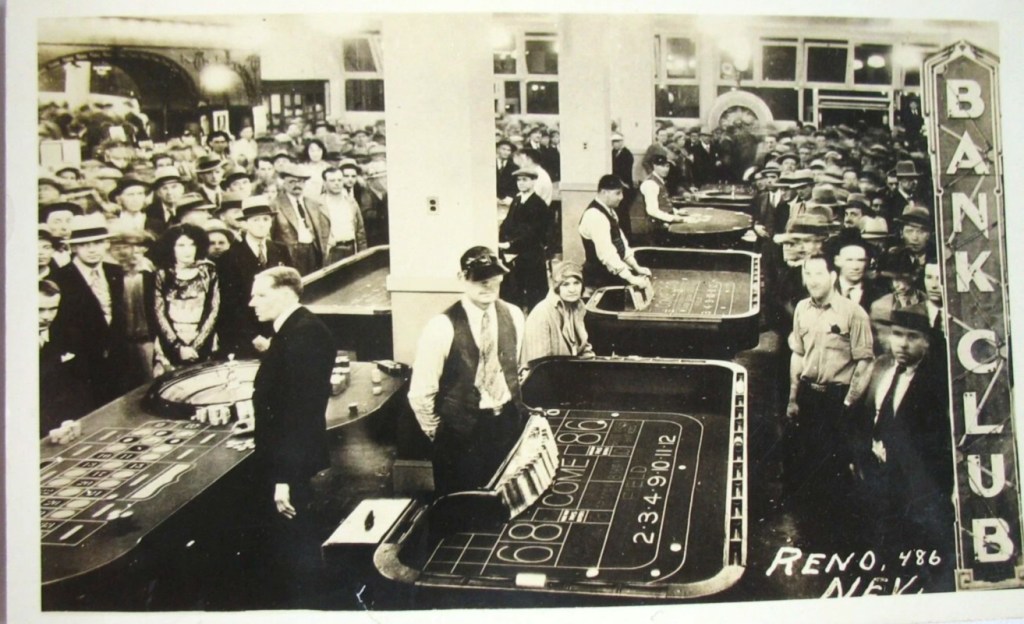
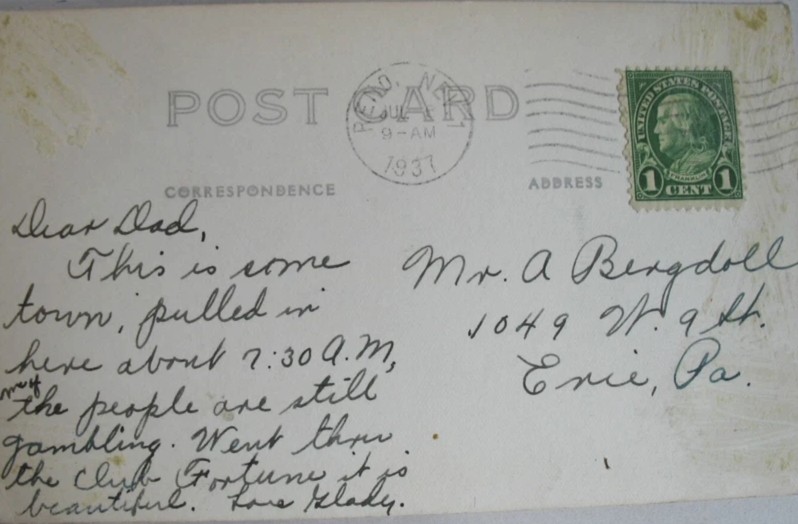
There was much history to be discovered regarding the Bank Club in Reno, Nevada. A photograph of a gambling scene taken inside the Bank Club is shown in front of a vintage 1934 postcard sent to Mr. A. Bergdoll, who lived at 1049 W. 9th Street in Erie, Pennsylvania. Gamblers, mostly men, are standing there staring at the camera like blind sheep. Arthur Sunder Bergsdoll’s daughter, Gladys, mailed this postcard to him with the following short message,
“Dear Dad,
This is some town, pulled in here about 7:30 A.M., some of the people are still gambling. Went thru the Club Fortune. It is so beautiful. Love Glady”
I discovered no hidden secrets or anything controversial about the Bergdolls. Arthur worked as a hairdresser while his wife, Mabel, was a teacher. In the 1940 census report, I assume the person recording the information meant ‘barber’ but, for whatever reason, chose ‘hairdresser’ for Arthur’s occupation.
Arthur Bergdoll, born in 1879, signed up for the military draft in 1942. He would’ve been 63 years old at that time. It seems strange that the military would want a man of that age. During World War II, all men were required to register for the draft, and Arthur complied.
Gladys Bergdoll was born in 1909. She would’ve been 25 years old while visiting Club Fortune and a single woman, undoubtedly kicking up her heels, even though Gladys doesn’t mention this to her father. She married Clarence Martin on June 26, 1945, while Clarence had just returned from overseas duty during WWII.
Gladys’ brother, Jack Richard Bergdoll, was 11 years younger than she. He served as a U.S. Marine during World War II. Fifteen years after the war ended, Jack married Carolyn Mock in 1960. They had 2 children before Carolyn divorced him in 1960 for “gross neglect of duty.” That generally means a serious drinking problem.
The following information I dug up on the Bank Club. There’s far more here than I wanted to include, yet I decided to start from the time it opened until now. It’s amazing that the original casino building still stands!
*******************************************************
Nestled in the heart of downtown Reno, Nevada—the city famously dubbed “The Biggest Little City in the World”—the Bank Club stands as a storied relic from an era when the Silver State’s fortunes were inexorably linked to gaming, glitter, and the promise of reinvention. The tale of the Bank Club is interwoven with the rise of Reno itself, mirroring the city’s embrace of legalized gambling, its vibrant nightlife, and its reputation as a hub for both vice and opportunity.
The story of the Bank Club begins in the aftermath of the Great Depression, when Nevada sought bold new paths to economic recovery. In 1931, a pioneering piece of legislation changed the state’s trajectory forever: the legalization of gambling. Reno, already a magnet for those seeking easy divorces thanks to Nevada’s liberal residency laws, rapidly transformed into a playground for adults and a beacon for entrepreneurs eager to capitalize on the newly legal gaming scene.
One of the earliest and most prominent clubs to emerge from this new climate was the Bank Club. The club took its name from its original location: the site of a former bank building at 238 North Virginia Street. The stately structure conveyed an air of legitimacy and grandeur that set it apart from some of the more makeshift establishments emerging throughout the city.
The founders of the Bank Club recognized that Reno’s clientele was not only interested in gambling but also in an atmosphere of sophistication and excitement. The club became known for its ornate art deco architecture, its gleaming neon signage, and its commitment to providing an immersive experience for guests. Unlike many of its competitors, the Bank Club strove to blend the allure of European casinos with the rugged spirit of the American West.
By the late 1930s, the Bank Club had secured its reputation as one of Reno’s premier gaming halls. Its offerings included blackjack, craps, roulette, and the ever-popular slot machines. The club’s high ceilings, elegant chandeliers, and polished marble floors made it a favorite among both locals and tourists. The Bank Club quickly became a centerpiece in the city’s social scene, offering not only gambling but also fine dining, live music, and dancing.
During World War II, Reno continued to attract visitors from across the nation, and the Bank Club thrived. It served as a gathering place for soldiers on leave, Hollywood celebrities passing through, and business magnates seeking both recreation and relaxation. The club’s management cultivated a reputation for hospitality and discretion, making it a preferred destination for those seeking both excitement and privacy.
This era also saw the rise of several legendary figures associated with the Bank Club—colorful personalities who contributed to its mystique. Among them were influential local businesspeople, skilled gamblers, and charismatic entertainers who turned the club into a stage for memorable nights and chance encounters.
Beyond its role as a gaming destination, the Bank Club served as a hub for the Reno community. It hosted charity events, civic meetings, and holiday celebrations that helped to cement its place in the city’s collective memory. Families would gather for brunch in its elegant dining rooms, while friends met for cocktails and lively conversation in its bustling bars.
The club’s location on Virginia Street was ideal, providing easy access for visitors arriving by train or car. As Reno grew and modernized, the Bank Club remained a symbol of the city’s resilience and adaptability. Its walls bore witness to generations of Nevadans seeking fortune, fun, and belonging.
As the decades marched on, Reno’s gaming industry evolved. New casinos, resorts, and entertainment complexes emerged, competing for attention and investment. While the Bank Club remained a beloved institution, it faced increasing challenges in adapting to changing tastes and regulations.
By the 1960s and 1970s, the club experienced a period of decline. Ownership changed hands several times, and the establishment’s original grandeur began to fade. The rise of larger, more lavish casinos on the Reno Strip and, later, in Las Vegas, contributed to a shift in the region’s gaming landscape. The Bank Club, like many smaller clubs, struggled to compete with these new giants.
Despite these difficulties, the Bank Club’s legacy endured. The building itself, with its distinctive façade and architectural charm, continued to attract interest from preservationists and history enthusiasts. Efforts were made to restore and repurpose the structure, ensuring that its historical significance was not lost amid the changing tides of commerce and entertainment.
Today, the Bank Club is remembered as a symbol of Reno’s first golden age of gaming—a tangible link to a time when the city was forging its identity as a place of possibility and adventure. While the club no longer operates as a casino, its influence persists in the lively atmosphere of downtown Reno and the stories shared by longtime residents.
The building itself has found new purpose over the years, housing a variety of businesses and serving as a reminder of the city’s dynamic past. Preservation efforts have ensured that the Bank Club’s architectural beauty remains visible to visitors and locals alike.
In historical retrospectives, the Bank Club is often cited as a catalyst for Reno’s rise as a gaming capital. Its blend of elegance, excitement, and community spirit helped establish standards that were emulated by subsequent establishments throughout Nevada and beyond.
The story of the Bank Club is more than just the history of a gambling hall; it is the story of Reno itself. From its beginnings in a repurposed bank building to its heyday as a glittering social center, the club embodied the optimism and energy of an evolving city. Though the gaming tables may be silent now, the legacy of the Bank Club lives on in the streets, stories, and spirit of Reno.
For those who stroll down Virginia Street today, the echoes of laughter, the flash of neon, and the glamour of a bygone era linger in the air—a testament to the enduring allure of the Bank Club and the city it helped to shape.


 I like to write junk...