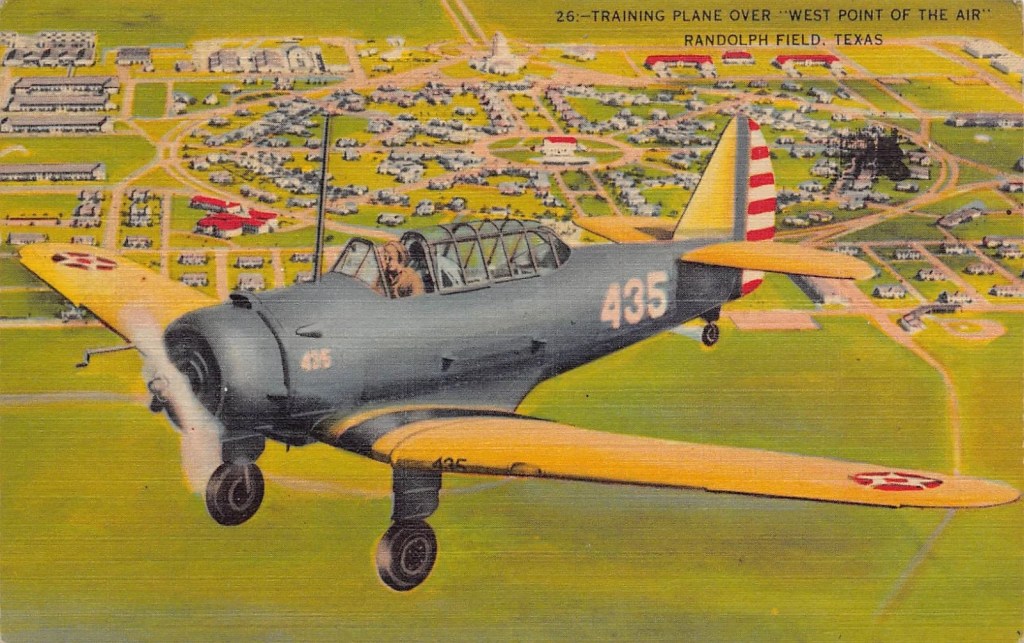
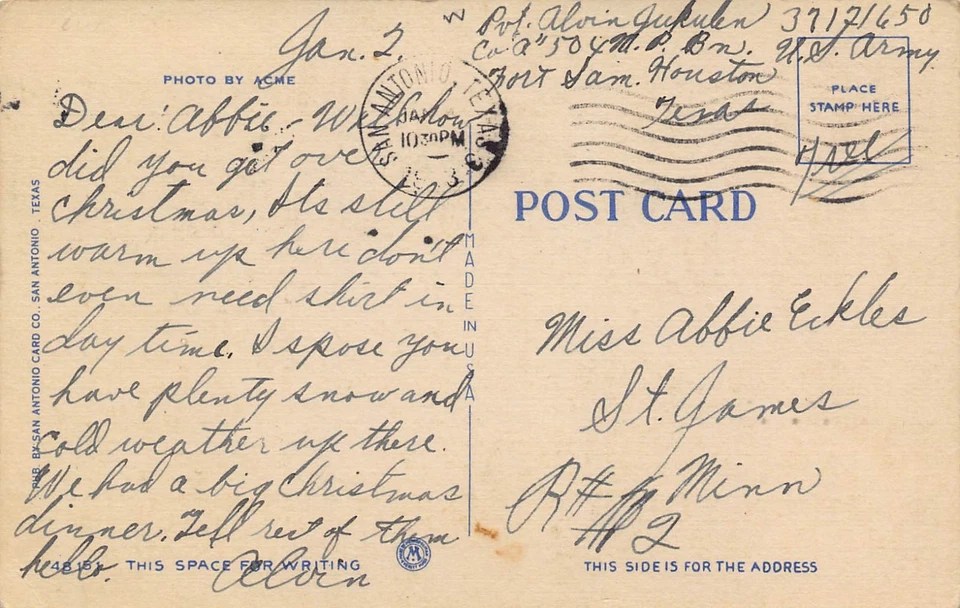
A brightly colored WWII-era postcard sent by Pvt. Alvin Jukulen to Miss Abbie Eckles in St. James, Minnesota, has military significance from two perspectives.
Army Pvt. Jukulen wrote in the address header that he was stationed at Fort Sam Houston, in San Antonio, Texas. The front of the postcard shows an Army Air Corps North American BT-9 trainer flying over Randolph Field. The two bases are 13 miles apart.
Private Alvin Milford Jukulen was assigned to the 504th Military Police Battalion at Fort Sam Houston. Born on June 21, 1911, Alvin Jukulen died on August 2, 1990, in Minnesota.
Not much was recorded about him after the war ended, other than that he married Helen Janda in 1962 and they divorced in 1978. Pvt. Jukulen was given credit for having served in WWII. The soldier’s letter to Abbie Eckles reads as follows:
“Jan 2
Dear Abbie,
Well how did you get over Christmas. It’s still warm up here don’t even need shirt in day time. I spose you have plenty snow and cold weather up there. We had a big Christmas dinner. Tell rest of them hello. Alvin”
Abbie Eckles was born on March 28, 1930. When Alvin wrote her, she would’ve been almost 13 while the private was 31, and it’s easy to jump to conclusions here, yet I found them to be from the same family. On September 12, 1948, Abbie married Burton J. Frederickson and divorced him on June 8, 1959. She remarried and passed away in 2025, at 91, with the last name of Larsen.
More information is available for Fort Sam Houston and Randolph Field over that of the postcard sender and recipient, and that’s how I’ll end this postcard investigation.
Randolph Field, located near San Antonio, Texas, was established in 1931 as a primary training base for U.S. Army Air Corps pilots. Known as the “West Point of the Air,” it became the model for military aviation training in the United States.
During World War II, Randolph Field played a pivotal role by graduating thousands of pilots who went on to serve in theaters around the globe. Its distinctive Spanish Colonial Revival architecture and landmark central administration tower have made it an iconic site in U.S. Air Force history.
Fort Sam Houston, located in San Antonio, Texas, stands as one of the oldest and most historically significant military installations in the United States. Its roots stretch back to the 19th century, but it was during World War II that Fort Sam Houston cemented its reputation as a cornerstone of U.S. Army operations, training, and medical innovation.
As the world descended into conflict, Fort Sam Houston was rapidly transformed to meet the demands of a global war. Already a well-established base by the 1940s, the fort’s facilities and personnel expanded dramatically.
The prewar garrison swelled as tens of thousands of soldiers cycled through the fort for basic and specialized training. The base’s strategic location in the heart of Texas made it ideal for year-round military exercises, away from the vulnerabilities of coastal attacks.
World War II was a catalyst for profound social change, and Fort Sam Houston reflected these shifts. The fort saw the integration of more women into the Army’s ranks, especially in medical and administrative roles, as members of the Women’s Army Corps (WAC) were trained and stationed at the installation.
Additionally, the base was part of the slow but significant process of integrating military units, as African American and other minority soldiers contributed to the war effort despite the challenges of segregation and discrimination.

 I like to write junk...