
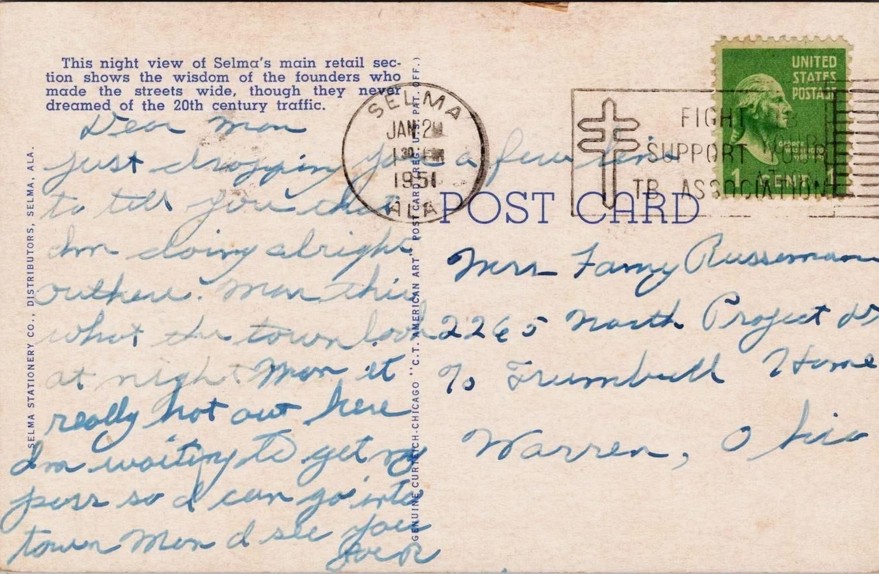
A picture postcard mailed on January 2, 1951, features Broad Street in Selma, Alabama, at night. 1940s vehicles can be seen parked, while one driver has their headlights on.
A Sears business sign is brightly lit as a full moon glows through partly cloudy skies. Stars are highly visible across the dark sky. It’s a scene that unfortunately no longer exists. A brief history of Selma’s decline explains why.
*********************************************************
Once a vibrant hub of commerce and community, Selma, Alabama, has witnessed significant transformation over the decades, marked by a gradual decline in its urban landscape and economic vitality. In the mid-20th century, bustling streets lined with businesses such as Sears, illuminated signs, and the lively movements of classic automobiles painted a picture of prosperity and civic pride. Selma’s nights, adorned by glowing marquees and starlit skies, reflected a thriving Southern town with strong cultural and historical roots.
However, like many American cities, Selma faced challenges as industries changed and populations shifted. Economic downturns, suburban migration, and the loss of major businesses contributed to the fading of its once-bustling downtown. Many historic buildings were left vacant or fell into disrepair, altering the character of streets that were once centers of activity. The social fabric, shaped by generations of families and a storied role in civil rights history, has been tested by outmigration and changing demographics.
Today, the decay of Selma is evident in shuttered storefronts, diminished public services, and the absence of the vibrant nightlife that postcards from the 1950s captured so well. While restoration efforts and renewed interest in Selma’s historic legacy continue, the city’s physical and economic decay remains a poignant reminder of the challenges faced by small towns across America in the wake of modernization and shifting priorities.
*********************************************************
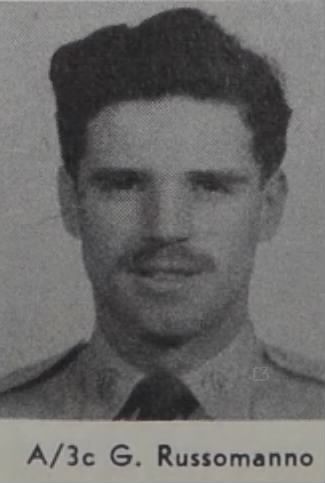
Joe R. mailed this Selma postcard to his mother, Mrs. Fanny Russomanno, in Warren, Ohio. It was quite easy to find out who the Russomanno family was, with Joe having 13 daughters and 3 brothers.
The brief message on his card says:
“Dear Mom,
Just dropping you a few lines to tell you that I’m doing alright out here. Mom this what the town looks like at night. Mom it really hot out here. I’m waiting to get my pass so I can go into town. Mom I see you. Joe R.
Concetta “Fannie” Clemente-Russomanno and her husband, Antonio Solvatore, came to America from Italy, where they were both born. Antonio (Tony) worked in Warren, Ohio, as an ironworker for Republic Iron and Steel, while Fanny was a stay-at-home mom.
Joseph Joe” Russomanno was born in 1931. At the age of 19, he enlisted in the US Air Force, where he was then sent to Craig Air Force Base in Selma for training. A2C Joe Russomanno quickly saw duty in South Korea during the Korean War. He safely made it home and entered civilian life.
Joe’s mother, Fanny, died on October 17, 1960, at the age of 57. Antonio “Tony” passed away, 24 days later, at the age of 57, most likely of a broken heart. Their son, Joseph “Joe” Russomanno, was 81 when he died in 2012.
Selma, as a once-prosperous city, seems to have been put on life support when Craig Air Force base closed in 1977. Hopefully, with proper leadership, things can be turned around.

 I like to write junk...