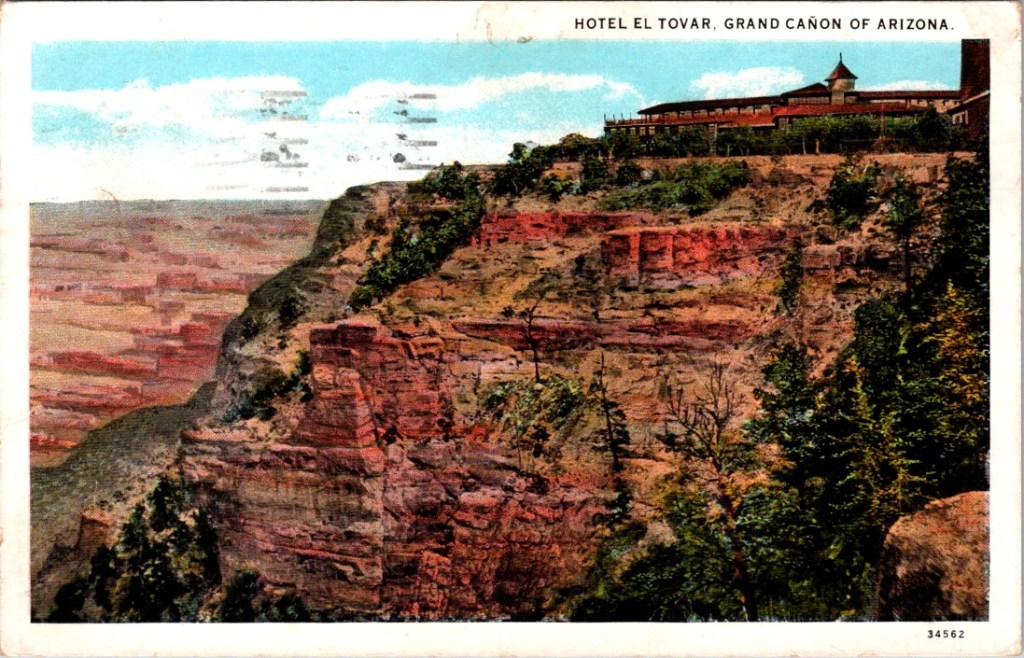
This is the second vintage postcard I’ve come across that has the Hotel El Tovar featured on front. I thought about passing on researching the sender and card recipient, for redundancy factors of postcards alone.
After doing some spot checking of Mrs. Louis Oster and Mrs. J.B. Faubion’s backgrounds, there was enough interesting stuff found to move forward with the project. First, though, a rather detailed history of the world-famous Hotel El Tovar.
Standing regally on the South Rim of the Grand Canyon, the Hotel El Tovar is both a monument to early 20th-century luxury and a living testament to America’s enduring fascination with its natural wonders. Since its grand opening in 1905, El Tovar has welcomed generations of travelers, celebrities, dignitaries, and adventurers, each drawn by both the breathtaking vistas of the canyon and the hotel’s matchless charm.
The story of El Tovar begins in an era when railroad expansion catalyzed tourism across the American West. The hotel was built by the Atchison, Topeka and Santa Fe Railway, in partnership with the Fred Harvey Company, a hospitality company renowned for its “Harvey House” hotels and restaurants that catered to railroad travelers.
Railroad executives envisioned a destination hotel that would both entice and accommodate the growing number of tourists seeking the wild splendor of the Grand Canyon.
Construction commenced in 1903, with famed architect Charles Whittlesey at the helm of design. Whittlesey, influenced by European chateaux and Swiss chalets, created a structure that harmonized rustic log-and-stone exteriors with elegant, refined interiors.
Named after Spanish explorer Pedro de Tovar—who played a role in the Coronado Expeditions—the hotel was designed to evoke a sense of romantic adventure and old-world grandeur.
El Tovar opened its doors on January 14, 1905, instantly establishing itself as the premier lodging option at the Grand Canyon. It was considered one of the most opulent hotels west of the Mississippi, boasting amenities such as electric lighting, hot and cold running water, and a fine dining establishment with china and silver imported from Europe. Guests were greeted by uniformed staff and treated to an ambience of both comfort and sophistication.
The hotel quickly gained a reputation as the “Crown Jewel of National Park Lodges.” Its perch on the canyon’s edge afforded guests spectacular views mere steps from their rooms. In the years that followed, El Tovar became a magnet for high society and international travelers, with luminaries such as Theodore Roosevelt, Albert Einstein, and Bill Clinton among its distinguished guests.
El Tovar was instrumental in shaping the Grand Canyon’s status as a world-renowned tourist destination. The Fred Harvey Company coordinated with the National Park Service to offer guided excursions, mule rides, and informative lectures, using the hotel as a base for exploration. The railway brought visitors from across the nation, their journey culminating in the awe-inspiring arrival at the rim and the welcoming arms of El Tovar.
Over time, El Tovar became a symbol of the symbiotic relationship between the hospitality industry and conservation efforts. The hotel was built with an eye toward sustainability and harmony with its surroundings—a principle that endures in its operations today.
El Tovar’s design is a master class in rustic elegance. Its exterior, constructed of Oregon pine logs and native stone, blends seamlessly with the landscape. Heavy timber beams, balconies, and dormer windows contribute to its chalet-like appearance, while inside, guests find a mix of Mission-style furnishings, Native American art, and touches of Edwardian luxury.
The hotel’s main lobby, with its stone fireplace and mounted animal trophies, offers a warm retreat from the canyon’s extremes. Guest rooms feature period antiques and original fittings, many with views that frame the ever-changing colors of the Grand Canyon below.
Over its century-long history, El Tovar has played host to a dazzling array of guests. Presidents, artists, explorers, authors, and entertainers have walked its halls. The hotel’s guest books tell stories of visits by luminaries such as Zane Grey, Paul McCartney, and Oprah Winfrey, each contributing to its lore.
El Tovar has also made appearances in literature and film, serving as a backdrop for countless stories set amid the grandeur of the canyon. Its presence is both iconic and evocative—a reminder of the romance and adventure that define the American West.
Recognizing its historical and architectural value, El Tovar was designated a National Historic Landmark in 1987. Preservation efforts have ensured that the hotel retains its original character, even as it adapts to the expectations of modern travelers. Renovations have been made with painstaking attention to detail, maintaining period features while updating amenities.
Today, El Tovar continues to operate year-round, welcoming guests from around the world. Its restaurant remains one of the finest in the region, offering local and international cuisine amidst panoramic canyon views. The hotel’s staff, trained in the Harvey tradition of attentive service, uphold the legacy of hospitality that has defined El Tovar for more than a century.
El Tovar is more than a hotel—it is a living museum, a retreat, and a gateway to one of the world’s greatest natural wonders. Its story is woven from the dreams of explorers, the ambition of railroad tycoons, and the enduring allure of the Grand Canyon itself. As it enters its next century, El Tovar stands as a testament to the spirit of adventure and the pursuit of beauty, continuing to inspire all who cross its threshold.
Irene Mae Snyder-Oster (Mrs. Louie Oster) was born on May 12, 1898, in Barton, Missouri. Louie and Irene married in 1923. She was the recipient of the El Tovar Hotel postcard sent from Mrs. J.W. Faubion in 1930. The Faubions, from Missouri as well, had moved to Prescott for John Wesley Faubion’s health.
Louis “Louie” George Oster, Irene’s husband, owned a small trucking firm in Lamar. Before opening his business, Louie was a farmer in Illinois. An interesting message in the Lamar newspaper had Louie walking out to his truck early one morning and finding a strange man inside.
With it being dark, and taking no chances, Louie quickly punched the guy in the nose, breaking it, also knocking this fellow to the ground. After the police arrived, it turned out the man was intoxicated and had climbed into the truck to sleep things off. In today’s leftist slanted court system, Louie would’ve been arrested instead of the drunk.
Louie Oster died on May 6, 1956, at the age of 58, while his wife, Irene Mae “Lou” Oster, passed away on August 15, 1990, at the age of 92.
The Faubions were simple dirt farmers, living clean lives away from the hustle and bustle of the big city. John was born on April 2, 1876. He attended school in Grant, Missouri, before finishing out his education at Albany Christian College.
J.W. Faubion was president of the local Grant Public School System. He married Lulu Mae Hendrickson on August 20, 1899, with them having four children. The couple remained married for 54 years.
When he incurred respiratory problems, at the advice of his doctor, he and his wife relocated to Prescott, Arizona, for what was supposed to be a short time. They likely visited the Grand Canyon while there, and that’s where they purchased the postcard.
With the clean air evidently helping with his recovery, they moved back to Missouri to be closer to family and friends. John died on November 2, 1953, at the age of 77.
A glowing obituary was written about him, with words describing the man as very humble, while living a life of simplicity. Lulu passed away three years later on May 23,1956, at the age of 79. She, too, was described as a dedicated Christian and loving wife. Both are buried side by side in the Grant City Cemetery.
Life was much simpler during the Oster and Faubion era. Technology and communication, in the form of social media and electronic devices, have actually destroyed much of the closeness people once felt for one another.
Postcards being mailed, such as the one Irene sent Lulu, have also gone by the wayside, including Christmas cards. What will things be like in another 25 years? Only God knows!


 I like to write junk...