During WWII, there were several airfields in and around our neck of the woods. My mother always used that term when describing her hometown in Alabama. Works for me here in Arizona, although there are no woods within sight; only rocks and sagebrush out my back door, along with the lake.
Lake Havasu City had yet to become a dream in developer Robert McCulloch Sr’s eyes when a military airfield was built on what’s now called “The Island.” That facility was simply named Site 6 and was used as a recreational site more than anything. On occasion, a civilian airplane experiencing engine trouble landed there for repairs.
Yucca had a military base, as did Kingman and Yuma. What some people don’t realize is that an Army Air Base at Blythe, California, played a significant role during World War II as a training and operational facility for the US Army Air Corp.
Established in 1942, the base was strategically located in the desert of Riverside County, which provided an ideal environment for flight training due to its generally clear weather and vast open spaces.
Blythe Army Air Base primarily served as a training ground for bomber crews, including those assigned to fly B-17 Flying Fortresses and B-24 Liberators. The facility was part of the larger West Coast airfield network, supporting the war effort by preparing air crews for combat missions overseas. Personnel stationed at Blythe underwent rigorous training in navigation, bombing techniques, and aerial gunnery.
In addition to its training functions, Blythe Army Air Base supported various operational units and hosted several temporary deployments. Its airstrips and facilities were also used for aircraft maintenance and logistics operations. The base contributed to the overall readiness of the Army Air Forces, helping to ensure the effective deployment of trained airmen to the European and Pacific theaters.
After the end of World War II, Blythe Army Air Base was deactivated and eventually repurposed for civilian use, becoming Blythe Airport. Today, its legacy endures as a reminder of the region’s contribution to the nation’s wartime aviation history.
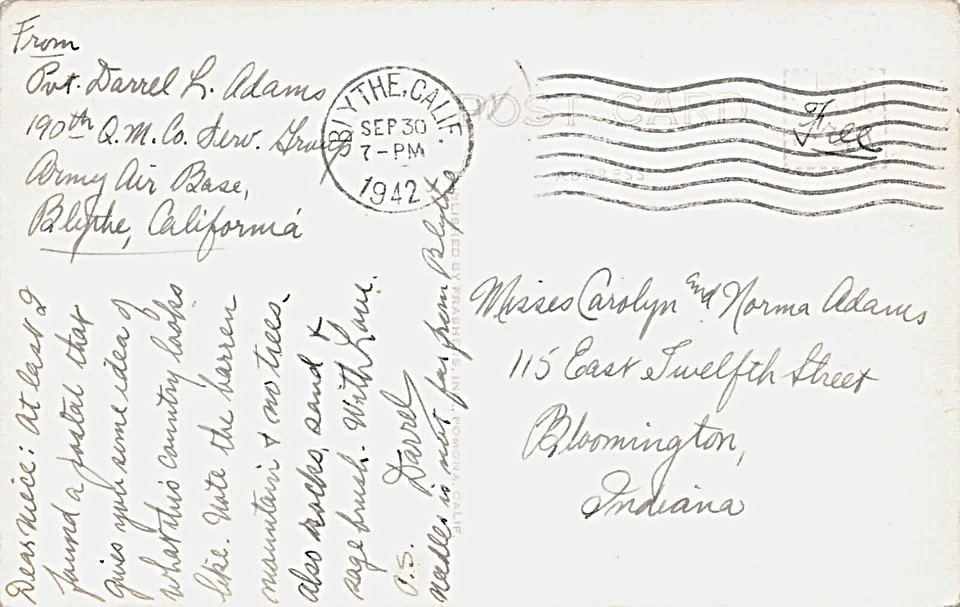
A postcard I acquired was sent by Pvt. Darrel L. Adams to his two nieces in Bloomington, Indiana, Carolyn and Norma Adams, while the private was stationed at Blythe Army Air Base in California. The message on this card briefly describes his surroundings:
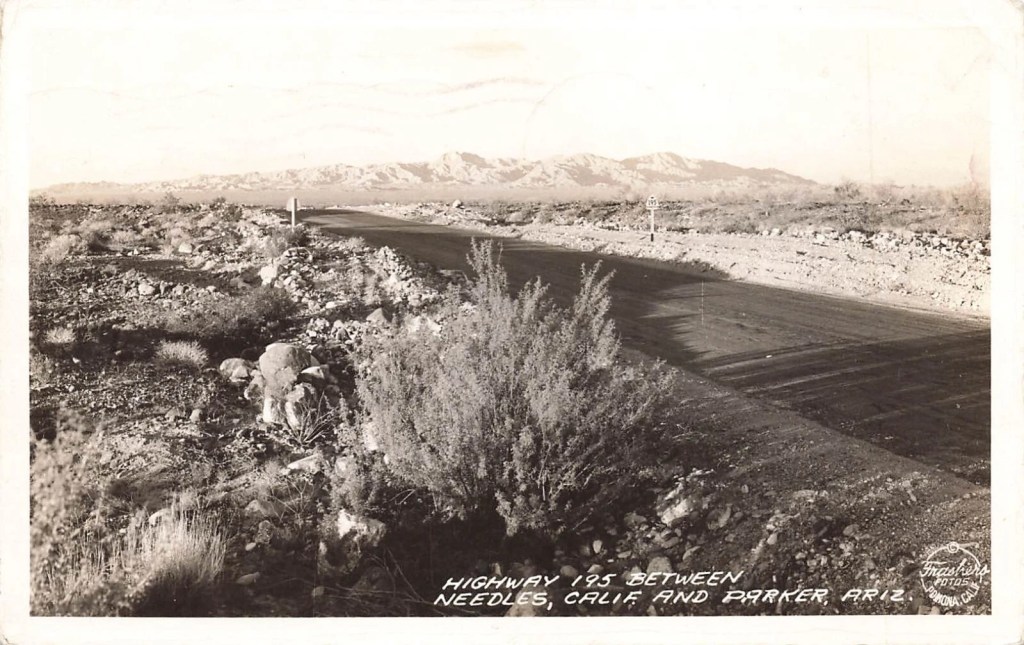
“Dear Niece: At last I found a postal that gives you some idea what this country looks like. Note the barren mountain & no trees, also rocks, sand, & sage brush. With love, Darrel. P.S. Needles is not far from Blythe.”
Darrel’s black & white postcard shows a picture of a bleak section of Highway 195 from Needles to Parker. The word Blythe alone doesn’t conjure up an oasis or vacation destination for me. This vintage postcard was postmarked in Blythe on September 30, 1942, with the return address being,
Pvt. Darrel L. Adams
190th. Qm. Co. Serv. Group
Army Air Base
Blythe, California
I wasn’t sure what I’d find regarding the card sender and recipients, greatly hoping that Pvt. Adams made it through the war alive. Thankfully, things turned out well for all three people.
Private Darrel Adams was honorably discharged from the US Army in 1945 after WWII ended. Adams went on to become a custodian for an office building. Previous to enlisting in the service, he declared his occupation on a 1940 census report as a professional projectionist. Born in 1921, Darrel Lewis Adams died in 1988 at the age of 77.
Carolyn June Adams was born August 24, 1925, and would’ve been 17 when Uncle Darrel sent that postcard to the girls. Carolyn’s sister, Norma, was only 14, having been born on March 7, 1928.
Carolyn married Roy Henry Torbit on May 5, 1944, while her sister Norma wed a guy named Ted Lee Fox in 1948. A previous marriage for Norma had failed. Carolyn died in 2000 at the age of 75, with younger sister Norma outliving her, passing away in 2012 at the age of 84.
I found nothing outrageous or controversial about Darrel, Carolyn, or Norma Adams. Their lives were what I call routine where ‘postcard people’ are concerned—much unlike “The Adams Family” of television fame.
Postcard people is a new terminology I’ve given to the sender and recipients of vintage postcards. If things catch on, there’s a very slight chance it’ll go viral!

 I like to write junk...
Hasn’t changed much 😏
LikeLiked by 1 person
My brother was an air traffic control person there for I believe two years. They’ve since closed that flight station down. Last time I was there was in 1978 or 1979.
LikeLike