Flat, Alaska, is one of my favorite places to visit. There’s something about the name that intrigues me, almost as much as that affable character, Flat Stanley.
I’m not sure the thin-faced Glat Stanley has ever been to this ghost town, but perhaps he hitched a ride there on a plane, boat, dogsled team, or snowmachine at some time. There are no drivable roads to Flat, so he couldn’t have come via car or truck. For those not knowing who Flat Stanley is, let’s just say he’s a famous world traveler.
Once a bustling gold mining town, Flat sprang to life during the early 20th-century gold rush. Founded in 1908 after gold was discovered along Otter Creek, Flat quickly grew as prospectors and entrepreneurs flocked to the area in hopes of striking it rich.
At its peak, the town boasted several thousand residents, complete with schools, hotels, stores, and even its own newspaper. However, as the gold deposits dwindled and mining operations slowed, Flat’s population declined just as rapidly as it had risen.
Today, Flat stands as one of Alaska’s best-preserved ghost towns, offering a glimpse into the state’s gold rush era and the adventurous spirit of those who once called it home.
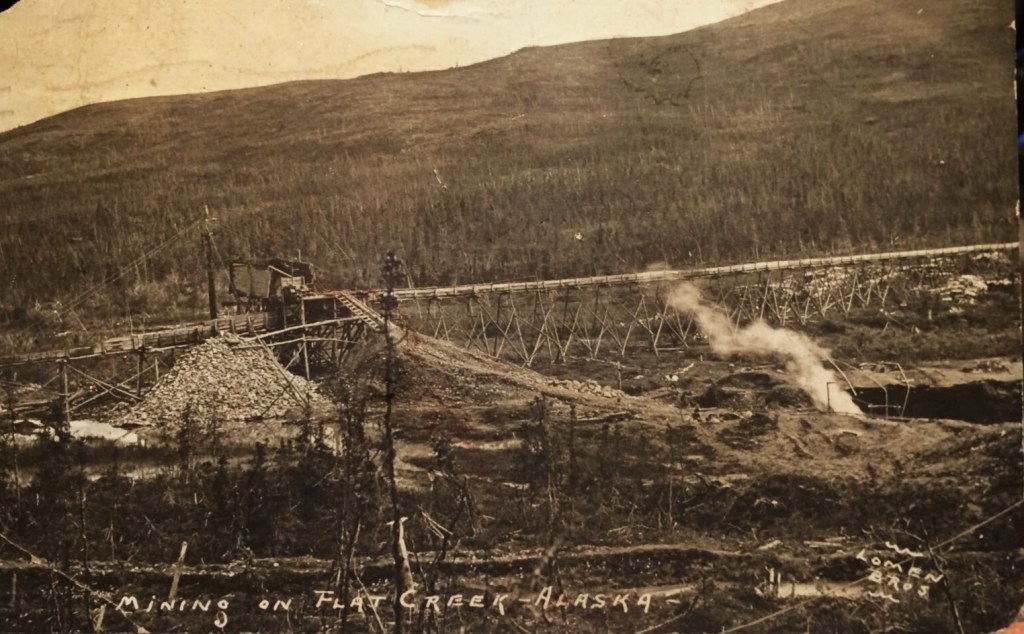
In 1920, H.J. Landwehr sent a picture postcard to Sidney Svensen in Fond du Lac, Wisconsin. This postcard shows mining on Flat Creek, which runs right beside the town. It appears they are thawing frozen tundra using wood fires to get at the rich paydirt.
The postcard was postmarked in Seattle on February 26, 1920. Mr. Landwehr possibly picked up the black and white card on a trip to Alaska. I hoped my research would show this as being true.
The short message reads”
“Feb 26/20
Dear friend, just a line to let you know I got your letter. Was shure glad to hear from you. I will write you a letter later.
H.J. Landwehr
2341 E Lake Seattle”
It took almost a day of careful searching to find out who Landwehr and Svensen were. Having last names like theirs, I figured they were of German and Norwegian descent. The problem I had was that there are different ways to spell each, and the handwriting was hard to read.
Heinrich Jacob “Henry” Landwehr was born in Iowa on July 28, 1876. His parents were from Germany, with H.A. and Louise Landwehr immigrating to America for a better life. Farming was their occupation.
Census records indicate that the youngest son, Henry, transitioned into a carpenter after working in a bar and being a policeman as well as a boomman. This final change in occupation might’ve had something to do with a December 25, 1920, newspaper article I found. Transcribed word-for-word, it reads like this.
“Raising a chair in the air, Tom Curtain, 39, recently released from the federal penitentiary at McNeil Island, smashed H.J. Landwehr, an employee of the Our House bar at 151 Washington St., into unconsciousness late Friday evening.
According to Landwehr’s statement to the police, the attack was brought on by Curtain’s belief that Landwehr had ‘squealed’ and sent him to the penitentiary.”
It’s possible, early on, that Henry had high aspirations to strike it rich in the gold fields of Alaska, perhaps even mining in Flat or Iditarod. After combing through archived newspapers, I found a record of the man being there.
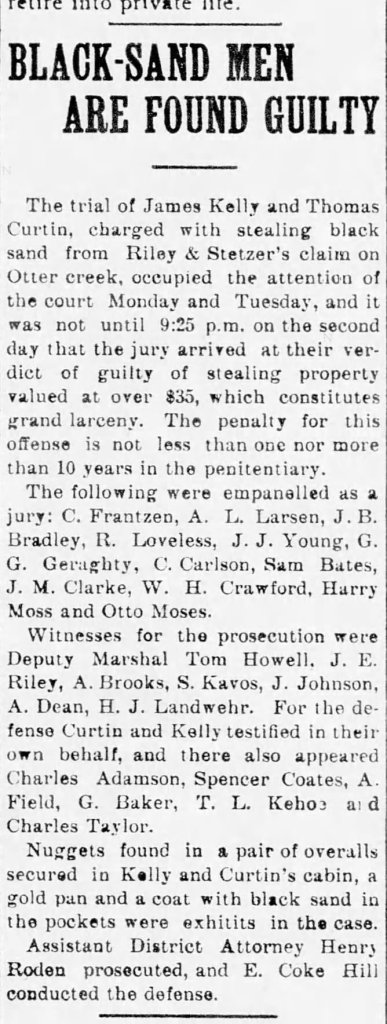
H.J. Landwehr is mentioned in the July 20, 1912, edition of the “Iditarod Pioneer” as a witness to individuals stealing gold-laden black sand from another prospector. After a proper trial, the men were found guilty by a jury, thanks in part to Henry Landwehr’s testimony.
Gold mining must not have been as prosperous as he thought it would be, with Henry returning home to Washington before 1920. Records show Henry Landwehr was a respected member of the Order of the Moose lodge in Seattle, with Mr. Landwehr passing away at the young age of 47 on March 21, 1924. It appears he was not married.
The postcard recipient, Sidney Svensen, is best described by his graphic obituary—as they don’t write them like this anymore. It goes into a little more detail than what I would see fit to print, especially the cause of death. I was correct once again in Svensen’s parents being of Norwegian descent.
“Longview Daily News, Monday, Sep 28, 1970:
Sidney Svensen, 81, of Puget Island, died Sept. 27 in a Longview hospital. He was born Aug. 16, 1889, on Puget Island.
Son of Sven and Servina Johnson Svensen, he married Esther Vog in 1914, was a commercial fisherman, lived at Rt 1 Box 55 Cathlamet, died in Cowlitz General Hospital of ventricular fibrillation with arrest, cancer of the duodenum with metastases, pulmonary emphysema due to asthma, per death certificate 20037, whose informant was his wife. Buried Sep 30, 1970.
He was a member of the First Lutheran Church on Puget Island, was a retired commercial fisherman, served three years as deputy sheriff, two years as town marshal of Cathlamet, and had been a fish buyer.
Surviving are his widow, Esther; two sons, Elroy of Puget Island and Eugene of Camano Island; two daughters, Mrs. Lorraine Bailey of Seattle, and Mrs. Selma Olsen of Longview; 14 grandchildren; six great-grandchildren; and a sister, Mrs. Garda Sherman of Portland.
Services will be at 2 pm on Wednesday at his church with Rev. Karl Berg officiating. Interment will be in Greenwood Cemetery.”



 I like to write junk...