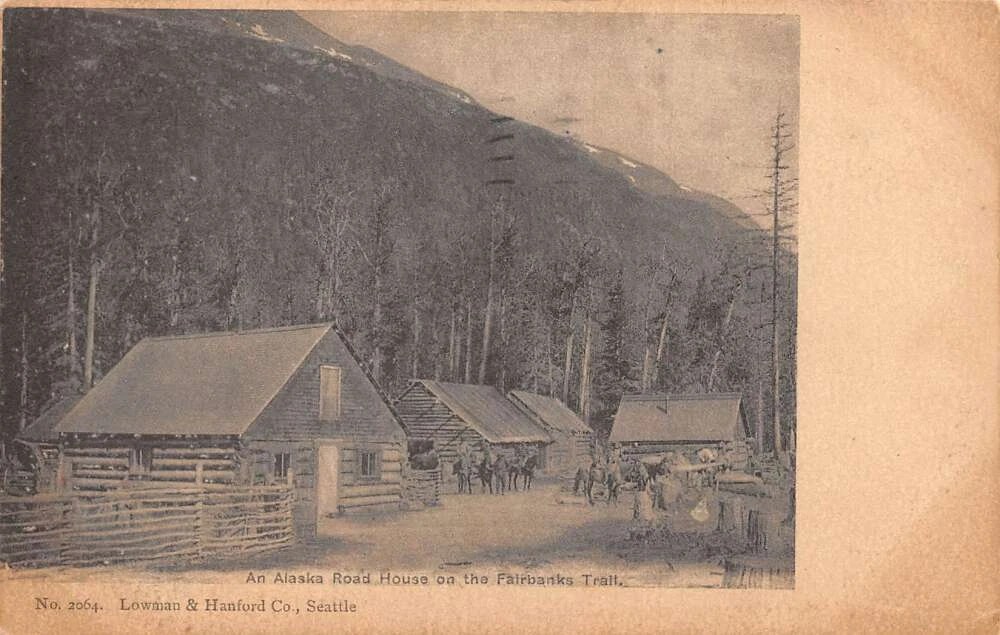
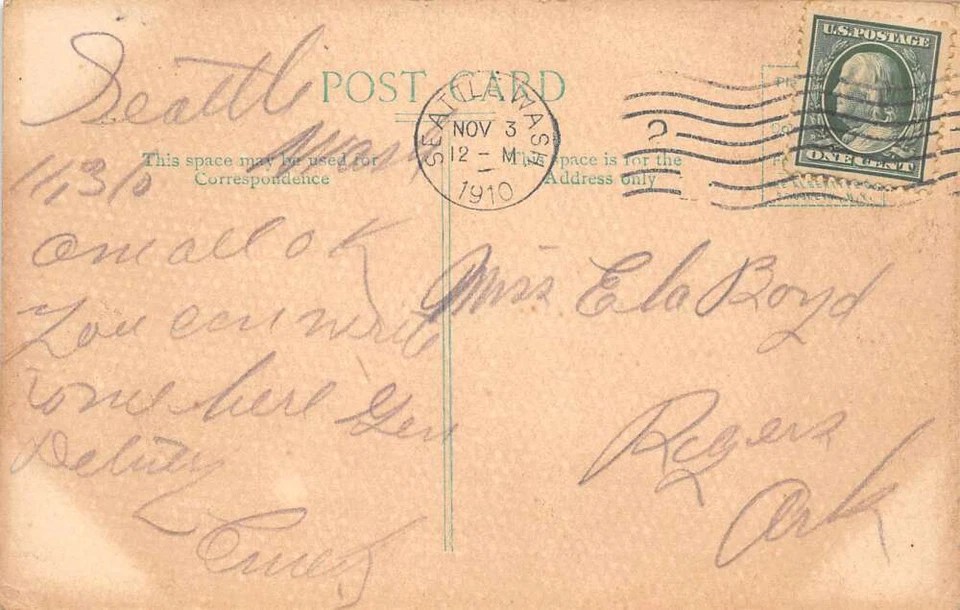
An old picture postcard mailed from Seattle, Washington, on November 3, 1910, to Miss Ela Boyd in Rogers, Arkansas, shows several rustic log cabin structures on the front with five riders on horses. The description underneath says:
“An Alaska Road House on the Fairbanks Trail”
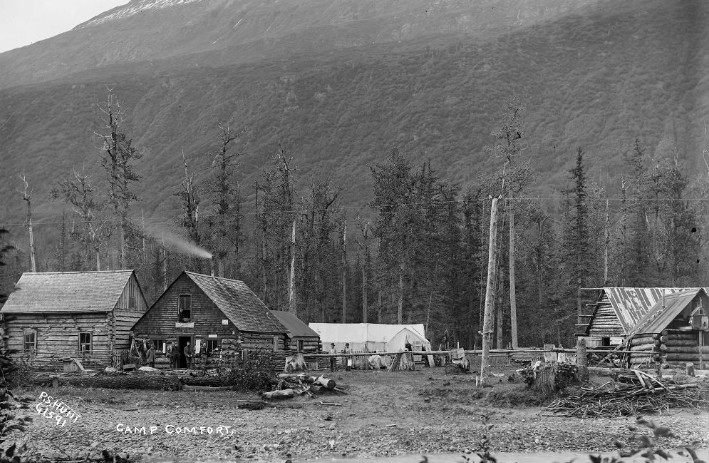
I tried to identify the name and exact location of this roadhouse using the book “Alaska Roadhouses” by Helen Hegener, along with other online sources. Poring over this information, I eventually came up empty. An expert on the subject, thankfully, renowned Alaska author Helen Hegener, came to my rescue. The pictured roadhouse is named Camp Comfort.
Fairbanks Trail refers to historic and recreational paths in the Fairbanks region of Alaska. Fairbanks, situated in the heart of Alaska, is renowned for its rich history, gold rush heritage, and vast wilderness. Trails in this area are significant for both their historical context and their modern use for outdoor recreation.
The term “Fairbanks Trail” is often associated with early routes used by gold prospectors and settlers in the late 19th and early 20th centuries. These trails were crucial for transporting supplies, mail, and people between key locations such as Fairbanks, Nenana, and other remote settlements. Some trails followed ancient paths used by indigenous peoples long before the arrival of Europeans and Americans.
This postcard was likely purchased in Fairbanks, Alaska, by the person sending it. I was able to partially decipher his fancy yet sloppy handwriting with the simplistic message to Miss Ema Boyd, reading as follows:
“Seattle 11, 3, 10
Am all ok. You can write to me here gen delivery.
Crue”
Unfortunately, the postcard sender, whom I believe the name to be spelled Crue, will remain a mystery, although I found sufficient personal information on the card recipient, Miss Ema Boyd. She was only 16 when she received the message.
Ela was born in Tennessee on June 12, 1894, to parents John and Leona. On February 9, 1912, she married Lester Trueblood, but that marriage didn’t last. On January 8, 1916, Ela wed William Harvey Compton. A child was born on February 3, 1917, to the couple, but sadly, one day later, little John Elmer Compton passed away.
On February 4, 1920, Ela Boyd-Compton died an unfortunate early death. Her obituary in the “Rogers Republican” newspaper, where she worked, tells a sad story.
“Mrs. Ela Compton died last Wednesday afternoon at New Orleans, the result of pneumonia following a severe attack of the grippe. Her father, John R. Boyd of Rogers, who had reached New Orleans that morning, brought the body back to Rogers, arriving here Saturday. Funeral services were conducted by the pastor, Rev. C.C. Cunningham. Mrs. Compton was a well-known young woman of Rogers. She was especially popular in the Baptist church circles, where she was superintendent of the primary department and a willing and efficient worker in all departments. She had worked for several years in the newspaper offices of Rogers as a compositor and at the time of her death was in New Orleans in the special school of the Merganthaler Linotype Co., studying to become a machine operator. She was a member of the Eastern Star and the Rebekah orders. He untimely death, she was only 26, was a great blow to the family and to the many friends.”

 I like to write junk...