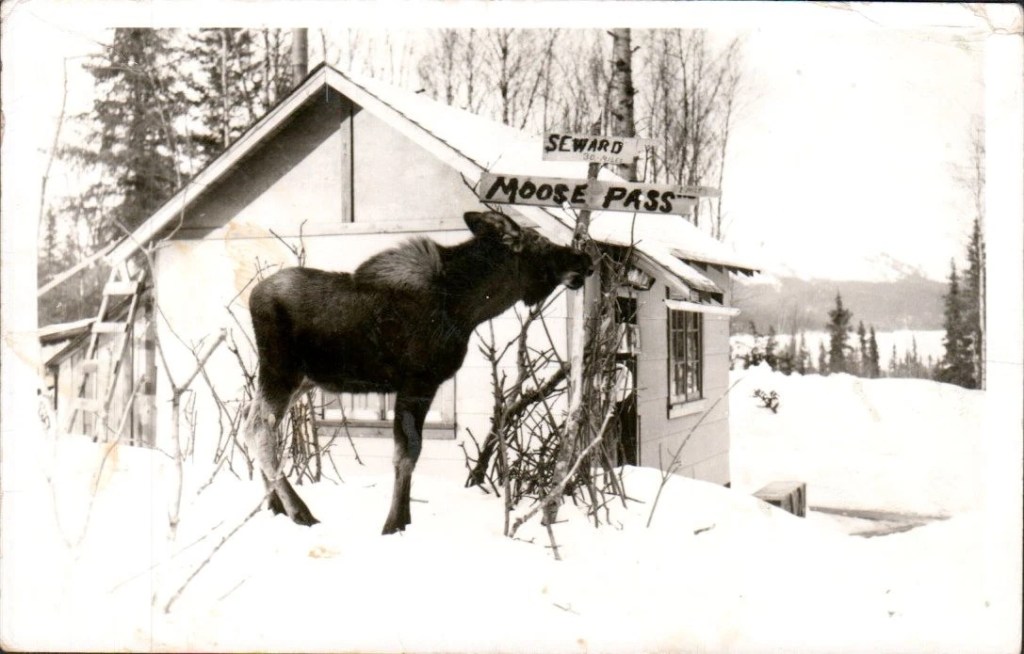
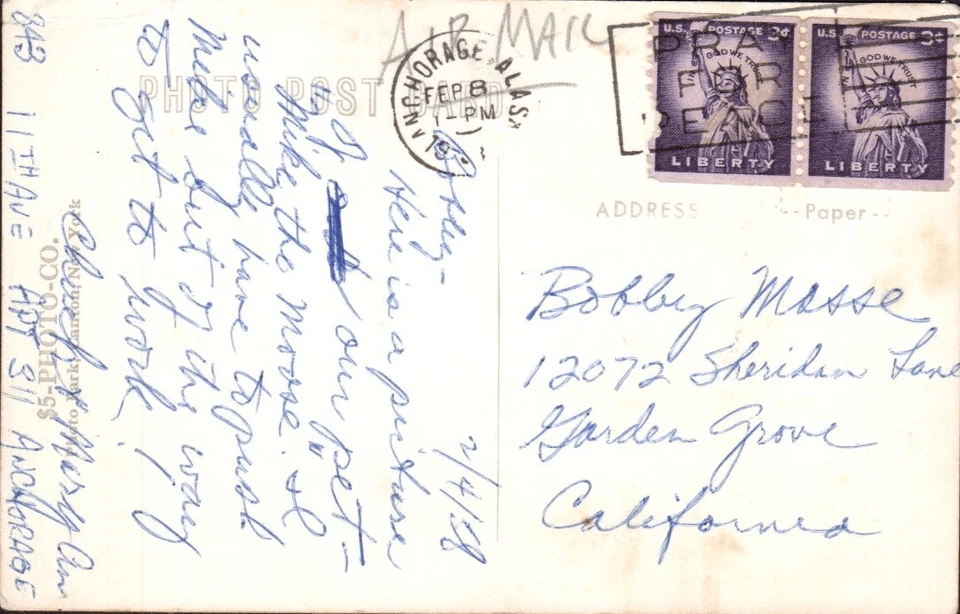
I came across another picture postcard that I could not positively identify the sender or recipient of. This one was postmarked in Anchorage, Alaska, on February 8, 1948, with the card having been written four days earlier.
The sender’s names, Chuck & Mary Ann, appear on it, with the recipient being Bobby Masse of Garden Grove, California. It appears that Bobby Masse is actually Robert Massey, although I could not verify that. It’s also possible that Chuck and Mary Ann are, in fact, Charles and Mary Ann Dismond. I base this loose assumption on a message on the card, believing that Charles wrote it.
Charles “Chuck” Dismond was an engineer on the Alaska Railroad, while Mary Ann worked for the Division of Forestry as a clerk. With no way to substantiate such, I’ll just have to assume that’s who they are and leave it at that.
The message written in ink is quite humorous:
“2/4/48
Bobby,
Here is a picture of our pet, “Mike the Moose.” I usually have to push Mike out of the way to get to work!
Chuck & Mary Ann
843 11th Avenue Apt 311 Anchorage”
What’s most interesting to me is the picture on the front showing a snow-covered dwelling and a moose munching on alders. A sign pointing north says: Moose Pass 1 mile—Seward 30 miles. With Moose Pass being located at milepost 29.5 of the Alaska Railroad, this cabin would be one mile south at milepost 30.5.
I’ve visited this area numerous times between the 1960s and the 1990s, and I don’t recall a place looking exactly like this, although in 50 years, things can change drastically. Perhaps it burned down or is further south than the sign indicates.
There is a cabin a bit further south that I believe was the Johnson Roadhouse. If it’s the same one, a pioneering couple lived there for many years until they passed away. Family members took the residence over after that to use as a weekend getaway. I’m not sure who owns it now or if it’s still standing.
The place I’m thinking of is close to railroad tracks with Trail Lake lapping the shore a few hundred feet away. After the older residents died, next of kin cleaned things out and burned much of the stuff in a fire pit close to the tracks. I was there when it was still smoldering.
A good friend, Dee Linton, pulled a giant coffee pot from the ashes and kept it. Undoubtedly, this well-used pot supplied large groups of visitors and railway workers with ‘hot coffee’ over the years.
Moose Pass, Alaska, is a picturesque community nestled in the Kenai Peninsula, known for its scenic beauty and rich history. Located about 30 miles north of Seward along the Seward Highway, Moose Pass has long served as a gateway to the wonders of southern Alaska.
The area that would become Moose Pass was originally inhabited by the Dena’ina Athabascan people, who hunted, fished, and gathered in the region for thousands of years. The abundant wildlife and waterways provided sustenance and transportation for these early residents.
The history of Moose Pass as a settlement began in earnest during the early 20th century, spurred by Alaska’s gold rush. Prospectors and miners traveled through the region, and the need for reliable transportation led to the construction of the Alaska Railroad. By 1912, the railroad reached this area, and a small community formed to support railroad workers and travelers.
According to local legend, Moose Pass received its name in 1928 when a freight team was delayed because a moose blocked the trail. The spot became known as “Moose Pass,” and the name stuck as the community grew around the railroad stop.
Throughout the 20th century, Moose Pass remained a small but vital community. It served as a rest stop for travelers heading to Seward and Anchorage, and its proximity to Kenai Lake made it a popular destination for fishing, hiking, and outdoor recreation. The local school, post office, and small businesses became the backbone of the town.
Today, Moose Pass is known for its welcoming atmosphere, annual community events, and access to pristine wilderness. Despite its modest size, the town embodies the spirit of Alaska—resilient, tight-knit, and deeply connected to the land.
Hopefully, with the release of this blog, someone will recognize the little cabin alongside Upper Trail Lake. As far as “Mike the Moose” goes, his relatives undoubtedly still trapse through the Moose Pass area. After all, the village is named after them.

 I like to write junk...