
I’ve been through Sanders, Arizona, several times while traveling east to Kansas from Lake Havasu City, on Interstate 40. During those times, I never stopped there, seeing no stores or restaurants that interested me.
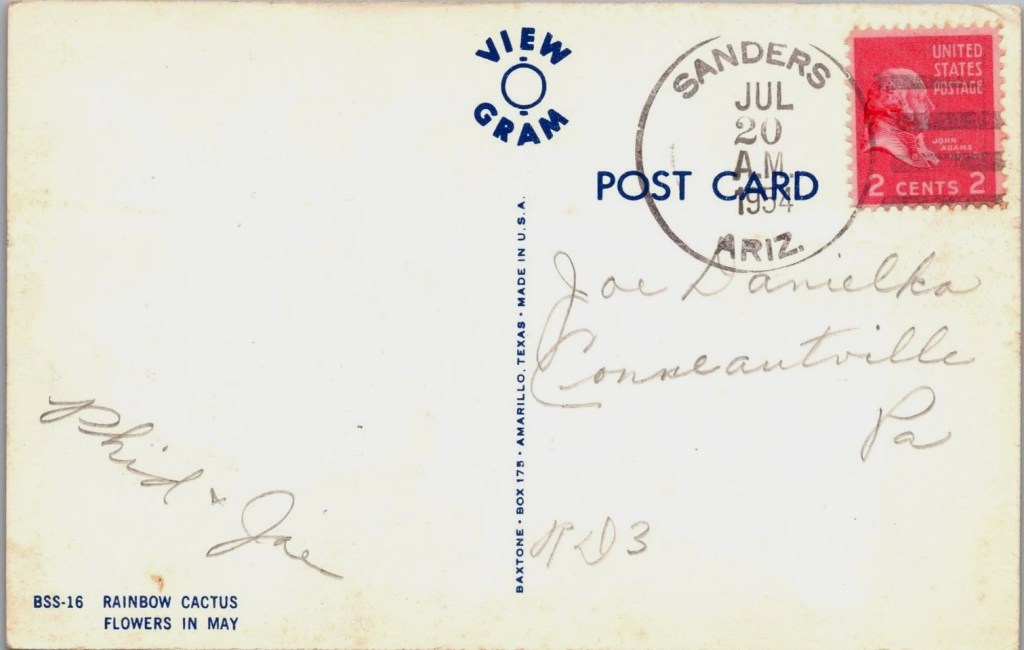
I knew nothing of Sanders’ history until coming across a picture postcard sent from Phil & Joe to Joe Danielka in Conneautville, Pennsylvania. The card was postmarked in Sanders on July 20, 1954, a mere 73 days after I was born. Delving into who the sender and recipient were, I performed a bit of town history first.
Sanders, Arizona, is a small unincorporated community located in Apache County, in the northeastern part of the state. Positioned near the border with New Mexico and situated along historic U.S. Route 66, Sanders has played a modest yet important role in the history of the region, particularly as a gateway to the Navajo Nation and as a stop along key transportation routes.
Long before European settlers arrived, the region surrounding Sanders was inhabited by indigenous peoples, most notably the Navajo (Diné) Nation. The Navajo have a rich history in northeastern Arizona, with deep cultural and spiritual ties to the land. Their presence continues to be a vital aspect of Sanders’ identity, as the community sits within the boundaries of the Navajo Nation reservation.
The community was originally known as “Ojo de Vaca” or “Cow Spring” by early settlers and traders, referencing a local water source. In the early 20th century, it was renamed Sanders, reportedly after a railroad engineer or official connected to the construction of the railroad lines in the area. The arrival of the railroad facilitated transportation and commerce, helping Sanders become a small but notable stop in the region.
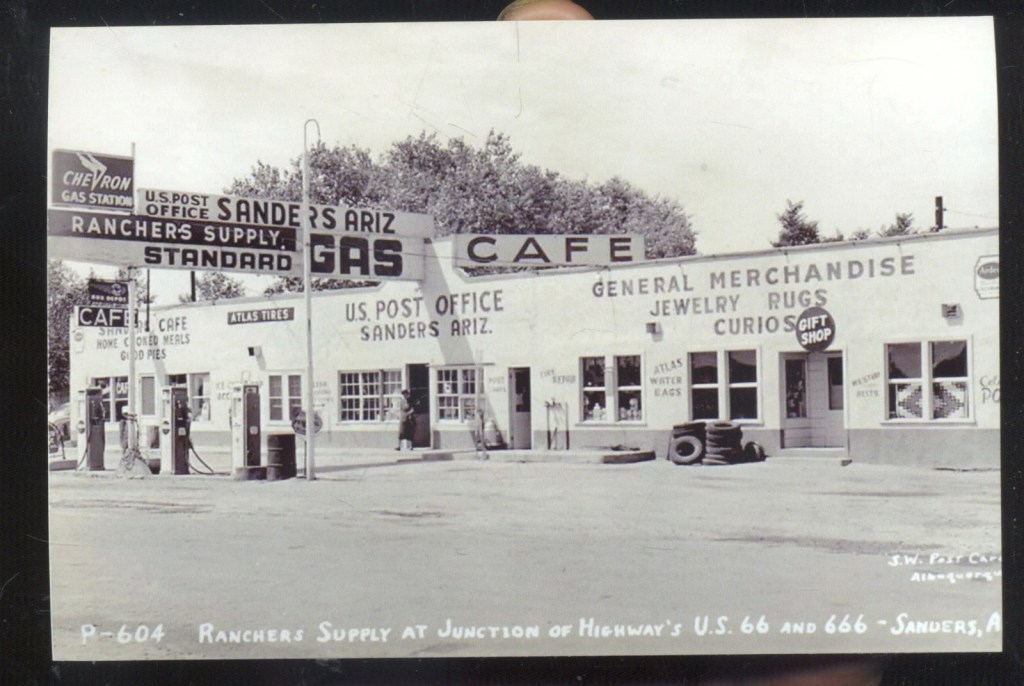
The construction of U.S. Route 66 in the 1920s and 1930s brought new attention to Sanders. As the “Mother Road” wound its way through northern Arizona, Sanders benefited from increased traffic and commerce.
The town became a stopping point for travelers seeking fuel, food, and lodging on their journey across the Southwest. Route 66 played a significant role in shaping the economic and social fabric of Sanders during the mid-20th century.
In recent decades, Sanders has remained a rural community with a small population. The local economy is largely supported by services for travelers, ranching, and businesses catering to residents of the Navajo Nation. The Sanders Unified School District serves the educational needs of the area, and community events often reflect the blend of Navajo culture and the traditions of the American Southwest.
Sanders is notable for its proximity to significant Navajo cultural sites and its role as a crossroads between Native American and non-Native communities. It stands as a testament to the enduring legacy of the Navajo people and the influence of transportation corridors like Route 66 and the railroad in shaping the development of northern Arizona.
Though small in size, Sanders, Arizona, has a rich and varied history shaped by its indigenous roots, transportation developments, and its role as a gateway to the Navajo Nation. Today, it continues to serve as a reminder of the region’s vibrant cultural heritage and its place in the story of the American Southwest.
The postcard senders, Joe and Phil, conjured up in my mind a couple coming out of the closet way before folks were openly doing so. It turned out that Phil was actually Philadel Eleanor Danielka, Joseph “Joe” Danielka Jr.’s wife. The recipient of the postcard in Pennsylvania was Joseph “Joe” Danielka Sr.
The history of this family is most amazing. Joseph Danielka Sr. was born in Bohemia, Czechoslovakia, and immigrated to America in 1914 with his wife, Bozena, and three children. Sadly, Bozena died soon after arriving, leaving Joseph a widower.
Undoubtedly, the two oldest children helped with raising their younger sibling, as families did back in the day. Joe’s obituary best sums up his life:
“Joseph Danielka, 86, died Sunday morning, April 4, 1965, at Meadville City Hospital.
Mr. Danielka was born on October 19, 1878, in Czechoslovakia, a son of Mr. and Mrs. John Danielka. He served as a captain in the Austrian Army before coming to the United States with his wife and three children in 1914 to visit a sister. He was stranded here at the outbreak of the First World War and was naturalized the same year.
A life-long farmer, Mr. Danielka was a member of the Little’s Corner Methodist Church and a 30-year-plus member of the Keystone Grange. He served for 30 years as a voluntary crop correspondent for the U.S. and the State Department of Agriculture.
He is survived by a daughter, Mrs. Stanley Kelley, with whom he made his home; two sons, Joseph Danielka, Lakewood, Calif., and John Daniels, Meadville, Pa., 11 grandchildren, and 8 great-grandchildren. Interment will be in Denny Cemetery.”
Joseph Danielka Jr. and his wife were evidently traveling through Sanders on Route 66 when they mailed the postcard. There’s nothing written inside other than their names. A colorful picture on the front shows a flowering Rainbow Cactus.
Joe Jr. was born in Bohemia, Czechoslovakia, on January 28, 1914. He married Philadel Eleanor White on December 23, 1933. The couple had two children, but one passed away at birth. Philadel died on April 25, 1961.
On July 9, 1964, Joe married Wanda Nadine Lusk. She died 28 years later on April 25, 1993. Joseph Danielka Jr. passed away on August 14, 2004, at 90. Exactly like his father, Joe Jr. was a hardworking farmer.

 I like to write junk...