
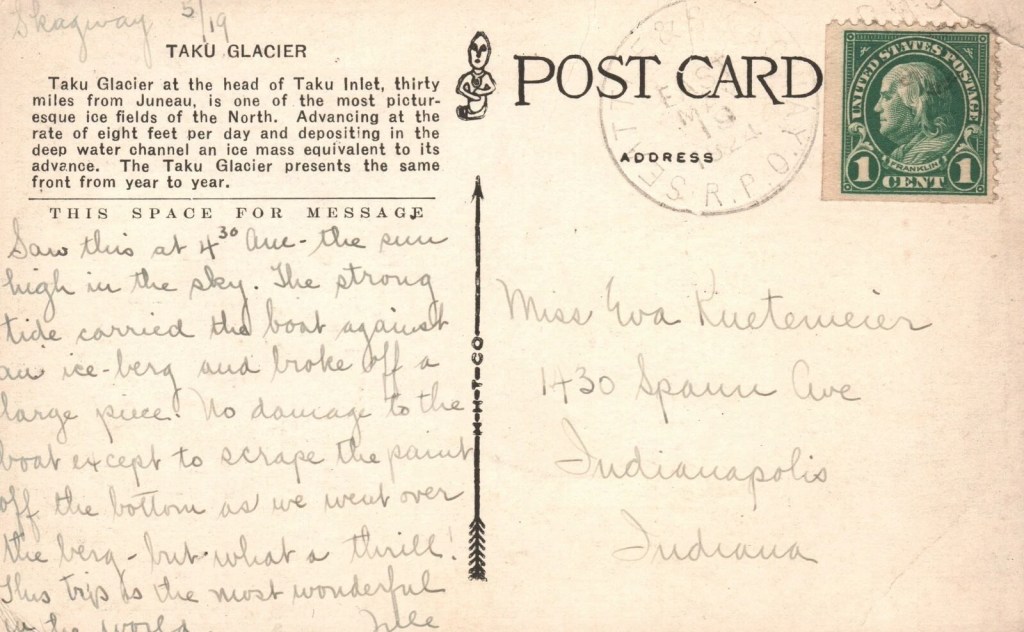
I wasn’t sure how to properly start this postcard story off other than talking about the picture first, and then the recipient, Miss Eva Kuetemeier, of Indianapolis, Indiana. Miss Kuetemeier’s life we’ll get to in a minute.
Taku Glacier is one of the largest and most dynamic glaciers in the Juneau Icefield of Southeast Alaska. Known for its impressive size and unique behavior compared to other regional glaciers, Taku Glacier holds a special place in the study of glaciology and climate change.
The renowned glacier is located about 12 miles southeast of Juneau, Alaska. It is part of the Juneau Icefield, which contains dozens of glaciers and covers approximately 1,500 square miles. The glacier flows from the icefield toward the Taku River, terminating near sea level.
Taku Glacier was named after the Taku people, a subgroup of the Tlingit Nation, whose traditional lands encompass the region surrounding the glacier and river. European and American explorers first began documenting the glacier in the late 19th and early 20th centuries. Early mapping efforts were limited by the region’s remote and harsh conditions, but the glacier gradually became a point of scientific interest.
Systematic scientific studies of Taku Glacier began in the mid-20th century, with the establishment of the Juneau Icefield Research Program (JIRP) in 1946. Researchers have monitored the glacier’s thickness, length, and terminus position for decades, making Taku Glacier one of the most studied glaciers in North America.
Unlike most glaciers in Southeast Alaska, which have been retreating since the end of the Little Ice Age (1300 – 1850), Taku Glacier exhibited a rare advance throughout much of the 20th century. It grew steadily, gaining mass and length, with its terminus advancing toward the Taku River. This behavior was attributed to high precipitation, cool temperatures, and the unique topography of the glacier’s basin.
In the early 21st century, scientists began to observe changes in the Taku Glacier’s dynamics. Around 2018-2019, the glacier’s long-standing advance came to a halt, and it started to show signs of retreat. This shift was attributed to warmer temperatures and changes in precipitation, consistent with broader regional and global patterns of climate change.
The retreat of Taku Glacier has significant implications for local ecosystems, hydrology, and the understanding of glacier response to climate variability. Its transition from advancing to retreating serves as a valuable indicator of the changing climate in Southeast Alaska.
Taku Glacier’s unique history of advance and subsequent retreat makes it an important case study for glaciologists and climate scientists. Its data record contributes to global understanding of glacier dynamics and the impacts of climate change. The glacier also holds cultural significance for the Indigenous peoples of the region and serves as a destination for scientific research and tourism.
Several buildings, businesses, and streets in Alaska are named Taku, including “M/V Taku,” a former State of Alaska ferry boat, the Taku Apartments in Anchorage, the Taku Restaurant in Juneau, and Taku Harley-Davidson in the capital city. On a side note, my wife makes a tasty Taku salad each year during Cinco De Mayo.
This Taku Glacier postcard was mailed from Seattle, Washington, to Miss Eva Kuetemeier on May 19, 1924. The sender was someone named Nile. I was not able to identify Nile, but did discover that the guy couldn’t write a proper cursive m, turning them into w instead. That had me scratching my head trying to decipher the text.
Born on March 9, 1888, in Indianapolis, Eva Kuetemeier remained there for 62 years as an unmarried woman. The only exciting thing I found about this person was that she was stuck in Holbrook, Arizona, in August of 1918, when the axle to a car she was riding in broke.
Eva and four friends, including a baby, were traveling to California in this vehicle. That had to be quite an experience with vehicles having no air conditioning back then. Temps would’ve been around 110 degrees during the hottest part of the day.
Newspaper clippings show Miss Kuetemeier hosting parties in Indianapolis for social groups, as well as working at the State of Indiana welfare office for most of her life. Sports must not have been one of her activities as there’s none mentioned.
A message on the postcard that Nile sent to Eva describes an event no traveler would wish to experience, especially those who survived the “RMS Titanic.” Nile evidently saw no danger in what happened here. His message reads as follows:
“Saw this at 4:30 am – the sun high in the sky. The strong tide carried this boat against an ice-berg and broke off a large piece. No damage to the boat except to scrape the paint off the bottom as we went over the berg – but what a thrill! This trip is the most wonderful in the world. Nile”
There’s not much else to say about this postcard or the recipient. Miss Eva Kuetemeier died in Indianapolis, Indiana, on September 13, 1950, at the age of 62. She’s buried in Crown Hill Cemetery.

 I like to write junk...