
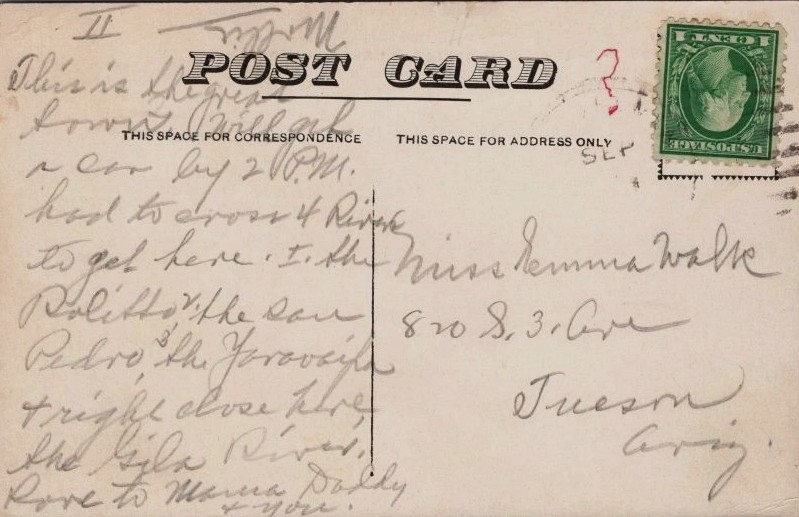
Motoring along on my picture postcard expressway, I came across a vintage card mailed around 1916 from an unidentified person in Winkleman, Arizona, to Miss Emma Walk in Tucson. Emma’s address was 820 South 3rd Avenue. The handwriting was so atrocious, I have to assume the card sender wasn’t a teacher but perhaps a doctor. A color photograph of Winkleman is on front of the card.
The postmark was faint, and I was unable to positively identify the date. Just enough letters were visible to make out Winkleman as the town it was mailed from. I came up with 1916 only by researching the recipient and Emma’s age at that time, as well as information regarding the house she lived in with her folks. The message reads:
“This is the great town will gh n car by 2 PM. Had to cross 4 rivers to get here. 1. The Publicco. 2. The San Pedro. 3. The Yarovgiha & right above here the Gila River. Love to Mama Daddy & you. Mollie II”
I believe the sender misspelled a couple of river names because there are none faintly close to Publicco or Yarovgiha. The shorthand letters gh n car evidently mean get here in car. “Mollie II” was added at the top of the card, and I assume it means the family dog.
Emma Mary Walk spent almost her whole life in Tucson. Born on August 30, 1904, the only child of Karl and Mary Walk, she graduated from Tucson High School in 1924 and married Frederic Nastor Finney on August 6, 1932. The couple had three children. Fred Finney was managing editor of the “Arizona Daily Star.”
Emma worked as a secretary for the Pima County Attorney’s office, and after retiring in 1976, was highly active with the Arizona Historical Society. She was an expert on Tucson history and often volunteered to help tutor students at Safford Elementary on the subject. Mrs. Emma Walk-Finney belonged to the Tucson Kennel Club for many years and was a dog lover. Emma Mary Walk-Finney died on January 8, 2002, at the age of 97. Tragically, her husband, Fred, died in 1965 of a self-inflicted gunshot wound to the head.
The person sending Emma the postcard, I believe, was a secretary based on her use of shorthand. He or she evidently knew the family well in referring to Emma’s parents as mama and daddy. Emma would’ve been around 12 or younger at the time she received this card. Why the anonymous sender was driving to Winkleman will undoubtedly never be known. It’s reasonable to say that the “car” crossing four rivers was a skinny-tired Ford Model T.
Winkelman, Arizona, located 343 miles east of Lake Havasu City and 63 miles south of Tucson, has a rich and unique history that reflects the broader story of mining towns in the American Southwest. Located in Gila and Pinal counties, Winkelman sits on the banks of the Gila River and has long served as a gateway to the copper mining regions of Arizona.
The area around Winkelman was originally inhabited by Native American tribes, including the Apache. In the late 19th century, with the expansion of railroads and increased interest in mining, settlers began to move into the region. The town is named after Peter Winkelman, an early settler and prospector who helped develop the local mining industry.
Winkelman’s growth was closely tied to copper mining, with nearby communities such as Hayden and Kearny also playing significant roles in the area’s mining boom. The construction of the Southern Pacific Railroad in the early 1900s made transportation of ore and goods easier, leading to increased economic activity. Winkelman became a supply and residential center for miners and their families.
During its peak mining years, Winkelman developed essential infrastructure, including schools, churches, and businesses catering to local residents. The Gila River provided water for agriculture and supported the town’s daily life. Community events, such as town fairs and parades, reflected the close-knit nature of Winkelman’s population.
Like many mining towns, Winkelman experienced fluctuations in population and prosperity as the fortunes of the mining industry changed. Environmental challenges, such as flooding from the Gila River, also impacted the town’s development. As mining activities declined in the late 20th century, Winkelman faced economic hardship, with many residents moving to larger cities for work.
Today, Winkelman is a quiet town with a population of fewer than 500 people. It serves as a reminder of Arizona’s mining heritage and the resilience of small communities. Visitors can explore nearby natural attractions and learn about the region’s history through local landmarks and stories passed down through generations.
The history of Winkelman, Arizona, is a testament to the pioneering spirit of its residents and the enduring legacy of the mining industry in shaping the American Southwest. Though its days as a bustling mining center have passed, Winkelman continues to embody the character and perseverance of rural Arizona.
I’ve marked Winkleman down as a place I now want to visit. Maybe then, I’ll find out what the true names of those two rivers are.


 I like to write junk...