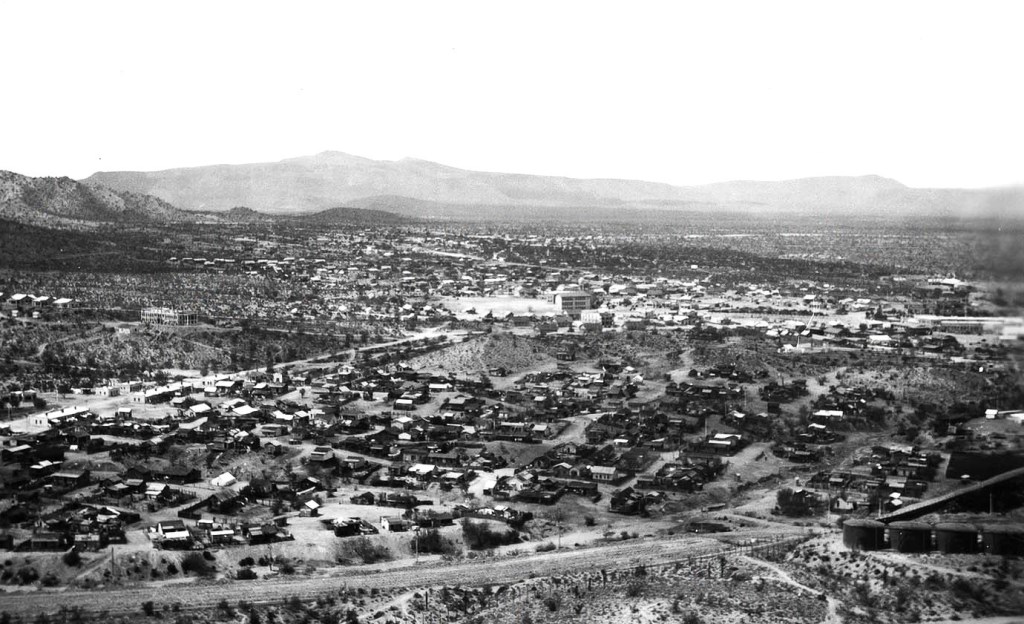
Ajo, Arizona, is a small town located in Pima County, nestled in the southwestern corner of the state near the border with Mexico and the Tohono O’odham Nation. It is 237 miles south of Lake Havasu City. The area’s history is deeply intertwined with mining and the unique desert landscape of the Sonoran Desert.
The name “Ajo” is believed to come from the Spanish word for “garlic,” though local lore suggests it may be derived from the Tohono O’odham word “Oʼoho,” which refers to a red pigment found in the area. Native peoples used this red pigment for decoration and trade long before European settlers arrived.
Mining shaped Ajo’s development. In the 19th century, Spanish and Mexican miners extracted copper from the region. The modern era of mining began in 1916, when the New Cornelia Copper Company, later purchased by Phelps Dodge, established large-scale copper mining operations.
The open-pit mine became the economic heart of the community, attracting workers and their families, and the town was carefully planned with a central plaza and mission-style architecture.
Ajo thrived as a mining town for decades. However, in 1985, copper prices fell and the mine closed, leading to population decline and economic challenges. Despite this, Ajo has reinvented itself as a gateway community to Organ Pipe Cactus National Monument and a center for art and tourism. Its historic town center, rich cultural heritage, and beautiful desert surroundings continue to attract new residents and visitors.
Today, Ajo is known for its welcoming community, vibrant arts scene, and as a hub for travelers exploring the Sonoran Desert. Its history as a mining town remains visible in the landscape and architecture, offering a glimpse into the story of the American Southwest.
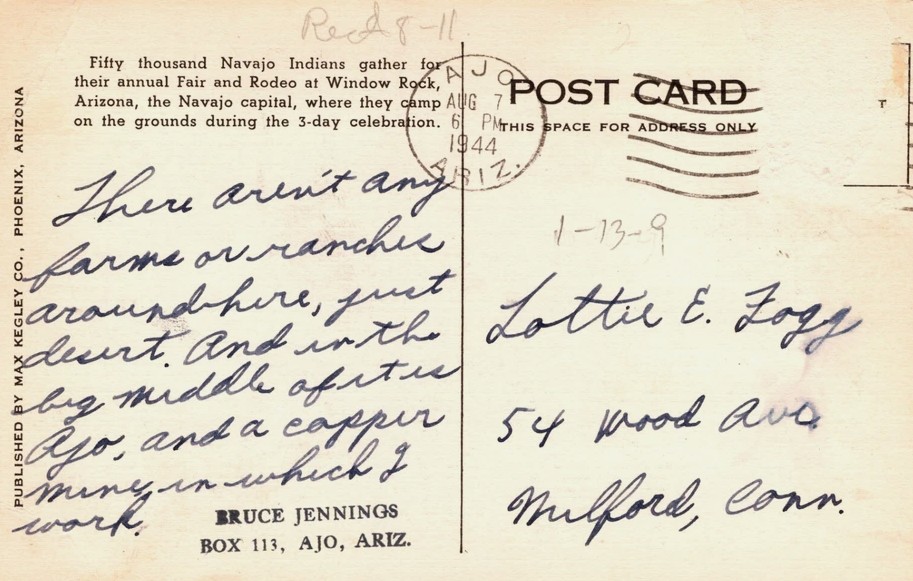
Bruce Jennings lived in Ajo, having moved there after serving with the US Army Air Corps during WWII. A postcard he sent to Lottie E. Fogg on August 7, 1944, postmarked in Ajo, attests to his being in the town.
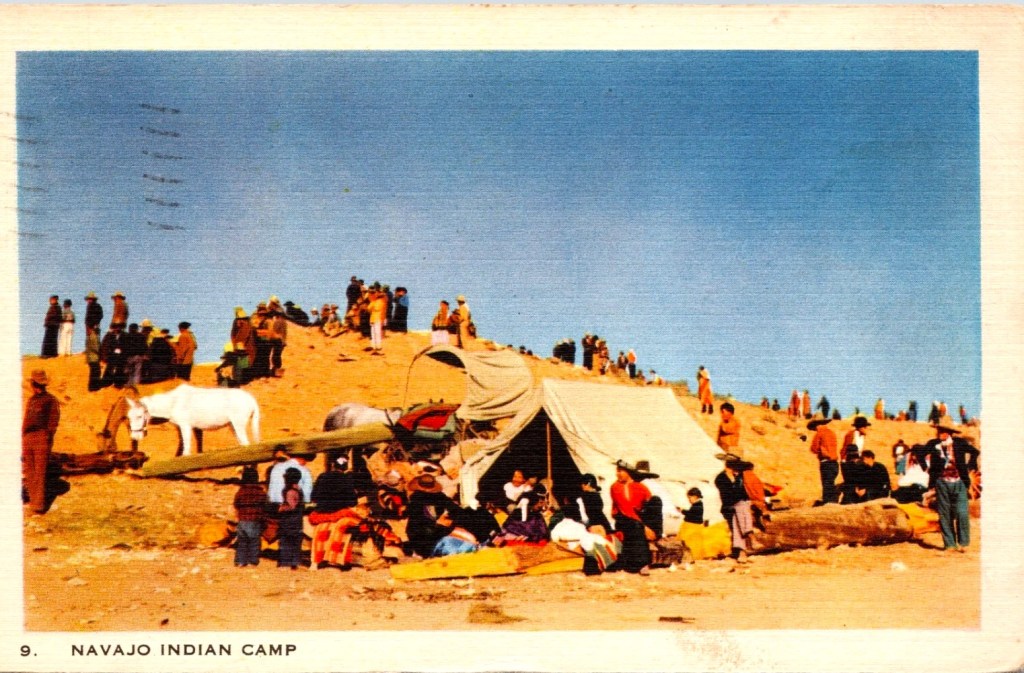
The front of the picture postcard shows a Navajo Indian camp in full color, with adults, children, and horses seemingly posed for this shot. They’ve assembled for the annual Fair and Rodeo at Window Rock, where as many as 50,000 attend.
Lottie E. Fogg, the card recipient, was born in Hartford, Connecticut, on January 31, 1892. During her early years, she worked as a factory inspector. In 1928, she married Raymond L Kelly. They had one child, a son. Her husband died soon after the child was born.
By 1930, Lottie claimed on census forms that she was a widow. The woman never remarried. Lottie passed at the age of 74 on January 15, 1966.
Clifford Bruce Jennings, the postcard sender, was born on April 3, 1919, in Tucson. After working in the mining industry at Ajo for just a short time, he reenlisted in the United States Air Force and saw duty in the Korean War. After being discharged, as a retired Master Sergeant, Bruce moved to California, where he worked for the Douglas Aircraft Company in Sacramento.
Sadly, Jennings died at the age of 47 on February 22, 1967, after taking an overdose of pills. A newspaper story reported him as despondent over the separation from his wife, Katherine. Bruce Jennings left behind three children.
I always remember the words of former United States Marine and Alaska State Trooper Dale Gibson on suicide. Sergeant Gibson had investigated many such incidents during his career as a policeman. “Suicide is a permanent solution to a temporary problem!” The late television talk show host Phil Donahue used those same words.

 I like to write junk...