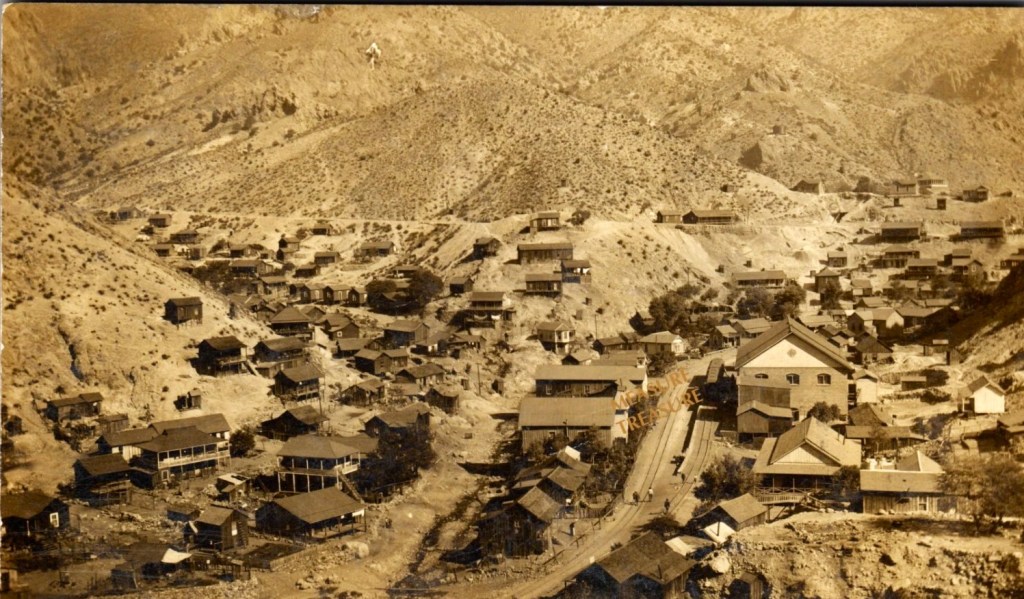
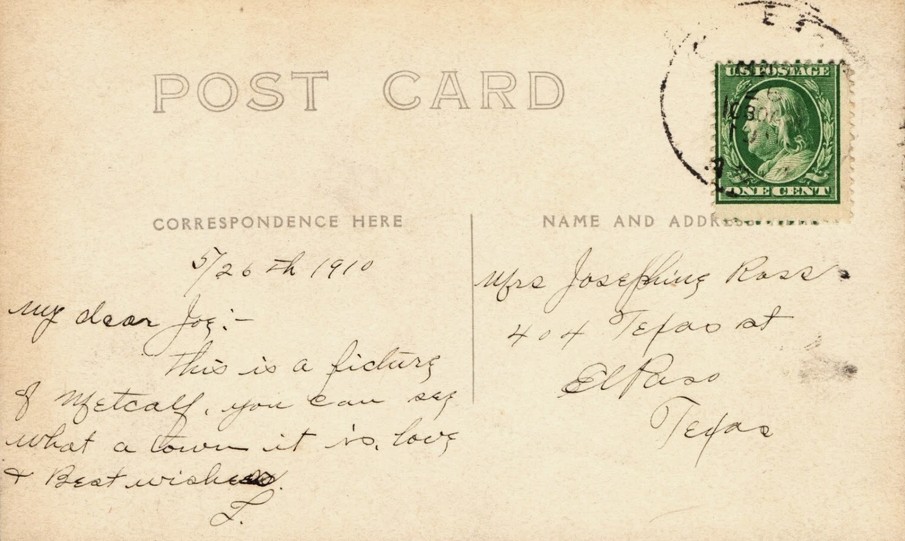
I’d never heard of the ghost town of Metcalf, Arizona, until coming across a postcard mailed from there over 115 years ago. Miss Josephine Ross in El Paso, Texas, was the recipient. The mysterious sender simply referred to themself as “L” with a short message as follows:
“5/6th 1910
My dear Joe:-
This is a picture of Metcalf, you can see what a town it is. Love and best wishes. L”
Josephine Henrietta Ross was born in New Jersey on May 18, 1890. Her father, Seaver Ross, M.D., was a well-known doctor in Paterson, N.J.
Somewhere around 1920, Josephine married Corporal Earl Eugene Kilmer. Josephine’s husband served in the US Army during WWII. After being honorably discharged, Earl and Josephine lived in Clifton, Arizona, a mining town, and it might’ve been there that she met the mystery card sender.
In 1928, they had a son, George Earl Kilmer. After leaving Arizona, Earl worked for El Paso County in Texas, while Josephine was a stay-at-home mom.
Josephine Henrietta Ross-Kilmer died in El Paso at the age of 83 on July 4, 1973. There’s a good chance Josephine was previously married, because the last name Bonfoey popped up on her obituary as previously being hers.
Metcalf, Arizona, was a small mining town located in Greenlee County, in the southeastern part of the state. Established in the late 19th century, the town played a significant role in the copper mining boom that shaped the region’s development. Metcalf is approximately 435 miles from Lake Havasu City.
Metcalf was founded in the 1890s as prospectors and mining companies flocked to the area in search of copper deposits. The town was named after Robert Metcalf, an early miner and prospector who helped discover the rich copper veins nearby. As mining activity increased, Metcalf grew rapidly, attracting workers and their families, and soon became a bustling community with stores, schools, and churches.
The town’s fortunes were closely tied to the copper mining industry. The neighboring Morenci Mine, operated by Phelps Dodge, became one of the largest copper mines in North America and provided jobs for many Metcalf residents. Community life revolved around mining, and the town developed a vibrant culture, despite its remote location and rugged surroundings.
By the mid-20th century, changes in mining technology and company operations led to the decline of small mining towns like Metcalf. The expansion of the Morenci Mine required more land, and Metcalf was eventually dismantled to make way for open-pit mining operations. Today, little remains of the original townsite, but Metcalf is remembered as an important chapter in Arizona’s mining history.
Although Metcalf no longer exists as a populated town, its legacy lives on in the stories of mining families and the historical records of Greenlee County. The rise and fall of Metcalf reflects the broader trends in American mining history and the transformation of rural communities in the southwest.
Although some folks say that a picture is worth 1000 words, it’s a crying shame that “L” didn’t take more time and tell Josephine in her postcard a bit more about the town she lived.

 I like to write junk...