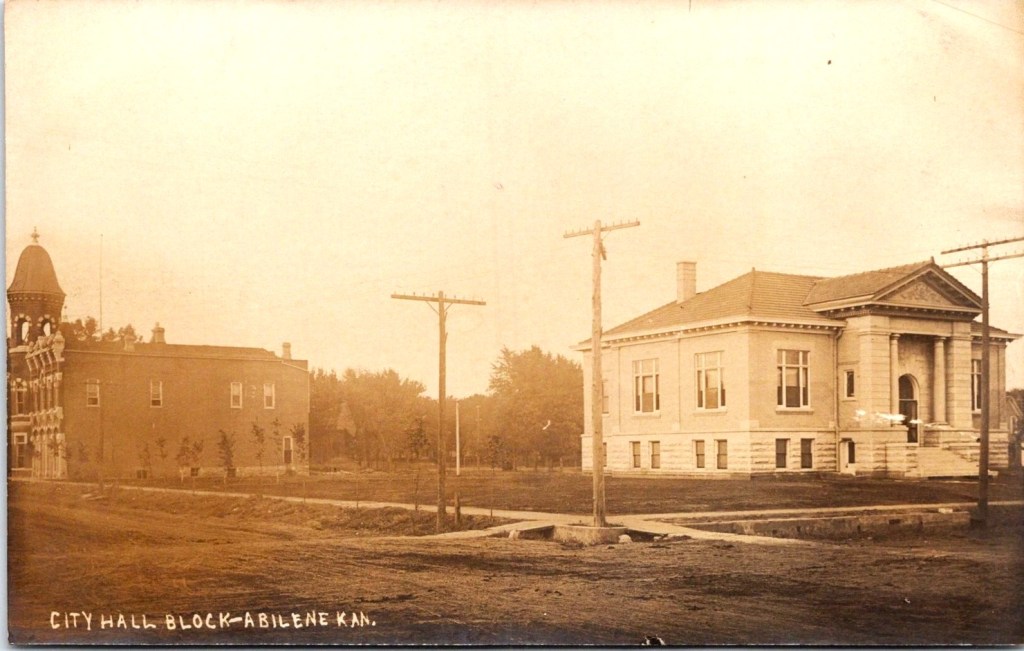
Telling these stories about postcard people gives me an opportunity to hold the very card a sender mailed off to a friend, family, or acquaintance. A writer can’t get any closer to history than that. These postcard senders either had their postcard sitting on their desk, table, lap, or wherever it was that they wrote the message on.
In some cases, they tell the exact place, with one person mentioning a railroad depot, while another wrote they were on a ship traveling to Alaska. The following historically significant card was postmarked and mailed from Abilene, Kansas, to Wakefield, Kansas, most likely traveling there via steam locomotive. A picture of Abilene is on the front. Just a bit of history on both towns is needed before delving into the sender and recipient of my card.
Wakefield, Kansas, is a small city located in Clay County in the north-central part of the state. Founded in 1886, the town was named after Wakefield, England, reflecting a common practice of early settlers naming their new communities after places from their homelands. The area was originally populated by pioneers attracted by the fertile land and prospects for farming.
The arrival of the railroad in the late 19th century played a significant role in Wakefield’s growth, facilitating the transport of agricultural products and connecting the community to larger markets. The town’s population and economy flourished, with businesses, schools, and churches becoming central to community life.
Abilene, Kansas, is a city located in Dickinson County in central Kansas. Founded in the 1860s along the Smoky Hill Trail, it quickly gained prominence as a key cattle shipping point during the era of the Chisholm Trail. In the late 19th century, Abilene became famous as the first “cow town” of the West, with thousands of cattle driven from Texas to its railhead for shipment to eastern markets. The town’s rapid growth brought entrepreneurs, lawmen, and notorious figures, including Wild Bill Hickok, who served as marshal in 1871.
As the cattle drives faded, Abilene developed into a regional center for agriculture and commerce. The city later became a center for business and commerce, with it headquarters for the A.B. Seelye patent medicine company, and Duckwall retail stores located throughout Kansas and other neighboring states.
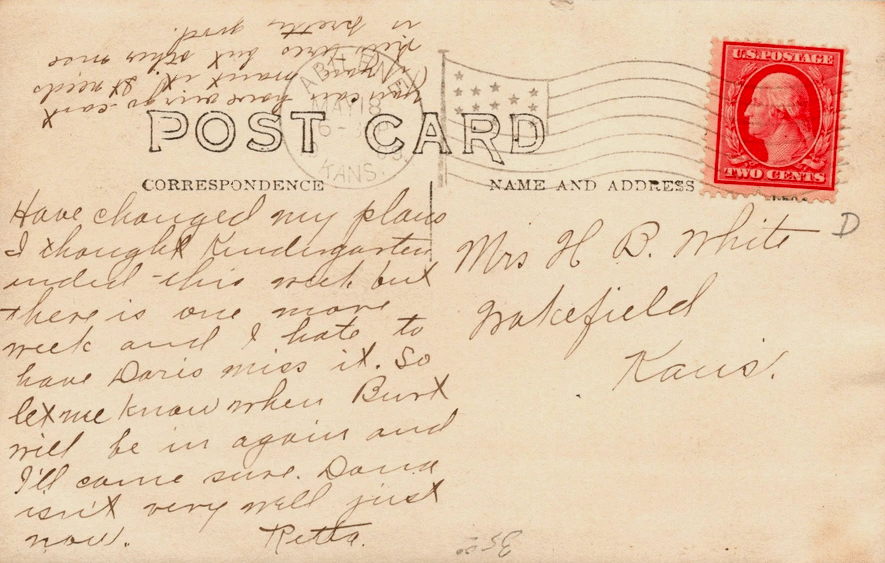
The postcard I recently came across was sent from someone named Retta. She crossed each alphabetical ‘t’ in her letter in a unique, slanted Christian manner. It looks much like an x. The brief composition reads as follows without any correction:
‘Have changed my plans. I thought kindigarten ended this week but there is one more week and I hate for Doris to miss it. So let me know when Burt will be in again and I’ll come sure. Doris isn’t very well just now.
Retta”
Written upside down on this postcard were a few more lines:
“You can have our go-cart if you want it. It needs new tires but other wise is pretty good.”
Mrs. H.B. White lived in Wakefield along with the family. Anna’s husband was Harry Burt White. Anna kept the local doctor busy, giving birth to seven children in a span of only eleven years. The postcard, sent to Anna from someone she knew in Abilene, Kansas, would’ve arrived in Wakefield around May 10, 1909.
Sadly, Harry Burt White passed away just three months later, on August 9, at the young age of 37, from typhoid fever. Harry was a successful businessman, always on the go, selling his merchandise. It’s possible he picked up the terrible disease while traveling by train.
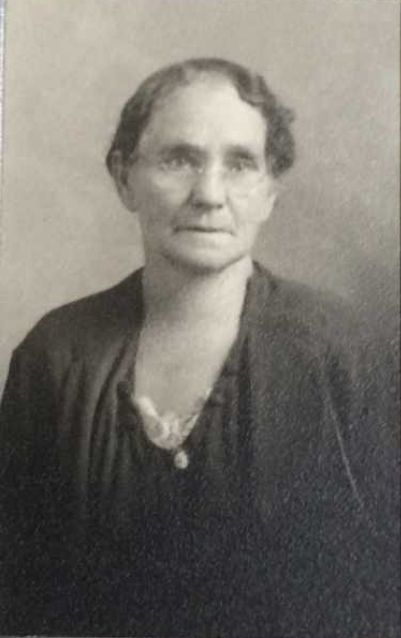
The card sender, Retta, was Harry’s sister. Retta and Harry White were both born in Wakefield. Retta Leota White-Duckwall, along with her husband, Alva, became two of Abilene’s wealthiest residents. The Duckwall family eventually owned a chain of retail stores throughout Kansas and other states.
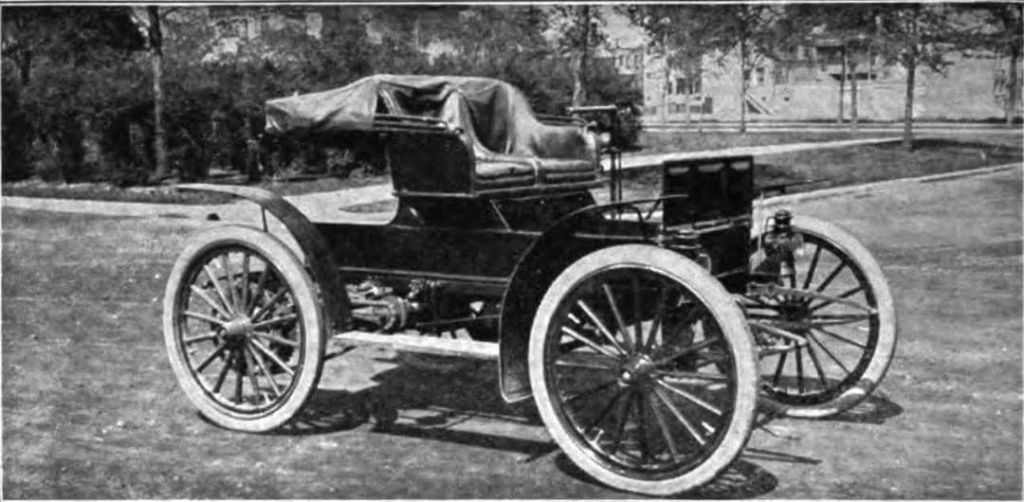
The ‘go-cart’ that Retta mentioned in her postcard was unlike the go-carts of today. It was most likely a small runabout car popular in the early 1900s, sold by Sears. The Duckwalls evidently had no need for the vehicle, having moved on to a Ford Model T, with Retta offering it to her sister-in-law.
Alva “Lease” Duckwall died in 1937, with Retta passing away on May 27, 1948. An obituary for Retta’s husband and a piece from a 1956 history book pretty much tell the whole Duckwall history.
Alva Lease Duckwall and Wilbur Duckwall were born in Ohio, with the family moving to Kansas in 1898. In 1901, “Lease” purchased a Racket Store in Abilene. Wilbur soon joined the business, and Duckwall Brothers was founded, featuring everything needed for the home.
******
From Kansas: The First Century
Lewis Historical Publishing Co., 1956, p.9
“One of the outstanding merchandising executives of Kansas history, Alva Lease Duckwall, built up the vast store chain bearing his name, now numbering sixty-five retail outlets in communities throughout Kansas and in eastern Colorado.
Born on a farm near Batavia, Ohio, on August 30, 1877, he was the son of Francis Marion and Sara Elizabeth (Slade) Duckwall. His father, who was a farmer, was born in Batavia on August 25, 1845, and died at Greenleaf, Kansas, on September 19, 1900.
Sara E. (Slade) Duckwall was born at Concord, Ohio, July 26, 1849, and died in Abilene on May 9, 1937. Reared on the home farm, A.L. Duckwall attended Greenbriar Country School and Batavia High School. He came to Kansas in 1898 and settled in Greenleaf.
Moving to Abilene on May 10, 1901, he opened a variety store on Broadway Street. This was to become Retail Unit No. 1 of the A.L. Duckwall Stores Company, a variety store group. The chain began to be forged when, in 1906, the young entrepreneur opened a second store at Salina.
In 1915, a corporation was formed under the name of The A.L. Duckwall Stores Company. Mr. Duckwall was elected president. W.F. Duckwall was vice president and director; G.E. Duckwall was treasurer and director; S.L. Wagaman was secretary and director; and, in addition to these men, E.H. Moore also served on the board.
A.L. Duckwall continued to head the organization, and his remarkable commercial abilities resulted in its constant expansion and the opening of new stores, until, at the time of his death, there were forty-two such outlets in Kansas and eastern Colorado. That was in 1937, and as it has continued its existence under a management of skill and vision, the number of stores now operated under the Duckwall name has now reached sixty-five.
Frank H. Buck is now president of the chain; A.L. Duckwall, Jr., and W.K. Grigg are vice presidents, Sam R. Heller is treasurer, and G.E. Duckwall is secretary. C.L. Brainard is assistant secretary, and R.G. Sanborn is assistant secretary-treasurer.
Describing his role in the building of this large and widespread enterprise, the Abilene “Daily Reflector” commented, on the occasion of Mr. Duckwall’s death:
‘Mr. Duckwall was, by instinct, a good businessman. To his progressiveness is due the growth and expansion of the companies, and to his conservatism the fact that the companies which he piloted went through the 1920-1921 and the 1929-1933 storms safely. Two other qualities which contribute toward making him a fine executive were his square shooting and his ability to get the most out of men without driving them.’
Besides his major business interest as head of The A.L. Duckwall Stores Company, he was president of The Western Merchandise Company, and a director of the Farmers National Bank, the Dickinson County Building and Loan Association, the Dye Candy Company of Kansas City, Missouri, and the Nehi Bottling Works. He had an interest in the Smith Barber and Beauty Supply Company.
He was a member of the Chamber of Commerce, the Rotary Club, and the Free and Accepted Masons. In the Masonic order, he was a member of the higher bodies, including the Chapter and Commandery at Abilene, the Consistory of the Scottish Rite, and the temple of the Ancient Arabic Order of Nobles of the Mystic Shrine at Salina. He was an official of the local chapter of the American Red Cross and the Young Men’s Christian Association, and was a charter member of the Abilene Country Club. He attended Trinity Lutheran Church.
On February 11, 1904, Alva Lease Duckwall married Retta Leota White at Wakefield. They became parents of three children: 1. Dorris Moyne, who was born on January 2, 1905. 2. Donna Gayle, born February 28, 1907. She is the wife of Mr. C.L. Brainard. 3. Alva Lease, Jr. He is an official of The A.L. Duckwall Stores Company. At the time of Mr. Duckwall’s death, there was one grandchild: Diane Gayle Brainard.
The merchandising executive died on August 2, 1937, in his office and among his business associates. The Abilene “Daily Reflector,” in its outline of his career, gives these words of description which serve to give a fuller picture of the character of the man:
‘Mr. Duckwall was everyone’s friend. The extent of his friends can scarcely be estimated. He was quick to help and slow to criticize. A tireless worker, tremendously interested in business, he always had time for a joke or friendly chat. His creed in life was to help others, to teach others to help themselves.’
My research into this story eventually showed that Mrs. H.B. White and her five surviving children were well taken care of, undoubtedly with the financial assistance of Retta Duckwall and her husband. Sadly, two of the little ones had died in 1902. Mrs. H.B. (Anna) White passed away in 1957 at the age of 86.
Dorris Duckwall, mentioned in Retta’s postcard, was the oldest child. She died in 1992 at the age of 86. Unfortunately, the Duckwall-Alco chain of stores went bankrupt and ceased operation, liquidating all assets in 2015.

 I like to write junk...