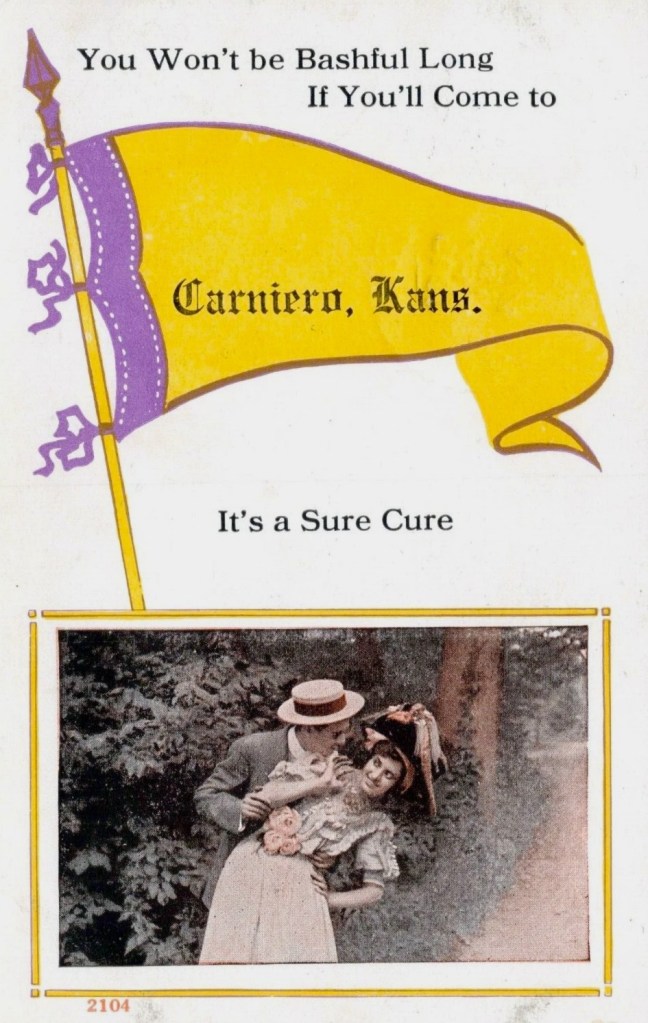
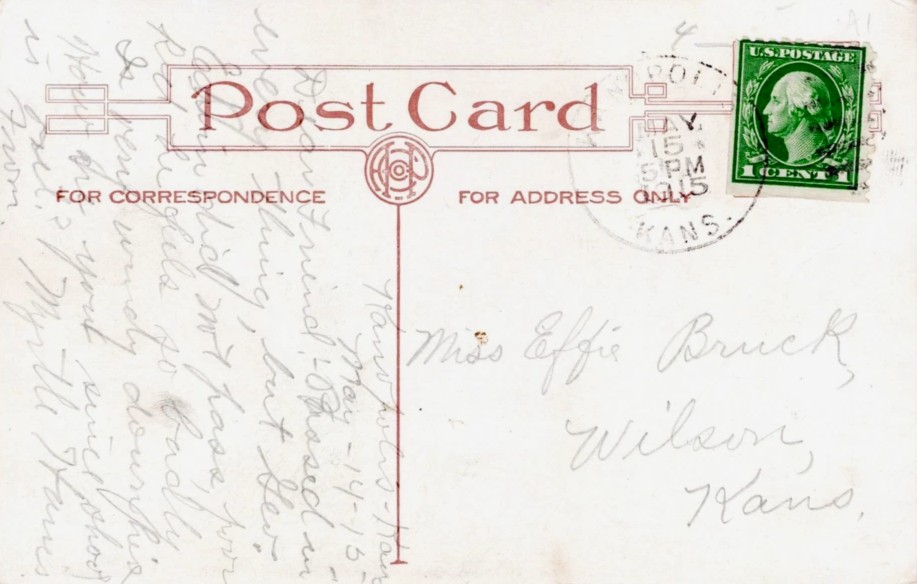
A postcard sent by Myrtle Harris on May 15, 2015, to her friend, Effie Bruck, in Wilson, Kansas, has three Kansas town connections. On the front of the card is an unusual saying,
“You won’t be bashful long if you come to Carniero, Kansas. It’s a sure cure.”
There’s a humorous picture at the bottom showing a young fellow dressed to the hilt attempting to kiss or hug some young gal. She’s smiling, so all must be okay. This card was postmarked and mailed from Kanopolis, Kansas. Carniero is only 11 miles from Kanopolis and 30 miles from Wilson. These three towns were all connected by rail.
Kanopolis is a small village-like locale located in Ellsworth County, in the central part of the state. Known today for its proximity to Kanopolis Lake and the scenic Smoky Hill region, Kanopolis has a rich and unique history shaped by its role in the development of the American Midwest.
The area that would become Kanopolis was originally inhabited by Native American tribes, including the Pawnee and Kansa. In the mid-19th century, settlers began moving into central Kansas, attracted by the opportunities presented by the Homestead Act and the promise of fertile land.
Kanopolis was officially founded in the late 1800s, with its plat filed in 1886. The city was named after the state (“Kan”) and the Greek word ‘polis’ meaning city, symbolizing aspirations for growth and civic pride.
The arrival of the Union Pacific Railroad was a pivotal moment in Kanopolis’ history. The city became a hub for commerce and transportation, serving as a shipping point for agricultural products, cattle, and supplies. The railroad also spurred population growth and the development of new businesses, schools, and churches.
In the mid-20th century, the construction of Kanopolis Dam and Lake transformed the area into a popular recreational destination. Built by the U.S. Army Corps of Engineers and completed in 1948, Kanopolis Lake offers fishing, boating, camping, and hiking opportunities, contributing to the city’s identity and local economy.
I’m not familiar with Kanopolis, but I am with Wilson, stopping there several times to pick up jars of their local honey.
Wilson is located approximately 30 miles from Kanopolis, a small town with its own distinct and vibrant history. Established in the late 1860s, Wilson became known as the “Czech Capital of Kansas” due to the significant number of Czech immigrants who settled in the area, bringing with them their cultural traditions and community spirit.
The town’s growth was closely tied to the expansion of the railroad, which made Wilson an important stop for commerce and transportation in central Kansas.
Throughout its history, Wilson has maintained a strong agricultural base, with farming and ranching serving as the backbone of its economy. The community is also celebrated for hosting the annual After Harvest Czech Festival, which honors the town’s heritage with music, food, and traditional festivities.
Today, Wilson is recognized for its historic limestone architecture, friendly atmosphere, and commitment to preserving its unique cultural legacy. Effie Bruck evidently went to school in Wilson, while the postcard sender, Myrtle Harris, attended a Kanopolis school. The two girls only lived 21 miles apart.
I’m very familiar with Carniero, Kansas, having spent some time there photographing the old buildings. It’s a ghost town these days and has been for quite a while. In the 1990s, the Carniero School was in good shape, with someone living there.
Today, the roof has caved in and is no longer inhabitable. A photograph I came across shows a large owl looking out of a classroom window. The history of Carniero revolves around sheep.
Carniero is a small, now-abandoned place with a history closely tied to agriculture, particularly sheep ranching. In its early years, Carniero thrived as a rural community, with its residents engaged primarily in raising sheep and supporting related agricultural activities.
Over time, however, population decline and changes in the agricultural industry led to Carneiro’s gradual abandonment, turning it into a ghost town. The only thing left of it are those old buildings, a cemetery, and a few mementoes like Effie Bruck’s postcard. Effie’s friend, Myrtle Harris, must’ve picked the card up while stopping in Carniero.
Myrtle Mae Harris was born in Empire, Kansas, in 1902, to parents Marida and Katie. She attended various schools during her early life, including the one in Kanopolis, where she finished her education in the 8th grade. Myrtle had eight siblings. The fledgling teenager was 13 in 1915 when mailed her card.
Myrtle Mae married Clifford B. Lindquist in 1921, moving to Ellsworth, Kansas, where “Cliff” was a farming implement salesman. It appears the couple divorced around 1940, with Myrtle resuming her maiden name. Myrtle Mae Harris died in 1990 at the age of 88. She is buried in Brookville Cemetery with a majority of her family.
Myrtle misspelled the last name of her friend. It’s Effie Brack instead of Bruck. Effie was born on April 13, 1903, to George and Elizabeth Brack. Like her friend, Myrtle, she also came from a large family, having 6 siblings. Effie was 12 when she received Myrtle’s postcard.
In 1919, at the age of 16, Effie married Emanuel Schlegel, who was a farmer. The couple had three children. When Emanuel passed away in 1957, Effie wed G.C. “Willie” Clymer. Effie died in 1967 at the age of 64. She’s buried in Garden City.
Returning to the postcard that Myrtle sent Effie, with Carniero identified during my research as a sheep town, I couldn’t help but think of a more fitting saying regarding shyness than the one used. Mine would read like this:
“You won’t be baaa-ashful long if you come to Carniero, Kansas. It’s a sure cure.”


 I like to write junk...