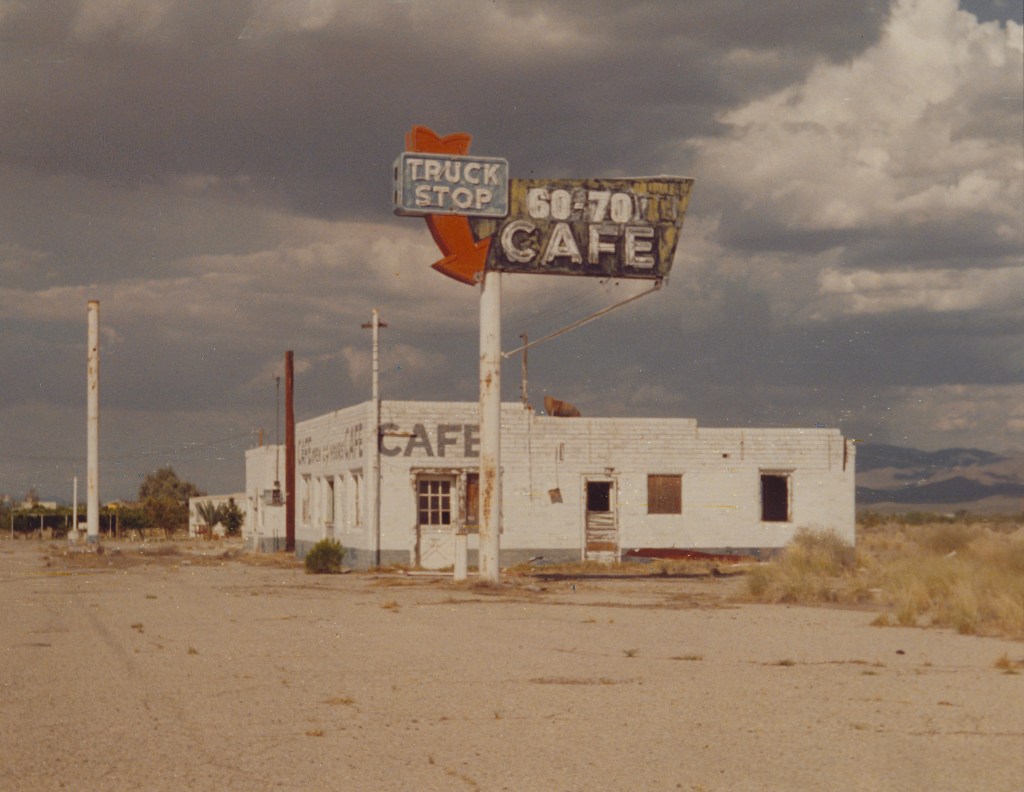
Forty years ago, I took this photo of the US 60-70 Café near Salome and Wenden, Arizona. The café was approximately 98 miles from Lake Havasu City, where we were heading.
Two years later, when we drove by, the building was gone. I was fortunate to be able to go inside back then and see that the booths and counters were still in place. The building hadn’t been vandalized or sprayed with graffiti, as is so common these days.
Nestled along the historic highways US 60 and US 70, just east of Salome, Arizona, the US 60 70 Café stood as an iconic pit stop for travelers journeying through the Arizona desert. Though the café is no longer in operation today, its history is emblematic of the golden era of cross-country road trips and the spirit of American roadside culture.
The US 60 70 Café was established in the late 1940s, during a period of significant growth in automobile travel across the United States. Positioned strategically near the intersection of U.S. Highway 60 and U.S. Highway 70, the café capitalized on the steady flow of motorists, truckers, and tourists heading to and from the West Coast.
The business also offered gas and diesel, making it popular with truckers. The simple yet welcoming architecture, featuring a neon sign visible from a distance, became a familiar sight for those crossing the arid landscapes of western Arizona.
During the 1950s and 1960s, the US 60 70 Café thrived as roadside diners became an essential part of American travel. The café was renowned for its hearty breakfasts, homemade pies, and bottomless cups of coffee, offering weary travelers a respite from the heat and monotony of the desert drive.
The interior décor reflected the era, with chrome stools, Formica countertops, and a jukebox filled with the latest hits. The café not only served locals and travelers but also became a gathering place for the small community around Salome, hosting social events and meetings.
The construction of the Interstate Highway System in the late 1960s and early 1970s dramatically altered traffic patterns across the United States. As more vehicles shifted to the faster and more direct Interstate 10, the once-bustling US 60 and US 70 saw a decline in cross-country traffic.
Like many other roadside businesses, the US 60 70 Café faced dwindling customers and increasing operational challenges. By the late 1970s, the café closed its doors, leaving behind memories and a shell of its former glory. I’m so thankful I was able to snap one picture before its total demise.
Though the US 60 70 Café no longer serves travelers, its legacy endures in the stories of those who visited and the nostalgia for a bygone era. The building’s remains, no longer there, still evoke a sense of wonder about the countless journeys that passed through its doors.
Local historians and longtime residents of Salome often recall the café as a symbol of the community’s connection to America’s great highway tradition. I came across several advertisements in the Phoenix newspaper saying that it was for sale. Evidently, there were no takers.
The US 60 70 Café near Wenden, Arizona, remains an evocative landmark in the history of American road travel. Its rise and fall mirror the broader trends of mid-century travel and the impact of changing transportation infrastructure.
Today, it serves as a reminder of the importance of small businesses in shaping the character and memory of America’s highways. For me, it was fodder for one more story.

 I like to write junk...