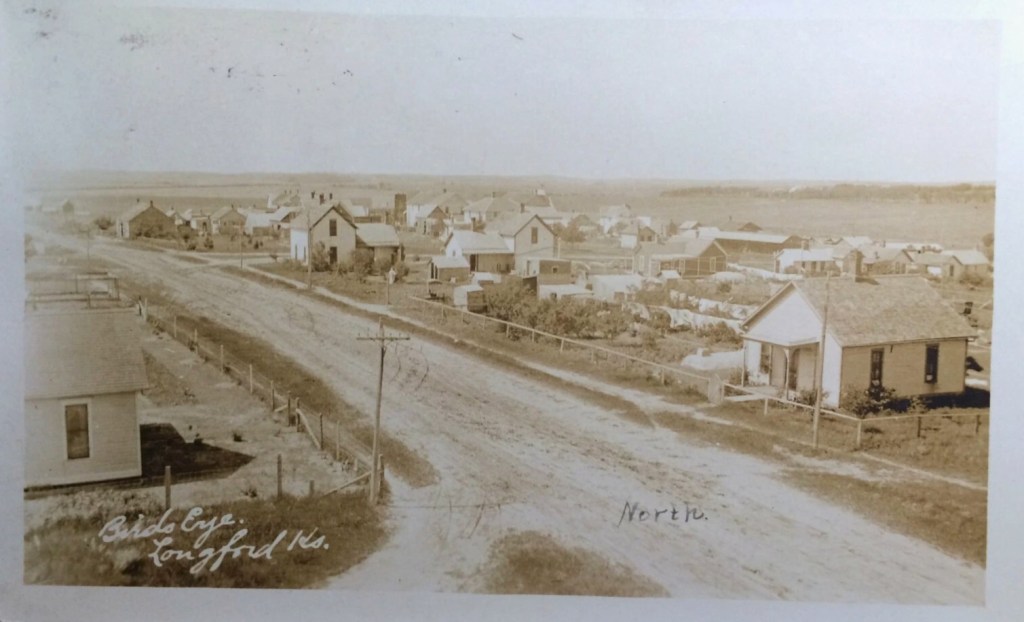
Longford, Kansas, is a small town situated in Clay County in the central part of the state. Like many rural communities in the American Midwest, Longford’s history reflects the broader patterns of settlement, growth, and change that shaped Kansas and the surrounding region.
The area that would become Longford was originally inhabited by Native American tribes, including the Kansa and Pawnee. European-American settlers began arriving in the mid-19th century, drawn by the promise of fertile farmland and the opportunities provided by the Homestead Act.
Longford was officially founded in the late 1800s, with the establishment of a post office in 1870 marking its emergence as a recognized community.
Longford’s growth was closely tied to the expansion of the railroad. The arrival of the Atchison, Topeka, and Santa Fe Railway facilitated access to markets and helped the community thrive. The railroad enabled local farmers to ship their products to distant buyers, and businesses soon sprang up around the depot, including general stores, blacksmiths, and grain elevators.
By the early 20th century, Longford had become a center of rural life in Clay County. Schools, churches, and civic organizations formed the backbone of the town’s social structure.
The Longford Rodeo, first held in the 1940s, became a beloved local tradition and continues to draw visitors from across the region each year. Community events and gatherings have long been an important aspect of life in Longford, fostering a sense of neighborliness and shared identity.
Like many small towns in Kansas, Longford experienced challenges during the 20th century. Advances in agriculture led to fewer farming jobs, and many residents moved to larger cities in search of work. Despite these changes, Longford has remained resilient, adapting to new economic realities while maintaining its rural charm.
Today, Longford is recognized for its tight-knit community and its enduring traditions. While its population is small, the town’s spirit is evident in its annual rodeo, community projects, and efforts to preserve its history. Longford serves as a reminder of the enduring legacy of small towns in American life, where history, culture, and community continue to shape the present.
The history of Longford, Kansas, is a testament to the perseverance and adaptability of rural America. From its origins as a railroad town to its present-day identity, Longford has weathered the changes of time while holding on to its distinctive character and community spirit.
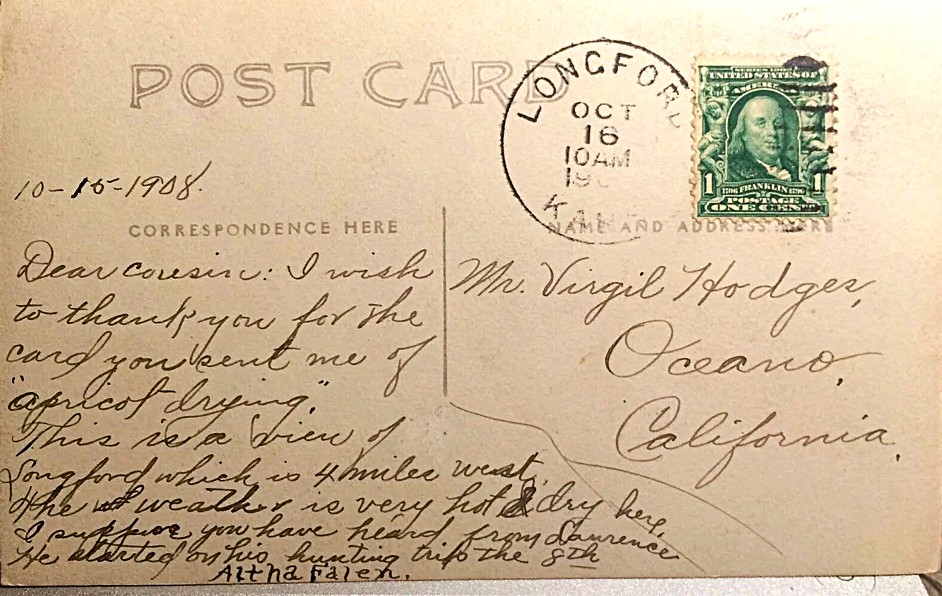
Altha Falen lived in Longford. She sent her cousin, Virgil Hodges, in Oceano, California, a picture postcard showing the north part of town. The card was postmarked in Longford 117 years ago, on October 16, 1908. The message to Virgil says:
“10-15-1908
Dear cousin: I wish to thank you for the card you sent me of “apricot drying.” This is a view of Longford which is 4 miles west. The weather is very hot and dry here. I suppose you have heard from Lawrence, He started on his hunting trip the 8th. Altha Falen”
Altha was born on October 5, 1880, to Phillip Elmer and Sarah Jane Hodges-Falen. There were four other siblings, three girls and one boy. According to census records, Altha completed public education through 8th grade, yet never married or held down a paying job.
When their father died in 1910, the family moved to town. In later years, Altha lived with her mother and an older sister, Melma Melina “Millie” Falen, and they often traveled together. Her brother was named Lawrence, while the other two sisters were Lela and Effie.
It seems reasonable that their mother’s house in Longford became Millie and Altha’s after their mom’s death. In a will prepared by their father, before his death, Millie and Altha were to get 115 acres of land, including a fair amount of cash. This was only to take place after their mom died. How the two sisters sustained themselves for so many years without working is a mystery.
Altha Catherine Falen died on October 15, 1962. Millie passed away on August 4, 1953. Both are buried next to each other in Althelstane Township Cemetery.
Virgil Ulysses Hodges was Altha’s cousin. Living in Oceano, California, for most of his life, he was a photographer, with many of his photographs now featured in local Lompoc museums. Virgil was born on September 29, 1879, and passed away 95 years later on April 3, 1975.

 I like to write junk...