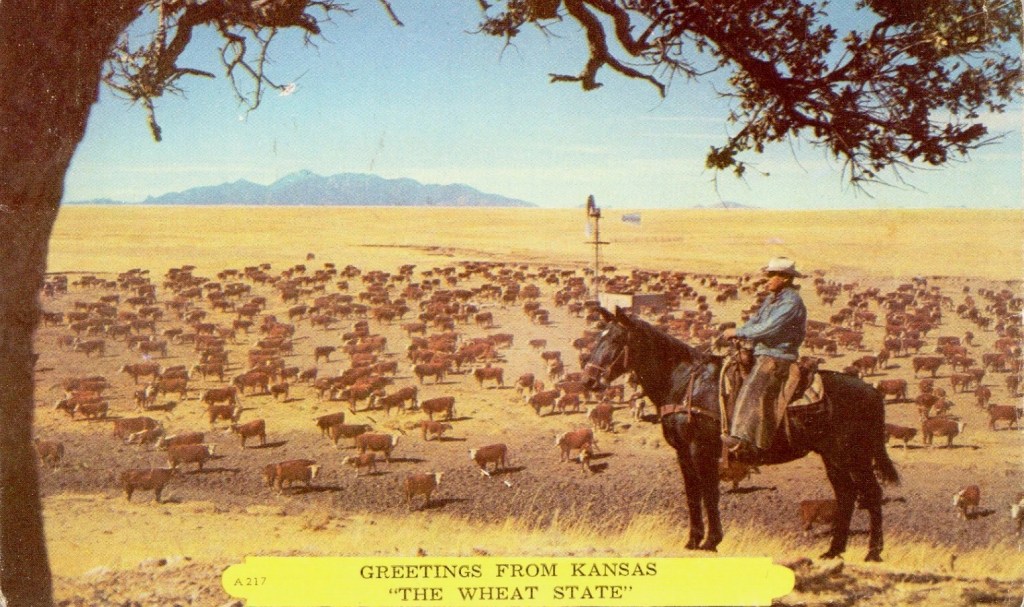
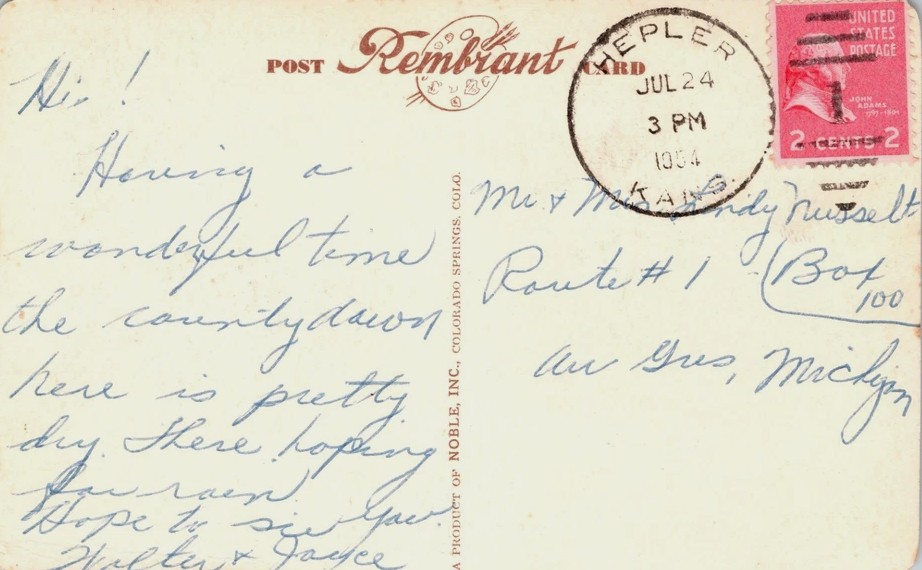
A picture postcard sent on July 23, 1954, from Hepler, Kansas, to Au Gres, Michigan, shows a cowboy riding herd over some cattle in “The Wheat State.” The card senders were Walter and Joyce, with their last name unidentified.
The message says,
“Hi – Having a wonderful time. The county down here is pretty dry. There hoping for rain. Hope to see you. Walter & Joyce”
The card recipient was Mr. and Mrs. Lindy Russelt of Au Gres. Lindbergh “Lindy” Russelt was born on June 27, 1927, to Peter and Meta Russelt. Lindy became a farmer like his father. Lindy married Marie Hohn in 1949, with her passing away on October 3, 1977. Seventeen days later, he married Romance Ernestine Slacker. Lindbergh E. Russelt died on June 23, 1986, at the age of 59.
There’s not a whole lot of information on Lindbergh Russelt. With me unable to positively identify who Walter and Joyce were, although I ‘believe’ them to be Walter and Joyce Miller from St. Clair, Michigan, the two towns on the postcard were more than interesting enough to research.
Hepler, Kansas, is a small rural community nestled in Crawford County in the southeastern region of the state. Though modest in size, Hepler has a rich and enduring history that reflects the broader trends of development, resilience, and community spirit found throughout Kansas.
Hepler was established in the late 19th century, during a period marked by westward expansion and the settlement of the Great Plains. The town was officially platted in 1871 and named after B. F. Hepler, a prominent early settler and influential figure in the region. Like many Kansas communities, Hepler’s early years were shaped by agriculture, with settlers attracted by the promise of fertile land and the opportunity for prosperity.
The arrival of the railroad was a pivotal moment in Hepler’s history. The Missouri-Kansas-Texas Railroad (often called the “Katy”) reached the town in the 1870s, providing a crucial link for transporting crops, livestock, and goods to larger markets. The railroad not only boosted the local economy but also facilitated the growth of Hepler as a trading and service center for surrounding farms.
In its heyday, Hepler boasted a range of amenities and businesses, including general stores, blacksmiths, schools, churches, and grain elevators. The town’s residents were known for their close-knit relationships and community-oriented activities. Social events, such as church gatherings, school plays, and local fairs, were central to life in Hepler and contributed to its enduring sense of identity.
Like many small towns in rural America, Hepler faced challenges as the 20th century progressed. Mechanization in agriculture, changes in transportation, and urban migration resulted in population declines and the closure of many local businesses. Despite these hardships, Hepler’s residents continued to demonstrate resilience, adapting to changing times while maintaining their community spirit.
Today, Hepler remains a testament to the enduring values of rural Kansas. While its population is smaller than in the past, the town’s history is preserved in its buildings, traditions, and the memories of its residents. Annual events and gatherings continue to bring people together, celebrating the town’s heritage and keeping its history alive for future generations.
The story of Hepler, Kansas, is one of perseverance, adaptation, and community. From its founding in the 1870s to the present day, Hepler reflects the broader narrative of many small American towns—rooted in the land, shaped by the railroad, and sustained by the strength of its people.
Au Gres, Michigan, is a small city located in Arenac County along the shores of Lake Huron in the northeastern part of the state. The area’s history dates back to the early 19th century, when it served as a stopping point for French fur traders navigating the Au Gres River. The city’s name, derived from the French “aux grès” meaning “with sandstone,” reflects the region’s distinctive geological features.
Settlement increased during the mid-1800s as lumbering and fishing became central to the local economy, attracting families seeking opportunity in Michigan’s burgeoning northern frontier.
As the lumber industry flourished, Au Gres grew into a vital community, with sawmills, shipping docks, and various businesses springing up to serve both residents and visitors. The arrival of the railroad in the late 1800s further spurred growth, making transportation of goods and people more accessible.
Over the years, as lumbering declined, the community transitioned to agriculture and tourism, capitalizing on its proximity to Lake Huron and the Au Gres River. Today, Au Gres is known for its recreational opportunities, annual events, and strong sense of community, all of which continue to honor and celebrate its rich historical heritage.

 I like to write junk...