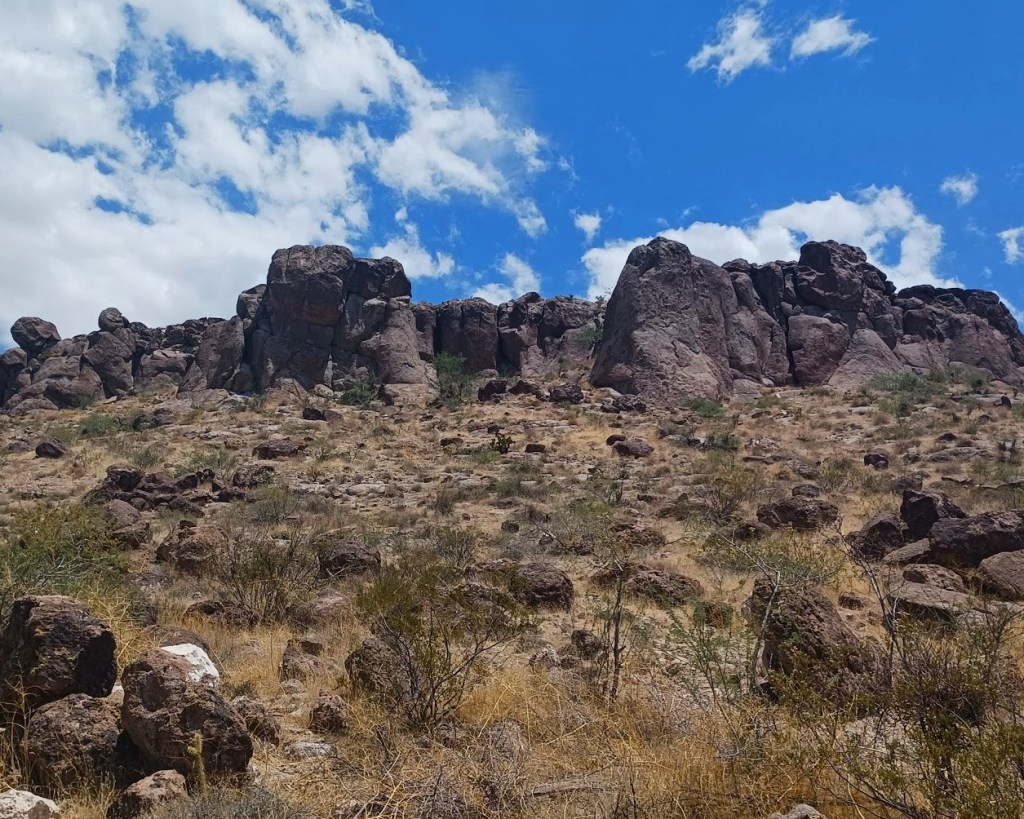
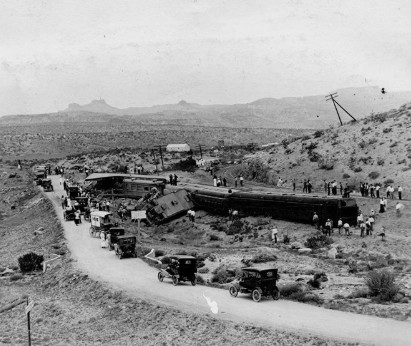
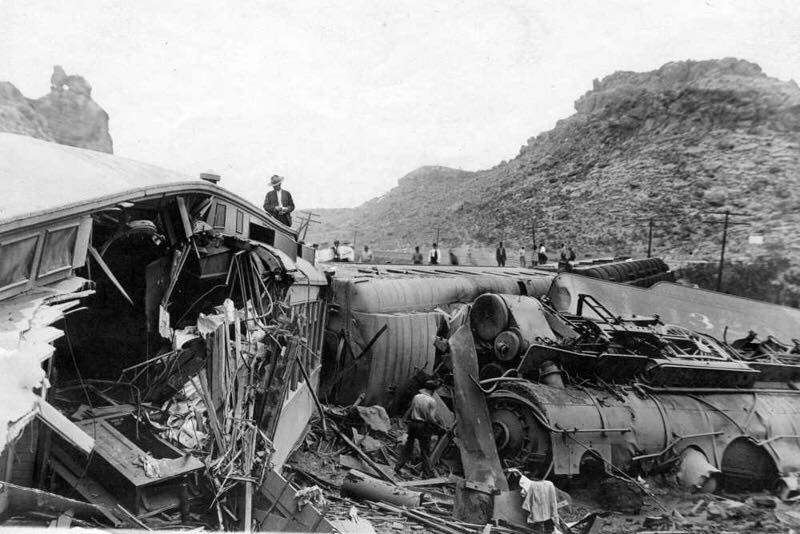
My wife and I decided to drive to Slaughterhouse Canyon Road in Kingman and take a close peek at the site of a train wreck happening near there on September 20, 1916. With such a macabre namesake as slaughterhouse, the canyon is mostly known for a chilling tragedy rather than this horrific locomotive accident.
I especially wanted to check out the canyon, with Joleen somewhat hesitant, this late in spring. Rattlesnakes are now slithering about. Wearing the right boots and clothing, along with using ample amounts of caution, makes for less chance of getting bitten, although just the mere sight of a rattler can instantly turn a beating heart into a kettledrum. I know that for a fact.
Old Trails Road winds along the tracks for a good distance, and that was our main destination, and I had a vintage photograph to use to pinpoint the derailment. With this photo showing numerous Ford Model Ts parked alongside the road, gawkers back then were as common as they are today. I counted 74 people along with 13 vehicles. A horse-drawn wagon in the group has “ICE” written on its side.
Sadly, four people perished in this derailment, along with several injuries, mostly bruises and broken bones. The four crewmen who died are: Ralph W. Gholson – engineer. Harry A. Osborne – fireman. William Dickens – chef. John Pluhachet – chef. Early newspaper accounts have a couple of the names wrong. John Truddick was not killed, nor was there a Mickey or Michael Osborne.
Bringing my metal detector along, I knew I couldn’t legally detect within 25 feet of the railway tracks for lost items such as coins, rings, earrings, necklaces, cufflinks, buttons, and keys, yet Old Trails Road was wide open for investigation.
To get to Slaughterhouse Canyon, start by heading south from Kingman on U.S. Route 93. Take the exit for White Hills Road, then continue southeast onto Slaughterhouse Canyon Road (also known as Luana’s Canyon Road).
Follow this unpaved road for several miles; the area is remote, so a high-clearance or four-wheel-drive vehicle is recommended. We took our Jeep. Signs are minimal, so having a GPS or map for navigation is helpful.
Be mindful that the canyon is on public land, and the crossing is railroad land, while always respecting private property and posted restrictions. It took us a few minutes to find a route without private property signs.
Also known as Luana’s Canyon, Slaughterhouse Canyon is steeped in legend and is one of the most famous haunted locations in Arizona. The story dates back to the 1800s, during the Gold Rush, when many families moved to the area in search of fortune.
According to the most popular tale, a family lived in the canyon, and the father would often leave for weeks at a time in search of gold. One season, he did not return, leaving his wife and children with dwindling supplies.
As starvation set in, the mother, driven mad by hunger and despair, is said to have murdered and mutilated her own children and then killed herself. It is believed that their spirits still haunt the canyon, and visitors report hearing the mother’s cries and wails, especially on quiet nights. That’s one place I wouldn’t want to be after dark.
Over the years, the legend of Slaughterhouse Canyon has become a part of local folklore, attracting those fascinated by ghost stories and the supernatural. The site remains a chilling reminder of the hardships faced by early settlers and the tragic consequences of desperation.
My research shows that two different canyons in Arizona share the same name. One at Fort Huachuca, near Tucson, is called that because of cattle slaughter. I found mentions of Slaughterhouse Canyon in Kingman dating back to 1912 in archived newspapers. There must be some truth to the gruesome tale—otherwise, why would it be labeled that?
Things have changed in the area since 1916, with the tracks seemingly straightened out a bit. Much of the hill had been excavated, but there are portions of ground closest to the road that were undisturbed.
While metal detecting in this area, Joleen and I found the usual amount of discarded junk, such as old railroad spikes and other metal debris. When my meter registered a high 80, indicating perhaps something silver, I became excited, hoping it was a silver soup spoon. Unfortunately, it was aluminum foil.
Newspaper articles from 1916 mentioned that one of the wooden dining cars was literally ripped apart as it tumbled towards Old Trails Road. That might explain an area with remnants of porcelain coffee cups and saucers still visible, along with shards of purple, green, and brown glass.
Running out of time, we plan to go back. There has to be a bent fork that somebody tossed aside, lying in the rocks, waiting to be discovered, along with a few sun-baked Indian head pennies!


 I like to write junk...