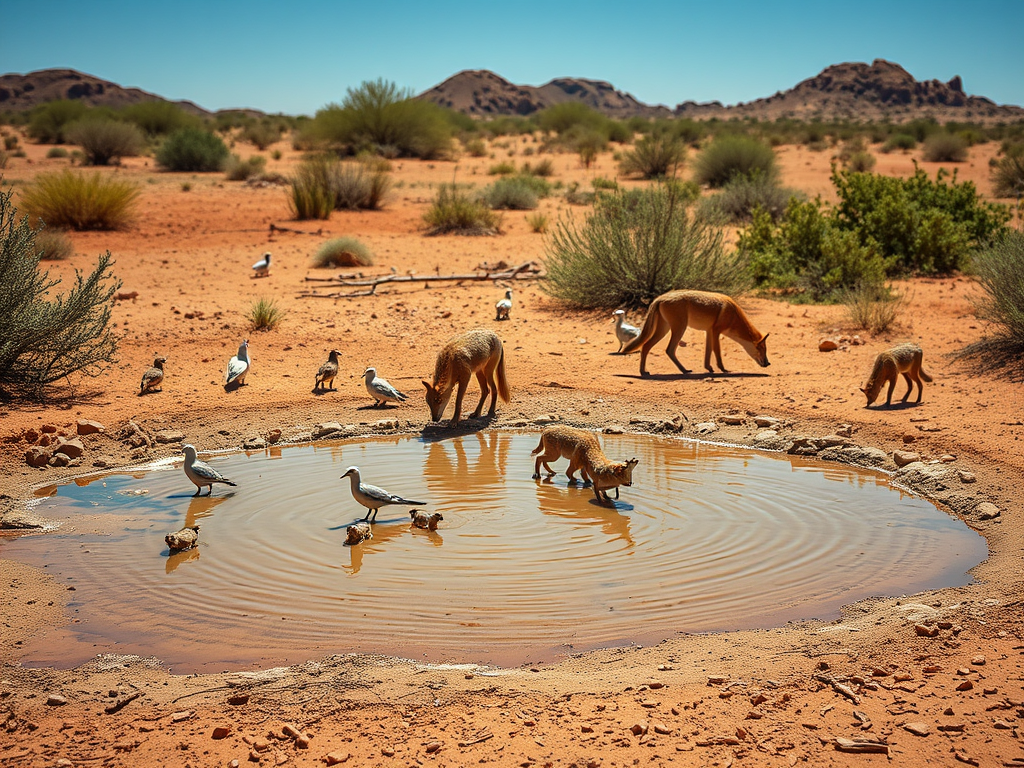
Agua, or water, is an important entity, especially in the Arizona desert. Without water, humans couldn’t survive, nor could wildlife. Even scaly lizards and snakes need a certain amount of the precious liquid to stay alive. Something within their biological system makes them living water conservators.
For the past several years, I’ve kept a bowl next to an automatic watering nozzle in our front yard. It’s partially hidden, yet quail, roadrunners, pigeons, hawks, and even coyotes still find it and take advantage of the bowl never being empty.
I’ve taken photos of some, with smaller birds using it as a bath house of sorts. During the heat of summer, I suppose a quick splash feels good, although the water isn’t always cool. They don’t seem to mind.
Our swimming pool, holding about 14,000 gallons of water, attracts bees more than anything else. I believe that the taste of chlorine probably keeps the other critters away. I’ve found a few tiny snakes swimming around, but that’s rare. The last time was maybe five years ago.
In the Arizona desert, swimming pools can lose significant water to evaporation, especially during the hot summer months. On average, a typical backyard pool may lose between 1/4 and 1/2 inch of water per day, which amounts to roughly 200 to 400 gallons per week for a standard-sized pool. During the hottest months and over the course of a year, that averages out to around 14,200 gallons.
Factors such as temperature, humidity, wind, and pool size can affect the exact amount lost to evaporation. We recently drained and refilled the concrete enclosure, which we do on average every two years. That’s a lot of wasted water.
On average, a person in the United States uses about 80 to 100 gallons of water per day for household activities such as bathing, cooking, cleaning, and watering plants. Over the course of a year, this adds up to approximately 29,000 to 36,500 gallons per person. This annual usage highlights the importance of conserving water, especially in arid regions like the Arizona desert.
The water that my wife and I drink is bottled, as our water softener adds sodium, which is not good to consume. We’ve never used the reverse osmosis system installed in our home because this device also wastes water. Reverse osmosis systems typically waste about three to four gallons of water for every gallon of purified water produced.
This means that while they provide high-quality drinking water, they are not the most water-efficient option, especially in areas where water conservation is important. I try to be conservative about showers and handwashing, yet savings are minimal compared to the pool’s evaporation.
Water in Arizona, despite the Colorado River and a few others still flowing, isn’t bottomless like fries at Red Robin. Aquifers are drying up, such as the one in Wenden. This relates to agricultural uses and to water being piped to the Phoenix area.
Folks living in Kingman are highly concerned about huge wells sucking up thousands of gallons for agriculture, mostly nut-growing. Nut-growing uses massive amounts of the precious liquid because nut trees, such as almonds, pistachios, and walnuts, require consistent irrigation to produce healthy crops, especially in arid climates like Arizona.
These trees have deep roots and require ample water throughout the growing season to support nut development and maintain yield. Additionally, growing nuts often involves watering not only the trees but also the surrounding soil to prevent stress and ensure optimal conditions for growth.
Builders continue to build homes while water supplies throughout the state are decreasing. To me, that’s like building boats when there’ll eventually be no water to float them. Politicians are allowing this to happen without any attempt to curtail the construction of homes or swimming pools.
Where will this eventually end up? Your guess is as good as mine. If no additional water is brought in through offshore desalination plants from California, life in Arizona as we now know it will come to a grinding halt.
Some time ago, I watched a 1973 horror movie about people evolving into snakes called “Sssssss.” In this film, a herpetologist, Dr. Thomas Stoner, develops a serum that could transform humans into the slithering creatures.
These snake people, much like lizards, undoubtedly, could survive without using large amounts of water, or agua as it’s called in Spanish. I’m not sure there’s another practicing Dr. Stoner out there, but if there is, Arizonians may very well need his services within the next 20 years.
Looking in the mirror this morning, at all of my dried, cracked skin and wrinkles, I could very well be evolving that direction naturally, without Dr. Stoner’s help!


 I like to write junk...