“This vintage postcard remains a simple yet wonderful reminder of its past.”
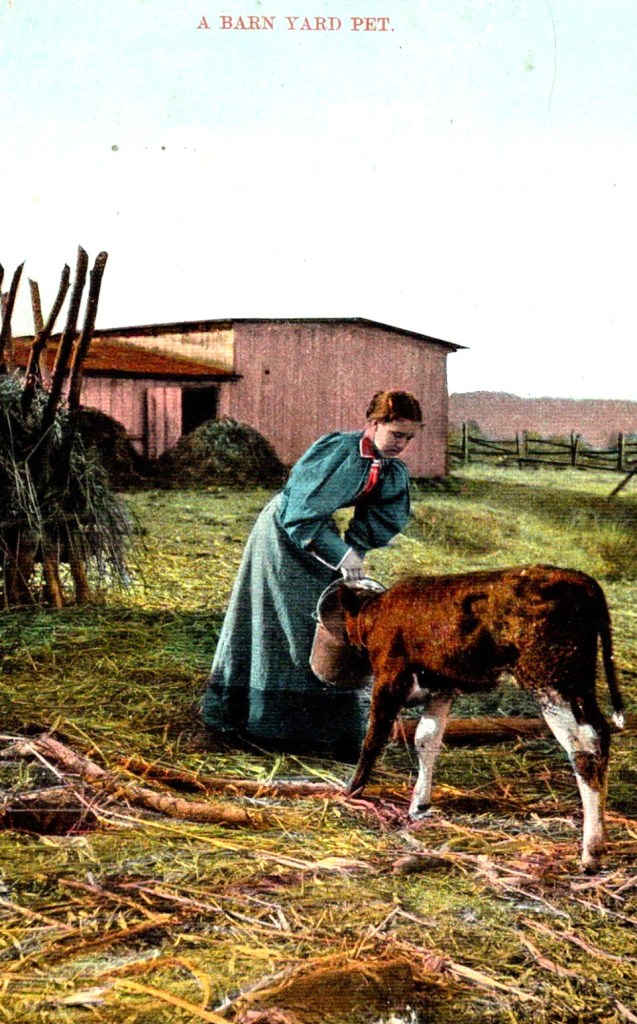
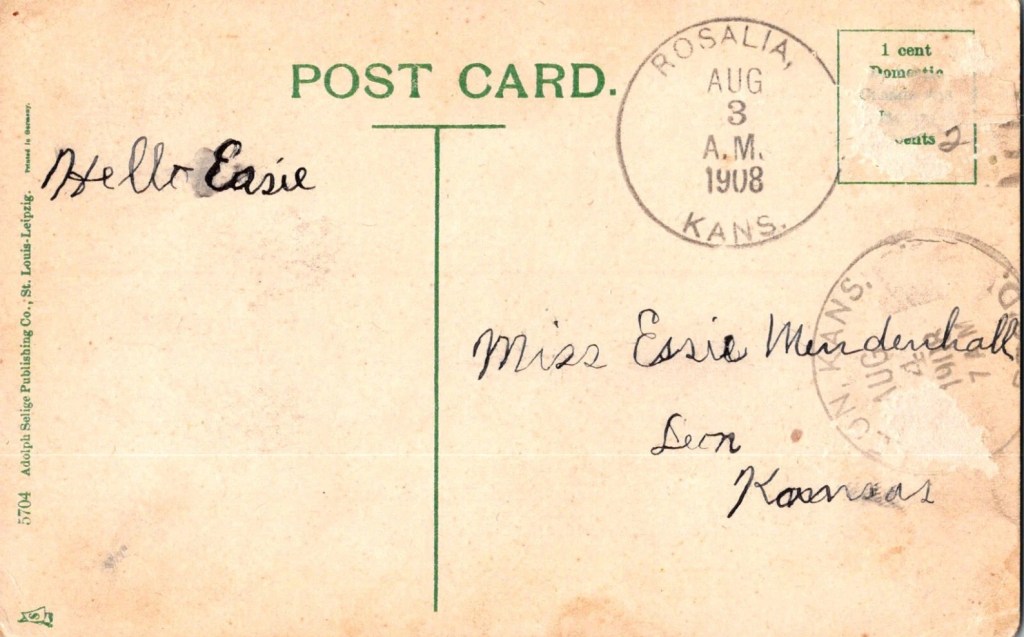
A vintage picture postcard I came across shows a baby calf being fed milk out of a bucket by a pretty farm girl. The title printed above this colorful photo says: “A Barn Yard Pet.” This card was mailed from Rosalia, Kansas, to Essie Mendenhall in Leon, Kansas. A round postmark says August 3, 1908.
There is no sender’s name, although I believe the card came from Essie’s mother, Amy Mendenhall, or sister, Julia A. Mendenhall-Brickley, all of whom lived near Rosalia. The Mendenhall family was evidently Quaker in religion.
Essie Mendenhall was born on September 23, 1893, with a newspaper article stating that she spent most of her life there. She married Jonathan Lee Dennis in Leon on November 8, 1922. Only a resident of Leon for two years at the time of their marriage, Jonathan was eight years younger than Essie, born on May 3, 1901.
The couple had one son, Ivan, who lived at home and never married. Census records show Ivan worked as a farmer like his father. Essie’s occupation is listed as housekeeper. Essie L. Mendenhall-Dennis died on May 27, 1983, at the age of 89. Jonathan Dennis passed away four years later on January 3, 1987. He was 85.
Ivan L. Dennis was born on March 20, 1927, and took his last breath on June 23, 2003, at the age of 75. All three members of the Dennis family are buried at Economy Cemetery in El Dorado, Kansas.
Leon, Kansas, is a small city in Butler County, established in the late 19th century amid westward expansion and settlement of the American Midwest. The town grew up around the arrival of the railroad, which brought new residents and economic opportunities, supporting agriculture and local businesses.
Over the decades, Leon became a close-knit rural community, with farming central to daily life and the local economy. Throughout the 20th century, Leon maintained its identity as a quiet farming town with strong Christian beliefs.
Today, Leon is known for its small-town charm, historic roots, and strong sense of community, with nearby landmarks marking the legacy of those who helped shape its history.
Rosalia, Kansas, is a small unincorporated community located in Butler County, just east of Leon. Founded in the late 19th century, Rosalia developed alongside the expansion of the railroad and agriculture, much like other towns in the region.
The town’s early settlers were primarily farmers, and the community grew around the rhythms of rural life, with farming and livestock playing central roles in the local economy. Rosalia has always maintained a modest population, fostering a sense of neighborliness and tradition.
Over the years, it, too, like Leon, became known for its close-knit families, many of whom have lived in the area for generations. Community events, local churches, and schools have been important gathering places, helping to sustain Rosalia’s identity and spirit.
Today, Rosalia remains a quiet rural community, reflecting the enduring legacy of Kansas’s agricultural heritage and the values of its residents. This vintage postcard remains a simple yet wonderful reminder of its past.
“The worst thing that could happen to me is for someone to steal my personal identity and then sue me a year later, finding out that it got them nowhere.”
My social media missile is ready to launch
I’ve been researching social media for some time, comparing its benefits to any downsides. For many years, benefits seemed to outweigh the negative, yet in the past year alone, or especially since President Trump was reelected, hatred has run amok.
I’ve had obscene messages and disgusting photos come through like gangbusters. Some of this was from a Chevrolet truck site I joined. Turned out this “group” was run by someone in another country and not from the USA. That’s now quite common. My wife has encountered the same.
While social media once offered numerous benefits, such as connecting with friends and sharing information, it now comes with significant downsides. One major drawback is the potential for privacy breaches. For example, users often unknowingly share personal information that others can access or misuse, leading to identity theft or unwanted solicitation.
Another downside is the impact on mental health. Studies have shown that excessive use of social media can contribute to feelings of anxiety, depression, and loneliness, especially among teenagers. The constant comparison to others’ seemingly perfect lives can lower self-esteem and foster dissatisfaction.
Social media accounts can also facilitate the spread of misinformation. I see this all the time. False news stories or misleading content can be rapidly shared and believed by large audiences, causing confusion and sometimes even harm. I’ve done this myself, but only as a joke. Unfortunately, on a few occasions, some couldn’t discern reality from the unreal.
Additionally, social media can be addictive, consuming valuable time and reducing productivity. Many users find themselves spending hours scrolling through feeds, which can interfere with work, study, and personal relationships. Some people report neglecting important tasks or missing family interactions because they’re engrossed in online activity. Thankfully, I’m not part of that.
Finally, cyberbullying is a serious issue on social media platforms for young people. Individuals can be subjected to harassment, threats, or public shaming. These negative interactions can have lasting emotional effects and, in extreme cases, lead to tragic outcomes.
While social media accounts can enhance communication and access to information, they also present risks related to privacy, mental health, misinformation, addiction, and online harassment. Users should be mindful of these downsides and take steps to protect themselves and their well-being.
I’ve been slowly eliminating my social media information, especially pictures, although it was limited from the start. Not wanting my exact residence location known, Latouche Island has worked perfectly for close to 20 years. My real friends know where I’m at.
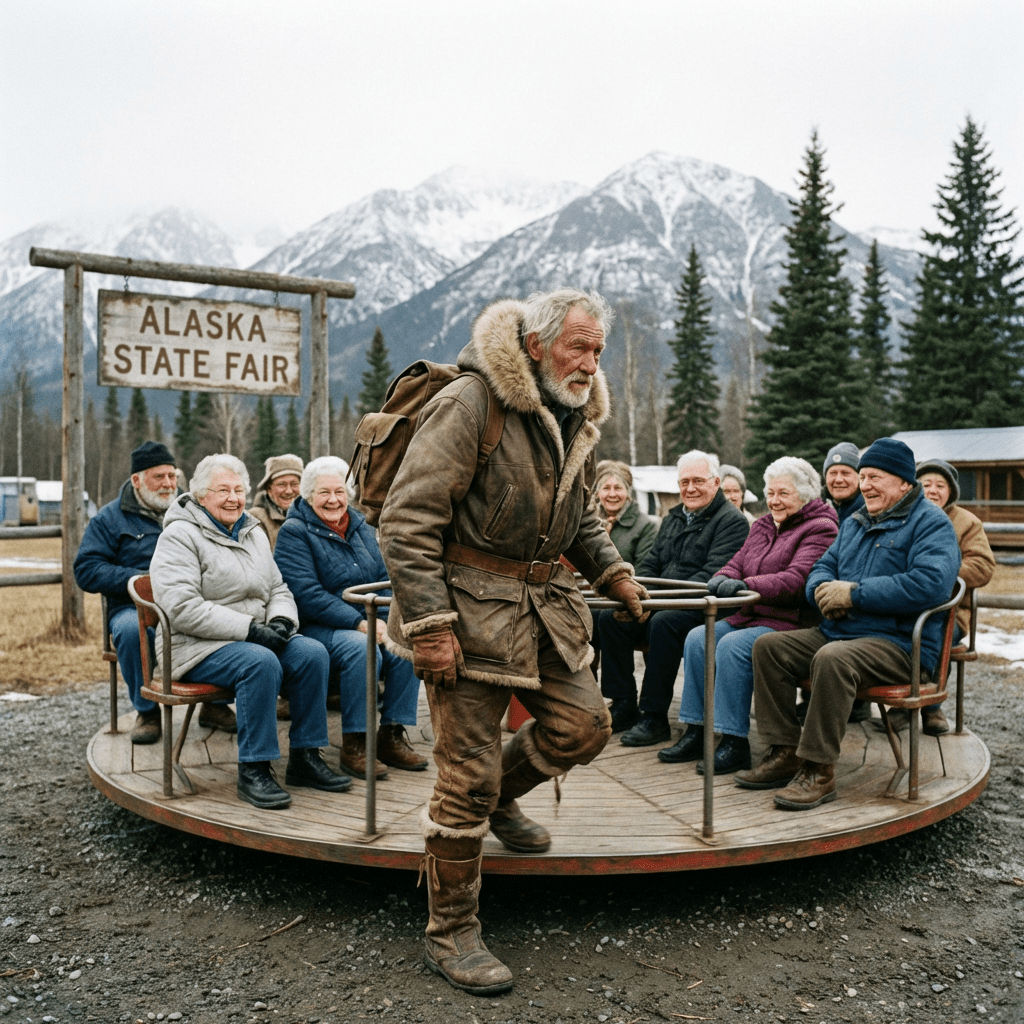
With cyber invasion now a big deal, and identity theft, gut feeling tells me to abandon ship, or in this case, get off the merry-go-round. I’ll still be monitoring certain data, yet I won’t be submitting anything myself. Many of my friends have wisely been doing this for years, and it seems to work for them.
The worst thing that could happen to me is for someone to steal my personal identity and then sue me a year later, finding that it got them nowhere. For those actually believing this statement, today is April Fools’ Day, and I couldn’t resist. Everything else here is true!
“It was like a scene from an Alaskan postcard, complete with moose and eagles.”
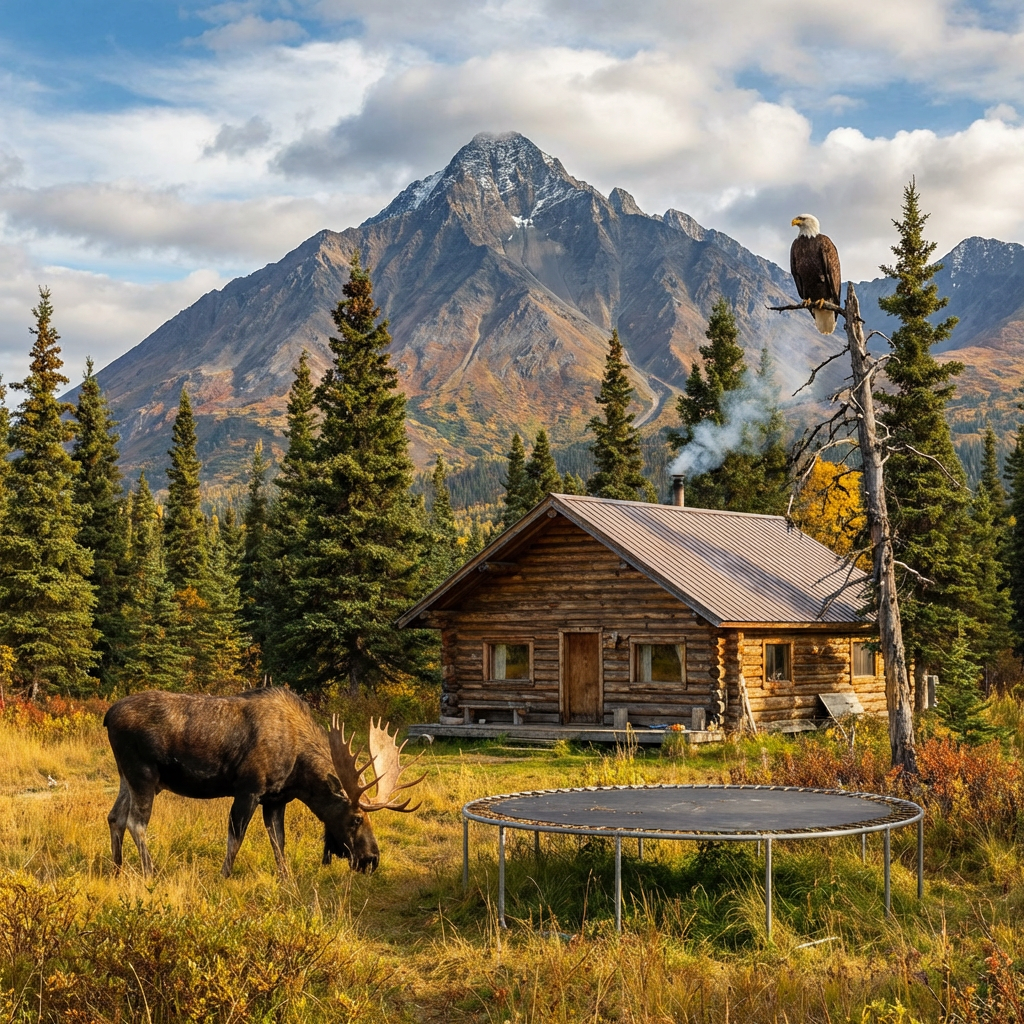
AI rendition of the Hart’s home near Palmer
I have fond memories of winter holidays when I was a child, with those spent at my grandparents’ in Alabama, the most memorable. Grandpa and Grandma Hankins lived in the tiny town of Vernon, while Papa and Mama Haynes owned a small farm on the outskirts.
Neither grandparent had a television, yet my brother, Jim, and I used creativity to keep ourselves amused. Meal time was always special. We brought tasty things that Mom had prepared beforehand, such as sweet potato casserole, glazed ham, creamed corn, and a package of Brown-n-Serve rolls, which always went in the oven last. Large slices of yummy Boston Cream Cake made for dessert.
We enjoyed our dinner at Grandpa and Grandma Hankins’ house while sitting in front of a crackling fireplace. That’s what they used to keep their small home warm. After eating, Jim and I had a whole gravel pit to play in. We’d toss balls down there with our Boxer dog, “Jet,” or fly kites.
Papa and Mama Haynes kept propane stoves in several rooms. These were never lit at bedtime, with quilts providing warmth throughout the night. I remember Mom once using an electric blanket, and when it was switched to high, the sudden surge popped a fuse.
A large table in the kitchen made for a comfortable place to eat. We generally switched residences each Thanksgiving and Christmas dinner so that no feelings would be hurt. Sometimes, my cousins came down from Birmingham or Mobile, and they always stayed at the Haynes’ place.
My adult holiday memories for both holidays were just as special. Joleen’s sister, Sonja, lived on the outskirts of Palmer, Alaska, with her husband, Charlie, and three children, Deric, Brynn, and Amanda. There was no GPS to guide me there with many turns to remember.
Their picturesque cabin sat up high above the Matanuska River, and it was only a short hike down to the water. It was like a scene from an Alaskan postcard, complete with moose and eagles.
On cold winter days, when the air was crisp and the skies were icy blue, adults and kids alike made use of a large trampoline in the backyard. If you bounced high enough, the river was visible down below through the trees.
I had an artificial intelligence (AI) artist try to duplicate a summer scene here, with it doing a fair-to-middling job. The strong image in my mind can never be replicated as it’s picture-perfect. I only wish I could go back in time and experience those precious moments all over again.
All of our nieces and nephews back then, including our two children, now have kids of their own. Those who are still living in Alaska get to experience what I did. There’s nothing like winter holidays in Alaska, especially experiencing a white Christmas with plenty of snow.
Packed away in numerous albums are photos from my holidays as a boy in Alabama and hundreds of shots from Alaska when I was a young father. One of those pictures shows all of the Hart children on the trampoline, along with Mitchum and Tara Adair, including Gunnar and Miranda. Our youngest niece, Crystal Miller, was yet to be born.
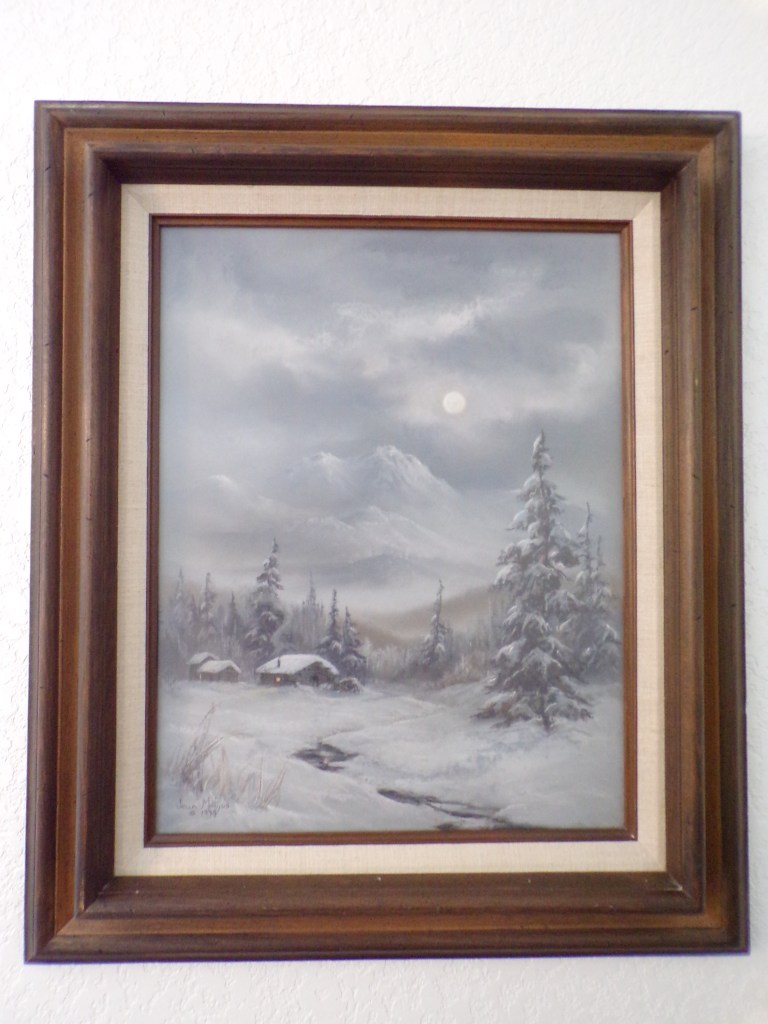
Hanging in my office is a cherished pastel painting by the late Alaskan artist, Jean Matiyas. Jean was a neighbor of ours in Elm-Rich Subdivision. This is an original work, circa 1979, and not a copy. We were fortunate to get it because Jean quit selling her originals and switched to making copies.
The artwork is of an Alaskan cabin on a blustery, cold, snowy evening, with mountains visible and a partially covered moon. Spruce trees are seen, including a nearly frozen-over stream. A building behind the cabin appears to be a workshop, reminiscent of the one my brother-in-law, Charlie Hart, had when the Harts lived out there. Smoke wisps from a chimney.
When I view this painting daily, it takes me back to those wonderful Alaskan Thanksgivings and Christmases. The scene is reminiscent of such. Changing one word here to express my final thoughts, “Where the Hart is” covers a multitude of special occasions in my life, especially the holiday season!
“I’m only thankful that King Charles and Queen Camilla weren’t here visiting to see it.”
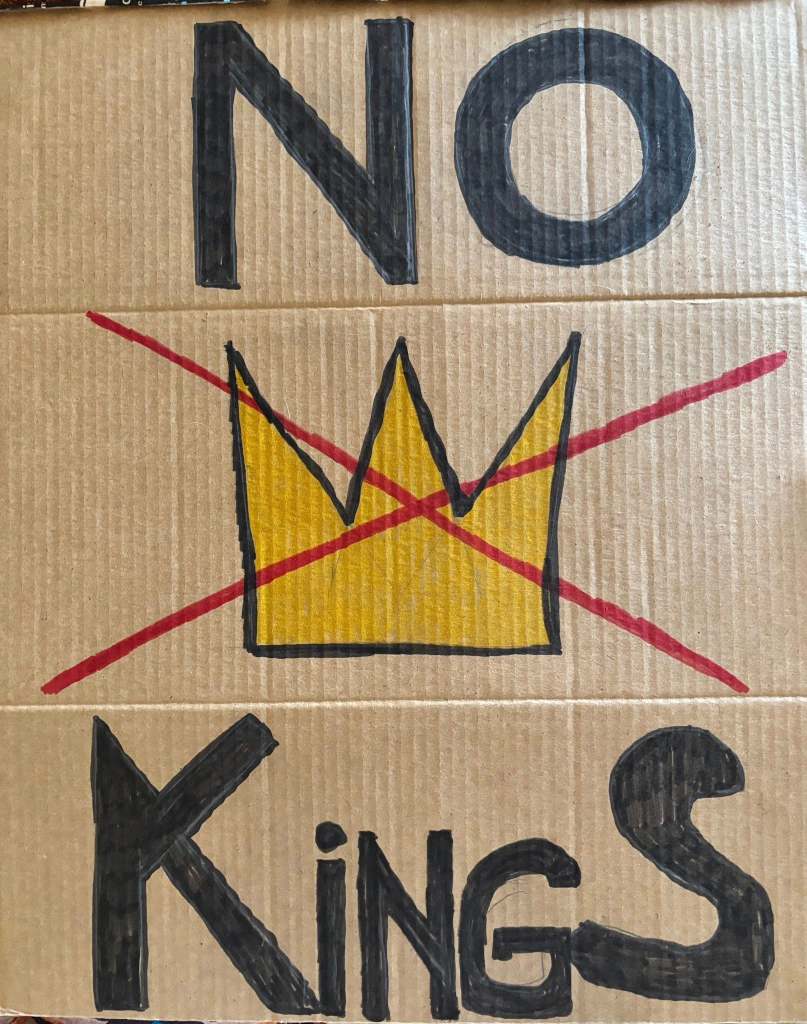
With Lake Havasu City having close ties to Great Britain, and the famous London Bridge and Bridgewater Channel in our city, the “No Kings” rally taking place on McCulloch Boulevard last Saturday seemed oddly out of place.
I’m only thankful that King Charles and Queen Camilla weren’t here visiting to see it, as they might’ve been deeply insulted by the unclear message.
Royalty at its highest level, I’m sure the couple would’ve visited Island Mall for a few knick-knacks and a bite to eat, along with hitting Pink Closet Boutique on Swanson Boulevard. Camilla loves hats, with Pink Closet being the “go-to” place for unique headwear.
Camilla Parker Bowles, now Queen Camilla, was a heavy smoker in her younger days, yet claims that she quit the nasty habit some 20 years ago. King Charles never started, and is an anti-smoking advocate. They say that opposites attract, and this is living proof.
For those members of the monarchy who continue to puff their lives away, what brand of smokes do they prefer? I took on that question and had no trouble finding an answer. It definitely wouldn’t be Marlboro, as the image of a rugged cowboy riding a horse seems light years away from English fox hunters sporting black velvet caps.
Asking my AI helpmate, Miss Purdy, this very question, she came up with the following. According to various reports, members of the English Royal Family who’ve smoked in the past have shown a preference for certain brands.
Specific brands associated with royal smokers have included Benson & Hedges and Rothmans, both well-known British cigarettes, as well as USA-manufactured Chesterfield King. These choices reflect the traditional and sophisticated image often linked to the monarchy.
Chesterfield King is a renowned American cigarette brand that has been part of tobacco history since its introduction in 1912. Originally produced by the Liggett & Myers Tobacco Company, Chesterfield quickly gained popularity for its distinctive blend of tobaccos and stylish packaging.
The brand became especially famous in the mid-20th century, often associated with Hollywood celebrities and politicians. They were featured prominently in movies, advertisements, and pop culture.
The “Chesterfield King” variant was introduced as a premium product, offering a longer cigarette with a classic unfiltered design that harkens back to the original Chesterfield style.
Over the decades, Chesterfield King became a symbol of nostalgia, attracting smokers who appreciated traditional tobacco products. Despite changing tobacco regulations and shifting consumer preferences, Chesterfield King remains a notable name, representing a bygone era of American smoking culture.
I tried to find a store in Havasu that still sells Chesterfield King, but came up empty. It seems they’re now only available in the United Kingdom. Chesterfield is the name of a town in England, so that could have something to do with it.
If Queen Camilla still indulged, perhaps as a closet smoker, and she graciously walked into any one of Havasu’s several smoke shops asking for Chesterfield, the stately lady would undoubtedly be told, “No Kings, but we still have Prince Albert in a can.”
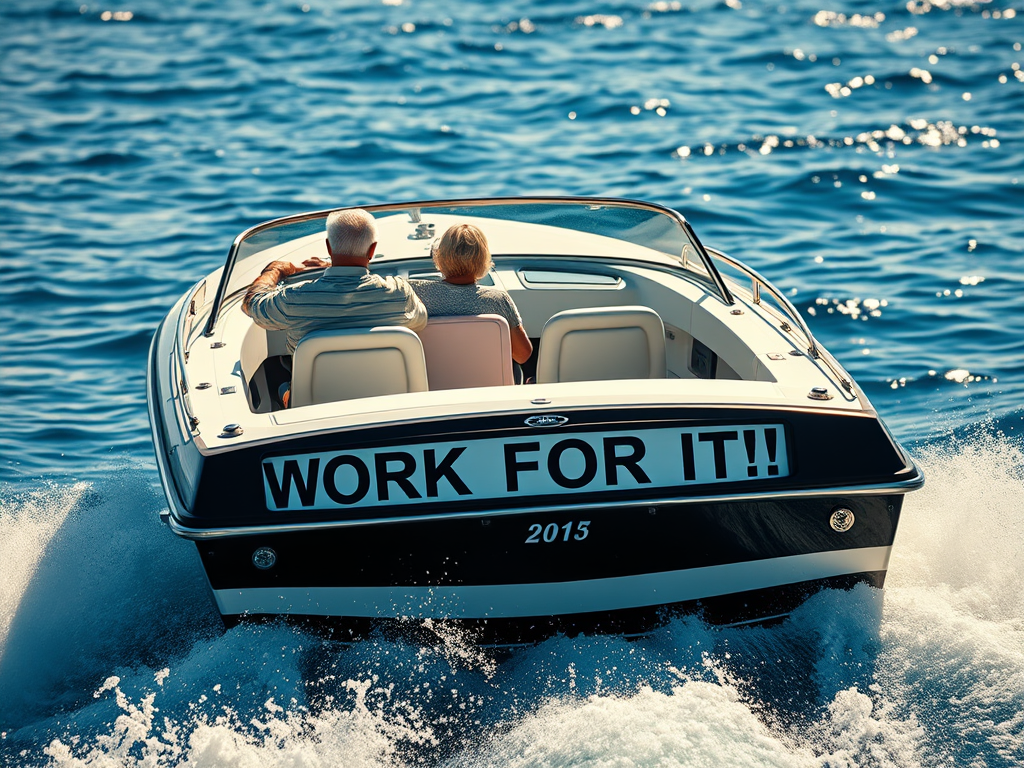
My latest story is a work in progress. Deals with one of my biggest pet peeves. They say a picture is worth a thousand words, and if that’s the case, I wouldn’t have to write anything else 🙂
“The boys had started out about noon Sunday, reaching the mouth of Crystal Cave about 1:30 o’clock.”
I’m as interested in reading about other people’s adventures as I am in my own. Reading has become more the norm here lately, with our excursions amounting to daily outings rather than weekly or longer ones.
I have over 150 stories about early-day expeditions, including this one from Arizona, written almost 100 years ago. I transcribed it, correcting numerous typos and archaic sentences. See my note at the end of this story for current cave information and a bit of personal trivia on those involved.
From “The Border Vidette” – Nogales, Arizona – August 9, 1930:
“Marooned for twenty-four hours a mile deep in a cave, in total darkness, and afraid to move more than a few feet of distance because of the treacherous passageways and deep canyons on all sides, four youths, three of them Nogales boys and one from Yuma, were rescued about 1:30 o’clock yesterday afternoon by a searching party at Crystal Cave in the Santa Rita Mountains, 20 miles west of Sonoita.
The boys who went through this rather harrowing experience were: David Coughanour, Jr., 20; his brother, Clay, 17; Paul Macgregor, 18, all of Nogales, and M. E. Hughey, 19, of Yuma.
“We owe our lives to the fact that we told our parents where we were going,” said David Coughanour, recognized leader of the exploring party, “and we surely were almost overcome with joy when we heard the searching party coming after us. We yelled as loudly as we could when we first heard sounds of tapping up above us, but it was fully two hours before they found us.”
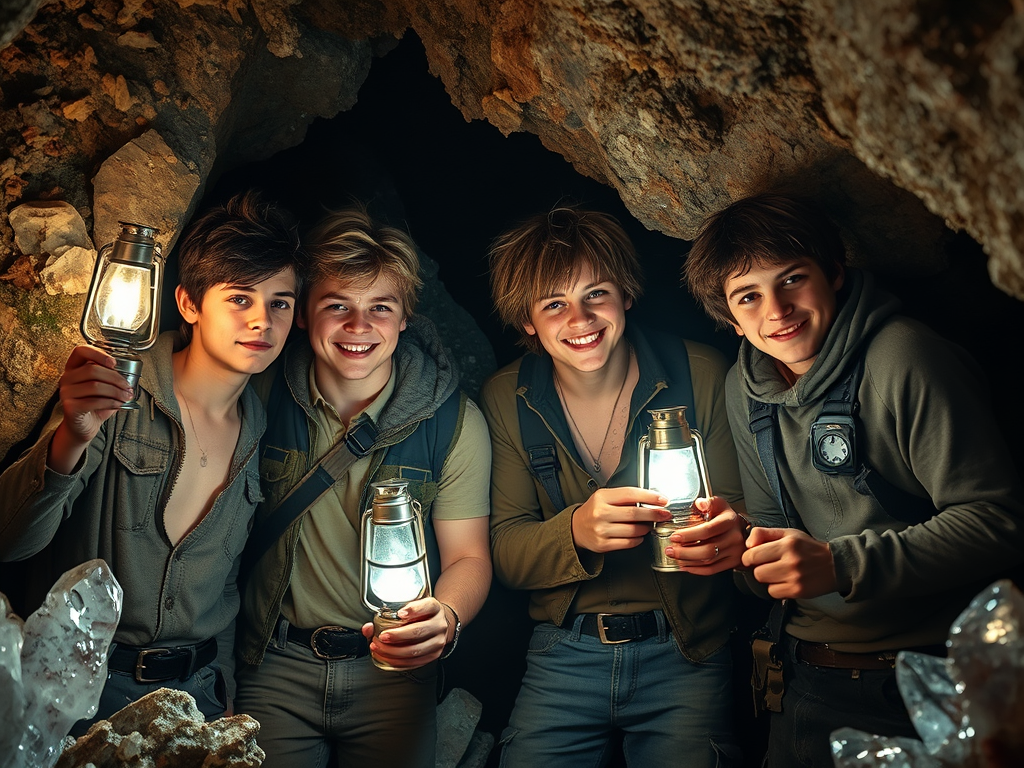
The boys had started out about noon Sunday, reaching the mouth of Crystal Cave about 1:30 o’clock. Armed with two carbide lights and a small supply of matches, they started into the narrow entrance on their exploring expedition. They had explored the same cave the Sunday before but were anxious to go further this time.
They had proceeded about a mile underground when Clay Coughanour, who was carrying one of the lights, stumbled as he tried to dodge a loose rock that was rolling down towards him, and the light slipped from his hand and fell to the bottom of a precipice, fully a hundred feet below. Hughey was with him at the time.
The other two were quite a distance away, and it was with considerable difficulty that Clay and Hughey finally managed to climb back to where the others were. Clay then carried the last remaining light. Again, he slipped and fell, and the light was extinguished, leaving the four boys in total darkness.
The heavy, damp atmosphere in the cave had rendered all of the matches useless, so nothing could be done. It was suicidal to attempt to find their way back, so they stayed where they were on a small elevation about 15 feet square and just waited.
Fortunately, there was a small pool of fresh water close at hand, so they did not suffer from thirst. But as time passed, they grew increasingly anxious about their safety. Being accustomed to exploring caves, they were not at all frightened by the darkness or loneliness. They were merely afraid that they might be exhausted from starvation or exposure.
Due to the dampness, they were unable to sleep and had to exercise as best they could to keep warm. They had driven to the cave, and their car was left standing near the entrance. They also had thrown their hats on the ground near the opening of the underground passage.
When their sons failed to return home late Sunday night, W. R. MacGregor and David Couganour, Sr., set out to search for the boys. The latter had said they were going to Crystal Cave. Unable to find any trace of the lads after an all-night search, the men returned to Nogales and formed a search party, including themselves, veteran deputy sheriff Hugo Miller, and a Mexican helper.
While they were still searching yesterday, they were joined by T. F. Friday and son and a detachment of troops from the C.M.T.C., occupying two Army trucks and bringing provisions enough to last for four days.
Several trips into the treacherous cave had been made by the search party, but without success. They located the boys. Hugo Miller was the first to reach them, and right behind him came Jack Donlin, carrying a strong light.
“They had come in the hardest way,” said David Coughanour Sr., “and as soon as he had a light, we showed them the easiest way out.” We were not long in getting out, either, and we sure were glad to see daylight again. We did not realize we had been in there for 24 hours. We thought it was midnight and were surprised to learn it was noon the next day. Certainly, we were hungry when we got home, but we were not suffering. We all feel fine now.”
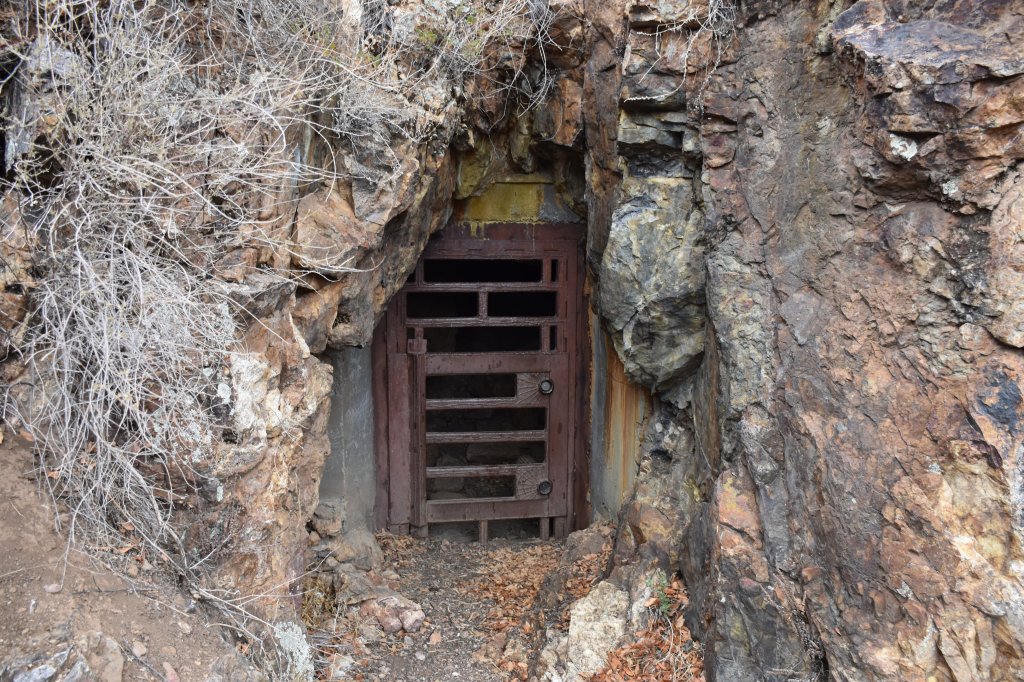
Note: The Chiricahua Crystal Cave is now a protected, gated cave in the Coronado National Forest near Douglas, AZ, roughly east of Nogales. It offers spectacular quartz crystal formations within 2.38 miles of passages. Access is strictly managed with a required permit, fee, and key from the Douglas Ranger Station. It is approximately 436 miles from Lake Havasu City.
Paul Clark MacGregor died on August 21, 1997, at the age of 85. He’s buried in Bisbee, Arizona. Marvin E. Huey passed away on June 11, 1981, in Oklahoma. He was 70. The newspaper had Marvin’s last name spelled wrong. Clay Bernard Coughanour died on April 10, 1988, and is buried at McGee Ranch Cemetery in Sahuarita, Arizona. He was 75.
David Elmer Coughanour Jr. was the hardest to track down, and it gets somewhat confusing. He had the same name as his father and grandfather, whom died in 1904 and 1937, respectively, while David Coughanour Jr. also named one of his sons David Coughanour IV.
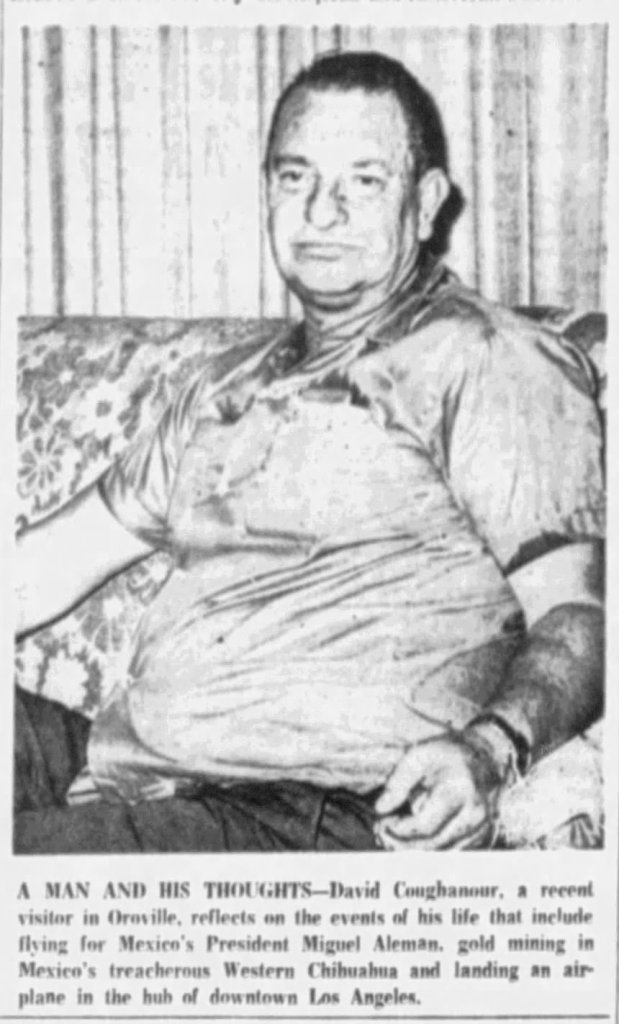
David III continued to live in Mexico, where he had mining interests and worked as a pilot and owner of a flying service. One newspaper article shows him losing power in a small Beechcraft airplane given to him by President Miguel Aleman of Mexico, as a Christmas present, during a flight over Los Angeles. He successfully landed in a field. This information is substantiated in the July 24, 1964, “Oroville Mercury Register.”
At one time, he was a pilot for several Mexican political figures, including the president, while some people also believed he had connections to a local cartel, although this was never proven. An article titled “The Bunker,” written by Melissa del Bosque and featured in The New Yorker on April 10, 2023, detailed such.
In 1962, David’s son, David Coughanour IV, was shot and tragically killed in Chihuahua over what was thought to be a robbery. David III died in 1975 at the age of 69, and his widow assumed control of all mining operations. From my research, it appears that after surviving that harrowing cave experience, this man literally lived on the edge of a cliff for the rest of his life.
“One of those songs was “Linda Sue Dixon” by Mitch Ryder and the Detroit Wheels.”
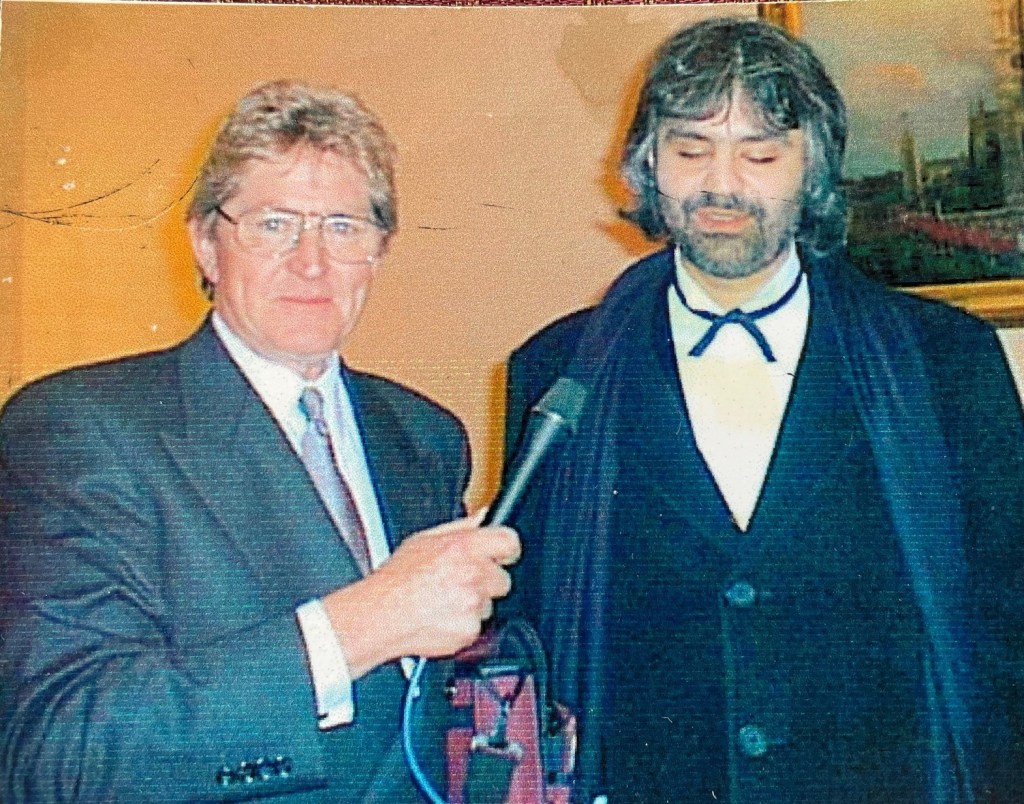
Bernie Quayle with Andrea Bocelli
Bernie Quayle is a well-known radio presenter (announcer) from the Isle of Man, recognized for his long-standing association with MANX Radio. Over the years, he became a familiar voice to listeners on the island, hosting a variety of shows and contributing significantly to the station’s popularity.
Quayle’s engaging style, deep knowledge of local affairs, and warm personality made him a beloved figure in Manx broadcasting. In addition to his radio career, Bernie was involved in community events and has played an active role in promoting Manx culture and heritage through his work and public appearances.
Born on January 28, 1941, at the beginning of WWII, he was undoubtedly much too young to remember any of the fighting. Starting in radio at an early age, he joined MANX Radio on the Isle of Man in the early 1960s, before moving to KNOX Radio in Knoxville, Tennessee, in 1967.
A radio celebrity by then, he had a crowd of some 3,000 fans waiting at the airport for his arrival. By this time, he had been crowned “Sir Bernie Quayle – Knight of the Turntable.” Staying with KNOX for two years, the lure of home brought him back to England.
In 1989, Bernie began a long-running radio show on MANX called “The Late Show.” For folks in the United Kingdom, this was actually midday for those of us in Alaska because of the time difference.
MANX broadcast to thousands of listeners around the world during that time and still does. At the time, with the computer’s age, streaming live was in its infancy. That’s how I came to know Bernie. My work computer, when not in official use, would be tuned in to MANX.
Bernie’s soft voice was easy to listen to, and his taste in music was the same as mine. I’d sometimes place his show on the shop intercom, and for short periods, the mechanics tuned in as well. We became known to Bernie and MANX listeners as Mike and the Mechanics from Alaska.
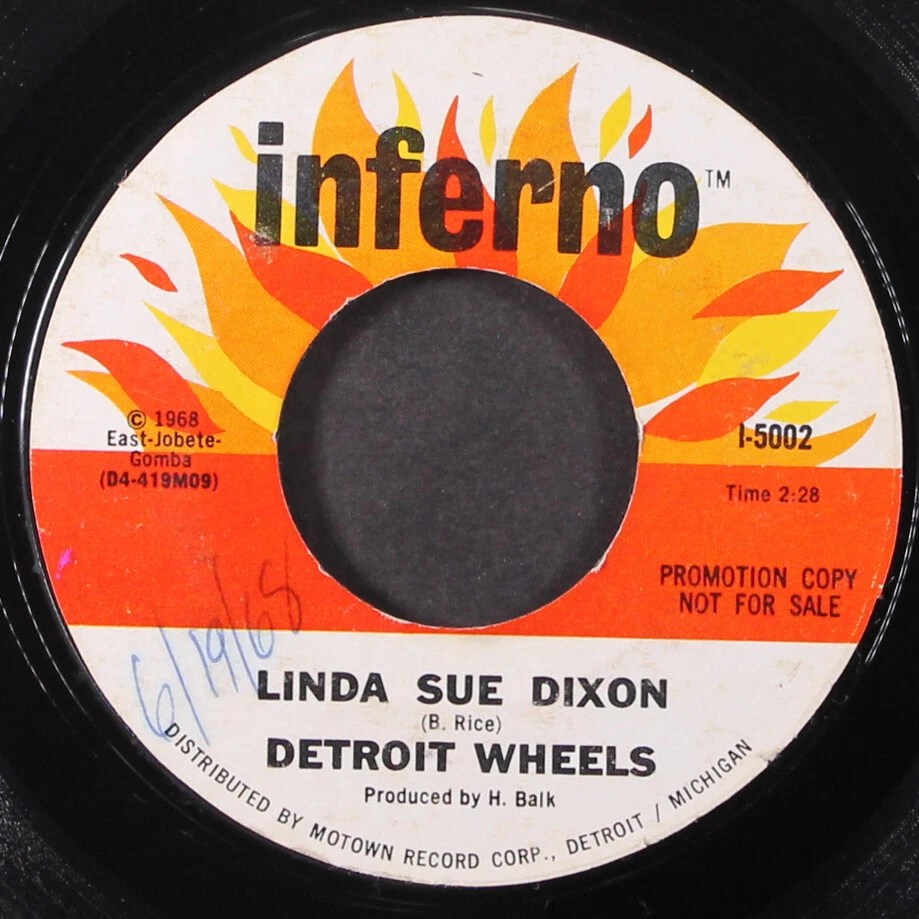
The MANX Radio studio was chock-full of tunes that American stations didn’t have, and one of those songs was “Linda Sue Dixon” by Mitch Ryder and the Detroit Wheels. I recalled this hit from around 1968, before it all but disappeared. When I asked Bernie via email if he still had the record, he replied that he did.
After asking for my address in Anchorage, two weeks later, I received a bootleg copy of the song courtesy of Mr. Quayle. In return, I sent him a large box of chocolates from Alaska Wild Berry Products. He shared them with the station employees, and they turned out to be a big hit, while the company received some free advertising.
Bernie wanted to know about Alaska, and several times he’d call and put me on live, with my task to tell the world about life in “The Last Frontier.” My shop leadman, Brian Flaherty, also did a radio episode, talking about the wild moose and bear that often visited our compound. Brian and I might’ve promoted Alaska better than the professionals.
It was humbling that our shop was chosen to represent the state by Bernie Quayle, because the man was friends with many celebrities, such as The Bee Gees, Andrea Bocelli, The Coasters, and others. He could’ve just as easily dialed up Governor Sarah Palin instead of us.
I still listened to MANX after relocating to Arizona, but Bernie had retired by then. The last news I received about Quayle was that he was having serious medical issues, with dementia a big part of it.
When Bernie passed away on January 22, 2022, at the age of 81, all those times we chatted or emailed came flooding back. I still have the cassette tape of “Linda Sue Dixon” safely tucked away, with Bernie telling me at the time he sent it, why radio stations across the US stopped playing the controversial song.
The initials for Linda Sue Dixon, of course, are LSD, known for being a popular hallucinogenic drug at that time. I’d never known that, or at least hadn’t noticed, and I’ll never forget, thanks to “Sir Bernie Quayle.”
“Misinformed voters, according to a good friend, are on the same level of incapacitation as alcoholics or junkies.”
There doesn’t seem to be a day that goes by that I don’t shake my head at something. Generally, it’s while I’m out driving, with yesterday no exception. An older woman had her right turn signal on, slowed down, and then turned left.
I’m not sure this occurred because of a lack of common sense, senility, unfamiliarity with the town, or driving under the influence of alcohol or drugs. Perhaps it was all four. I’ll try to define ‘common sense’ here because it can be subjective to each person.
A lack of common sense refers to situations in which individuals fail to use basic practical judgment in everyday situations. This can lead to poor decisions or actions that most people would naturally avoid or handle differently.
Crossing a busy street without looking both ways.
Touching a hot stove to check if it is on.
Mailing a letter without placing a stamp on it.
Shaking a can of soda and then opening it in a car or truck.
Driving without fastening the seatbelt.
Suddenly placing a boat transmission into reverse while going fast.
Trying to fix live electrical wires without disconnecting the vehicle battery.
Driving at night without turning the headlights on.
Drunk dialing friends or strangers.
Voting while inebriated.
Of the 10 examples, I’m guilty of 8. The last one really caught my attention, because I can’t fathom drunk voting, or worse yet, incapacitated people in any form being allowed to vote.
Misinformed voters, according to a good friend, are on the same level of incapacitation as alcoholics or junkies. In her way of thinking, many uninformed voters boldly walk the streets, namely, those people supporting open borders and benefits for illegals. I can see her point, although I’d say they were grossly misguided more than anything.
“Drunk dialing” is something I’ve heard former co-workers talk about, yet it wasn’t anything I experienced because I don’t drink alcohol. Listening to several conversations on the subject, it appears these guys didn’t have a clue they’d even done so. It wasn’t until being told by the person they dialed that they found out. That’s a scary thought.
“Butt dialing” is an entirely different matter and quite common. On a lengthy trip across the US, my father accidentally did this, and we listened to him and his truck radio for several minutes out of curiosity more than anything else.
My daughter did the same, and we heard our three grandchildren chatting in the background. That was a welcome call, because even though it was unintended, any calls from our kids are always a blessing.
I’ve never “drunk dialed” or “voted drunk,” and never will, but I suppose the day is still to come when I’ll “butt dial!”
“This is supposedly a derogatory term, but I’ve never seen it that way.”
I have a mechanic friend who often says, “Up the Ying Yang with no paddle.” I’ve never known what Ying Yang means, falsely believing for some time that it was a river in China. I use the phrase randomly myself, generally to describe a major problem.
Deciding to look things up—it appears our meaning of Ying Yang is a contorted version of the real thing. Even the spelling of it is wrong. Turns out that Ying Yang is not a body of water after all, but something entirely different.
The term “yin yang” refers to a concept in Chinese philosophy that describes how seemingly opposite or contrary forces are actually interconnected and interdependent in the natural world.
Yin represents qualities such as darkness, femininity, and passivity, while yang embodies brightness, masculinity, and activity. Together, yin and yang illustrate the balance and harmony of dualities within the universe, for whatever that’s worth.
“Skosh” is another word that I’ve picked up, undoubtedly gleaned while I was working in automotive shops. A skosh to me is just a tad bit more. Women should know what a skosh is. In cooking circles, a skosh is akin to a pinch or a dash.
“Retard” is offensive when used to describe people, yet in automotive circles, the word’s used quite extensively, without apology, to describe a decrease in distributor ignition timing. “Zerk” is another commonly used shop term, while it has nothing to do with a mechanic’s first name.
“Jerk” is often heard in towing circles, and I don’t mean the tow truck driver impounding your car. A jerk is often needed when a vehicle becomes stuck in mud or snow to get things rolling. I watched on one occasion, when a too-hard jerk by a novice ripped a car’s front bumper off.
“Short block” confused me as a teen until an old mechanic told me it means absolutely nothing about the size of an engine. “Cam followers” is another strange term that you’ll have to look up, as it’s much too hard for me to explain here. Oddly enough, each time I hear this phrase, which is rare, I visualize baby ducks following their mama.
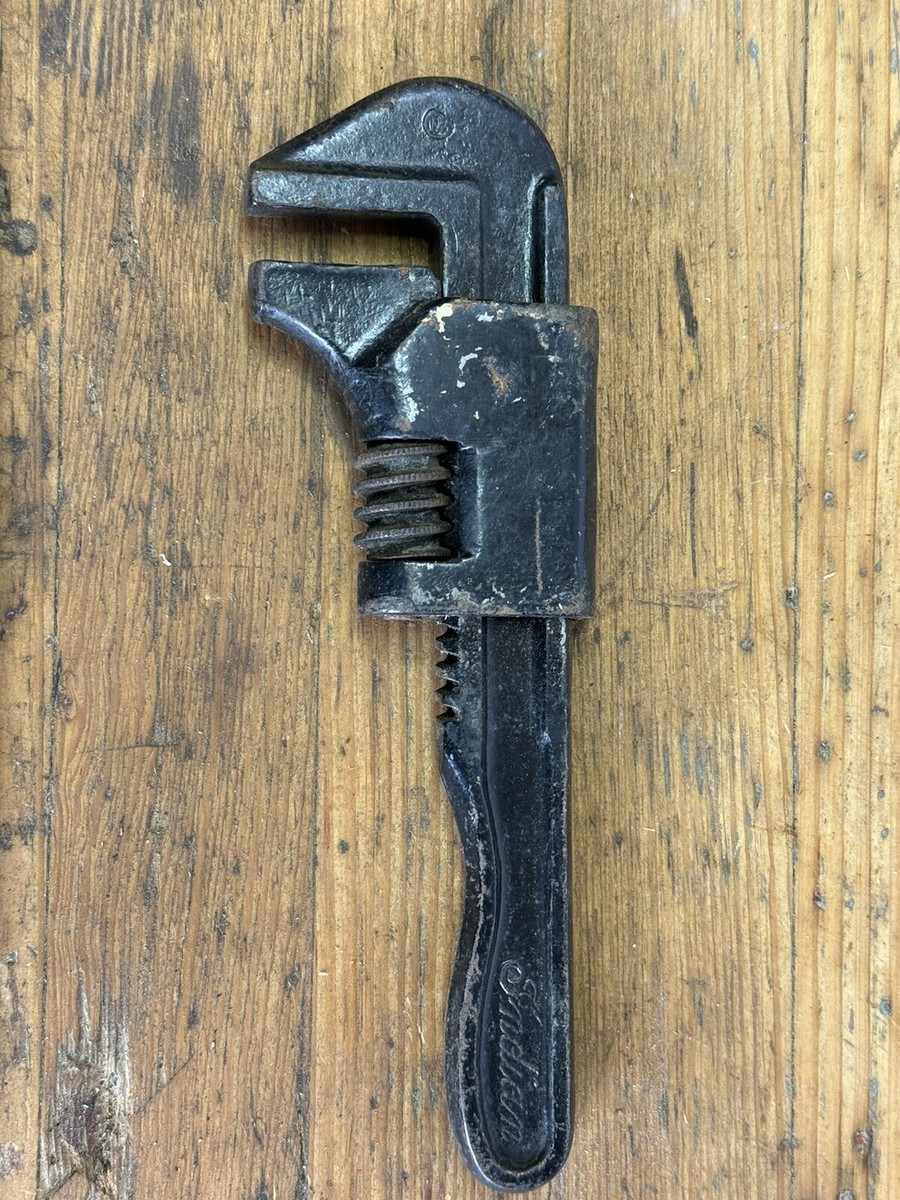
One term that is seldom heard these days is “monkey wrench.” A monkey wrench is an adjustable hand tool with smooth jaws, used for gripping and turning pipes or other objects. Its jaws can be widened or narrowed by turning a screw mechanism, making it versatile for different sizes of fasteners or fittings.
This tool was once common in mechanical and plumbing work, though it has largely been replaced by more modern adjustable wrenches. An adjustable Crescent wrench is not a monkey wrench, although it looks like a laughing monkey when the jaws are open.
“Jerry can” is a term I first heard while working in a gas station, having no clue how it was named until now. The Jerry can is a robust, rectangular fuel container originally designed by the Germans before World War II. The name comes from “Jerry,” a slang term used by Allied soldiers to refer to Germans.
American soldiers admired the sturdy design and began using captured cans, leading to the nickname. Today, the Jerry can remains a popular container for transporting fuel and water, recognized for its durability and practicality.
“Jerry rig” refers to making a temporary fix or improvised repair, usually with materials that are readily available, rather than using proper tools or parts. The term is often used to describe solutions that are clever but not necessarily permanent or up to standard. I was an expert at jerry-rigging things, and still am, or is that are?
The origin of “jerry rig” is believed to be a blend of “jury rig,” a nautical term for makeshift repairs, and “Jerry,” which was slang for Germans during World War II. Over time, the phrase evolved in American English to mean any improvised repair, regardless of its connection to the original slang or its naval roots.
On my resume, I list “pump jockey,” which is slang for a service station attendant. A pump jockey was someone who pumped gas, checked oil, and provided other customer services at a gas station. Pump jockeys went the way of dinosaurs when self-serve fueling stations and convenience stores came along.
Last but not least on my list of obsolete shop terms is “shade tree mechanic.” This is supposedly a derogatory term, but I’ve never seen it that way. A shade tree mechanic works on vehicles or machinery outside of formal repair shops, often in their own backyard or driveway—literally under the shade of a tree.
These individuals typically rely on resourcefulness, practical knowledge, and basic tools rather than professional training or certifications. The term can be used in a derogatory way to imply amateurism, but many view it as a mark of ingenuity and hands-on experience.
These days, with the newer computerized vehicles requiring specialized diagnostic tools to work on them, jerry rigging is next to impossible, and a jerk isn’t going to help if they’re not stuck. Whenever a car or truck breaks down on a desolate stretch of road, the driver is basically up the Ying Yang with no paddle.
It happens thousands of times daily. In most cases, a skosh more fuel in the tank would’ve gotten them to the next station. If only they’d brought along a jerry can!
“Everyone goes to Walmart, including the Clintons…”
I might be running out of good material to write about, as the low-hanging fruit in our town and neighborhood has already been picked. ‘Low-hanging fruit’ refers to topics or ideas that are easy to write about because they’re familiar, straightforward, and commonly discussed.
These include personal anecdotes, popular trends, well-known events, and topics extensively covered in the media, such as Joe Biden and Kamala Harris. Taking the easy way out, I tackled these subjects first because they required less research and creative effort compared to more complex, obscure, and off-limits topics, such as family and friends.
Telling my wife, Joleen, that I finally reached writer’s block, a goal I’ve not achieved before, she suggested a few topics, with Walmart being one of them. I’ve never written about our trips to Walmart, figuring they weren’t print-worthy.
Everyone goes to Walmart, including the Clintons, with nothing out of the ordinary ever happening there, at least I’ve never seen or read about anything terribly strange occurring at ours.
People sometimes walk the wrong direction in Walmart aisles, yet they do that in all stores. The right side is for all traffic going forward, while the left is for the opposite. This might not seem like a big deal, but it can be if a person’s not paying close attention.
I’ve never had a big problem because I walk slowly, as older people are expected to. With a fully loaded buggy and wheels that don’t easily turn, moving too fast without brakes is an invitation to sideswipe someone. Thankfully, that’s never happened to me, but I have lightly ‘tapped’ the back of a few shoes, namely, Joleen’s.
Folks sometimes wear strange clothing in these stores, with the Walmart in Kingman easily beating out the one in Lake Havasu City in this department. That might have something to do with I-40 being close by Kingman and lots of California travelers dropping in.
During the last holiday season, just for kicks, I walked up to a life-size cardboard replica of Patrick Mahonnes in Walmart, jokingly asking where the Pop-Tarts were. Joleen saw what I was doing and quickly scurried ahead to escape the embarrassment.
A kindly female employee with red hair, who’s been there for many years, evidently overheard my question and walked over, telling me, with a straight face, that they were next to the cereal section. Caught off guard, I didn’t expect this, with me saying, “Thank you!” in return.
Strangely enough, that woman didn’t act as if ‘my comedy routine’ was anything out of the ordinary. Joleen later told me that some Walmart shoppers undoubtedly chatted with that cardboard replica all the time, and that it was no big deal to workers. To that seasoned clerk, I was just another one of their “special customers.”








 I like to write junk...