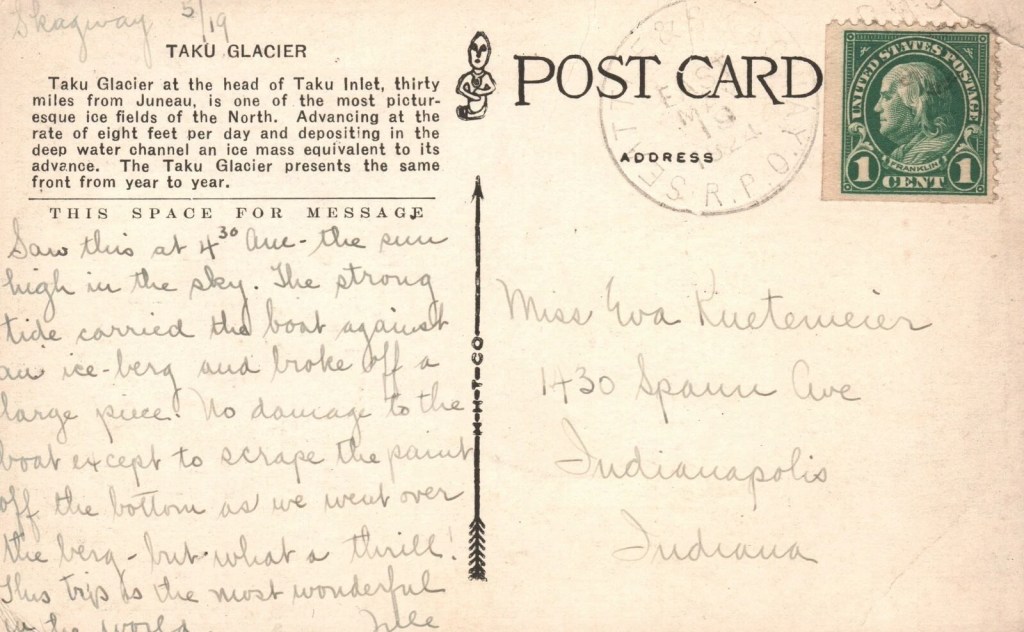
TAKU GLACIER

“On a side note, my wife makes a tasty Taku salad each year during Cinco De Mayo.”

I wasn’t sure how to properly start this postcard story off other than talking about the picture first, and then the recipient, Miss Eva Kuetemeier, of Indianapolis, Indiana. Miss Kuetemeier’s life we’ll get to in a minute.

Taku Glacier is one of the largest and most dynamic glaciers in the Juneau Icefield of Southeast Alaska. Known for its impressive size and unique behavior compared to other regional glaciers, Taku Glacier holds a special place in the study of glaciology and climate change.

The renowned glacier is located about 12 miles southeast of Juneau, Alaska. It is part of the Juneau Icefield, which contains dozens of glaciers and covers approximately 1,500 square miles. The glacier flows from the icefield toward the Taku River, terminating near sea level.

Taku Glacier was named after the Taku people, a subgroup of the Tlingit Nation, whose traditional lands encompass the region surrounding the glacier and river. European and American explorers first began documenting the glacier in the late 19th and early 20th centuries. Early mapping efforts were limited by the region’s remote and harsh conditions, but the glacier gradually became a point of scientific interest.

Systematic scientific studies of Taku Glacier began in the mid-20th century, with the establishment of the Juneau Icefield Research Program (JIRP) in 1946. Researchers have monitored the glacier’s thickness, length, and terminus position for decades, making Taku Glacier one of the most studied glaciers in North America.

Unlike most glaciers in Southeast Alaska, which have been retreating since the end of the Little Ice Age (1300 – 1850), Taku Glacier exhibited a rare advance throughout much of the 20th century. It grew steadily, gaining mass and length, with its terminus advancing toward the Taku River. This behavior was attributed to high precipitation, cool temperatures, and the unique topography of the glacier’s basin.

In the early 21st century, scientists began to observe changes in the Taku Glacier’s dynamics. Around 2018-2019, the glacier’s long-standing advance came to a halt, and it started to show signs of retreat. This shift was attributed to warmer temperatures and changes in precipitation, consistent with broader regional and global patterns of climate change.

The retreat of Taku Glacier has significant implications for local ecosystems, hydrology, and the understanding of glacier response to climate variability. Its transition from advancing to retreating serves as a valuable indicator of the changing climate in Southeast Alaska.

Taku Glacier’s unique history of advance and subsequent retreat makes it an important case study for glaciologists and climate scientists. Its data record contributes to global understanding of glacier dynamics and the impacts of climate change. The glacier also holds cultural significance for the Indigenous peoples of the region and serves as a destination for scientific research and tourism.

Several buildings, businesses, and streets in Alaska are named Taku, including “M/V Taku,” a former State of Alaska ferry boat, the Taku Apartments in Anchorage, the Taku Restaurant in Juneau, and Taku Harley-Davidson in the capital city. On a side note, my wife makes a tasty Taku salad each year during Cinco De Mayo.

This Taku Glacier postcard was mailed from Seattle, Washington, to Miss Eva Kuetemeier on May 19, 1924. The sender was someone named Nile. I was not able to identify Nile, but did discover that the guy couldn’t write a proper cursive m, turning them into w instead. That had me scratching my head trying to decipher the text.

Born on March 9, 1888, in Indianapolis, Eva Kuetemeier remained there for 62 years as an unmarried woman. The only exciting thing I found about this person was that she was stuck in Holbrook, Arizona, in August of 1918, when the axle to a car she was riding in broke.

Eva and four friends, including a baby, were traveling to California in this vehicle. That had to be quite an experience with vehicles having no air conditioning back then. Temps would’ve been around 110 degrees during the hottest part of the day.

Newspaper clippings show Miss Kuetemeier hosting parties in Indianapolis for social groups, as well as working at the State of Indiana welfare office for most of her life. Sports must not have been one of her activities as there’s none mentioned.

A message on the postcard that Nile sent to Eva describes an event no traveler would wish to experience, especially those who survived the “RMS Titanic.”  Nile evidently saw no danger in what happened here. His message reads as follows:

“Saw this at 4:30 am – the sun high in the sky. The strong tide carried this boat against an ice-berg and broke off a large piece. No damage to the boat except to scrape the paint off the bottom as we went over the berg – but what a thrill! This trip is the most wonderful in the world. Nile”

There’s not much else to say about this postcard or the recipient. Miss Eva Kuetemeier died in Indianapolis, Indiana, on September 13, 1950, at the age of 62. She’s buried in Crown Hill Cemetery.
YUMA BLUES – PART TWO

I composed a story titled “Yuma Blues – Part One” a short time ago. The story talks about a young Army soldier stationed at the Yuma Army Air Field in Arizona, during WWII.

This recently enlisted man, Private William “Bill” Hilleboe, was undergoing desert training in Yuma, yet found time to write a postcard to a woman, Miss Ruby Ellens, in Sioux Falls, South Dakota.

The postcard shows downtown Yuma, with many 1940s vehicles driving and parked in front of stores. Pvt. Hilleboe tells his friend in a note written on back that he visited the old cowboy town and refrained from drinking liquor. William Hilleboe went on to say that he planned to do that once he got back home.

My research shows that Hilleboe’s message evidently did not impress the young woman, especially where marriage is concerned. I’m sure the lonely private often developed the blues during this long-distance courtship, as any ordinary guy would.

Another Army soldier in Yuma was interested in Ruby at the same time, and this fellow mailed her a postcard six days later. It showed a colorful Gila Monster walking in the desert. Before I go into further detail on a potential love triangle here between two lonely soldiers and a single gal, I’ll touch on the rare Gila Monster first in so many words.

Gila monsters (Heloderma suspectum) are found in Mohave County, Arizona. Although I’ve never seen one in Lake Havasu City, these distinctive, venomous lizards are native to the southwestern United States, and their range includes the northwestern part of Arizona, which encompasses Mohave County. I’ve yet to come across such a lizard in our area, although they may be lurking in places I don’t venture.

Gila monsters inhabit desert and semi-arid environments, favoring rocky foothills, washes, and areas with ample cover such as burrows, rocks, and dense vegetation. The giant lizards are present in the lowland desert areas of Mohave County, particularly where rocky terrain meets desert scrub.

Gila monsters are protected by state law in Arizona; it is illegal to harass, capture, or harm them. If you encounter a Gila monster in Mohave County, observe from a distance and do not attempt to handle or disturb it.

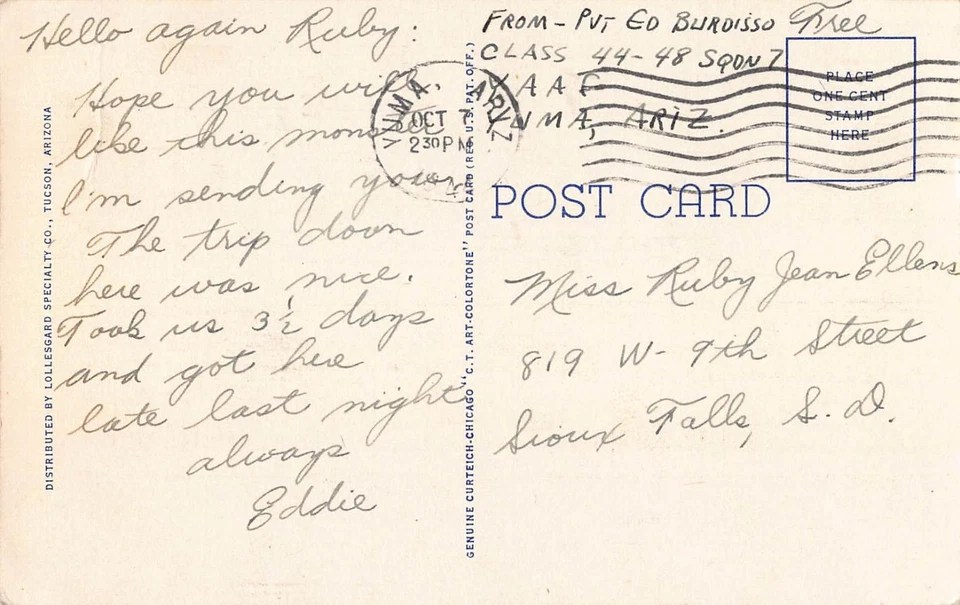
On October 7, 1944, Private Ed Burdisso, assigned to the Army Air Training Center in Yuma, Arizona, sent his Gila Monster postcard to Miss Ruby Jean Ellens in Sioux Falls, North Dakota. Pvt. Burdisso’s message to Ruby reads as follows:

“Hello again Ruby

Hope you will like this monster I’m sending you. The trip down here was nice. Took us 3 ½ days and got here late last night.

 Always

Eddie”

There’s nothing unusual about Pvt. Burdisso, corresponding with a single female during WWII, as thousands of lonely GIs did. I’m sure Ed Burdisso didn’t know that Pvt. Charles William “Bill” Hilleboe also had feelings for Miss Ellens and vice versa. When things didn’t work out for Ed, the blues came knocking one more time.

Neither Pvt. Bill Hilleboe nor Pvt. Ed Burdisso was able to slip a ring on Ruby Jean Ellen’s finger, although they eventually married and led successful lives. Both Burdisso and Hilleboe survived the war, going on to marry and lead long, successful lives.

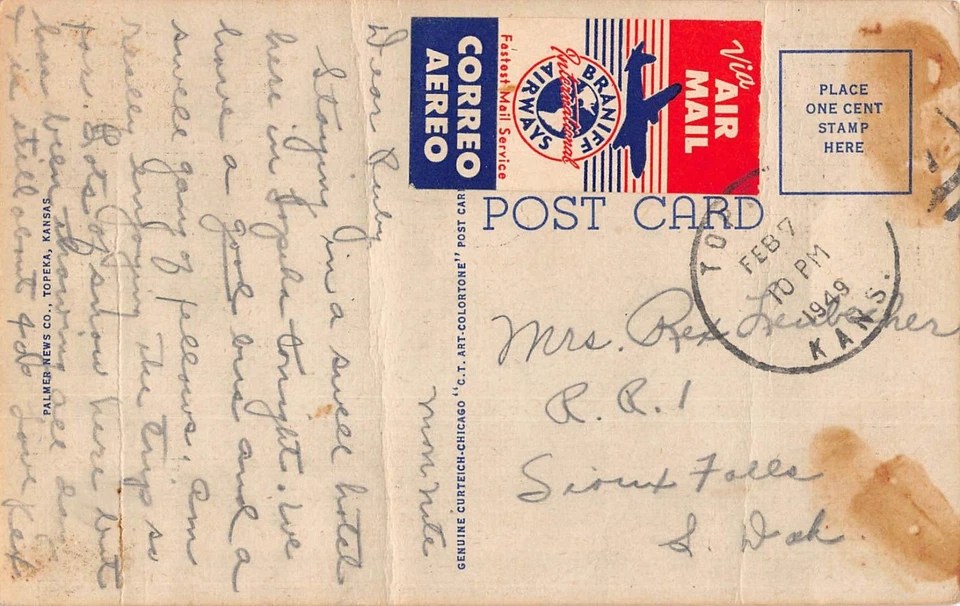
Somewhere along the way, Miss Ruby Ellens was communicating with a third military man, Pvt. Rex Leubecher. Ms Ellens finally found the man she was looking for. I came across a postcard sent from him to her in 1949 while Rex was in Topeka, Kansas. She evidently liked to receive cards, as some people still do. Excerpts from Rex and Ruby’s obituaries best sum up their blessed lives.

“Rex Leubecher, 93, died Tuesday, March 19, 2013. Mr. Leubecher was born on January 5, 1920, on the family farm in rural Sioux Falls to Herman George and Iva (Peterson) Leubecher. He graduated from Washington High School in 1937 and then farmed in partnership with his father.

Rex joined the SD National Guard, and on November 25, 1940, he was called to active duty and sent to Fort Ord, CA. His ship left Pearl Harbor a week before it was bombed, and he proudly served his country in the South Pacific until his honorable discharge in July 1945.

After his discharge, he resumed farming and soon met the love of his life, Ruby Jean Ellens. They married on September 15, 1946, and shared 66 wonderful years of marriage. In 1966, Rex was persuaded by Erling Haugo of Valley National Bank to be his agricultural representative/public relations officer.

He served the Valley Banks of Sioux Falls, Harrisburg, Tea, Lennox, Elk Point, and Yankton. His business sense, love of farming, and love of people made him a natural fit for the job. He retired as vice president in 1983 and continued to serve on the Valley Bank Board of Directors for many more years.

Rex served as chairman of Lincoln County Farm Bureau, Lincoln County Republican Party, Lincoln County Planning Commission, Southeastern Council of Government, Minnehaha Coop Oil, and numerous other ag-related boards.

He served on the Board of Directors of the Crippled Children’s School, was a charter member and past president of South Sioux Kiwanis, and a lifetime member of the American Legion and VFW. Rex served on the SD Highway Commission under Governor Archie Gubbrud.

A man of faith, he was baptized, confirmed, married, and was a longtime usher of First Lutheran Church.

In their late years, Rex and Ruby moved to Stoney Brook Assisted Living in 2010 and to Bethany Meadows Nursing Home in 2012. Rex endeared himself to all those who helped care for him and Ruby.


Rex was the consummate gentleman and family man. His kindness, integrity, and genuine interest in everyone he encountered earned the respect of all whose lives he touched. His positive attitude was contagious. Whenever anybody asked how he was, his reply was always the same. “It’s the best day of my life!”

Ruby Leubecher, 91, died Friday, November 29, 2013. A memorial service will be held on Friday, December 13, at 3:00 PM at First Lutheran Church, Sioux Falls, SD.  Ruby Jean Ellens was born on February 16, 1922, to John and Minnie (Albers) Ellens near Harrisburg, South Dakota. At the age of 9, the family moved to a farm near Wall Lake, and she graduated from Hartford High School in 1939 as valedictorian of her class.

Wanting to continue her education at Eastern State Normal (now DSU) in Madison, SD, she worked candling eggs for tuition money and doing housework for her room and board. She earned her teaching certificate, which qualified her to teach in rural schools in South Dakota.

She taught schools in Hartford, Valley Springs, and Lincoln County. While teaching at Springdale School District, she met the love of her life, Rex Leubecher, and they shared 66 wonderful years of marriage. In 1986, Ruby received the Rural School Teacher Award.

Ruby was a devoted farm wife and mother to three daughters. She was a charter member of the Echo Extension Club and was active in county and state SD Extension Homemakers. She was a member of First Lutheran Church in Sioux Falls and an active member of Springdale Lutheran Church Women. She served as Women’s Chairman of Lincoln County Farm Bureau and was active in Lincoln County Republican politics.

An excellent seamstress, Ruby lovingly styled and sewed many prom and bridesmaid dresses and dozens of quilts for the church. She was also accomplished at cake decorating. Countless hours spent in her vegetable and flower gardens gave her much joy. Another form of relaxation was writing poetry, and her daughter, Kathy, helped her compile many of her poems into a book.

Rex and Ruby moved to Stoneybrook Assisted Living in 2010 and to Bethany Home in 2012. She suffered from Parkinson’s Disease for many years, never complaining and always thankful for those who helped care for her.


Ruby’s motto and advice to her family was always “If you’re handed a lemon, make lemonade.” She truly exemplified that during the last years of her life.”


Mailed to Ruby by Rex after they had married.

SANDERS, ARIZONA

“Undoubtedly, the two oldest children helped with raising their younger sibling, as families did back in the day.”

I’ve been through Sanders, Arizona, several times while traveling east to Kansas from Lake Havasu City, on Interstate 40. During those times, I never stopped there, seeing no stores or restaurants that interested me.

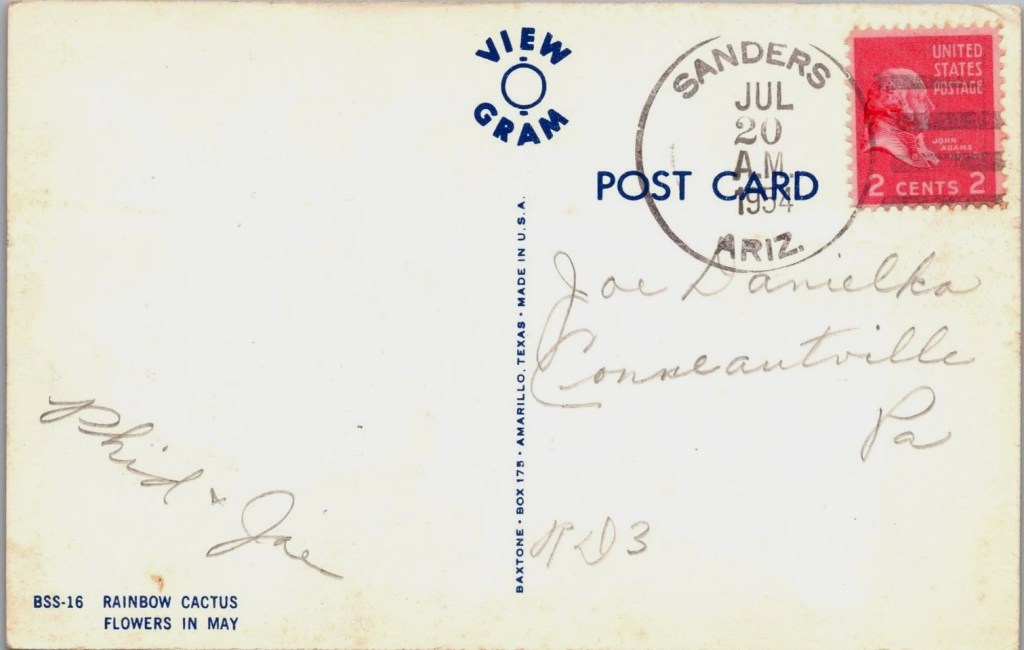
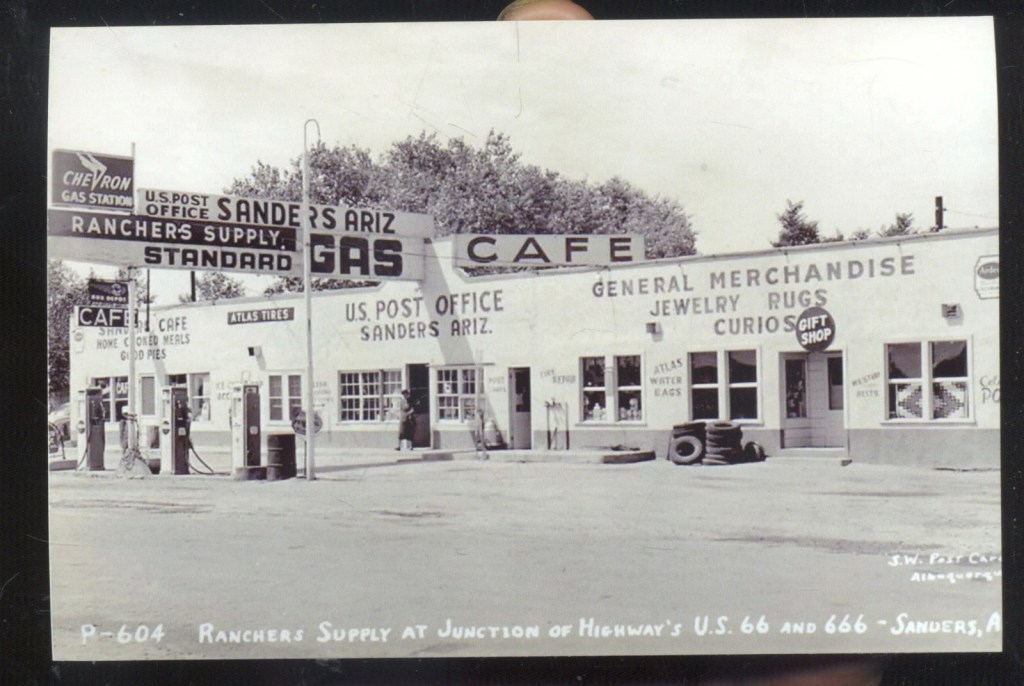
I knew nothing of Sanders’ history until coming across a picture postcard sent from Phil & Joe to Joe Danielka in Conneautville, Pennsylvania. The card was postmarked in Sanders on July 20, 1954, a mere 73 days after I was born. Delving into who the sender and recipient were, I performed a bit of town history first.

Sanders, Arizona, is a small unincorporated community located in Apache County, in the northeastern part of the state. Positioned near the border with New Mexico and situated along historic U.S. Route 66, Sanders has played a modest yet important role in the history of the region, particularly as a gateway to the Navajo Nation and as a stop along key transportation routes.

Long before European settlers arrived, the region surrounding Sanders was inhabited by indigenous peoples, most notably the Navajo (Diné) Nation. The Navajo have a rich history in northeastern Arizona, with deep cultural and spiritual ties to the land. Their presence continues to be a vital aspect of Sanders’ identity, as the community sits within the boundaries of the Navajo Nation reservation.

The community was originally known as “Ojo de Vaca” or “Cow Spring” by early settlers and traders, referencing a local water source. In the early 20th century, it was renamed Sanders, reportedly after a railroad engineer or official connected to the construction of the railroad lines in the area. The arrival of the railroad facilitated transportation and commerce, helping Sanders become a small but notable stop in the region.

The construction of U.S. Route 66 in the 1920s and 1930s brought new attention to Sanders. As the “Mother Road” wound its way through northern Arizona, Sanders benefited from increased traffic and commerce.

The town became a stopping point for travelers seeking fuel, food, and lodging on their journey across the Southwest. Route 66 played a significant role in shaping the economic and social fabric of Sanders during the mid-20th century.

In recent decades, Sanders has remained a rural community with a small population. The local economy is largely supported by services for travelers, ranching, and businesses catering to residents of the Navajo Nation. The Sanders Unified School District serves the educational needs of the area, and community events often reflect the blend of Navajo culture and the traditions of the American Southwest.

Sanders is notable for its proximity to significant Navajo cultural sites and its role as a crossroads between Native American and non-Native communities. It stands as a testament to the enduring legacy of the Navajo people and the influence of transportation corridors like Route 66 and the railroad in shaping the development of northern Arizona.

Though small in size, Sanders, Arizona, has a rich and varied history shaped by its indigenous roots, transportation developments, and its role as a gateway to the Navajo Nation. Today, it continues to serve as a reminder of the region’s vibrant cultural heritage and its place in the story of the American Southwest.

The postcard senders, Joe and Phil, conjured up in my mind a couple coming out of the closet way before folks were openly doing so. It turned out that Phil was actually Philadel Eleanor Danielka, Joseph “Joe” Danielka Jr.’s wife. The recipient of the postcard in Pennsylvania was Joseph “Joe” Danielka Sr.

The history of this family is most amazing. Joseph Danielka Sr. was born in Bohemia, Czechoslovakia, and immigrated to America in 1914 with his wife, Bozena, and three children. Sadly, Bozena died soon after arriving, leaving Joseph a widower.

Undoubtedly, the two oldest children helped with raising their younger sibling, as families did back in the day. Joe’s obituary best sums up his life:

“Joseph Danielka, 86, died Sunday morning, April 4, 1965, at Meadville City Hospital.

Mr. Danielka was born on October 19, 1878, in Czechoslovakia, a son of Mr. and Mrs. John Danielka. He served as a captain in the Austrian Army before coming to the United States with his wife and three children in 1914 to visit a sister. He was stranded here at the outbreak of the First World War and was naturalized the same year.

A life-long farmer, Mr. Danielka was a member of the Little’s Corner Methodist Church and a 30-year-plus member of the Keystone Grange. He served for 30 years as a voluntary crop correspondent for the U.S. and the State Department of Agriculture.

He is survived by a daughter, Mrs. Stanley Kelley, with whom he made his home; two sons, Joseph Danielka, Lakewood, Calif., and John Daniels, Meadville, Pa., 11 grandchildren, and 8 great-grandchildren. Interment will be in Denny Cemetery.”

Joseph Danielka Jr. and his wife were evidently traveling through Sanders on Route 66 when they mailed the postcard. There’s nothing written inside other than their names. A colorful picture on the front shows a flowering Rainbow Cactus.

Joe Jr. was born in Bohemia, Czechoslovakia, on January 28, 1914. He married Philadel Eleanor White on December 23, 1933. The couple had two children, but one passed away at birth. Philadel died on April 25, 1961.

On July 9, 1964, Joe married Wanda Nadine Lusk. She died 28 years later on April 25, 1993. Joseph Danielka Jr. passed away on August 14, 2004, at 90. Exactly like his father, Joe Jr. was a hardworking farmer.

WAR BROTHERS

“There’s much more to this postcard than a scene from a 1940s movie.

Old Tucson, located just west of Tucson, Arizona, is well known today as a movie studio and theme park. However, its history during World War II is less widely discussed.

Old Tucson was originally constructed in 1939 as a movie set for the film “Arizona,” starring William Holden and Jean Arthur. The set was built to resemble a western frontier town, and its authentic design quickly made it a popular location for film production. After the completion of the movie, the site remained intact and began to attract attention from both Hollywood and the local community.

When the United States entered World War II in late 1941, much of the nation’s resources and attention shifted toward the war effort. Tucson itself became a hub for military activity, with Davis-Monthan Air Force Base playing a critical role in flight training and aircraft operations.

Old Tucson, however, did not directly serve as a military installation or training ground during WWII. Instead, its primary use remained as a movie set. Hollywood productions slowed during the war years, but the site was maintained and occasionally used for film work when resources allowed. Some local residents visited the site, and it became a small tourist attraction, offering a glimpse of the Old West to servicemen on leave or stationed in the area.

The war years were marked by resource shortages and rationing, which affected all aspects of life, including movie production. Building materials, fuel, and manpower were prioritized for the war effort, limiting expansion or redevelopment of Old Tucson during this time. Nevertheless, the site’s existence helped sustain local interest in western heritage and provided a modest economic boost through tourism.

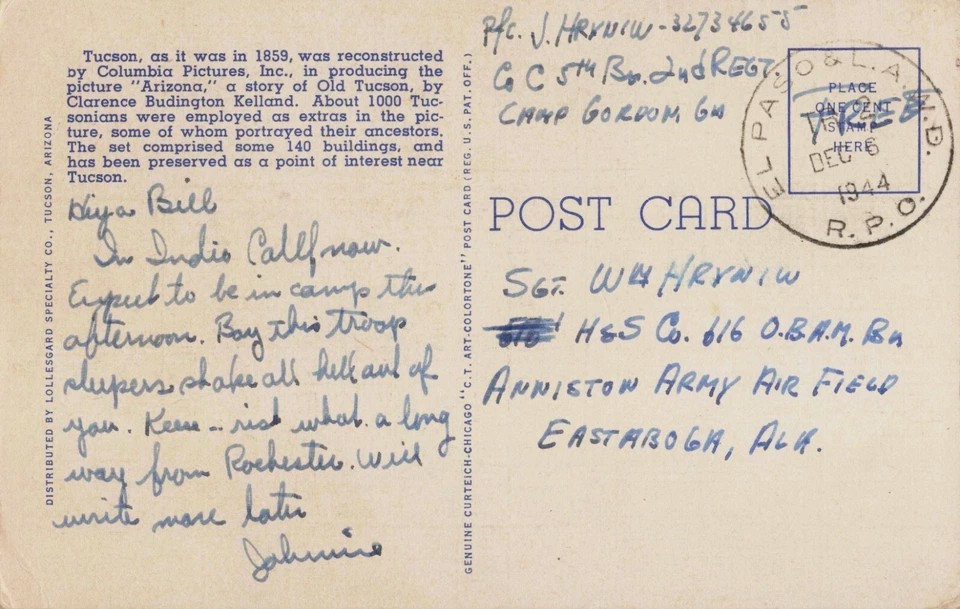
A 1944 picture postcard sent from Pfc. John Hryniw in Indio, California, to Sgt Wm. Hryniw at Anniston Army Airfield in Eastaboga, Alabama, shows a photo of Old Tucson as it looked in the successful western movie, “Arizona.” There’s much more to this postcard than a scene from a 1940s cowboy movie.

A message on the back of this card reads as follows:

Hi ya Bill,

In Indio Calif now. Expect to be in camp this afternoon. Boy this troop slupers shake all hell out of you. Keee-rish what a long way from Rochester. Will write more later.

Johnnie”

John Hryniw and William Hryniw were brothers from Rochester, New York. Their parents, Peter and Anna, were immigrants from the Ukraine. Both young men had enlisted in the Army during WWII, with “Johnnie” sent to the Desert Training Center at Camp Young for duty.

I’m not sure what John meant by troop slupers, other than perhaps military slang for maneuvers, or supervisors. Marching and performing war games in the California, Nevada, and Arizona deserts was beyond brutal. Pfc. John Hryniw, along with thousands of others, endured the horrible elements with a good many dying. John’s brother, William Hryniw, on the other hand, had things much better in Alabama.

General George Patton had the following to say about soldiers training in the desert, “The California desert can kill quicker than the enemy. We will lose a lot of men from the heat, but training will save hundreds of lives when we get into combat.” 

PBS did a documentary on Patton’s Desert Training Center, and I’ve enclosed a short portion on what they reported:

“Indeed, during maneuvers away from camp, men lost their lives in the heat, with locals in Yuma and Phoenix registering protests over the training conditions.

Few of the troops had ever experienced the dry climate, and they struggled to acclimate to temperatures upwards of 120 degrees and brutal sandstorms. Salt tablets were distributed to the men in hopes they would prevent dehydration and cramping, but water was rationed.

Sometimes, particularly early on or while out on maneuvers, troops received only one canteen of water per day, with an erroneous understanding that one could be trained to survive on less water and that such deprivation prepared them for the harsh conditions they would face in North Africa.

Men learned to keep cool without much shade and to avoid the natural dangers of the desert like rattlesnakes and scorpions. The testing of equipment proved equally important and led to practice in desert camouflage, better maintenance of tanks and other vehicles, and even new supplies like dust respirators.

To prepare bodies for long hours and hard work, all troops were required to run a 10-minute mile within a month after their arrival, an activity that not only acclimated them to the desert but also hardened their bodies and minds for the challenges that lay ahead.

This “seasoning” of the men proved an important goal; while abroad, troops sometimes faced desolate locations, cut off from supplies or even water, lacking shade and the comforts of home.

Even as the Desert Training Center shifted to broader training operations after fighting in North Africa ended, officers celebrated the hardening of men as crucial preparation for the difficult conditions faced in Europe and the Pacific. That the landscape varied, with valleys, rocky foothills, and mountain ranges, served as an additional bonus; troops could prepare for diverse battle terrains.

The vast expanse of land provided enough room for multiple battalions to train in situ, to create living spaces from the ground up, and experience maneuvers that mimicked actual warfare. Engineers outlined camp roads, signal corpsmen laid telephone lines, and army air corpsmen took advantage of year-round clear skies to obtain crucial flying skills and practice. Thus, troops gained actual practice in the roles they would hold abroad in a landscape and climate similar to what they would encounter.

They did so in their units, which bonded the men together, particularly because of the isolation and new experiences they shared. Difficult conditions provided confidence to men who worked through them; even the days without sleep and hundred-mile marches provided a taste of what was to come.

Patton’s early emphasis was on constant movement; not only did this train the men for actual combat situations, but made it more difficult for the enemy to find and destroy a camp as well. Thus, while the Desert Training Center held about 14 divisional camps, much of the training happened beyond their borders in the raw desert landscape.”

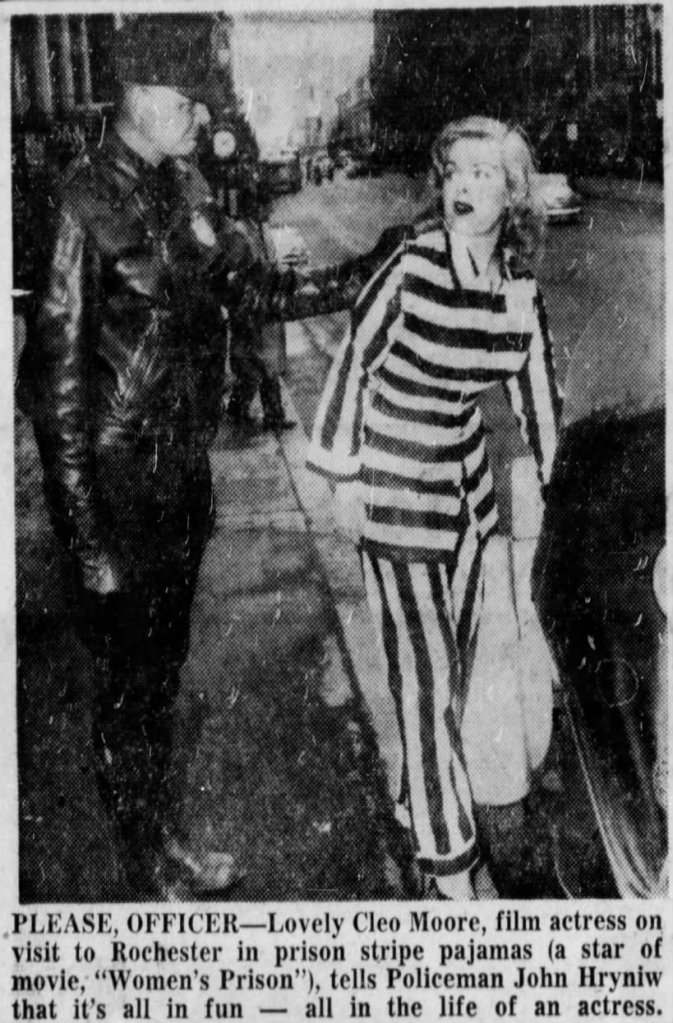
After the war, Pfc. John Hryniw became a policeman in Rochester, with newspaper accounts telling about some of his exploits dealing with criminals. There’s no doubt that the desert training toughened him up for this type of work.

Patrolman Hryniw spent time as a motorcycle cop—even surviving a crash when an evidently inebriated driver ran into his Harley-Davidson, knocking him off the bike. Injured as he was, John was still able to arrest the fellow and send him to jail.

For the latter part of his police career, John Hryniw became a detective before retiring, moving to Oregon with his wife, and then spending time as an auctioneer. John died on May 16, 2014, at the age of 92.

William Hryniw found a much safer and profitable occupation after leaving the service. He was a successful insurance agent and property manager, remaining in New York after retiring. William “Bill” Hryniw passed away at 83 on September 7, 2002.

The California and Arizona deserts are still littered with remnants of General George Patton’s desert training. I’ve found my share while out poking around. Old Tucson survives as well, although it’s seldom used for movies anymore.

From a 1955 Rochester, New York, newspaper

A BIT FISHY

“Salome, Arizona, is a small quirky desert town in La Paz County.”

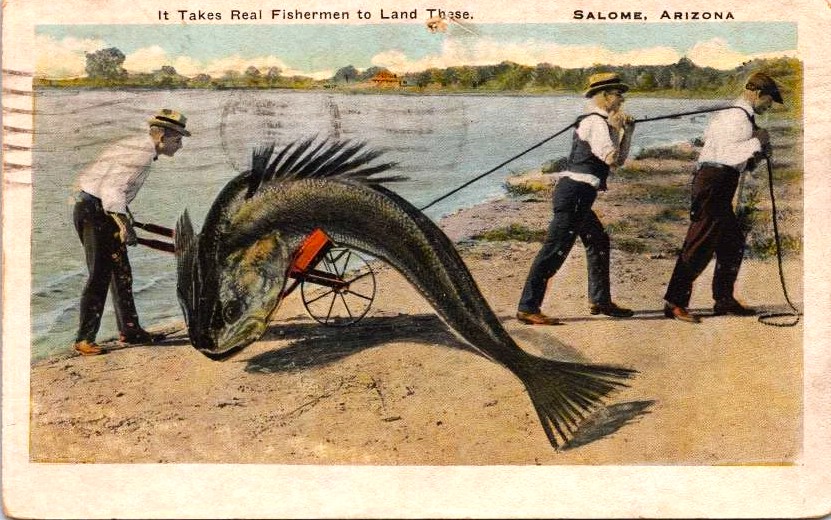
I’ve been through Salome, Arizona, several times, yet I didn’t know it was famous for having large fish. A picture postcard mailed to James Worcester in Middletown, New York, on May 23, 1925, shows three men with a wheelbarrow hauling what appears to be a giant carp or catfish to shore. “It takes real fishermen to land these” is written on top, along with Salome, Arizona.

The closest lake to Salome is Alama Lake, some 40 miles away. Lake Havasu is even further away, at a distance of 80 miles via highway. That phony fish is as close to being artificial intelligence (AI) as there was 100 years ago.

Salome, Arizona, is a small, quirky desert town located in La Paz County. It was founded in the early 20th century and is known for its unique history and playful spirit—its name comes from a tale about a woman named Salome who danced on the hot sands. A sign in town advertises that fact.

The town has long been a stop for travelers crossing the vast Arizona desert and is recognized for its whimsical roadside attractions and vintage charm. In addition to its reputation for unusual postcards featuring giant fish, Salome offers visitors a glimpse into the character and humor that define many small towns in America.

The recipient of the card was James B. Worcester in Middletown, New York. Someone with initials A.J.S. mailed it to him from Frankfort, Indiana. Evidently, A.J.S. made a trip through Salome, and this hilarious card caught his eye.

A message on the postcard reads without correction:

“Thot you would be glad to know that I have a Ford that I painted over a year ago with ‘P.R.K.’ chemical paint and it still looks good.

A.J.S.”

I didn’t discover who A.J.S. was, yet there was sufficient information on James Blaine Worcester to complete this story.

Mr. Worcester was born on January 24, 1893, in New York. After marrying Mary Louise Blum on June 19, 1920, James opened up an automobile repair facility appropriately named Worcester Garage. By 1925, he was the dealer in Middletown for Oldsmobile automobiles. I could find no record of when it closed.

James and Mary had two children, a boy and a girl. James Blaine Worcester died on July 24, 1973, at age 80, while his wife, Mary, passed away just 21 days later on August 15, 1973. They’re both buried at Hillside Cemetery in Middletown.

1925 advertisement

HORSE SHOE CAFE

“How did this postcard not end up as a family heirloom?”

A picture postcard mailed from Benson, Arizona, on Wednesday, April 6, 1955, has special significance for three reasons. 1. The Horse Shoe Café in Benson is a town landmark. 2. The recipient of this card, Miss Ila Mettee, has a most extraordinary career in both military and political circles. 3. How did this postcard not end up as a family heirloom?

The Horse Shoe Café stands as one of Benson, Arizona’s most enduring and beloved establishments. With roots tracing back to the early 20th century, it has served as a gathering place for locals, travelers, and railroad workers alike. This document explores the history, evolution, and cultural significance of the Horse Shoe Café, painting a portrait of a classic American diner that has stood the test of time.

Benson, Arizona, founded in 1880 as a railroad town, quickly became a bustling stop for trains, cattle drives, and travelers heading west. The Horse Shoe Café was established in the midst of this vibrant activity, with its original opening believed to be in the 1930s or 1940s.

Its strategic location on East 4th Street made it accessible for the railroad community, ranchers, and local residents. The café’s name was inspired by the cowboy and ranching culture surrounding Benson, with the horseshoe symbolizing good luck and prosperity.

Throughout the decades, the Horse Shoe Café became a cornerstone of Benson’s social life. It was known for its hearty, home-style meals, friendly service, and welcoming atmosphere. The café’s classic American menu featured favorites such as steak and eggs, homemade pies, and bottomless coffee, attracting a steady stream of regulars and visitors. Its walls, adorned with Western memorabilia and historical photographs, offered patrons a glimpse into Benson’s colorful past.

The Horse Shoe Café weathered various changes over the years, including shifts in ownership, refurbishments, and economic ups and downs. Despite these challenges, the café remained true to its roots, preserving its old-fashioned charm and commitment to customer service. Its character as a vintage diner was further enhanced by its neon signage and retro décor, which evoke nostalgia for the golden era of roadside cafés.

More than a restaurant—Horse Shoe Café is a living piece of Benson’s history. It has been featured in local publications and travel guides as an iconic spot in southeastern Arizona. The café is often referenced in stories about Benson’s railroad heritage, the heyday of Route 80, and the enduring traditions of the American Southwest. For many, it represents the spirit of small-town America: resilient, friendly, and full of character.

Today, the Horse Shoe Café continues to serve residents and visitors, maintaining its legacy as a classic diner with a storied past. Whether stopping in for breakfast, lunch, or a slice of pie, patrons can experience a sense of history and hospitality that has defined the café for generations. Its continued success is a testament to the community’s appreciation for its heritage and the enduring appeal of authentic, local establishments.

The restaurant remains a cherished landmark in Benson, Arizona. Its history is intertwined with the town’s development, the railroad era, and the enduring culture of the American Southwest. As it continues to serve new generations, the café upholds its reputation as a welcoming place where stories are shared and memories are made.

Getting back to that vintage postcard, the picture on the front of it shows waitresses and customers inside the dining room. A vintage Coca-Cola cooler sits in the middle. For many people, server is now the politically correct word for waitress, but I prefer to use the old definition.

A short note on the card reads as follows:

Tuesday nite

Here is where we ate Supper to nite. We have a nice room. Have had a fine trip so far. We plan to get to Grady’s tomorrow nite. We was in a dust storm about 3 hours in Mexico. It sure was bad – Love from Mama”

The message was written on Tuesday night, which was April 5, 1955. It wasn’t mailed until the following day. The person sending it to Miss Ila Sue Mettee appears to be her mom, Annie, who also signed off as Mama. It was hard to read the signature even after enlarging.

Ila Sue Mettee, according to many newspaper accounts, led an exemplary life beginning in high school and college. A book could be written about her life. After college, she joined the Women’s Army Corps (WAC) as a lieutenant. She climbed the ladder quite fast. Captain Mettee went on to become commander of Headquarters and Operations Company – 18th Combat Intelligence Group at Fort Bragg, North Carolina.

On October 13, 1974, Ila wed Captain John McCutchon, also in the Army. The couple has one daughter.

Lt. Colonel Ila Mettee-McCutchon became head of the 741st Military Intelligence Battalion at Fort George G. Meade in Maryland. Before retiring, she reached the rank of colonel.

Mrs. Ila Mettee-McCutchon moved to California with her husband and daughter, where she ran for mayor of Marina, California, and won. She was also elected to the Monterey County Board of Supervisors, a prestigious nomination. While serving in that capacity, Ila became Garrison Commander for the Presidio of Monterey, another noteworthy accomplishment.

Today, Ila and her husband, John, continue to serve as volunteers in the Colorado town in which they live. Horse Shoe Café in Benson, Arizona, is still in operation as well, continuing to dish out breakfast, lunch, and dinner to locals and visitors alike. I’ll mark this eatery down as a place I want to eventually visit.

DATELAND

“Dateland is on my list of places to visit.”

I’ve never been to Graceland in Memphis, Tennessee, and it’s not on my bucket list to ever go there. That’s not to say it isn’t on my wife’s. I believe there’ll come a day when they close Graceland down and sell off all the furniture and fixtures, just as they did with the Roy Rogers and Dale Evans museum and home in Apple Valley, California. Some younger people don’t know who the late Roy Rogers and Dale Evans are. They were Western television celebrities from the 50s and 60s.

Graceland, for those who don’t know, is Elvis Presley’s former mansion, with it also being home to his parents, Vernon and Gladys Presley. The infamous “Jungle Room” in Graceland can no longer be seen by paying visitors, so that should tell you something. I’m assuming that the celebrated green shag carpet has been flattened beyond reprieve by countless shoes.

Dateland, Arizona, is on my list of places to visit. This place has a history that goes much further back than the King of Rock-n-Roll’s former pad. Dateland is a small, unincorporated community located in Yuma County, in the southwestern part of the state, approximately 200 miles from Lake Havasu City.

Nestled amid the vast Sonoran Desert, Dateland is best known for its date palms, date milkshakes, and its role as a memorable stop along Interstate 8. While it may seem unassuming to passersby, Dateland’s history is rich and deeply intertwined with the story of transportation, agriculture, and military activity in the region.

The area that would become Dateland has long been inhabited by Indigenous peoples, including the Cocopah and Quechan tribes, who traversed the arid landscape for centuries. The harsh desert environment, however, limited permanent settlement until the arrival of modern infrastructure in the early 20th century.

Dateland’s modern history began during World War II. In the early 1940s, the United States military established a series of desert training camps in the Southwest as part of the Desert Training Center, designed to prepare troops for combat in North Africa’s harsh conditions. One such installation was Camp Horn, located near what is now Dateland. The camp housed thousands of soldiers and brought increased activity and infrastructure to the area—including roads, water wells, and basic services.

Around the same period, efforts were made to develop agriculture in the arid region using irrigation. The climate and soil of the area proved ideal for growing date palms, a crop originally introduced to Arizona from the Middle East in the early 20th century. The abundance of date palms gave the settlement its distinctive name: Dateland.

After the war, the military camps were decommissioned, but the agricultural industry remained. Farmers continued to cultivate date palms, and Dateland became a unique outpost for travelers seeking fresh dates and date products. Miraculously, the old aircraft runways and some of the building foundations are still visible.

When U.S. Route 80 and later Interstate 8 were constructed, Dateland found new life as a highway stop. Its location made it a convenient rest area for motorists traveling between Yuma, Phoenix, and beyond. The Dateland Travel Center, established in the mid-20th century, became locally famous for its date shakes and other date products, drawing visitors from across the country. My reason for wanting to go there is to sample one of those date shakes.

Today, Dateland’s economy is closely linked to tourism and the date industry. The community remains small, with a population of only a few hundred residents, but it has carved out a niche as a quirky and memorable destination for travelers.

Dateland’s legacy is a testament to adaptation in the desert. From its beginnings as a military outpost to its transformation into a hub for date agriculture and a beloved roadside stop, Dateland reflects the broader history of the American Southwest—one of resilience, innovation, and hospitality. The date palm groves, roadside stands, and echoes of military history continue to define this unique Arizona community.

Despite its small size, Dateland, Arizona, holds an outsized place in the memories of travelers and the agricultural history of the region. Its evolution from a remote desert site to a symbol of Arizona’s agricultural ingenuity and highway culture makes it a fascinating chapter in the story of the American West.

I came across a July 23, 1962, picture postcard sent from someone named Scotty to Mr. James J. Coleman in Middleton, Pennsylvania. It was nine o’clock in the morning, judging by the official postal stamp. Scotty’s watch must have been an hour ahead of time, as you’ll soon see.

A photograph on front of the card shows a Chevron gas station in Dateland, along with a cafe and post office. Scotty’s short message to James Coleman reads as follows:

“Monday

We are here for a cool drink. Yesterday the temp was 110. Today at 10 AM it’s 94.

Scotty”

I have no earthly idea who Scotty is, other than he might’ve been passing through Dateland on his way to hook up with Captain Kirk and the Starship Enterprise crew in Phoenix. James J. Coleman, the postcard recipient, was quite easy to track down. I’ll supply the basic biographical information here, as there wasn’t much personal data to go by.

James Joseph Overfield Coleman was born on December 1, 1906. He married Claire Rita Garrity on June 23, 1928. Married for 62 years, the couple had one daughter, Ellin. James was a draftsman and mechanical engineer for a heating and cooling sheet metal business. His wife, Claire, died on September 1, 1990, and James passed away on June 3, 1994, at the age of 87. Daughter, Ellin Coleman-Tutrone, died six years later on June 29, 2000. That pretty much sums things up.

Dateland, Arizona, on the other hand, now has a historical society, and they’re attempting to reconnect with soldiers who served in the area during WWII. With the majority of them now deceased, that project will unlikely find few living sources if any.

Before he died, former Army Air Corps B-25 aviator Lt. Robert “Bob” Adair Dethlefsen penned the following letter to the Dateland historical society. I’ll end things with his unique recollection and my final thoughts.

“On December 23rd, 1943, due to pervasive bad weather in the San Joaquin Valley, approximately 40-50 B-25 airplanes arrived at Datelan AAF for temporary duty. This contingent, including instructors, students, and ground support crews, was a B-25 pilot training group from Mather AFB, Sacramento, California. After three weeks of innumerable take-offs and landings, it became apparent that the Datelan runways had not been built to withstand this type of pounding. After completing the training of one class, the entire operation was moved to DAAF Deming, NM. Although the airfield remained in operation, there was very little activity thereafter. It had been in use for less than a month. For whatever reason, the military referred to this location as DATELAN. During my brief stay at this desolate oasis, the highlight of the day was walking out to the junction, sitting on the front porch of the general store-gas station, and watching the train go by.”

Bob Dethlefsen – San Jose, California – November 3, 2007

I hope to emulate Lieutenant Robert Dethlefsen when I get to Dateland. With a cool, refreshing date shake in hand, I’ll find a place to park near the railroad tracks and wait for a train to roll by.

After it passes, and I finish my drink, I’ll pull my vehicle back onto hot black asphalt and hit the gas. On Monday, July 23, 1962, a few minutes after 9 o’clock AM, with 110 degrees rapidly closing in on Scotty, I’m sure he did the same.

“MIKE the MOOSE”

“According to local legend, Moose Pass received its name in 1928 when a freight team was delayed because a moose blocked the trail.”

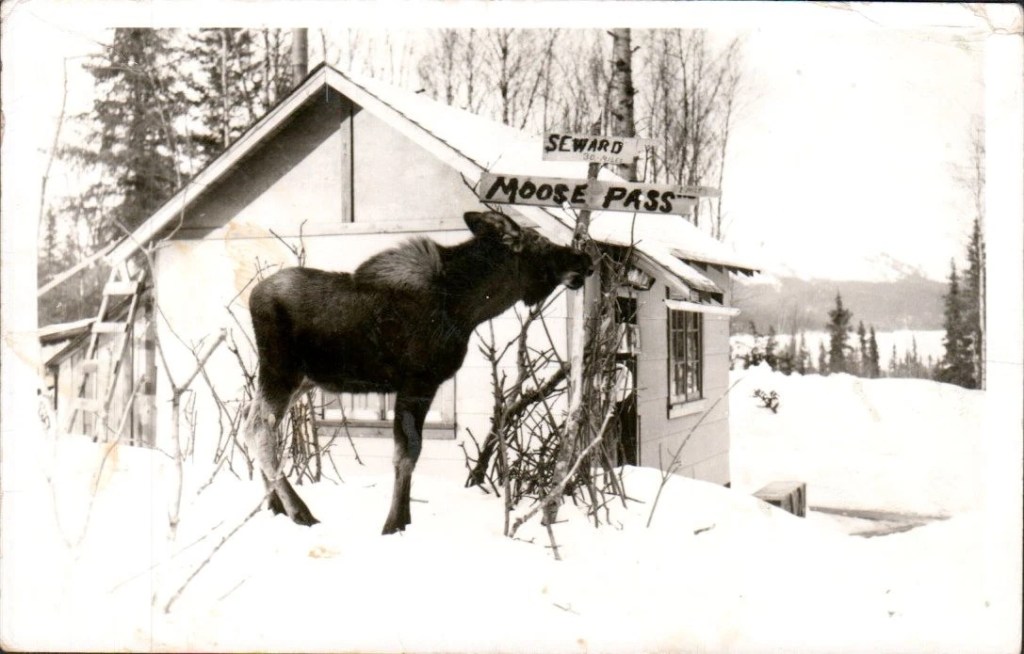
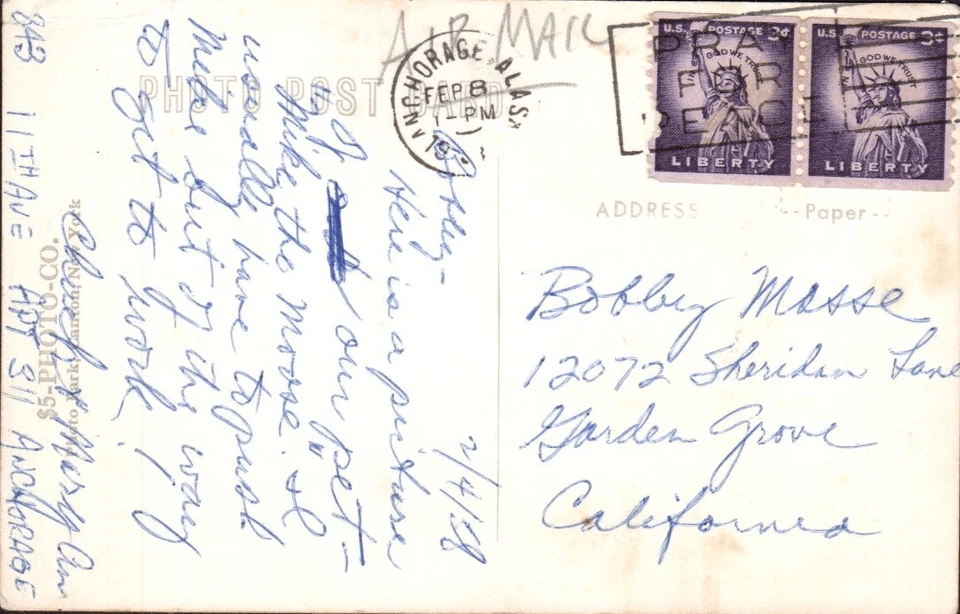
I came across another picture postcard that I could not positively identify the sender or recipient of. This one was postmarked in Anchorage, Alaska, on February 8, 1948, with the card having been written four days earlier.

The sender’s names, Chuck & Mary Ann, appear on it, with the recipient being Bobby Masse of Garden Grove, California. It appears that Bobby Masse is actually Robert Massey, although I could not verify that. It’s also possible that Chuck and Mary Ann are, in fact, Charles and Mary Ann Dismond. I base this loose assumption on a message on the card, believing that Charles wrote it.

Charles “Chuck” Dismond was an engineer on the Alaska Railroad, while Mary Ann worked for the Division of Forestry as a clerk. With no way to substantiate such, I’ll just have to assume that’s who they are and leave it at that.

The message written in ink is quite humorous:

“2/4/48

Bobby,

Here is a picture of our pet, “Mike the Moose.” I usually have to push Mike out of the way to get to work!

Chuck & Mary Ann

843 11th Avenue Apt 311 Anchorage”

What’s most interesting to me is the picture on the front showing a snow-covered dwelling and a moose munching on alders. A sign pointing north says: Moose Pass 1 mile—Seward 30 miles. With Moose Pass being located at milepost 29.5 of the Alaska Railroad, this cabin would be one mile south at milepost 30.5.

I’ve visited this area numerous times between the 1960s and the 1990s, and I don’t recall a place looking exactly like this, although in 50 years, things can change drastically. Perhaps it burned down or is further south than the sign indicates.

There is a cabin a bit further south that I believe was the Johnson Roadhouse. If it’s the same one, a pioneering couple lived there for many years until they passed away. Family members took the residence over after that to use as a weekend getaway. I’m not sure who owns it now or if it’s still standing.

The place I’m thinking of is close to railroad tracks with Trail Lake lapping the shore a few hundred feet away. After the older residents died, next of kin cleaned things out and burned much of the stuff in a fire pit close to the tracks. I was there when it was still smoldering.

A good friend, Dee Linton, pulled a giant coffee pot from the ashes and kept it. Undoubtedly, this well-used pot supplied large groups of visitors and railway workers with ‘hot coffee’ over the years.

Moose Pass, Alaska, is a picturesque community nestled in the Kenai Peninsula, known for its scenic beauty and rich history. Located about 30 miles north of Seward along the Seward Highway, Moose Pass has long served as a gateway to the wonders of southern Alaska.

The area that would become Moose Pass was originally inhabited by the Dena’ina Athabascan people, who hunted, fished, and gathered in the region for thousands of years. The abundant wildlife and waterways provided sustenance and transportation for these early residents.

The history of Moose Pass as a settlement began in earnest during the early 20th century, spurred by Alaska’s gold rush. Prospectors and miners traveled through the region, and the need for reliable transportation led to the construction of the Alaska Railroad. By 1912, the railroad reached this area, and a small community formed to support railroad workers and travelers.

According to local legend, Moose Pass received its name in 1928 when a freight team was delayed because a moose blocked the trail. The spot became known as “Moose Pass,” and the name stuck as the community grew around the railroad stop.

Throughout the 20th century, Moose Pass remained a small but vital community. It served as a rest stop for travelers heading to Seward and Anchorage, and its proximity to Kenai Lake made it a popular destination for fishing, hiking, and outdoor recreation. The local school, post office, and small businesses became the backbone of the town.

Today, Moose Pass is known for its welcoming atmosphere, annual community events, and access to pristine wilderness. Despite its modest size, the town embodies the spirit of Alaska—resilient, tight-knit, and deeply connected to the land.

Hopefully, with the release of this blog, someone will recognize the little cabin alongside Upper Trail Lake. As far as “Mike the Moose” goes, his relatives undoubtedly still trapse through the Moose Pass area. After all, the village is named after them.

MISS ELA BOYD

“This postcard was likely purchased in Fairbanks, Alaska, by the person sending it.”

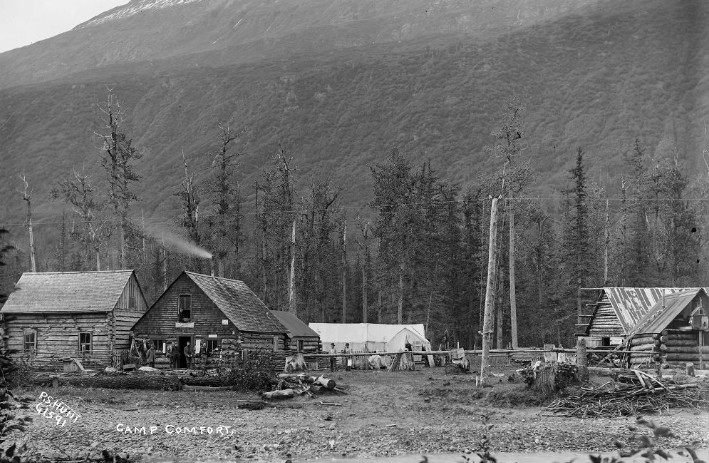
Camp Comfort

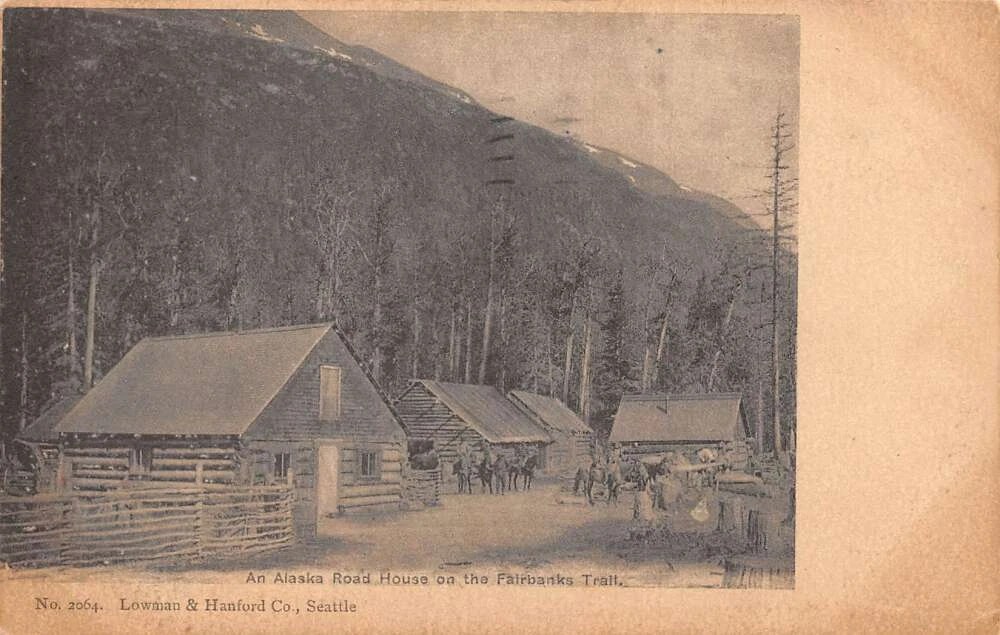
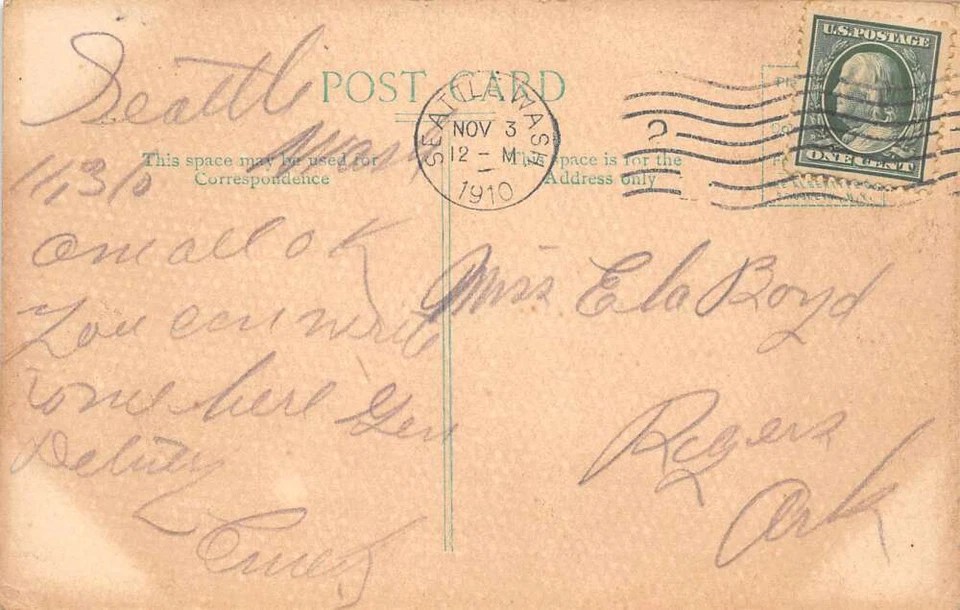
An old picture postcard mailed from Seattle, Washington, on November 3, 1910, to Miss Ela Boyd in Rogers, Arkansas, shows several rustic log cabin structures on the front with five riders on horses. The description underneath says:

“An Alaska Road House on the Fairbanks Trail”

I tried to identify the name and exact location of this roadhouse using the book “Alaska Roadhouses” by Helen Hegener, along with other online sources. Poring over this information, I eventually came up empty. An expert on the subject, thankfully, renowned Alaska author Helen Hegener, came to my rescue. The pictured roadhouse is named Camp Comfort.

Fairbanks Trail refers to historic and recreational paths in the Fairbanks region of Alaska. Fairbanks, situated in the heart of Alaska, is renowned for its rich history, gold rush heritage, and vast wilderness. Trails in this area are significant for both their historical context and their modern use for outdoor recreation.

The term “Fairbanks Trail” is often associated with early routes used by gold prospectors and settlers in the late 19th and early 20th centuries. These trails were crucial for transporting supplies, mail, and people between key locations such as Fairbanks, Nenana, and other remote settlements. Some trails followed ancient paths used by indigenous peoples long before the arrival of Europeans and Americans.

This postcard was likely purchased in Fairbanks, Alaska, by the person sending it. I was able to partially decipher his fancy yet sloppy handwriting with the simplistic message to Miss Ema Boyd, reading as follows:

“Seattle 11, 3, 10

Am all ok. You can write to me here gen delivery.

Crue”

Unfortunately, the postcard sender, whom I believe the name to be spelled Crue, will remain a mystery, although I found sufficient personal information on the card recipient, Miss Ema Boyd. She was only 16 when she received the message.

Ela was born in Tennessee on June 12, 1894, to parents John and Leona. On February 9, 1912, she married Lester Trueblood, but that marriage didn’t last. On January 8, 1916, Ela wed William Harvey Compton. A child was born on February 3, 1917, to the couple, but sadly, one day later, little John Elmer Compton passed away.

On February 4, 1920, Ela Boyd-Compton died an unfortunate early death. Her obituary in the “Rogers Republican” newspaper, where she worked, tells a sad story.

“Mrs. Ela Compton died last Wednesday afternoon at New Orleans, the result of pneumonia following a severe attack of the grippe. Her father, John R. Boyd of Rogers, who had reached New Orleans that morning, brought the body back to Rogers, arriving here Saturday. Funeral services were conducted by the pastor, Rev. C.C. Cunningham. Mrs. Compton was a well-known young woman of Rogers. She was especially popular in the Baptist church circles, where she was superintendent of the primary department and a willing and efficient worker in all departments. She had worked for several years in the newspaper offices of Rogers as a compositor and at the time of her death was in New Orleans in the special school of the Merganthaler Linotype Co., studying to become a machine operator. She was a member of the Eastern Star and the Rebekah orders. He untimely death, she was only 26, was a great blow to the family and to the many friends.”

From another angle – Camp Comfort – P.S. Hunt – RPPC postcard

NO HOCUS POCUS

“I generally take a nap after lunch as part of my daily regimen.”

Undoubtedly, I’m not the only senior citizen in town claiming that certain drugs make them dream about weird things. When I say drugs, I’m not talking recreational, as in coke, pot, LSD, or smack. The prescription pills playing tricks on my mind are used for lowering high cholesterol, blood pressure, including aches and pains.

This past year, I’ve found myself in unrelenting dreams, most of them having me back at work doing what I did before retiring. I’d even wake up and then return to sleep, the same mundane hallucination coming back to haunt me. I jokingly told my wife I should mail in a time sheet to my former place of employment and see what happens.

Passwords have become a topic of conversation here lately between Joleen and me, with them eventually entering my dream world late one afternoon. I’ll get to that in a minute.

My wife and I keep our computer passwords written down in a spiral notebook, changing them out every so often, but not often enough. It’s getting harder and harder to create new ones that are easy to remember, with some sites wanting a certain selection of words, special characters, numbers, and in some cases, upper and lower case letters.

Years ago, I used the words ‘Hocus Pocus’ on all of my accounts. Abracadabra should’ve been the key to unlock things, but it was too hard to spell.

Our Verizon account couldn’t be opened the other morning because I’d changed the password and forgot to write down a new one. As I’d done time and time before, I hit the ‘forgot password’ button, yet when I entered what I thought was a unique password, it wasn’t accepted. Turned out I’d used that one before.

Not remembering passwords takes me back to my school days and the notorious hallway combination lockers. I can recall having a ‘senior moment’ even back then and forgetting the opening sequence of only three numbers.

The custodian easily got inside while I unsuccessfully attempted to watch. I was told by other students that there’s a secret master combination that unlocks all lockers, although none of the kids knew it. I’m sure those good at mastering a Rubik’s Cube could do so if they tried.

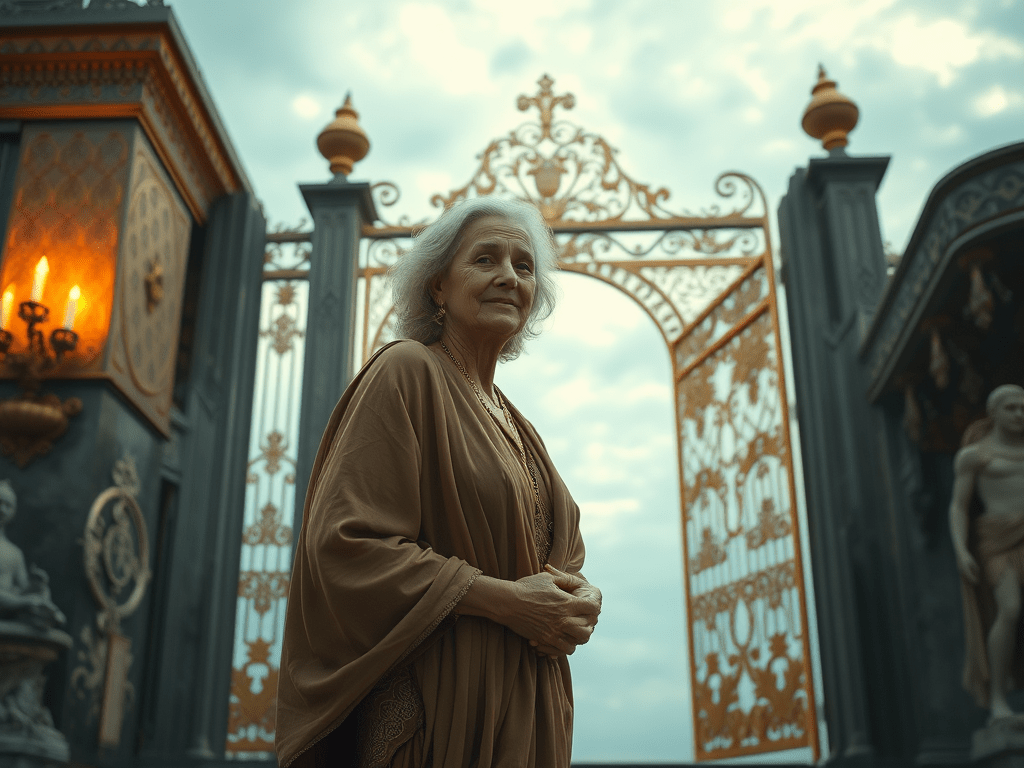
With me now emulating a trait from a man, John Miscovich of Flat, Alaska, who nearly made it to 100 years of age, I now take a nap after lunch as part of my daily health regimen. A week ago, while napping, I began dreaming that I was at the gate of Heaven—desperately needing a password to get in. It was not a good dream because I couldn’t crack the code.

Quickly waking, I told myself to remember this dream because it was good writing material. There’s a notebook and pen on my nightstand just for that, but I didn’t use them this time. Falling back asleep, when I awakened again, I had no idea what my dream was about. Spending several minutes trying to recall things left me scratching my head.

Today, while entering a password for my Lowe’s account, and it being the wrong one, that lost dream was suddenly rekindled in my head. This time, I wasted no time jotting things down in my notebook.

Some folks I’ve met along the way seem to believe that all people automatically go to Heaven after they die. I’m not sure where they get this idea, but it definitely isn’t from the Bible.

There’ll be no password needed, unlike in the dream I had, but they will have to have their name written in the Lamb’s book of life. Revelation 21:27 tells us that much. I asked Miss Purdy, my AI helpmate, how one gets their name in this book, and she came up with an answer, as she often does.

“According to God’s promise, substantiated through Biblical scripture, we get our name written in the Lamb’s book of life by sincerely repenting of our sins and believing in Jesus Christ as savior.” Miss Purdy went on to say that this can be done through a simple prayer performed in no specific place. I dedicated my life to Christ in the front seat of a 1965 Chevrolet.

Thankfully, there’ll be no need to remember complex passwords to enter Heaven, unlike the one required to access my Lowe’s account. Standing at the pearly gates shouting, “Hocus Pocus,” isn’t going to cut the mustard.

Life’s password, for those still desiring to call it that, is merely our name, permanently written down by God in the Lamb’s book of life at the exact moment we made that life-changing decision to follow Jesus Christ.