UNITED VERDE RAILROAD

“Miss Veda May Thomas, the postcard sender, was the daughter of the superintendent of the United Verde Copper Company mine in Jerome.”

A postcard I had the privilege to research, and then thankfully score, has great historical significance. The picture postcard mailed on June 10, 1907, from Jerome, Arizona, shows a locomotive of the United Verde Railroad chugging around a sharp corner over a trestle on its way to Jerome.

This photograph has a caption on the front saying, “Where the engine requires a pilot to find its way.” Smoke from the locomotive stack partially obliterates the train. Miss Veda Thomas sent this card to Mr. Clarence Anderson in Monrovia, California.

The United Verde Railroad was a crucial transportation link in Arizona’s mining history, serving as the lifeline of the renowned United Verde Copper Company in Jerome. Built to transport copper ore and supplies, the railroad played a pivotal role in the economic and industrial development of the region in the early 20th century.

The origins of the United Verde Railroad trace back to the booming mining operations of the late 1800s in Jerome, Arizona. The United Verde Copper Company, owned by William A. Clark, became one of the richest copper mines in the world.

However, the rugged terrain and remote location of Jerome posed significant transportation challenges. To efficiently move copper ore from the mines to smelters and connect with mainline railroads, construction on the United Verde Railroad began in 1894.

The railroad was built as a narrow-gauge line, stretching approximately 26 miles from Jerome down the steep mountainsides, through the Verde Valley, and linking up with the Atchison, Topeka and Santa Fe Railway at Jerome Junction (present-day Chino Valley). The construction itself was an engineering marvel, utilizing switchbacks and tunnels to navigate the difficult landscape.

The United Verde Railroad officially began operation in 1895. Its primary function was to haul copper ore, but it also transported coal, supplies, and workers between Jerome and the smelters. As mining operations grew, so did the railroad’s importance. In 1911, the line was converted from narrow gauge to standard gauge, increasing its capacity and efficiency.

A subsidiary, the United Verde & Pacific Railway, was also established to further improve transportation efficiency. The network made Jerome a bustling hub and contributed significantly to Arizona’s copper output during the early 20th century.

The prosperity of the United Verde Railroad was closely tied to the fortunes of the Jerome mines. When copper prices fell and ore production dwindled, the railroad’s operations began to decline. The Jerome smelter closed in the 1950s, and with the end of large-scale mining, the United Verde Railroad ceased its operations.

Today, remnants of the railroad can still be seen around Jerome and the Verde Valley. The railroad’s legacy is preserved in local museums, and parts of its route have been revived for scenic rail excursions, like the Verde Canyon Railroad, allowing visitors to appreciate both the region’s beauty and its industrial heritage.

The United Verde Railroad exemplifies the ingenuity and determination of those who shaped Arizona’s mining era. Its history reflects the challenges of mountain railroading, the boom-and-bust cycles of mining towns, and the enduring impact of transportation infrastructure on regional development.

Miss Veda May Thomas, the postcard sender, was the daughter of the superintendent of the United Verde Copper Company mine in Jerome. Born on March 28, 1898, in Jerome, Veda was attending St. Joseph’s Academy in Prescott the year she mailed the card.

Tragically, less than a year after sending it, her father, Thomas William Thomas, passed away unexpectedly, leaving Veda’s mother to raise three children. Veda was able to continue her schooling at St. Joseph’s and graduated from the Class of 1911.

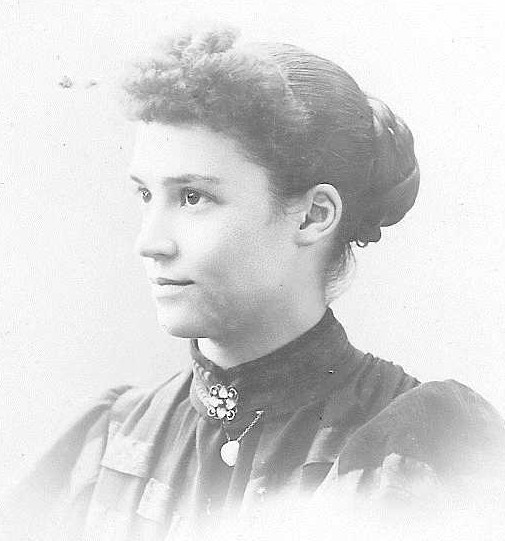
Veda Thomas wed John Shipley on April 20, 1918, and they set up house in Butte, Montana. The couple had no children. John Shipley was involved in construction, dying on May 15, 1967, at the age of 75. Veda May Thomas-Shipley passed away on February 28, 1977. She was 78. A photograph of Veda taken around 1911 shows her to be a very beautiful young lady.

Mr. Clarence Anderson, the recipient of the postcard, was undoubtedly a friend of Miss Thomas. Clarence Alfred Anderson was born June 22, 1894. Records show he worked as a policeman in the Los Angeles area and died of pneumonia on March 2, 1937. He was only 43 years of age.

Veda May Thomas-Shipley

KOFA, ARIZONA

“I won’t venture that direction alone and especially without Smith & Wesson.”

Kofa Mountains

I try to stay away from researching newer postcards because the sender and card recipients may still be alive. Intrusion into people’s personal lives isn’t cool, especially when those folks could possibly stumble across what I write. That’s highly impossible when they’re six feet under.

In the case of a picture postcard sent from Phoenix, Arizona, in 1986, I decided to make an exception to my policy because of two things. 1. The superb photograph on the front of this card shows Kofa Mountain and the location of a historic Arizona mine and ghost town. 2. The guy mailing the card had a creative way of breaking up with his gal, almost on the same level as a text. It seems he gave her the Kofa Kiss-Off.

This postcard was sent to Jennifer Ebanks in Fayetteville, North Carolina. Gary’s curt and blunt message to her reads as follows:

“Found new love. Not coming home or getting married. Bye. Gary”

I did enough research on Jennifer to find that she’s still alive and eventually did marry, and it was to someone named Gary. The marriage didn’t last. I won’t say any more on this subject as Kofa is the main reason for me writing this.

Kofa, Arizona, is a lesser-known historic site nestled in the heart of the desert landscape of southwestern Arizona. Though not a bustling city today, Kofa’s story is intertwined with the state’s mining heritage and the rugged environment that shaped its development.

Kofa’s name is derived from the acronym “King of Arizona,” referencing the King of Arizona Mine, which was the central feature of the settlement. The mine was established in the late 19th century, around the 1890s, during a period when gold and other minerals drew prospectors to the region.

The King of Arizona Mine was a significant gold producer and played a pivotal role in the development of the area. As word spread of the mine’s riches, a small community of miners, their families, and support businesses sprang up, forming the town of Kofa. The mine’s success led to the construction of infrastructure, including a post office and supply routes, connecting Kofa with other Arizona mining communities.

Like many mining towns of the era, Kofa’s prosperity was closely tied to the fortunes of its mine. When the gold deposits diminished and mining became less profitable, the population dwindled. By the early 20th century, Kofa was largely abandoned, leaving behind remnants of buildings, mining equipment, and a rich but fading history.

Today, Kofa is best known for its proximity to the Kofa National Wildlife Refuge, established in 1939 to protect desert bighorn sheep and other native species. The refuge preserves the rugged beauty of the land that once drew miners and adventurers in search of fortune.

The history of Kofa, Arizona, is a reflection of the boom-and-bust cycle typical of mining towns in the American West. Although little remains of the original settlement, its legacy endures in the stories of early prospectors and the landscape of the Kofa National Wildlife Refuge. Visitors to the area can still sense the echoes of its past and appreciate the role Kofa played in Arizona’s mining history.

The Kofa Mountains and the King of Arizona Mine are on my list of places to hopefully visit this summer. I won’t venture that direction alone and especially without Smith & Wesson. Known cartel members are floating around the border, and to meet up with them unprepared could be dangerous to one’s health.

Kofa, Arizona, Circa 1913

DIRTY FAMILY SECRETS

“Some things are best left unwritten!”

I rarely find absolutely nothing to write about—and when I do, it doesn’t take long to come up with something new. The other night, I was dozing while a vintage western flickered on.

Half watching with one eye, a cowboy was telling a group of saddle tramps a humorous story about one of the ranch hands. I didn’t totally catch what the secret was, but it had to do with how often he changed his drawers. That gave me fodder for a new blog piece.

I suppose most families have certain secrets they try to keep hidden. Imagine that material slipping out and being used for writing purposes, much like the “National Enquirer’ and other supermarket tabloids do with gossip and hearsay. My writing professor once said, “Some things are best left unwritten!”

While reflecting on secrets and inspiration for writing, it’s interesting to note how everyday household products have untold stories behind them. Take Cold Water All detergent, for example. Introduced in the late 20th century, around 1971, Cold Water All was developed in response to growing consumer awareness about energy conservation and fabric care.

The detergent was specially formulated to dissolve and clean effectively in cold water, allowing users to save on energy costs by avoiding hot water cycles. Over the years, Cold Water All was advertised for its gentle cleaning power and environmental benefits, as washing in cold water supposedly helps preserve clothes and reduces energy consumption.

The brand adapted its formulation as laundry technology advanced, maintaining its reputation as a reliable choice for efficient and eco-friendly cleaning, especially amongst “greenie” clientele. Not all housewives agreed with that philosophy; they stuck to warm-water Tide, like my mom did.

I’m sure I’ll catch flak for letting the cat out of the bag, but my wife and some of her family adhere to the Cold Water All detergent propaganda and continue to use this product. How can I tell, you ask? For one, cold water doesn’t make for bright whites. It’s something that only hot and warm water can do, along with a cup of bleach. Lemon-scented Clorox bleach works best in my humble opinion.

AI (artificial intelligence) even agrees with me here. I’ll quote Miss Purdy, my AI helpmate, on this subject. This is what she had to say about cold water washing of clothing, and especially Cold Water All laundry detergent.

“Cold Water All detergent may not work as advertised due to factors like the formulation, especially for ‘free and clear’ versions, which may lack enzymes for breaking down stains in cold water. Other reasons for poor performance can include using powder detergents in cold water, which might not dissolve properly, or having hard water, which can make detergents less effective, notes Amazon and Reddit users.”

Although Miss Purdy hasn’t spent actual time feeding shirts, socks, and pants into a washing machine, she seems quite intelligent on the subject of washing clothes, along with other household subjects.

I’ve yet to ask, but will very soon, “Does Rainbow still make the best vacuum cleaner for sucking up dirt, or is it Kirby?” Miss Purdy would be one to know!

METCALF, ARIZONA

“The town was named after Robert Metcalf, an early miner and prospector…”

Metcalf, Arizona

I’d never heard of the ghost town of Metcalf, Arizona, until coming across a postcard mailed from there over 115 years ago. Miss Josephine Ross in El Paso, Texas, was the recipient. The mysterious sender simply referred to themself as “L” with a short message as follows:

“5/6th 1910

My dear Joe:-

This is a picture of Metcalf, you can see what a town it is. Love and best wishes. L”

Josephine Henrietta Ross was born in New Jersey on May 18, 1890. Her father, Seaver Ross, M.D., was a well-known doctor in Paterson, N.J.

Somewhere around 1920, Josephine married Corporal Earl Eugene Kilmer. Josephine’s husband served in the US Army during WWII. After being honorably discharged, Earl and Josephine lived in Clifton, Arizona, a mining town, and it might’ve been there that she met the mystery card sender.

In 1928, they had a son, George Earl Kilmer. After leaving Arizona, Earl worked for El Paso County in Texas, while Josephine was a stay-at-home mom.

Josephine Henrietta Ross-Kilmer died in El Paso at the age of 83 on July 4, 1973. There’s a good chance Josephine was previously married, because the last name Bonfoey popped up on her obituary as previously being hers.

Metcalf, Arizona, was a small mining town located in Greenlee County, in the southeastern part of the state. Established in the late 19th century, the town played a significant role in the copper mining boom that shaped the region’s development. Metcalf is approximately 435 miles from Lake Havasu City.

Metcalf was founded in the 1890s as prospectors and mining companies flocked to the area in search of copper deposits. The town was named after Robert Metcalf, an early miner and prospector who helped discover the rich copper veins nearby. As mining activity increased, Metcalf grew rapidly, attracting workers and their families, and soon became a bustling community with stores, schools, and churches.

The town’s fortunes were closely tied to the copper mining industry. The neighboring Morenci Mine, operated by Phelps Dodge, became one of the largest copper mines in North America and provided jobs for many Metcalf residents. Community life revolved around mining, and the town developed a vibrant culture, despite its remote location and rugged surroundings.

By the mid-20th century, changes in mining technology and company operations led to the decline of small mining towns like Metcalf. The expansion of the Morenci Mine required more land, and Metcalf was eventually dismantled to make way for open-pit mining operations. Today, little remains of the original townsite, but Metcalf is remembered as an important chapter in Arizona’s mining history.

Although Metcalf no longer exists as a populated town, its legacy lives on in the stories of mining families and the historical records of Greenlee County. The rise and fall of Metcalf reflects the broader trends in American mining history and the transformation of rural communities in the southwest.

Although some folks say that a picture is worth 1000 words, it’s a crying shame that “L” didn’t take more time and tell Josephine in her postcard a bit more about the town she lived.

AJO, ARIZONA

“Suicide is a permanent solution to a temporary problem!”

Ajo, Arizona, is a small town located in Pima County, nestled in the southwestern corner of the state near the border with Mexico and the Tohono O’odham Nation. It is 237 miles south of Lake Havasu City. The area’s history is deeply intertwined with mining and the unique desert landscape of the Sonoran Desert.

The name “Ajo” is believed to come from the Spanish word for “garlic,” though local lore suggests it may be derived from the Tohono O’odham word “Oʼoho,” which refers to a red pigment found in the area. Native peoples used this red pigment for decoration and trade long before European settlers arrived.

Mining shaped Ajo’s development. In the 19th century, Spanish and Mexican miners extracted copper from the region. The modern era of mining began in 1916, when the New Cornelia Copper Company, later purchased by Phelps Dodge, established large-scale copper mining operations.

The open-pit mine became the economic heart of the community, attracting workers and their families, and the town was carefully planned with a central plaza and mission-style architecture.

Ajo thrived as a mining town for decades. However, in 1985, copper prices fell and the mine closed, leading to population decline and economic challenges. Despite this, Ajo has reinvented itself as a gateway community to Organ Pipe Cactus National Monument and a center for art and tourism. Its historic town center, rich cultural heritage, and beautiful desert surroundings continue to attract new residents and visitors.

Today, Ajo is known for its welcoming community, vibrant arts scene, and as a hub for travelers exploring the Sonoran Desert. Its history as a mining town remains visible in the landscape and architecture, offering a glimpse into the story of the American Southwest.

Bruce Jennings lived in Ajo, having moved there after serving with the US Army Air Corps during WWII. A postcard he sent to Lottie E. Fogg on August 7, 1944, postmarked in Ajo, attests to his being in the town.

The front of the picture postcard shows a Navajo Indian camp in full color, with adults, children, and horses seemingly posed for this shot. They’ve assembled for the annual Fair and Rodeo at Window Rock, where as many as 50,000 attend.

Lottie E. Fogg, the card recipient, was born in Hartford, Connecticut, on January 31, 1892. During her early years, she worked as a factory inspector. In 1928, she married Raymond L Kelly. They had one child, a son. Her husband died soon after the child was born.

By 1930, Lottie claimed on census forms that she was a widow. The woman never remarried. Lottie passed at the age of 74 on January 15, 1966.

Clifford Bruce Jennings, the postcard sender, was born on April 3, 1919, in Tucson.  After working in the mining industry at Ajo for just a short time, he reenlisted in the United States Air Force and saw duty in the Korean War. After being discharged, as a retired Master Sergeant, Bruce moved to California, where he worked for the Douglas Aircraft Company in Sacramento.

Sadly, Jennings died at the age of 47 on February 22, 1967, after taking an overdose of pills. A newspaper story reported him as despondent over the separation from his wife, Katherine. Bruce Jennings left behind three children.

I always remember the words of former United States Marine and Alaska State Trooper Dale Gibson on suicide. Sergeant Gibson had investigated many such incidents during his career as a policeman. “Suicide is a permanent solution to a temporary problem!” The late television talk show host Phil Donahue used those same words.

Ajo townsite – Circa 1916

COLORADO BELLE

“Frank and Helen were merely rubbing things in with their postcard, as Fred was already freezing his buns off in Minnesota.”

A colorful picture postcard I came across reveals that Frank and Helen (last name unknown) were visiting Laughlin, Nevada, on September 12, 1987, undoubtedly, to do a little gambling. They’d probably never tell friends or family that, especially Reverend Archie Bunker back home in Prescott, although I doubt that is their pastor’s name. We’ll just assume it is for this story.

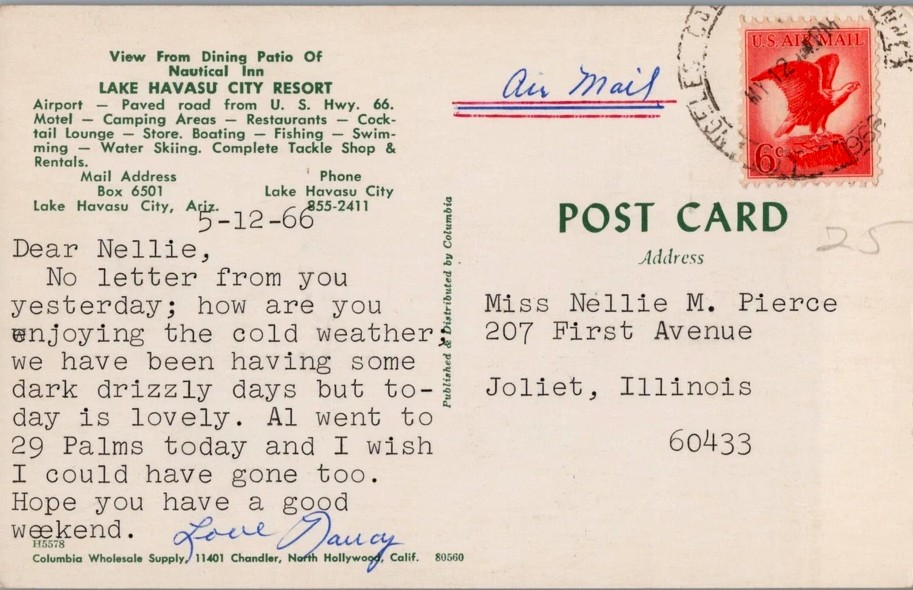
This postcard, sent by Frank and Helen to Mr. Fred Modlin in Hopkins, Minnesota, offers a brief glimpse into their trip to Nevada. The card was mailed from Prescott, where the couple were most likely getting ready to leave for warmer digs, perhaps even Lake Havasu City.

“Boy a week sure goes by in a hurry. We spent Tues & Wed in Laughlin at the Colorado Bell. I won’t stay there again as their new hotel is just too hard to get around. Back to the Riverside next time. It is now right about 100 degrees in Phex but it is cool here in fact we will likely need heat tonite. I don’t have any acorns to put up with, just carob beans. We are still going to try to get a little painting done but not much more than that. Frank & Helen

Just why the Colorado Belle was so hard for Frank and Helen to get around will remain a mystery. Were they stumbling about from perhaps too much German stout? Serious beer drinkers will know what I’m talking about here. These days, with the casino doors shut tight, getting around inside is an impossibility unless you’re a rat or mouse. More on that later.

The Colorado Belle Casino was one of the most iconic landmarks in Laughlin, Nevada. Shaped like a grand paddlewheel riverboat, it stood as a symbol of the city’s vibrant gaming and tourism industry for decades.

The idea for the Colorado Belle was born in the early 1980s, as Laughlin was transforming from a modest riverside town into a bustling gaming destination. The concept was to create a casino that would evoke the romantic imagery of 19th-century riverboats navigating the mighty Colorado River. Construction began in 1980, and the project was a massive undertaking, requiring innovation to replicate the appearance and grandeur of a paddlewheel steamboat.

The casino officially opened its doors to the public in July 1981. Its unique design, complete with twin paddlewheels and towering smokestacks, made it instantly recognizable and a popular subject for postcards and photographs.

In its early years, the Colorado Belle established itself as a premier gaming destination in Laughlin. The casino offered a wide variety of slot machines and table games, while the hotel provided comfortable accommodations for visitors. Over time, the property underwent multiple renovations and expansions, adding more guest rooms, dining options, and amenities to attract a growing number of tourists.

The Colorado Belle became known not just for its gaming floor, but also for its entertainment venues, restaurants, and riverside location. The property’s riverwalk offered scenic views and easy access to the Colorado River, making it a favorite spot for both gamblers and leisure travelers.

Throughout its history, the Colorado Belle changed ownership several times as the gaming industry in Laughlin evolved. It was operated by several different companies, including Circus Circus Enterprises (which later became Mandalay Resort Group), and eventually by Golden Entertainment. Each change in ownership brought varying degrees of renovation and modernization, but the casino maintained its classic riverboat theme.

The Colorado Belle was more than just a casino; it was a community icon. The property hosted numerous events, including concerts, festivals, and poker tournaments, which drew visitors from across the region. Its distinctive design and welcoming atmosphere helped define the look and feel of Laughlin’s waterfront.

As one of the city’s original themed casinos, the Colorado Belle played a significant role in shaping the identity and tourism appeal of Laughlin. It was also a major employer, providing jobs for hundreds of local residents over the years.

The Colorado Belle Casino faced challenges in the 21st century, including increased competition and economic downturns. In March 2020, the casino closed temporarily due to the COVID-19 pandemic and, unlike many other properties, did not reopen. In June 2020, operators announced that the closure would be indefinite, citing the ongoing economic impact and uncertainty.

Today, while the riverboat structure still stands as a familiar sight on the Laughlin Strip, the Colorado Belle’s gaming floor remains dark. Despite its closure, the casino’s legacy endures in the memories of visitors and residents who experienced its unique charm. The Colorado Belle remains a symbol of Laughlin’s history, a testament to the city’s evolution from a remote outpost to a vibrant gaming and entertainment destination.

I had the opportunity to recently view the Colorado Belle up close. It is rapidly deteriorating from the excess Laughlin heat and, in a matter of time, will most likely have to be torn down.

Rodent feces could be spotted on the outside, along with the smell of mildew. Much more is needed to get the stationary paddlewheels turning than just a fresh coat of paint. The wheels actually never moved, as it was special lighting that made it seem that way.

The Colorado Belle Casino’s story mirrors the rise and transformation of Laughlin itself. From its grand opening in the early 1980s through decades of entertainment and community involvement, to its closure in 2020, the Colorado Belle remains an enduring part of Nevada’s colorful gaming history.

Unfortunately, I was unable to find Frank and Helen’s full identity, yet Frederick Edwin Modlin in Hopkins, Minnesota, was no problem. He was born in Hopkins on December 23, 1922, and died there 77 years later on November 20, 2000. It appears he was a fruit farmer like his father.

Frank and Helen were merely rubbing things in with their postcard, as Fred was already freezing his buns off in Minnesota. Some folks have a way of doing that to their family and friends living in cold states.

If Fred had been a prankster, he would’ve made a copy of the card and sent it to Reverend Archie Bunker. Their message was perfect fodder for the fictitious preacher’s next sermon on gambling addictions.

WINKLEMAN

“The person sending Emma the postcard, I believe, was a secretary based on her use of shorthand.”

Motoring along on my picture postcard expressway, I came across a vintage card mailed around 1916 from an unidentified person in Winkleman, Arizona, to Miss Emma Walk in Tucson. Emma’s address was 820 South 3rd Avenue. The handwriting was so atrocious, I have to assume the card sender wasn’t a teacher but perhaps a doctor. A color photograph of Winkleman is on front of the card.

The postmark was faint, and I was unable to positively identify the date. Just enough letters were visible to make out Winkleman as the town it was mailed from. I came up with 1916 only by researching the recipient and Emma’s age at that time, as well as information regarding the house she lived in with her folks. The message reads:

“This is the great town will gh n car by 2 PM. Had to cross 4 rivers to get here. 1. The Publicco. 2. The San Pedro. 3. The Yarovgiha & right above here the Gila River. Love to Mama Daddy & you. Mollie II”

I believe the sender misspelled a couple of river names because there are none faintly close to Publicco or Yarovgiha. The shorthand letters gh n car evidently mean get here in car. “Mollie II” was added at the top of the card, and I assume it means the family dog.

Emma Mary Walk spent almost her whole life in Tucson. Born on August 30, 1904, the only child of Karl and Mary Walk, she graduated from Tucson High School in 1924 and married Frederic Nastor Finney on August 6, 1932. The couple had three children. Fred Finney was managing editor of the “Arizona Daily Star.”

Emma worked as a secretary for the Pima County Attorney’s office, and after retiring in 1976, was highly active with the Arizona Historical Society. She was an expert on Tucson history and often volunteered to help tutor students at Safford Elementary on the subject. Mrs. Emma Walk-Finney belonged to the Tucson Kennel Club for many years and was a dog lover. Emma Mary Walk-Finney died on January 8, 2002, at the age of 97. Tragically, her husband, Fred, died in 1965 of a self-inflicted gunshot wound to the head.

The person sending Emma the postcard, I believe, was a secretary based on her use of shorthand. He or she evidently knew the family well in referring to Emma’s parents as mama and daddy. Emma would’ve been around 12 or younger at the time she received this card. Why the anonymous sender was driving to Winkleman will undoubtedly never be known. It’s reasonable to say that the “car” crossing four rivers was a skinny-tired Ford Model T.

Winkelman, Arizona, located 343 miles east of Lake Havasu City and 63 miles south of Tucson, has a rich and unique history that reflects the broader story of mining towns in the American Southwest. Located in Gila and Pinal counties, Winkelman sits on the banks of the Gila River and has long served as a gateway to the copper mining regions of Arizona.

The area around Winkelman was originally inhabited by Native American tribes, including the Apache. In the late 19th century, with the expansion of railroads and increased interest in mining, settlers began to move into the region. The town is named after Peter Winkelman, an early settler and prospector who helped develop the local mining industry.

Winkelman’s growth was closely tied to copper mining, with nearby communities such as Hayden and Kearny also playing significant roles in the area’s mining boom. The construction of the Southern Pacific Railroad in the early 1900s made transportation of ore and goods easier, leading to increased economic activity. Winkelman became a supply and residential center for miners and their families.

During its peak mining years, Winkelman developed essential infrastructure, including schools, churches, and businesses catering to local residents. The Gila River provided water for agriculture and supported the town’s daily life. Community events, such as town fairs and parades, reflected the close-knit nature of Winkelman’s population.

Like many mining towns, Winkelman experienced fluctuations in population and prosperity as the fortunes of the mining industry changed. Environmental challenges, such as flooding from the Gila River, also impacted the town’s development. As mining activities declined in the late 20th century, Winkelman faced economic hardship, with many residents moving to larger cities for work.

Today, Winkelman is a quiet town with a population of fewer than 500 people. It serves as a reminder of Arizona’s mining heritage and the resilience of small communities. Visitors can explore nearby natural attractions and learn about the region’s history through local landmarks and stories passed down through generations.

The history of Winkelman, Arizona, is a testament to the pioneering spirit of its residents and the enduring legacy of the mining industry in shaping the American Southwest. Though its days as a bustling mining center have passed, Winkelman continues to embody the character and perseverance of rural Arizona.

I’ve marked Winkleman down as a place I now want to visit. Maybe then, I’ll find out what the true names of those two rivers are.

1932

FORT HUACHUCA, ARIZONA

“A high school photo shows her to be a beautiful young lady.”

Fort Huachuca

Judging by a picture postcard that Aunt Lill wrote to her niece, Fern Cunningham, in 1916, from Fort Huachuca, Arizona, the woman must’ve been in a tizzy.

“Dear Fern – This is one of the views back of our mansion am in a hurry good bye. Aunt Lill”

The front of the card shows a fading photograph of the Army fort with what appears to be the headquarters building. Aunt Lill was being a bit sarcastic because my research shows there were no mansions present during that time near the fort.

Fort Huachuca, located in southeastern Arizona near the city of Sierra Vista, stands as one of the most historically significant military installations in the American Southwest. Established in the late 19th century, the fort has played crucial roles in the Indian Wars, border security, military innovation, and continues to serve as a vital center for intelligence and communications in the modern era.

Fort Huachuca was founded on March 3, 1877, by Captain Samuel Marmaduke Whitside of the 6th Cavalry Regiment. The fort was strategically situated at the base of the Huachuca Mountains to counter Apache resistance led by the famed leader Geronimo and to protect settlers and travelers in the region. Its location provided a reliable water source and a defensible position, making it an ideal site for military operations during the turbulent period of the Apache Wars.

During the late 1800s, Fort Huachuca became a key operational base for the U.S. Army’s campaigns against the Apache tribes. The fort’s troops, including units of the famed Buffalo Soldiers (African American regiments), conducted patrols, secured supply lines, and participated in expeditions that ultimately contributed to the surrender of Geronimo in 1886.

The presence of the Buffalo Soldiers at Fort Huachuca is a celebrated chapter in the fort’s history, highlighting the contributions of African American soldiers to the nation’s military heritage.

As the Indian Wars ended, Fort Huachuca’s mission shifted. The fort was deactivated and reactivated several times, reflecting changes in national security needs.

During World War II, the fort experienced significant expansion, serving as the home of the 92nd and 93rd Infantry Divisions—both composed primarily of African American soldiers. The fort’s facilities were expanded to accommodate the influx of troops, and it became one of the largest training centers for Black soldiers during the war.

After World War II, Fort Huachuca continued to evolve. In the 1950s, it became a center for testing electronic equipment and unmanned aerial vehicles. The fort’s mission further expanded to include intelligence and communications. Today, Fort Huachuca is home to the U.S. Army Intelligence Center of Excellence and the U.S. Army Network Enterprise Technology Command, making it a hub for military intelligence training and cyber operations.

Fort Huachuca’s historical significance is recognized through its designation as a National Historic Landmark. The fort maintains several museums, historic buildings, and monuments that preserve its rich legacy. It stands as a testament to the evolving role of the U.S. military in the Southwest, the contributions of Buffalo Soldiers, and the ongoing importance of technological innovation in national defense.

From its origins as a frontier outpost during the Apache Wars to its current status as a center for military intelligence and technology, Fort Huachuca has played a pivotal role in American military history. Its enduring legacy continues to shape the region and the broader mission of the United States Army.

Miss Fern Cunningham, the recipient of the postcard, was born September 15, 1906, in Junction City, Kansas. A high school photo shows her to be a beautiful young lady. Fern’s dad and mom were Thaddeus and Theressa Cunningham. Thaddeus worked for the railroad as a switchman.

Fern married Tom Encell, and the couple lived in Junction City for a while, where Tom was involved in construction. They eventually moved to California. Fern Elaine Cunningham-Encell died on August 24, 2001, at the age of 94, and is buried at Forest Lawn Memorial Park in Glendale, along with her husband.

Aunt Lill was Lillian Schlatter, born in Wakefield, Kansas, on April 19, 1887. The Schlatter family hailed from Germany. Theresa was Fern’s mother, Lillian’s sister. Lill married Roy Thomas Dalton on October 7, 1907, in Geary County, Kansas. The couple had two boys.

Also involved in the building industry, like Tom Encell, Tom Dalton went on to become a highly successful contractor. Lillian was most likely living in Fort Huachuca because her husband was constructing government housing. The “mansion” Lillian made a sarcastic mention of living in was undoubtedly one of those less-than-stellar dwellings.

The Encells eventually moved to Granada Hills, California, where they accrued substantial property. Lillian and Tom divorced around 1942. Tom continued to build and was very wealthy when he passed away in 1957.

Lillian Schlatter-Dalton (Aunt Lill) died at the age of 85 on November 5, 1972. Ironically, Tom Encell’s second wife, Elizabeth, passed away that same year. Lillian is buried in prestigious Forest Lawn Memorial Park in Glendale, where her niece, Fern, is interred.   

Fern Elaine Cunningham

SUNNYSLOPE, ARIZONA

“When I first saw the name Sunnyslope, I thought of Aspen and Vail, Colorado, or some other skiing locale.”

Nogales, Mexico

In my enjoyable journey through vintage postcards that somehow escaped musty-smelling dresser drawers and old trunks, I came across one from the 1950s sent from Nogales, Mexico, to Clyde, Kansas. I found these two locales to be most interesting, yet a town mentioned in the postcard composition had me searching for its whereabouts.

Before we venture in that direction, I’ll transcribe and share the simple message sent to Geo. Chartier in Kansas from his brother, P.D., mailed from Nogales.

“Dear Brother

In Mexico to see the bull fight this afternoon. Weather nice and warm. Back to Sunnyslope tomorrow.

P.D.

When I first saw the name Sunnyslope, I thought of Aspen and Vail, Colorado, or some other sun-drenched skiing locale. It didn’t take but a few minutes on the internet to discover there’s such a place in Arizona, and there still is.

Sunnyslope is a vibrant, historically rich neighborhood in north-central Phoenix, Arizona. Known for its scenic views, close-knit community, and distinctive character, Sunnyslope has evolved from a rural outpost to an integral part of the city of Phoenix.

The area now known as Sunnyslope was first settled in the early 1900s. Originally attracting homesteaders and settlers seeking a fresh start in the Arizona desert, the region’s dry climate was considered beneficial for individuals with respiratory ailments, such as tuberculosis. The abundance of sunshine and the picturesque backdrop of the Phoenix Mountains gave rise to the name “Sunnyslope.”

During the 1920s and 1930s, Sunnyslope began to attract more residents, many drawn by the hope of healing and the promise of affordable land. Small businesses and services began to appear, supporting the growing population. The area remained somewhat isolated from Phoenix proper, developing its own sense of community and independence.

After World War II, Sunnyslope experienced significant growth. The influx of returning veterans and their families spurred a building boom, with new homes, schools, and churches established throughout the area. As Phoenix expanded, Sunnyslope’s population increased and its infrastructure improved. The community continued to foster a spirit of resilience and self-sufficiency.

In 1959, Sunnyslope was officially annexed by the city of Phoenix. This integration brought new municipal services and investments, further spurring development. Despite its incorporation into Phoenix, Sunnyslope retained its unique identity, with local organizations, businesses, and residents working to preserve the neighborhood’s character and history.

Sunnyslope is home to several notable landmarks, including the Sunnyslope Mountain (also known as “S” Mountain), which overlooks the neighborhood and serves as a symbol of community pride. The area also hosts historic churches, schools, and annual events that celebrate its diverse heritage. Throughout the decades, Sunnyslope has been recognized for its grassroots activism, local art scene, and welcoming atmosphere.

Today, Sunnyslope stands as a testament to the enduring spirit of its residents. From its beginnings as a desert retreat for health seekers to its present-day role as a dynamic Phoenix neighborhood, Sunnyslope’s history is marked by resilience, community engagement, and a deep appreciation for its natural surroundings. Its story continues to evolve as new generations contribute to the landscape and culture of Sunnyslope, Arizona.

George Albert Chartier was born in Clyde, Kansas, on January 1, 1890, and spent his whole life there as a farmer. He was one of six children of parents, Charles and Cora. Only completing 8th grade, George was a hard worker and successful. He went on to marry Marjorie Quinnette, and they had two children. George died on January 26, 1969, at the age of 79. George and Marjorie are buried in Clyde.

Pearl Dunning Chartier led a more adventurous life. Born two years earlier than George, Pearl was drafted into the US Army and saw service in France during WWI. Records show that he went beyond the call of duty. The following short bio, taken from his obituary, sums things up best about his honorable military career.

“The President of the United States of America, authorized by Act of Congress, July 9, 1918, takes pleasure in presenting the Distinguished Service Cross to Private Pearl D. Chartier (ASN: 2176261), United States Army, for extraordinary heroism in action while serving with Company H, 140th Infantry Regiment, 35th Division, A.E.F., near Charpentry, France, 27 September 1918. Private Chartier voluntarily went forward in the face of intense artillery and machine-gun fire and cut gaps through wire entanglements, to facilitate the advance of his battalion.”

Pearl also received the Purple Heart during the war and was a disabled veteran. Despite his injuries, Pearl Chartier served as deputy sheriff in Cloud County, Kansas, for a short time. Pearl Dunning (P.D.) married Gladys Pacey on June 21, 1944. The couple had one child, Duane.

Their time spent in Sunnyslope, Arizona, was most likely an attempt to improve his damaged health. The abundant sunshine and vitamin C must’ve helped. Pearl died on July 23, 1970, at the age of 82, and is buried in Salt Lake City, Utah, along with his wife, Gladys.

KLONDYKE FEVER

“A large body of water is seen in the background, undoubtedly the Yukon River.”

A souvenir 1912 postcard that I recently purchased has an interesting history behind it. To begin with, a photograph on the front shows a couple of Klondyke hunters dressed like cowboys with rifles and their Cocker Spaniel dog, along with rabbit furs and unskinned ducks tacked to a cabin wall.

A large body of water is seen in the background, undoubtedly the Yukon River. I only say this because underneath the picture, a caption says that it is the famous river.

I believe this picture was taken at Forty Mile in the Yukon Territory of Canada. A nicely penned, yet very tough to translate message on the back reads as follows:

“At Camp May 10 1912

Dear Henry

Recivd you nice letter was so glad you were well also Teddie don’t drive Teddie to much when it gets hot he might get sick, This is a picture of some hunters see all the rabbits & ducks they have. Guess you are lonesome now that school is out. Be careful of snakes when the weather get some sun land. By love you. Papa

The card was sent to Mr. Henry Flynn, French Corral, Nevada County, California. French Corral is a small town located near Nevada City. There’s not much left of it now, other than some building foundations and remnants of the Wells Fargo bank. It’s classified as a ghost town.

Nevada City has a unique history of its own. The town was founded during the California Gold Rush in 1849 and quickly grew into one of the most prominent mining towns in the region. The city’s historic downtown reflects its rich past, with many buildings dating back to the mid-19th century.

Over the years, Nevada City has transitioned from a bustling mining hub to a vibrant community known for preserving historical landmarks and its active arts scene. Today, it is recognized for its charming architecture, cultural festivals, and scenic surroundings in the Sierra Nevada foothills.

The person sending this postcard was Patrick Henry “Patsy” Flynn. Friends called him Patsy. Patrick mailed it to his 10-year-old son, also named Henry. The mention of Teddie most likely points toHenry Jr.’s horse. The short biography of Patrick Flynn was taken from his obituary.

Patrick Henry Flynn was born on January 22, 1866. As a young man, Patrick followed the vocation of teaming, supplying materials for the construction of early railroads in California.

From this, he learned the blacksmithing trade and proceeded to North San Juan Ridge, where hydraulic mining was in its “heyday”. From 1904-1914, Patrick traveled to Alaska & worked in the gold mines during the new gold rush there.

He served as a blacksmith and mechanic for the Esperanza Mining Co. and later for the Bay Counties Power Co. at Colgate, Yuba County. When hydraulic mining was discontinued, the elder Flynn worked for the Guggenheim Corp. in the Yukon Territory, Canada.

In 1914, he moved his family to Nevada City, where he resided until his death at the age of 84 on November 14, 1950. Patrick was a devout Catholic, a member of the Knights of Columbus and the Holy Name Society.

Young Henry Clinton Flynn was born on March 2, 1902, in Birchville, Nevada. In 1931, he married Elsie Clara Casci. Married for 57 years, the couple had no children.

Henry worked for Pacific Gas and Electric for 47 years. He died at the age of 85 on December 16, 1987. Elsie passed away on February 15, 1993, at the age of 83.