THE NUTCRACKER

“My brother and I eventually came to possess our own.”

I recently wrote a story about my most memorable Thanksgiving experience. It had to do with a visit to Uncle Noel and Aunt Gay’s house in Birmingham, Alabama sometime around 1960, and my knocking over a glass of sweet tea into a hot bowl of gravy, just as the meal got underway. That blunder pretty much ruined Aunt Gay’s well-planned Thanksgiving dinner.

Flashing ahead to Christmas which is rapidly approaching, I can’t nail down any one specific holiday standing tall above the rest. They were all special. There were several things repeatedly happening during our Christmases that I believe other families took part in as well. Tossing balls of wrapping paper at each other being one, while always having fruitcake on hand being another.

Somewhere back in time, Mom purchased or was given a nutcracker set. I recall it being chrome plated, with spring-loaded hinges on top. Our nutcracker basically resembled a set of martial arts nunchuks. You’ll have to Google that word to get the full picture.

A nut would be placed in the middle of two rods and squeezed until its shell broke. This worked fine for soft nuts like peanuts and pecans, but for some of the harder stuff it was a joke. Dad didn’t even have strength to break them open. Sometimes, this flimsy nutcracker did more damage to fingers and knuckles than nuts. A hammer was generally hauled out to finish things off.

Included in Mom’s nutcracker set were several sharp metal picks used to pull “meat” out of a broken shell. For whatever reason, my parents referred to the edible part of a nut as meat. Go figure? A wood tray, selection of nuts, and cracking tool were placed on our coffee table each holiday season. Mother kept the picks out of harms way in a kitchen drawer.

My brother and I eventually came to possess our own. Much bigger and totally different than Mom’s, they were given to us as Christmas gifts in San Antonio, Texas. I still have an ancient, 8mm movie, showing them parked in our living room, with a silver Christmas tree proudly standing in the background.

The exclusive nutcrackers I’m referring to were a matched pair of “English Racer” bicycles. They were manufactured by AMF and had skinny tires along with three-speed shifters. Both bikes were a bit tall for us, yet the folks evidently figured we’d grow into them. From the get-go they were nothing but problems. Stuff was always going wrong like the headlights never working including brakes, and gear shifters malfunctioning. I ignorantly blamed it on them being from England although they were made in the U.S.

Jim and I would race around the block, standing up while pedaling to reach maximum speed. That’s when we learned to be respectful of the deadly machines. Sometimes, when pedaling for all it’s worth and shifting gears, the chain would unexpectedly fly off. When that happened, you’d come down hard between the middle of your legs on the upper frame tube. To say this was a painful experience is an understatement. It happened numerous times.

I recall my brother performing this act as the grand finale to an otherwise spectacular burst of speed. We were racing and he was in the lead like always, when Jim’s chain disengaged and his body quickly dropped to the center bar like a ragdoll.

Out of control at this point, he slowly veered off the gravel road, with toes of both shoes dragging the ground to stop. He soon crashed and burned; figuratively speaking. In severe agony, my brother was black and blue in the most sensitive area of male anatomy, and had to be taken to the emergency room.

After that incident, Dad converted the bikes into single-speed by eliminating shifters and other components. Technically, we no longer rode English Racers although we still called them that. These now much slower bikes didn’t hang around long before being sold or traded to friends.

The other day, my wife was listening to a holiday music channel on our Jeep radio. “Dance of the Sugar Plum Fairy” came on and it’s one of my favorites. The tune was written by Russian composer, Peter Tchaikovsky, as part of his famous, “The Nutcracker Suite” ballet.

I seriously doubt Tchaikovsky was thinking of an English Racer bicycle when he composed this ballet, although if he removed the word Suite, the title fits like a glove!

TURKEY DAY DILEMMA

“Thanksgiving with my grandparents didn’t happen every year, as we lived too far away to always venture that direction.”

My sixty-eighth Thanksgiving is rapidly approaching, and it appears the wife and I will be celebrating this one alone. We’d prefer to be with family, but unfortunately, medical events and logistics prevent such. Sometimes, there’s no way around life’s roadblocks unless you decide to barrel straight through them. I’m less apt to do that at this point because the consequences aren’t always good.

I have many great Thanksgiving memories stored upstairs for safekeeping. All of them are precious except for one. More on that in a few minutes. Thanksgiving with my grandparents didn’t happen every year, as we lived too far away to always venture that direction. I enjoyed five holidays with them at most. The one I remember quite vividly was in 1964, when we journeyed for two days from Lubbock, Texas to Vernon, Alabama, and the same amount of time driving back. I believe after four days of travel, we only spent seventy-two hours with both sets of grandparents.

On that trip, Dad was behind the wheel day and night to get us there. I’d brought along a new camera and somewhere around two in the morning, as I toyed with the device, the flash accidentally went off directly into his rearview mirror. My father veered off the road and blew a tire in the process. He was so mad that Mom had to intervene, or he would’ve killed me. In an act to make sure it wouldn’t happen again, he grabbed and tossed my flash attachment as far as he could. Other than that slight delay, I believe this Thanksgiving turned out just fine.

My worst recollection of a Thanksgiving was when I was perhaps six or seven. We traveled to Birmingham, Alabama to visit my Uncle Noel & Aunt Gay McDaniel, including cousins Randall and Cheryl. Aunt Gay was a perfectionist and she always set a perfect table for holiday dinners. The silverware was in its proper spot, with dishes, plates, and napkins following suit. This was the first time I came in contact with a gravy boat. In our mobile home, gravy was always placed in a small cup or bowl.

When we ate dinner at other people’s homes, my brother and I were often relegated to a small table in the living room. For reasons that I’ll never know, at this meal, Jim and I were allowed to sit with the adults along with our older cousins.

Aunt Gay used a fancy linen tablecloth to cover her expensive oak table. The chairs were big and heavy. At our little trailer in Selma, Mom kept a plastic tablecloth in a kitchen drawer, and it was only brought out for special occasions.

Soon after the blessing was said, I fumbled my glass of sweet Alabama tea. Sticky liquid went everywhere, including into Aunt Gay’s gravy boat. The boat didn’t sink, yet hot gravy overflowed like it’d been torpedoed. To mother, this simple blunder was a major calamity. I’m sure a certain word was whispered by all to describe my clumsiness, yet I’ll keep it secret ’til the very end of this story.

I can still rehash minute details because Mom oftentimes brought this dilemma up at family get-togethers. Over time, she eventually found humor in such.

After the mess was cleaned and tablecloth changed, a card table was quickly erected for us youngsters to finish our meal on. I believe sympathy is the only reason my cousins politely joined Jim and me. For several years after that incident, “card table status” remained a ritual of my holiday dining experience.

These days, I chuckle whenever I see kids enduring the same, figuring at least one of them is also a klutz.

TREASURE HUNT

“The worst thing so far was coming across bones that we thought were human.”

One of my favorite hobbies is taking a metal detector into the nearby desert and searching for gold, silver, meteorites, WWII bullets, and anything else metallic. For the most part, my wife and I have uncovered a bucketful of old bullets versus a miniscule number of precious metals.

We feel we’re doing the environment good by hauling out all that toxic lead. I discovered one small meteorite in Yucca a few years back. It was actually setting right on top of the ground near an abandoned gas station. Joleen detected a cache of newer coins scattered along a section of trail in the Standard Wash area of Havasu. They amounted to $3.85, and most likely spilled out of a hiker’s pocket as he or she walked the rugged terrain.

We’ve came across cellphones, knives, jewelry, and even a Mercedes trunk emblem. Perhaps the most unusual find is a 10-foot-long octagon pole made of steel. It has a squared, tapered point on one end. I believe it was used in surveying years ago, or perhaps a hunter stuck the thing down a rattlesnake hole in hopes of shish kabobbing one.

My first detector was bought in 1976. It’s a White’s hip mount model and still works like new. I use it on occasion although it’s much heavier than the Garrett and Fisher models we also own. My first major find was a glass piggybank with rusted glass lid near Wakefield, Kansas. The jar was located on a long-abandoned farm dating back to the late 1800s. It contained three, plastic, gas-ration-tokens from WWII. The value is minimal but nonetheless a great discovery.

As a means to get my son and grandson interested in metal detecting, I purchased a plethora of vintage coins, both silver and copper. Although most were minted some 100 years ago, none were of substantial value. I probably spent fifty bucks on the whole parcel.

We live next to the BLM, so it was no problem walking out back and planting all 30 coins in a sandy and rocky, 50-foot x 50-foot area. The coin locations were clearly marked on a hand drawn map, so that I had a way of locating them in case they weren’t discovered.

Gunnar and Kevin had a blast searching for the treasure. It took them a couple of hours and they uncovered 29. Using my map, I gave them the general proximity of the lost one, and it, an Indian head penny, was plucked from the earth.

My wife and I don’t metal detect strictly for the find, but more for exercise than anything else. We take plenty of water and snacks for breaks, plus a cellphone just in case something bad should happen. The worst thing so far was coming across bones that we thought were human. Turns out they belonged to an unfortunate burro instead.

On my list of things yet to do, I intend on planting more coins on a parcel of land that we own. I’ll do the same as before, mapping out the locations, along with listing what year and denomination the coins specifically are. The kids and grandkids won’t get to search for this treasure until after I’m gone.

It’ll give them something to remember grandpa by, other than him being cranky at times, and having a quirky sense of humor. The memory of this hunt, hopefully, will be worth more than the treasure stuck in their pockets!

Portion of treasure hunt area behind our house.

DIG IT

“There’s deep meaning here and totally beyond my comprehension.”

In-crowd wannabes

Approximately thirty years ago, after listening to the classic 1960’s hit, The “In” Crowd by Dobie Gray, my daughter asked if I hung out with those type of students. Chuckling, I quickly told her, “Not that I recall!”

To be honest, I don’t know who the in-crowd was back then. Pondering this question for the past several days, Dobie Gray’s song title was Googled to refresh my memory on lyrics. Opening lines go like this:

“I’m with the in crowd.

I go where the in crowd goes.

I’m in with the in crowd.

And I know what the in crowd knows.”

I have no idea where the in-crowd went back then. I’m talking East Anchorage High School in Alaska during the late ’60s and early ’70s.

Shakey’s Pizza was one of our favorite haunts, yet I doubt this crowd spent much time there. As far as that second stanza, what did those classmates know that I didn’t?

I’m guessing it was algebra and trigonometry. I never did catch on to either subject and they’re totally useless at this point. A couple more lines from Gray’s tune are as follows:

We got our own way of walkin’.

We got our own way of talkin’.

I didn’t share either of those traits unless the statement, “Cool!” accounts for something. This word was frequently used by my friends and still is.

And my favorite Dobie Gray line out of all is,

“Oh, if it’s square, we ain’t there.”

There’s deep meaning here and totally beyond my comprehension. It’s much like the saying, “Dig it.”  Dig what?

Now, fifty years after graduating from high school, I can say without question that I’m a bonified member of the end-crowd. This group of cool, hip seniors, is a tough and cagey bunch. Just being able to walk and talk is highly important to us. Dobie Gray’s no longer here to compose a tune, so I did it for him:

The End Crowd

“I’m with the end crowd.

Needin’ a cane, to ease back pain.

Gettin’ the chills, where are my pills?

In front of me, I still can’t see.

I’m with the end crowd.

Whether far or near, I just don’t hear.

Turn up the heat, can’t feel my feet.

Parked on a line, is that some crime?

Who cut the cheese? Thank you, Febreze!

I’m with the end-crowd.

We got our own way of walkin’.

We got our own way of talkin’.

We got our own way of gawkin’.

And we got our own way of rockin’.

Dig it, but not too deep!

End Crowd

GOING SPIRAL

“What difference does it make?”

Spiral notebooks

I was going through some of my clutter and came across an elementary school report card from fifth grade. For the most part, I did well in all subjects, except there was one glaring remark in the comments section that flagged my attention.

“Michael does not follow directions.

That was something my folks already knew. Most young guys had the same problem if you can even call it one. I believe it’s hereditary to the male species and more of a “trait” than anything.

Part of my not following instructions had to do with placement of headings. Some instructors wanted your name, class, and teacher’s identity in the upper left-hand corner, while others expected it just the opposite. I’d sometimes get confused before a test began, especially if it was Monday morning.

Having a 50/50 chance of getting things right, I was generally wrong. Evidently, Mrs. Drake deemed this a real dilemma, along with her students using spiral notebooks. She briefly mentioned that in the comments section as well.

Spiral notebooks were disliked by some teachers, most likely because they hated seeing all those jagged edges when a page was removed. There were many times I had to borrow a regular sheet of paper from a classmate to avoid being penalized. Some kids went so far as to use scissors to trim the ragged remnants, but that narrowed the border considerably.

On the flip side, some spiral notebooks that my wife recently purchased from Wal-Mart have perforations next to the springs for ease of page removal. Why didn’t notebooks from the 1960s have the same? It seems we’ll be going spiral for eternity, because at .19 cents apiece on sale, Joleen purchased twenty of the books in a variety of colors.

Getting back to that ancient report card. The “does not follow directions” still remains a part of my life.  Now days, I find it more challenging in trying to put something together while looking at an instruction sheet, than not. With so much stuff being manufactured in China, it’s often a brain teaser attempting to decipher their crudely composed schematics.

The other evening, I successfully assembled a Chinese made paint sprayer purchased from Harbor Freight. The manual showed a couple of bolts being installed one direction, while a picture on front of the box showed them turned the other.

“A picture is worth a thousand words!” came in handy here. I stopped looking at the instructions and went strictly by photo. All turned out well.

One specific guideline that I seldom adhere to, is using black ink when it’s called for on legal, government, and medical papers. Some folks believe it’s a cardinal sin to not follow this rule. If a blue ink pen is found in my desk drawer first, blue automatically becomes the color. To this date, no one’s ever denied nor returned any paperwork due to improper hue.

As Hillary Clinton would say, “What difference does it make?”

That’s exactly what I was thinking near sixty years ago regarding the use of spiral notebook paper!

PET PEEVE

“I’m sure some Sherlock Holmes would’ve wandered over with a buddy, stood there for several seconds before unwisely replying…”

“Run to the Sun”

The “Run to the Sun” car show is almost here, and I’m looking forward to it. My wife and I have been attending this event for close to thirty-five years, not as participants, but as gawkers. I’ve always said I’d love to enter a vehicle just one time, and perhaps this is the year.

It’s not that we didn’t have anything to display. Our vehicles were always in Alaska, and I didn’t have sufficient time to trailer one down. Those were the working years, so vacation time was limited.

We’ve been to so many shows over the past fifty-years that it’d be impossible to count. The Street Machine and Street Rod Nationals in Tulsa, Oklahoma, and Minneapolis-St. Paul, Minnesota, are the first shows visited. This was in 1974, 1976, and 1977, when those events were just getting off the ground.

Many shows don’t allow newer automobiles to be entered, and I’ve never figured out why. It’s a pet peeve of mine. Modern vehicles like Hellcats, ZO6 Corvettes, Supercharged ZL1 Camaros, and even Teslas turn teenage cranks more than ’32 Ford Roadsters or ’55 Chevys. Our local show allows most of the above except Tesla’s, and for some odd reason, Dodge Chargers were excluded.

Where demographics are concerned. I rarely spot, but a handful of young faces taking in “Run to the Sun.” Most are middle-aged or ancient dinosaurs like me.

At automotive venues that allow late-model vehicles, I often hear the same cliché repeated by car-show geniuses. “Yeah, that car was purchased new and brought here. Anyone can do that!” In their minds, if a car isn’t old or “built,” it’s nothing special. Usually, the ones vocalizing such had someone else build theirs.

My father owned a Texaco service station in the late 60s and early 70s. This was during my teen years. As an employee, I took it upon myself to test-drive some of the fastest iron Detroit offered: Pontiac GTO Judges, Chevrolet Z-28 Camaros, Plymouth Roadrunners, GTXs, and Ford 428 Mach 1 Mustangs, to name a few.

Those were all newer, showroom-quality vehicles back then. Today, these same muscle cars draw a slew of admirers, though the numbers are dwindling as this older generation quietly rides into the sunset.

We have only one vehicle eligible for the upcoming show. Our 1950 Chevy truck will have to suffice, although it’s not pretty. Had we even been allowed to enter the Dodge Redeye Hellcat Charger, I would’ve hesitated.

I’m sure some Sherlock Holmes would’ve wandered over with a buddy, stood there for several seconds with a beer in hand, before unwisely replying, “Yep, definitely purchased from a showroom and then brought here. Anyone can do that!” He would’ve only been partially right because it was special-ordered in Ohio through a dealer friend of ours.

No biggie. I’m sure the owners of 426 Hemi Chargers, 428 Shelby Mustangs, 455 Pontiac GTOs, and SS-454 Chevrolet Chevelle’s had to endure the same head-shaking wisdom some fifty years ago.

Should someone ask if I built my ’50 Chevy, I’ll tell them, as I’ve wanted to tell so many others: “No, Cloyd Boddington slapped it together.” Only seasoned car guys and gals will catch the humor!

Michael Hankins standing in front of his 1968 Dodge Charger (1972 photo)

SHOP TALK

“I always looked forward to going, making sure to pack a tasty lunch.”

Turnagain Arm near Girdwood with Seward Highway on left

There’s a tiny hamlet located some forty miles south of Anchorage, Alaska that holds a special space in my heart. Girdwood is on the Seward Highway, directly across from the gray, silty waters of Turnagain Arm. It’s home to the world famous Alyeska Ski Resort. To some locals, the nickname for this place is “Girdweed.” Savvy readers will know what I’m referring to. Approximately two thousand residents live there.

The surrounding terrain is popular with hikers during summer months, and some higher mountain peaks never fully shed their snow and ice from winter. I was fortunate to work in Girdwood for several years.

The State of Alaska – Department of Transportation, has a shop on the outskirts of town where equipment is stored for road maintenance. I’d travel there several times a month to service and repair graders, snowplows, loaders, and smaller equipment. I always looked forward to going, making sure to pack a tasty lunch.

Most of the work was dirty and greasy, yet the beautiful drive from Anchorage and back more than made up for my pungent diesel fuel aroma. That odor clung to orange coveralls like an overdose of Brut cologne on a freshly shaved face.

It was common to spot Beluga whales searching for Hooligan in the salt water. Hooligan are a delicacy not only to whales but people as well. Dip nets are used on Twentymile River to capture them before they head upriver to spawn. This glacier fed river is about twenty miles south of Girdwood thus the name.

Dall sheep posturing along the roadway for photos are seen, along with timid black bears scurrying across soggy tundra near the Girdwood shop. Eagles, either flying or perched on rocks, moose, and birds of all type hung around most of the year.

Just recently, a friend sent me a hiring announcement for three operator positions at the Girdwood DOT facility. That’s unheard of, because back in the day when people actually wanted to work, getting hired there took patience. Some guys never left unless they physically or medically had to.

Thinking back to these always welcome road trips, I recall above everything else, taking breaks or eating lunch with the guys. This was if they were still in the shop, as most of the time the crew was out doing road repairs. We’d talk cars, trucks, motorcycles, snowmobiles, boats, hunting, fishing, along with the normal everyday shop talk. It’s surreal that no one’s left from that group other than five: Andy Hibbs, Doug Webster, Drew Motsinger, Dick Redman, and me. Sadly, a good many have now left this world. I considered all of them friends.

Larry Bushnell was an equipment operator before becoming shop foreman. He was a state employee for thirty-eight years. It was only one year after leaving state service that he had a massive heart attack and died. That was 2014. Larry was operating a personal backhoe when it happened.

Pat Vail passed four years earlier from a longtime illness. It was suspected that his Parkinson’s disease came from being subjected to agent orange during the Vietnam War. I have another pal that fought over there and came down with the same affliction.

Rob Hammel was helping a lady get her vehicle unstuck on the Seward Highway one winter, when a car slid out of control and struck him. He died instantly. I often saw Rob at art exhibits where we both shared a love for Alaskan wildlife pictures. He was looking forward to retirement.

Terry Onslow succumbed to complications from pneumonia not long after retiring. Terry was in charge of avalanche control and very knowledgeable in this area. His radio moniker was Avalanche One. I jokingly called him, “Avalanche Juan.”

Leif Loberg enjoyed his “freedom” for twelve years before an illness took him down. A veteran mechanic once candidly told the good-natured man, “Leif it alone!” This was after Loberg started to take a partially repaired loader from the shop. After that, everyone used the comical phrase including Leif.

I swapped tales with all of these guys during my DOT tenure. I still vividly remember some of them, especially one story regarding a huge, seventy-pound king salmon caught by Pat Vail.

If I was younger, I’d happily take one of those three open jobs. There’s no better place to work than Girdwood. Undoubtedly, some mechanics and road maintenance personnel in Lake Havasu City would argue the point. Girdwood and this community share similar traits. Both lie in picturesque settings surrounded by pristine water and rugged mountains. Working in Arizona’s summer heat can be brutal while the same can be said for subzero Alaskan winters.

Shop talk here is probably much the same during breaks and lunch as it was in Girdwood back in the day. Some guy or gal bragging about a huge striper or bass reeled in from Lake Havasu being an example. The stories would all be similar except for one major part. It’d be impossible to top Pat Vail’s story regarding that massive salmon. When fish stories end up in the workplace, Alaska will always come out on top!

Seventy-pound king salmon representative of the one that Pat Vail caught.

MAKE MINE RARE!

“If my books never make a best seller list that’s okay.”

A simplification of the word rare regarding collectibles is, limited quantity or scarce. I have a few items meeting this definition, and some things headed that direction.

A special 1799 silver dollar given to me by a departed friend is quite rare. There were several minted but only a few survive. Twenty or more Alaska drug store bottles in my possession are quite scarce. Only five or six are known of the Iditarod specimen.

A prized book by author, William Guthman, is extremely rare and valuable. I’m blessed to have a copy in my library. The rarity comes from a limited amount being printed.

Years ago, I looked into writing screen plays for movies. I was immediately turned off in seeing that writers need to belong to the Screen Writer’s Guild. That was an immediate let down. The same with writing music. There’s even a Song Writer’s Guild.

What these guilds amount to are hands sticking out wanting a share of your talent and money. They’re nothing more than a hungry buzzard circling overhead, much like Colonel Tom Parker was to Elvis Presley.

The same greediness exists where writing books is concerned. It’s hard to get new publications noticed unless you have a publicist or agent. There again, more fingers are lurking in the shadows wanting their cut. Thankfully, I don’t write strictly for money as some writers do. I’d be better off flipping cars or houses if financial reasons were what powered me.

I get offers all the time from companies and individuals professing to be promotional experts where selling books is concerned. I screen my calls carefully and never pick up. They’ve went so far as to track down my children and friends, asking if they knew how to get hold of me.

I was once asked why I didn’t reach out to these professionals. One person said I could sell a lot more books if I did. I look at it this way. I didn’t seek their help composing my material, and I don’t need it now.

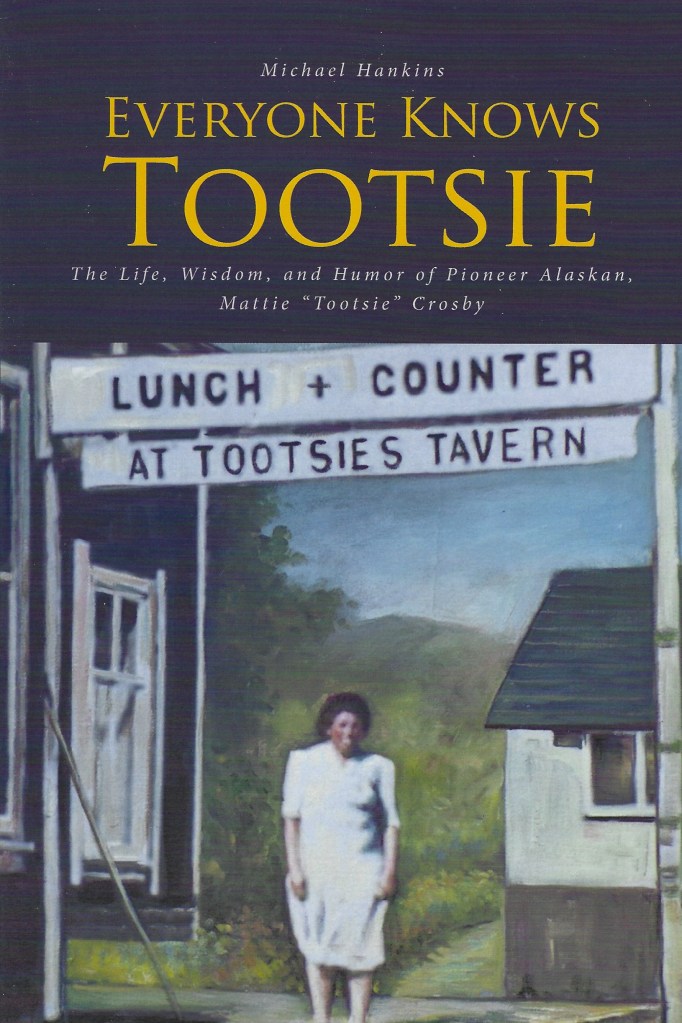
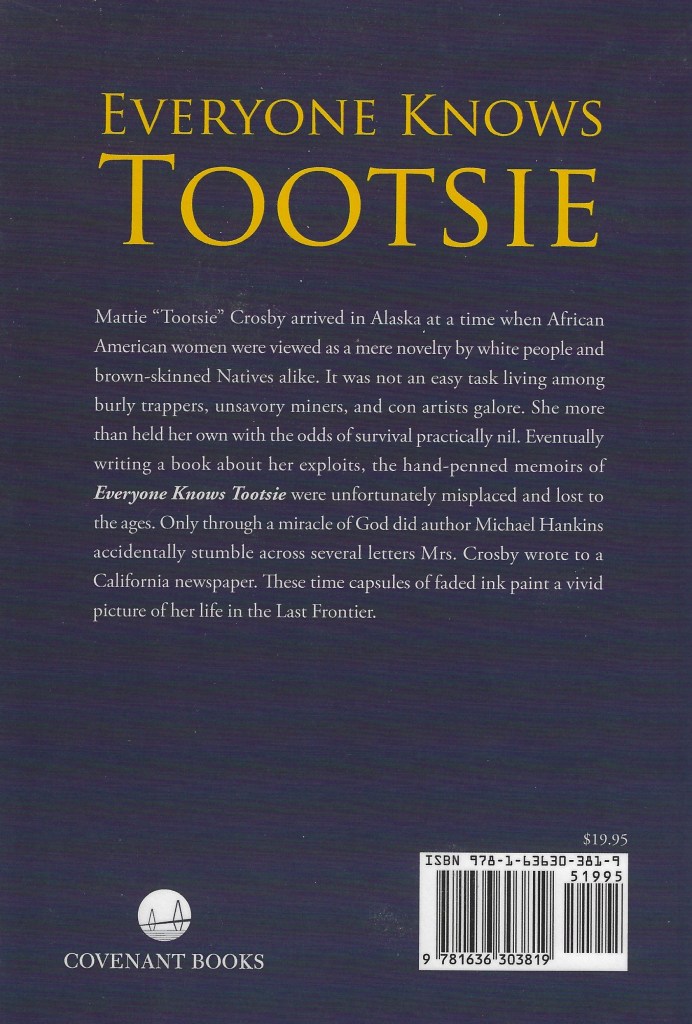
I’ve even had some criticism where my writing is concerned. When you’ve lived in Alaska as long as I have, snide remarks have a way of getting back to you. One self-acknowledged expert on Alaska history criticized a book that I wrote on Mattie “Tootsie” Crosby. “He should’ve never included religious viewpoints!”

What this fellow failed to realize is that I was led to do so. I’m not sure he’d even know what that means. I took the time and effort to put this book together strictly because it came to me one night while sleeping. Mattie “Tootsie” Crosby wanted folks to know foremost, that she was a Christian. Her letters to a newspaper that I accidentally came across dictated such. Earlier articles published on Mattie Crosby failed to disclose anything dealing with her faith.

If my books never make a best seller list that’s okay. In one hundred years, they’ll join the ranks of rare collectibles much like that 1799 silver dollar, Iditarod medicine bottle, and William Guthman book. I’d much rather have a few publications in this category, than a thousand, sitting on secondhand store markdown tables throughout the country.

I truly wish I could be here when my future grandchildren inform their friends, “My great grandpa wrote this book and it’s rare.”

That alone will be priceless!