“Driving is the only way to fly when taking in scenery or stopping at unique little places to eat…”
In my review of vintage postcards, this one had me laughing at the name alone. Shangri-La Motel conjured up a vision of some seedy dive one might find on Bourbon Street in New Orleans, or Las Vegas, but not Tuscaloosa, Alabama.
Checking this motel’s history out, the name was a bit risqué for a very nice place to stay. It appears the Shangra-La was built in the 1940s, advertised as meeting AAA and Duncan Hines motel standards. In 1957, an ad for the place said that they offered year-round air conditioning, free TV, tile baths, and telephones. It was located 7 blocks from the business section of Tuscaloosa and next door to the famous Waysider Restaurant.
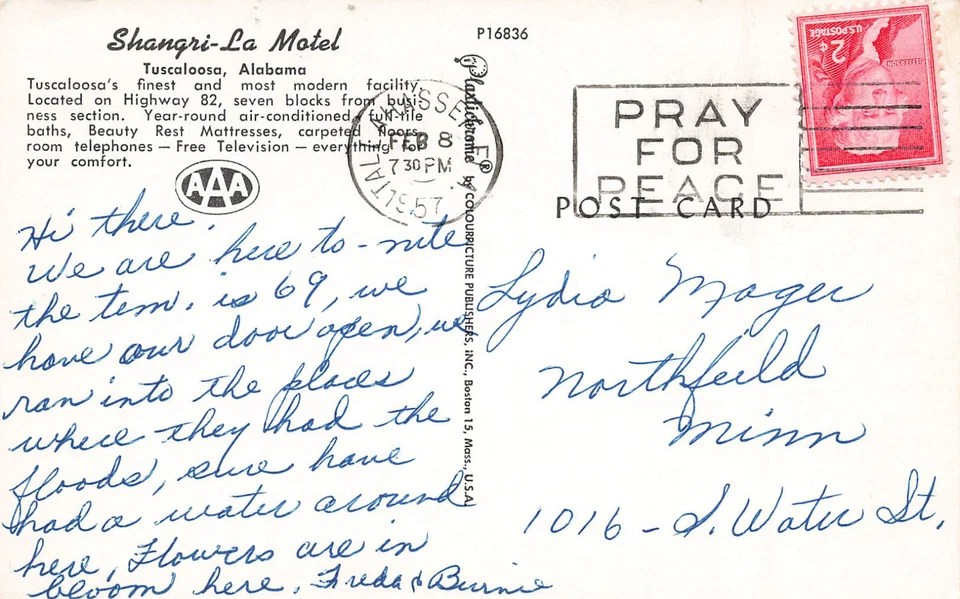
Someone named Freda & Burnie sent this postcard to Mrs. Lydia Mager in Northfield, Minnesota, on February 8, 1957. The traveling couple mailed it from a Tallahassee, Florida, post office. The free postcard would’ve been found in the motel room desk for Freda & Burnie’s use, along with a Gideon’s Bible. The message said:
“Hi there,
We are here to-nite. The tem. is 69, we have our door open. We ran into the places where they had the floods, sure have had a water around here, flowers are in bloom here. Freda & Burnie”
Lydia Mager was a widowed lady living in Northfield, Minnesota, at 1016 S. Water Street. Researching this address, amazingly, the house still stands and is quite cute in appearance. Lydia must’ve thought highly of the postcard for it to have survived. Perhaps she, too, was curious about a motel called Shangri-La.
It took some digging, but I was able to figure out that Freda and Burnie’s last name was Hanson. They too lived in Northfield and were undoubtedly on a road trip. Good for them. Driving is the only way to fly when taking in scenery or stopping at unique little places to eat, like the Waysider Restaurant. Thankfully, it’s still open.
Burnie and Freda Hanson were Lutheran Norwegian Farmers. Married on June 7, 1928, they were unable to have children of their own; thus, they adopted a little girl, Doris Fjerstad. In an interview after her stepparents passed away, Doris told a reporter that she couldn’t have had any better parents than Burnie and Freda.
Burnie Raymond Hanson died on June 7, 1958. He was only 56. Freda Augusta Schultz-Hanson passed away on October 20, 2002, at the age of 96. Lydia Caroline Schultz-Mager was Freda’s older sister. She died on February 23, 1994, at the age of 90.
The Shangri-La Motel may have been one of Tuscaloosa’s finest motor lodges, but by the 1970s, things had gone downhill. A fire took out a good portion of the rooms in 1975, and it was shuttered for good.
In 1979, a Huntsville newspaper reporter used the Shangri-La to make a subtle yet hilarious slam at the Auburn Tiger football team, basically saying that their favorite place to stay while in Tuscaloosa had seen a wrecking ball.
Circa 1940sMere days before the structure was torn down.1512 Greensboro AvenueLydia Mager’s little home in Northfield, Minnesota (2024)
“It was quite easy to find out who the Russomanno family was, with Joe having 13 daughters and 3 brothers.”
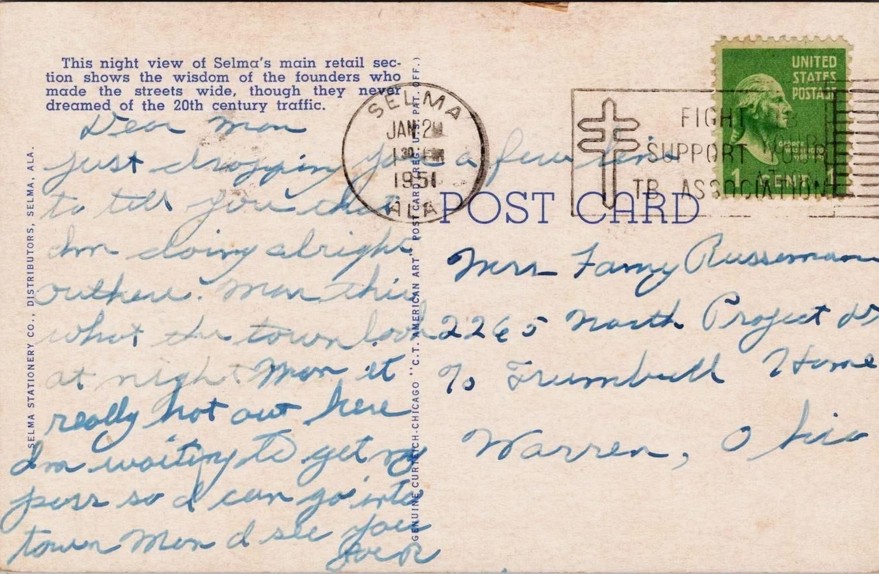
A picture postcard mailed on January 2, 1951, features Broad Street in Selma, Alabama, at night. 1940s vehicles can be seen parked, while one driver has their headlights on.
A Sears business sign is brightly lit as a full moon glows through partly cloudy skies. Stars are highly visible across the dark sky. It’s a scene that unfortunately no longer exists. A brief history of Selma’s decline explains why.
Once a vibrant hub of commerce and community, Selma, Alabama, has witnessed significant transformation over the decades, marked by a gradual decline in its urban landscape and economic vitality. In the mid-20th century, bustling streets lined with businesses such as Sears, illuminated signs, and the lively movements of classic automobiles painted a picture of prosperity and civic pride. Selma’s nights, adorned by glowing marquees and starlit skies, reflected a thriving Southern town with strong cultural and historical roots.
However, like many American cities, Selma faced challenges as industries changed and populations shifted. Economic downturns, suburban migration, and the loss of major businesses contributed to the fading of its once-bustling downtown. Many historic buildings were left vacant or fell into disrepair, altering the character of streets that were once centers of activity. The social fabric, shaped by generations of families and a storied role in civil rights history, has been tested by outmigration and changing demographics.
Today, the decay of Selma is evident in shuttered storefronts, diminished public services, and the absence of the vibrant nightlife that postcards from the 1950s captured so well. While restoration efforts and renewed interest in Selma’s historic legacy continue, the city’s physical and economic decay remains a poignant reminder of the challenges faced by small towns across America in the wake of modernization and shifting priorities.
Joe R. mailed this Selma postcard to his mother, Mrs. Fanny Russomanno, in Warren, Ohio. It was quite easy to find out who the Russomanno family was, with Joe having 13 daughters and 3 brothers.
The brief message on his card says:
“Dear Mom,
Just dropping you a few lines to tell you that I’m doing alright out here. Mom this what the town looks like at night. Mom it really hot out here. I’m waiting to get my pass so I can go into town. Mom I see you. Joe R.
Concetta “Fannie” Clemente-Russomanno and her husband, Antonio Solvatore, came to America from Italy, where they were both born. Antonio (Tony) worked in Warren, Ohio, as an ironworker for Republic Iron and Steel, while Fanny was a stay-at-home mom.
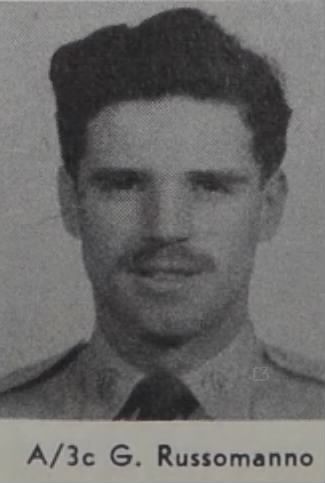
Joseph Joe” Russomanno was born in 1931. At the age of 19, he enlisted in the US Air Force, where he was then sent to Craig Air Force Base in Selma for training. A2C Joe Russomanno quickly saw duty in South Korea during the Korean War. He safely made it home and entered civilian life.
Joe’s mother, Fanny, died on October 17, 1960, at the age of 57. Antonio “Tony” passed away, 24 days later, at the age of 57, most likely of a broken heart. Their son, Joseph “Joe” Russomanno, was 81 when he died in 2012.
Selma, as a once-prosperous city, seems to have been put on life support when Craig Air Force base closed in 1977. Hopefully, with proper leadership, things can be turned around.
“Maude, Harry, and Minnie took that private information to the grave.”
Pennell Building – Junction City, Kansas
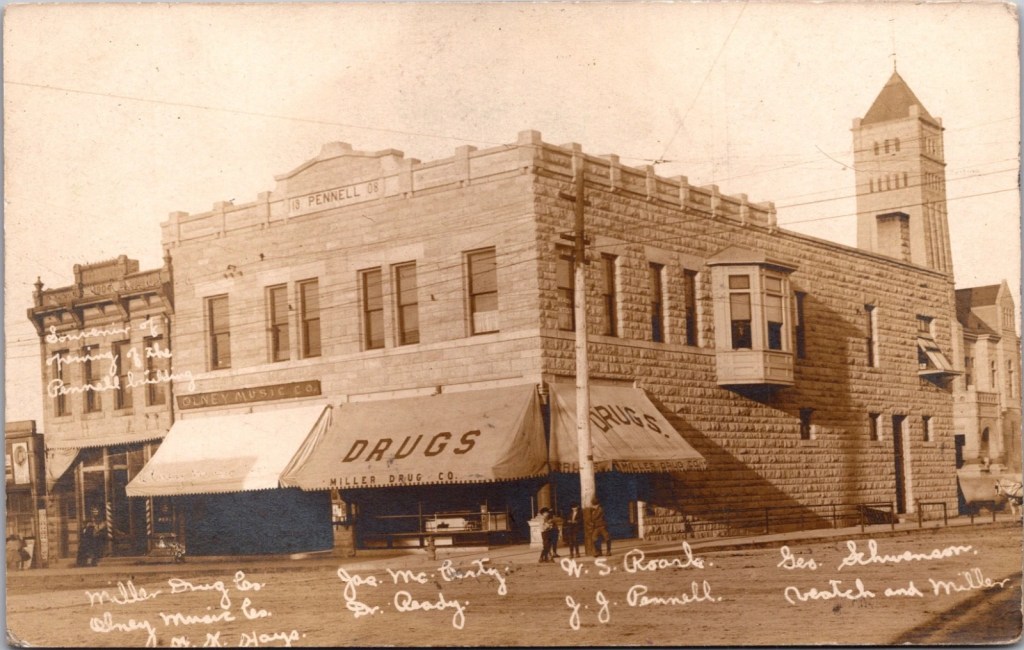
An interesting old 1910 postcard I came across is actually a celebratory announcement of the opening of a new commercial building in Junction City, Kansas. The card sender was Maude K. of Junction City, with the recipient, Mr. Francis Bowman of Chapman, Kansas.
Given my familiarity with this structure and my wife’s birth in Junction City, I felt it was worthy of a full historical review of both entities. I’ll get to the biography of the sender and recipient at the end of my writing.
Located in the heart of Junction City, Kansas, the Pennell Building stands as a testament to the city’s commercial evolution and architectural heritage. For over a century, this structure has witnessed the ebb and flow of local history, entrepreneurship, and community life, earning its place as a cherished landmark in Geary County.
Junction City, founded in the mid-19th century at the confluence of the Republican and Smoky Hill Rivers, blossomed as a hub of trade and transportation thanks to the arrival of the railroad. As the city’s population and economic ambitions grew, so did the demand for more commercial square footage. It was against this backdrop, in 1887, that the Pennell Building was constructed.
Commissioned by William Pennell, a notable local entrepreneur and investor, the building was designed to be a prominent fixture in the city’s burgeoning downtown district. Its construction reflected both the optimism of Junction City’s business community and the Victorian architectural trends sweeping the nation during the late 1800s.
The Pennell Building quickly distinguished itself through its stately brick façade, tall arched windows, and intricate ornamental details, features that set it apart from the simpler wooden storefronts common at the time.
Upon completion, the Pennell Building became a prime location for a variety of businesses. Its ground floor was home to general stores, mercantile shops, and other retail ventures that catered to both locals and travelers passing through Junction City by rail or stagecoach. The upper floors housed professional offices, including lawyers, doctors, and real estate agents, further cementing the Pennell Building’s reputation as a commercial nucleus.
Throughout the late 19th and early 20th centuries, the building evolved alongside the city’s changing economic landscape. As Junction City grew, so too did the diversity of enterprises within the Pennell Building. It became home to everything from specialty boutiques and financial institutions to printing presses and small manufacturing companies. The building’s adaptability mirrored the resilient spirit of Junction City itself, which weathered economic booms and busts, wars, and periods of rapid growth.
Beyond its role as a commercial center, the Pennell Building played an integral part in the social and cultural fabric of Junction City. Its upper floors were often used for meetings, gatherings, and even small performances. Community organizations, fraternal orders, and social clubs found a home in the building’s spacious rooms, making it a lively gathering place for local residents.
The Pennell Building’s location on Washington Street, one of Junction City’s main thoroughfares, made it a focal point for parades, celebrations, and public events. Its distinctive architecture provided a charming backdrop for photographs and festivities, endearing it to generations of townspeople.
Its original brickwork, decorative cornices, and grand windows are characteristic of Victorian commercial architecture—a style that emphasized both function and beauty. Over time, the building underwent several renovations, but much of its historic character has been carefully preserved.
Local preservation efforts in the late 20th and early 21st centuries recognized the Pennell Building’s significance. When many historic structures in small-town America faced demolition, Junction City’s leaders and citizens rallied to protect their architectural heritage. Restoration projects ensured that the building’s façade remained true to its 19th-century origins, while interior spaces were modernized to accommodate new businesses and offices.
In recent decades, the Pennell Building has experienced a renaissance, reflecting broader trends in downtown revitalization across the United States. Its street-level spaces have been home to a range of businesses—from cafes and antique stores to local service providers and boutiques—each contributing to Junction City’s vibrant small-business ecosystem.
All upper floors, once the domain of professionals and organizations, have been adapted for modern offices and, in some cases, residential lofts. This adaptive reuse has breathed new life into the historic structure, attracting entrepreneurs and residents who value its unique blend of old-world charm and contemporary amenities.
Today, the Pennell Building remains a cornerstone of Junction City’s downtown district. Its red-brick silhouette continues to evoke the city’s storied past, while its bustling storefronts and renovated interiors signal a commitment to the future. For longtime residents and newcomers alike, the Pennell Building is more than just an old structure—it is a living symbol of the city’s resilience, adaptability, and sense of community.
Few buildings in Junction City encapsulate the city’s history as completely as the Pennell Building. Over more than a century, it has weathered fires, economic challenges, and changing urban landscapes. In doing so, it has provided a sense of continuity and identity for the community.
Its preservation is a testament to the dedication of local citizens who recognized the importance of maintaining connections to their shared heritage. Educational tours, historical exhibits, and community events held in or around the building continue to foster appreciation for the city’s past.
The story of the Pennell Building is, in many ways, the story of Junction City itself. Born of entrepreneurial vision, shaped by the currents of commerce and community, and preserved through collective effort, the building remains a vital part of the city’s cultural landscape. As Junction City grows and changes, the Pennell Building stands as a reminder that history is not only something to be remembered but something to be lived—brick by brick, generation after generation.
From its prominent architectural features to its ever-changing roster of businesses and its enduring role as a community gathering place, the Pennell Building exemplifies the rich tapestry of Junction City’s evolution. Its walls have witnessed the ambitions, struggles, and celebrations of countless residents, and its continued presence ensures that the city’s heritage remains a living, breathing part of daily life.
A message on my vintage postcard, written to Francis Bowman, reads as follows:
“November 28, 1928
Dear Cousin – Please tell those people that we will be out Thursday if it does not storm for the turkeys. Guess me will find you. And oblidge.
Maude K.”
Born on April 16, 1873, Mr. Francis Bowman was a farmer living in the Rinehardt agricultural area of Chapman. Several wealthy ranchers and farmers resided in the vicinity, including Joseph Strickler Hollinger and John Hiram Taylor. These two distinguished gentlemen are buried in the Rinehart Cemetery.
Francis and his wife Emma eventually moved to Woodbine in 1913, a distance of approximately 15 miles from Chapman. They had a son one year later, whom they named Martin. Newspaper accounts have Francis listed as a wealthy and industrious farmer. An interesting thing I found printed about his farming operation was that he purchased a manure spreader in 1913. This bit of news was perhaps placed in the newspaper as a form of subtle humor.
Francis Bowman died on December 1, 1936, at the age of 63. His wife Emma passed away in 1974, living to be 93. They’re both buried in Woodbine Cemetery. Their son, Martin, was a retired Rock Island railroad conductor. He died in Alabama on June 28, 2010, at the age of 95. His body was brought back and interred in Herington, Kansas, in Dickinson County.
Maude K. or Maude Kipperling was, of course, a cousin to Francis Bowman. She, along with husband Harry Hoover Kipperling, farmed in the Junction City area. There wasn’t much found about them in local newspapers, yet a 1940 census report had a ‘servant’ living with them, Minnie Stiner. That in itself seems unusual.
Minnie Stiner appears to be someone they knew who lost her husband. It also appears that the Stiners kindly took her in, with Minnie helping out around the house as payment. Why she told a census taker that she was the Kipperling’s servant seems most strange, almost humorous. My guess is that she didn’t want it to seem as if Harry had two wives.
The Ancestry.com website shows Harry Kipperling was born in 1878 and died in 1949. His wife, Maude, was born in 1893 and passed away in 1949. Minnie Stiner was born in 1893 and died in 1943.
With Minnie only living with the Stiner’s for a short time, perhaps she was not in good health? My research did not disclose such, with Maude, Harry, and Minnie taking that personal information to the grave.
“Maude Spencer created some controversy when she told a newspaper reporter in 1927 that co-ed travel was okay, even if some ‘petting’ did occur.”
Athol, Kansas
This postcard story begins in Athol, Kansas, and ends there. Athol is a small community located in Smith County, Kansas. Established in the late 1800s, it has remained a quiet rural community throughout its history.
Athol is known for its agricultural heritage and close-knit population, reflecting the charm of small-town life in the American Midwest. It is also close to being a ghost town, with a current population of 47.
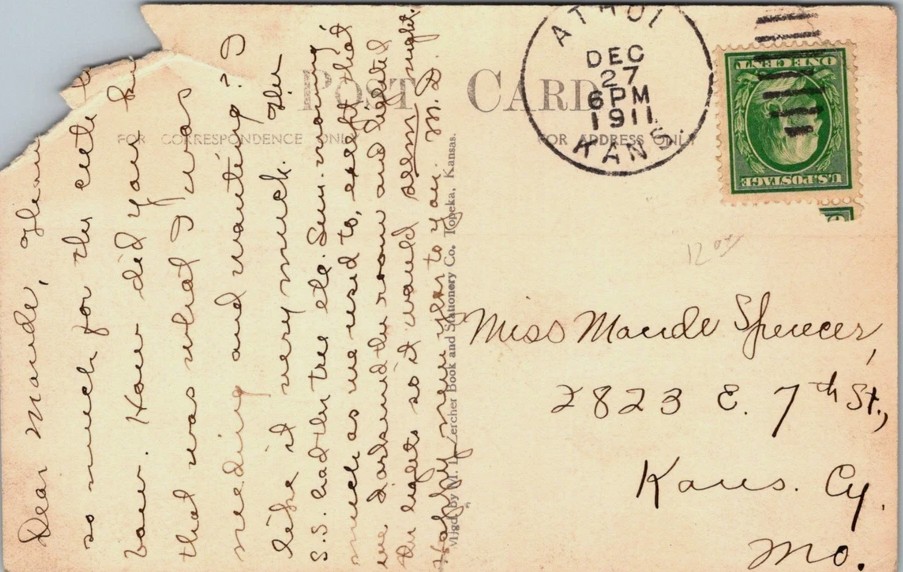
Pictured on one side of the slightly damaged postcard is Main Street in Athol. A Ford Model T is driving in front of the local bank, with someone using an ink pen to write on the card that a hotel and the old post office are visible. The person writing this also mentions a dwelling being around back. Telephone poles are visible, giving some indication of modern technology.
The postcard is dated December 27, 1911, and stamped 6 PM. Although not mentioned, the weekday was Wednesday. A one-cent Thomas Jefferson stamp is affixed to the card upside down.
One corner is missing, but I was able to figure out what I believe was there in transcribing the main message. This was only two days after Christmas. The initials S.S. within the letter I take to mean Sunday School.
“Dear Maude,
Thank you so much for the cute tree bow. How did you know that was what I was needing and wanting? I like it very much. The S.S. had their tree etc Sun. morning as much as we used to, except that we darkened the room and lighted the lights so it would seem night. Happy New Year to you. M.D.”
The recipient of the postcard was Miss Maude Spencer. 2823 E. 7th St., Kansas City, Missouri. I had no problem finding out who Maude Spencer was, yet M.D. was a different story. It took much research to come up with a name.
Maude was born on May 4, 1881, in Salina, Kansas. Spencer was her maiden name and remained that way for life. She lived with her dad, mom, and two brothers at the 7th St. address. Miss Spencer continued living there even after her father and mother passed away.
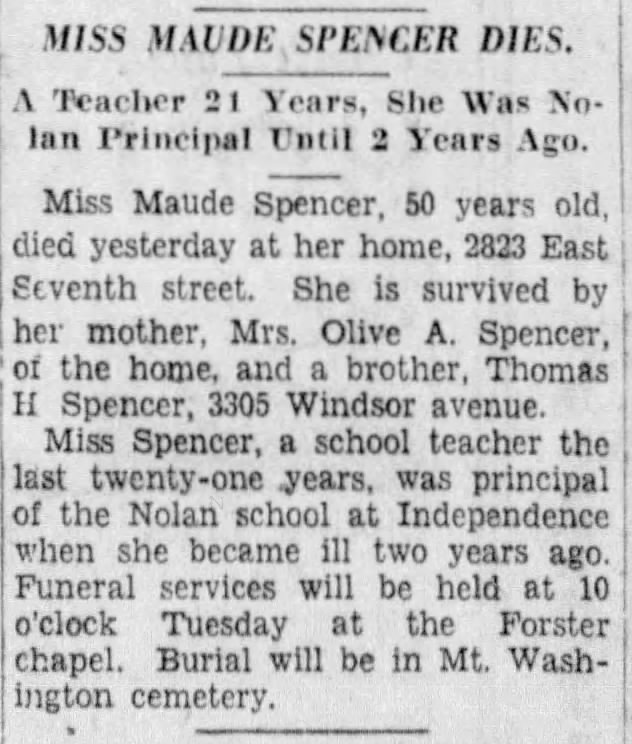
Maude Spencer created some controversy when she told a newspaper reporter in 1927 that co-ed travel was okay, even if some ‘petting’ did occur. Miss Spencer had just completed an 8-month semester cruise on the ship, SS Ryndam, to 35 countries and 90 cities. Maude was one of the older college students on this vessel at 46 years of age.
The SS Ryndam floating university was a trailblazing academic initiative of the late 1920s, providing students with a unique opportunity to learn as they traversed the globe by sea. On board the SS Ryndam, students from 143 colleges set sail for a semester-long cruise, visiting 35 countries and 90 cities.
This journey combined formal instruction with the vibrant experiences of travel, blending classroom learning with firsthand exposure to new cultures, histories, and ideas.
The floating university fostered a spirit of adventure and open-mindedness, challenging traditional educational boundaries. Notably, passengers like Maude Spencer participated in this international academic community, and the program even sparked social conversation—such as when Maude’s views on co-ed travel made headlines in 1927.
This voyage remains a remarkable chapter in the history of experiential learning, marking the early days of study-abroad programs and demonstrating the transformative power of learning beyond the traditional classroom.
Four years after her cruise, Maude passed away on August 31, 1931. During that time, up until her adventure, and for two years afterward, she’d been a teacher and a school principal. Miss Spencer was quite ill during the last two years of her life and was unable to perform either job.
Margaret Belle Douglass (M.B.D.), it appears, was Maude’s friend living in Athol. Like Miss Spencer, she was also a teacher in her early working years, a Sunday School instructor, and worked as a bookkeeper for her father’s grain elevator.
Moving to Kensington, Kansas, in 1918, she worked there as a teller for 36 years at First National Bank. With the initials of M.D., Margaret Douglass seems to be the only acquaintance or family member of Miss Maude Spencer that fits the puzzle. Athol is only 7 miles away from Kensington.
While living in Kensington, Miss Douglass volunteered as a Sunday School teacher, church treasurer, and choir member at the Methodist church. Margaret Douglass was born on August 7, 1880, and died on October 31, 1954, at the age of 74. She’s buried in Athol.
It appears that the last big event to take place in Athol was the Centennial Days Parade in 1988. A large contingent of people from throughout the surrounding country turned out with clowns, displays, floats, old tractors, trucks, and cars.
The parade lasted for almost an hour, which is long-lasting for a small community. Since that time, quiet has enveloped the old town much like the peaceful silence at Pleasant View Cemetery, where Martha Douglass was laid to rest
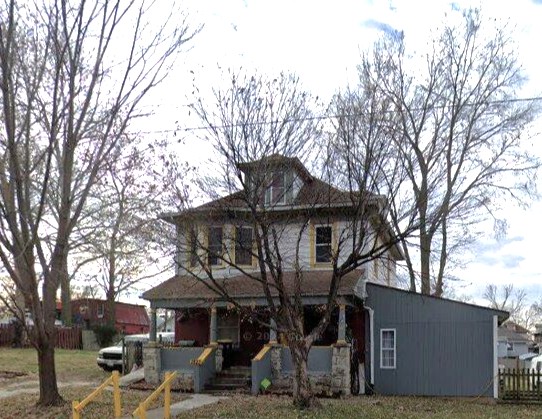
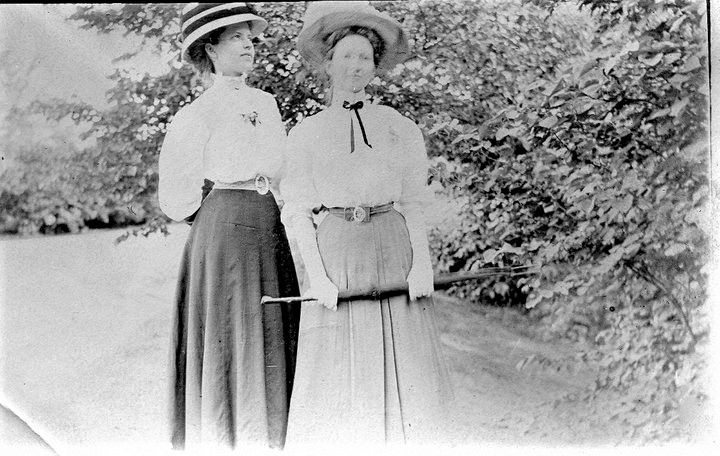
The Spencer house in Kansas City, MissouriMaude Spencer on the right and possibly Margaret Douglass on the leftSS Ryndam
One thing that our town does not lack is patriotism. We saw that Saturday evening at the Charlie Kirk Memorial ceremony under the London Bridge. A photograph showing thousands of people holding candles and flags was most touching.
Take a drive through our city and you’ll see more red, white, and blue flags than perhaps anywhere in the country. Next to flags, colorful and loud boats, including hot rods, come in a close second and third. All three are good reasons to live here—along with the lake, of course. Freedom is alive and well in Lake Havasu City.
I read daily, via social media and newspaper editorials, people criticizing the United States. It seems that many are folks who have come here from other nations. That’s akin to inviting someone to your house for Thanksgiving dinner, and then afterwards, having to listen to them complain about the food.
I believe a good many of these complainers are here for one reason: to try to tear this country apart. It’s comparable to some guy or gal seeing your new car in a parking lot, and using their key to deliberately scratch the paint.
Some folks are out there to destroy merely for the purpose of destroying. Thankfully, we have a president and strong leaders attempting to thwart this hate movement. Criminals, haters, and rabble-rousers are being deported by the thousands.
Leftists use the words fascists to describe President Trump and his followers, but they haven’t a clue what a real fascist is. Undoubtedly, they’re mimicking what they’ve heard on some mainstream media news channels. Hollywood celebrities are good at spewing this hateful garbage.
Fascist is a popular ‘buzz word” among left-leaning politicians. They use it for only one reason: to try to brainwash their constituents into believing them, hoping to garner votes.
Thank goodness the majority of American citizens have common sense to see through this twisted agenda. Count me in with that group, along with my closest friends. I believe a good many of these ‘informed patriots’ reside here in Lake Havasu City.
I’m not sure where this country will be in another 10 years, yet for my children and grandchildren’s sake, hopefully, they’ll never see the likes of another 2020 – 2024. Those four years were far worse than any I’ve ever been through, including the Cold War.
I was afraid to speak my conservative mind during the Biden era, greatly concerned that speech police would come knocking on my door. Laugh if you like, but that’s happening in Great Britain right now. Citizens and non-citizens alike are being arrested for mere thoughts alone.
It appears that our city will maintain its basically conservative population for some time. Opinions of all kinds are welcome in a free society, including liberal viewpoints.
It became a real problem for me and others when those on the left attempted to muzzle those of us on the right. I’d like to personally thank President Trump for removing the gag. I don’t know who said this, but they hit the nail square on the head,
“There’s no satellite dish on the side of her house, nor does there appear to be an air conditioner.”
Martha Ann Mann-Amos
For many of the postcards that I’ve analyzed thus far, the people who either wrote or received them, I’ll eventually see in Heaven. This I know after reading about their lives in either census reports, newspaper articles, church records, and most importantly, obituaries.
Sadly, these days, some family members no longer compose an obituary for their loved one. An obituary can be a powerful testimony to those unsaved souls reading it, describing how and when this person came to know the Lord.
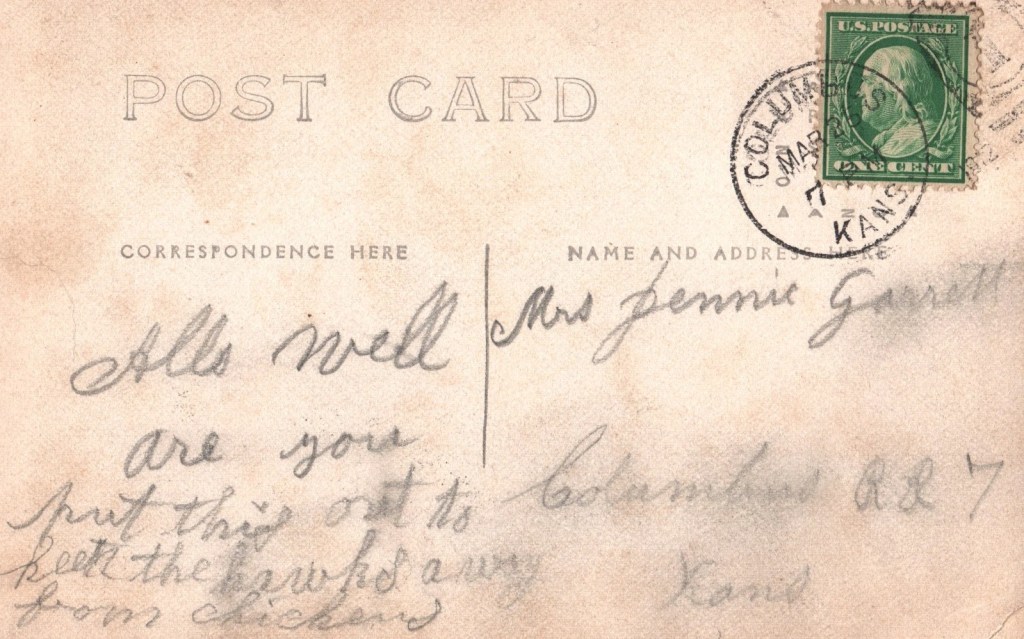
A postcard mailed from Ann Amos to Mrs. Pennie Garrett doesn’t say a lot on the outside, word-wise, but after researching both people, I discovered what I really wanted to know: they were believers.
Martha Ann Amos lived in Columbus, Kansas, and it’s easy to see in the photo on the front that she didn’t have it easy. There’s no satellite dish on the side of her house, nor does there appear to be an air conditioner. It can get very hot and humid in Kansas during the summer.
A brief note on the back of the card explains why the dog is sitting in her lap. It doesn’t appear that Mrs. Amos or the hound wanted their picture taken, judging by the photograph on the front.
“Alls well
are you
put this out to keep
the hawks away
from chickens”
Pennie Angy Garrett and her husband Edmund lived on small farms in Columbus, Kansas. Just like Ann Amos and her spouse, John, they were struggling farmers right up until the great depression hit, with the disastrous ‘Dust Bowl’ following soon after.
For those unaware of this, the Dust Bowl was caused by farmers stripping the land of almost all native vegetation. Winds then took over, making for what’s called a haboob in the desert. Dust and dirt were so thick that humans and animals struggled to breathe. Plants wouldn’t grow due to a lack of natural fertilizer.
Jennie Brown was born on August 21, 1871, in Kansas. She married Edmund Armson Garrett on December 12, 1895. Their first child didn’t arrive until 1897, with three others soon following. Jennie was the secretary/treasurer of their Baptist church.
On June 27, 1907, the Garretts lost one of their children. Little Ralph was a little over two years old. His obituary was most sad, with a touching poem at the end. Jennie passed away 12 years later, on September 23, 1919. She was only 48.
Jennie’s husband, Edmund, lived to be 82, dying on April 19, 1946. He never remarried. Interestingly enough, the farmer was born in London, England, before deciding to settle down in Kansas.
Martha Ann Mann-Amos lived a much different life from her friend, Jennie. Born in 1852 in Indiana, she came to Kansas already married to her husband, John. Their first child had died at birth.
With her most likely not able to bear children, in 1891, John and Ann eventually adopted a three-year-old boy. Named William Thacker Amos, sadly, in 1914, at the age of 23, while still living at home, “Willie” was struck in the head at his worksite and eventually died. Martha Ann passed away just 10 years later, on June 19,1924.
According to a census report from 1930, John Thacker was no longer working, with his home valued at $500. John died on July 19, 1934, at the age of 82. Enough was written about both the Amoses and the Garretts to tell me they were followers of Jesus Christ.
Were these people poor folk? It depends on who you ask. Despite all of the sadness found during my investigation, I tend to believe that before they left this world, the Amos and Garrett elders were happy, knowing without a shadow of a doubt they’d see their loved ones again. That’s worth far more than financial standing. Philippians 3:7-8
Singer/songwriter Benny Mardones had a hit tune in 1980 called “Into the Night.” The beginning lyrics, if sung by some old guy during a karaoke session today, this fool would undoubtedly be heckled or laughed at.
“She’s just 16 years old
Leave her alone, they said
Separated by fools
Who don’t know what love is yet.“
Benny was 34 years old when he first performed this song, yet I suppose most listeners didn’t give it much thought back then. I did, and still do, knowing that if some guy that age tried putting the moves on my teenage daughter, he would’ve suffered the consequences.
Another singer, Jerry Lee Lewis, followed through on his infatuation in the 1950s with a 13-year-old cousin, going so far as to marry her. He was already married. Lewis was scorned by his peers for doing so and was almost arrested. Jerry Lee Lewis stayed with Myra Gale Brown for 13 years before going on to wed 5 others.
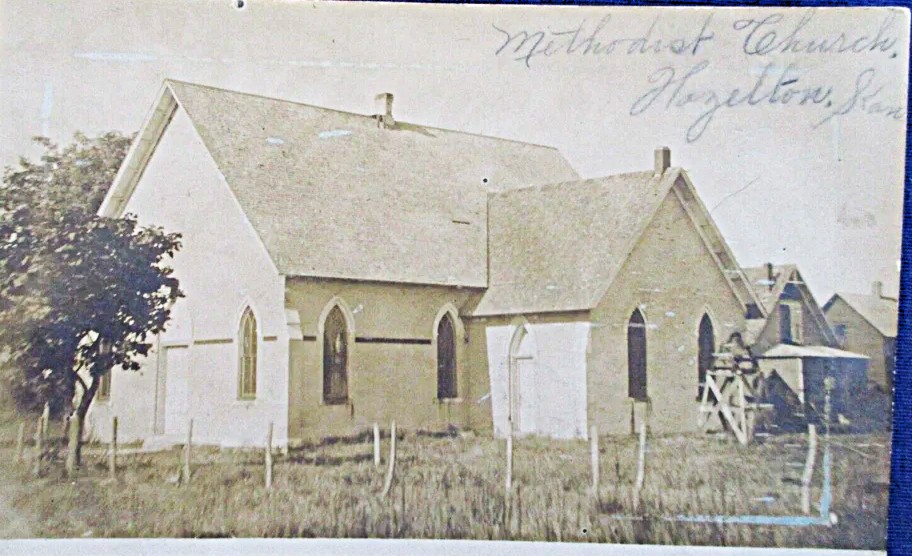
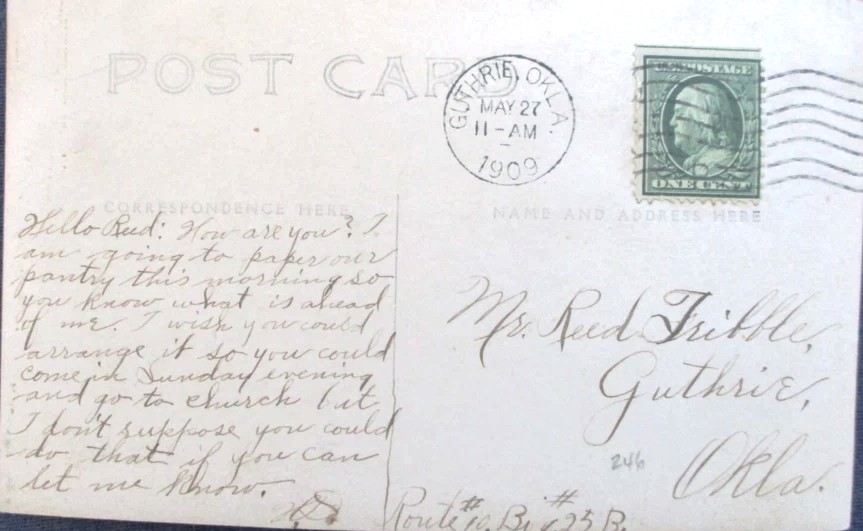
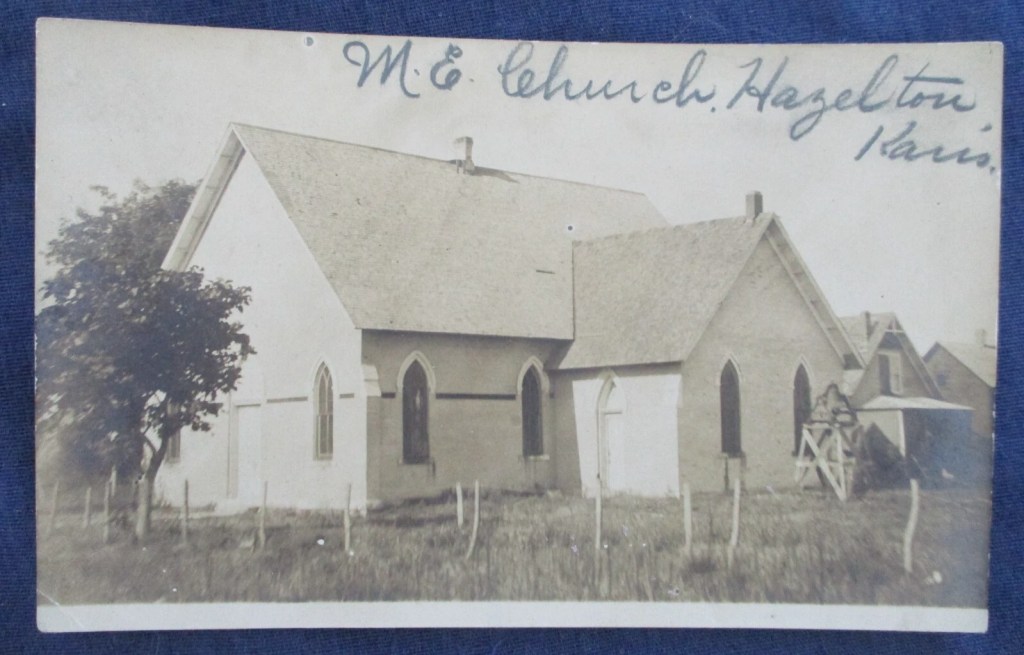
A 1909 postcard I came across follows what I’m talking about here. The 116-year-old card, featuring a Methodist church on the front in Hazelton, Kansas, was sent from someone in Guthrie, Oklahoma, to Mr. Reed Tribble. An interesting history was found by looking deep inside.
Unfortunately, the sender can’t be identified because his initials appear as chicken scratches, something on the order of TOS. I suppose Elvis Reed Tribble knew this person well, with me believing it was a minister. The message reads as follows:
“Hello Reed. How are you? I am going to paper our pantry this morning so you know what is ahead of me. I wish you could arrange it so you can come in Sunday evening and go to church but I don’t suppose you could do that let me know if you can. TOS
I believe this person had concern for Reed Tribble’s spiritual well-being. He needed to be more affirmative, unfortunately giving Tribble an escape route by saying, “…but I don’t suppose you could do that…”
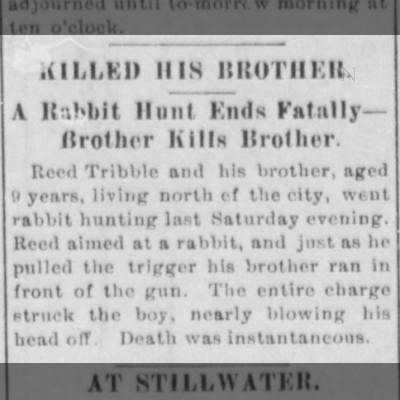
Born on January 3, 1881, Elvis Reed Tribble led a sad yet interesting life. In 1898, at the age of 14, he accidentally shot and killed his younger brother while rabbit hunting. That tragedy undoubtedly bothered him ’til the end.
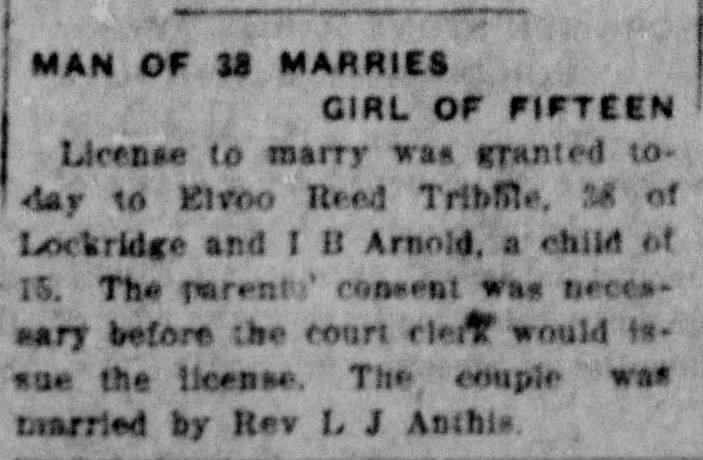
Reed Tribble married Miss I. B. Arnold on August 13, 1919. That wouldn’t have been such a big deal had the girl been older, yet she was only 15, and he was 38. ‘Rob the cradle’ comes to mind here. Several Oklahoma newspapers made sure to headline this piece of gossip. I suppose there were many folks forecasting, “That marriage will never last!”
Elvis Reed Tribble began as a farmer but soon gave up the plow for a mail vehicle, joining the US Postal Service around 1917. Perhaps that’s how he met his future bride, at a mailbox.
His rural route consisted of driving 58 miles each day. Retiring in 1951, I calculated that Tribble drove approximately 656,676 miles through rain, snow, sleet, and hail to make his deliveries. I’m sure those miles didn’t come without numerous flats while getting stuck in Oklahoma mud and snow.
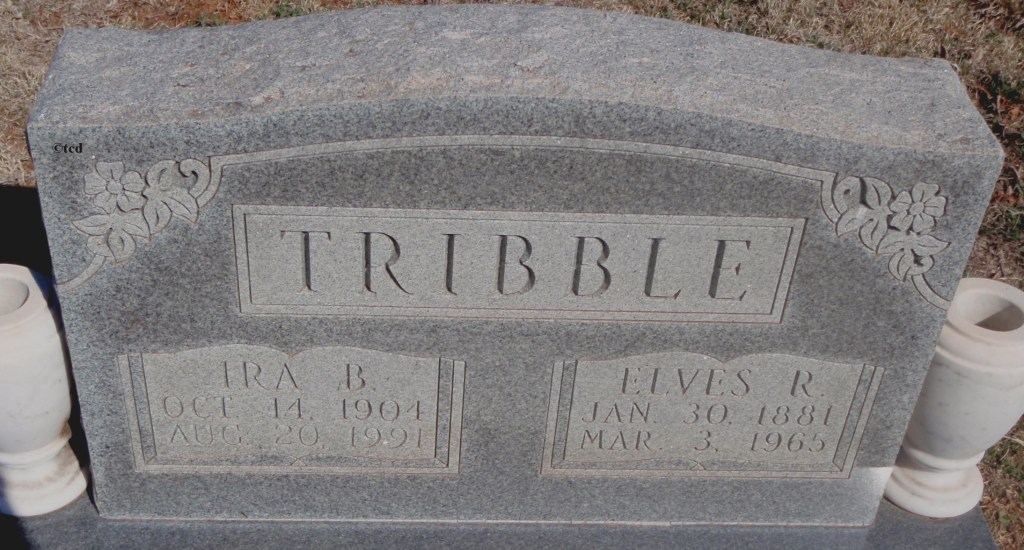
Elvis (Elves) Reed Tribble died in 1965, with his wife passing away in 1991. Regardless of what people might’ve said, in and around Guthrie, Oklahoma, they remained together the whole time. Mrs. Ira B. Tribble never remarried after her husband’s death. The couple had one daughter, Zola Mae.
“Miss Ona Blankinship lived to be 100 years old and never married.”
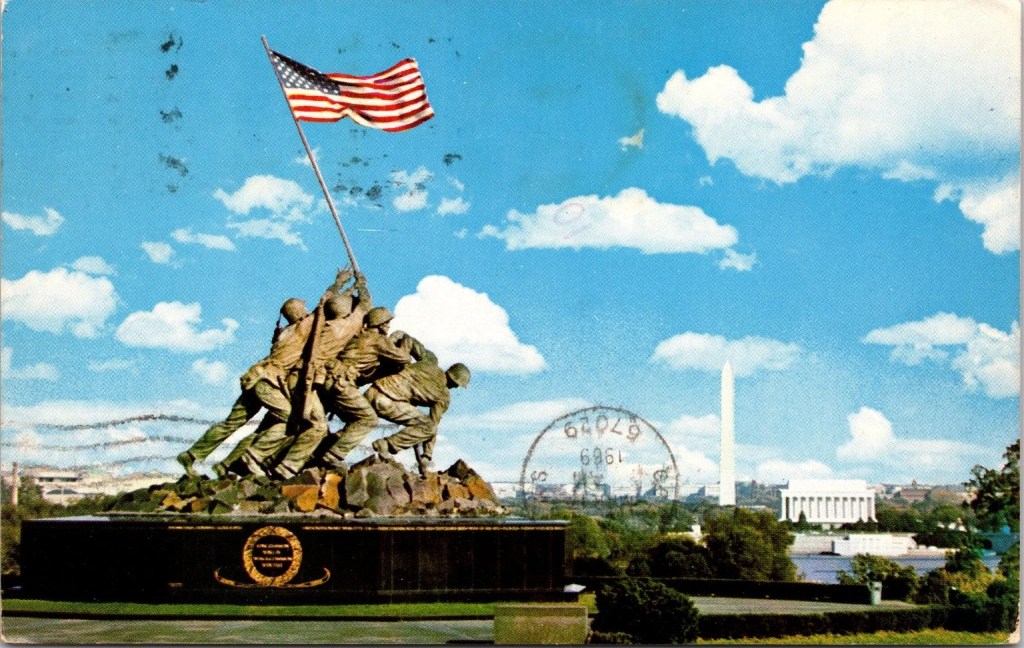
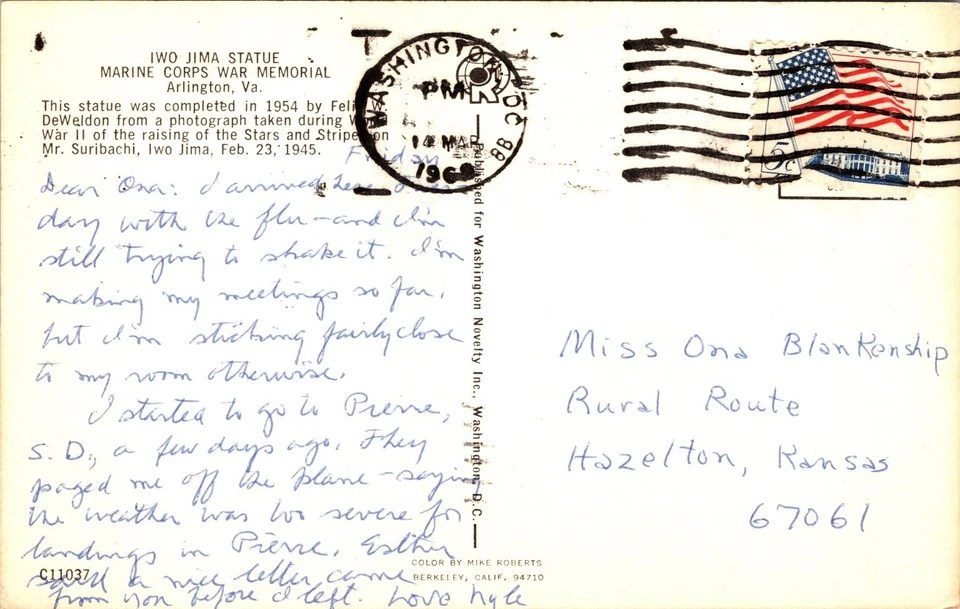
A 1969 postcard I came across on eBay shows the US Marine Corps War Memorial monument in Arlington, Virginia. This monument celebrates the raising of the American flag at Mt. Suribachi during WWII on the island of Iwo Jima.
The historic event took place on February 23, 1945, with many stories written about it, including Hollywood movies.
The recipient of this March 14, 1969, double-postmarked postcard, sent from Washington, D.C., was Miss Ona B.J. Blankenship in Hazelton, Kansas. The Hazelwood post office was still open at that time, and that’s where she picked it up. Ona was 82 at that point.
The sender only signed his first name, Kyle, and that person appears to be Kyle A. Wallace. I could never precisely pin things down here to say this for sure. Kyle may have been a student of Ona Blakenship or a friend. He had Ona’s last name spelled wrong as it’s Blankinship with an i.
A message written in hurried cursive reads as follows:
“Friday
Dear Ona. I arrived here Tuesday with the flu – and I’m still trying to shake it. I’m making my meetings so far, but I’m sticking close to my room otherwise. I started to go to Pierre, S.D., a few days ago. They paged me off the plane – saying the weather was too severe for landing in Pierre. Esther said a nice letter came from you before I left. Love Kyle”
Miss Blankinship was born on November 10, 1887, in Butler County, Kansas. She taught school in Hazelton and other locales until retiring, passing away on November 19, 1987. Ona Blankinship lived to be 100 years old and never married. She’s buried in Rosehill (Hazelton) Cemetery.
Ona was a real social butterfly, with her name appearing in local newspapers 147 times. Almost all of them have the teacher either attending or putting on lunches and dinners in conjunction with school activities.
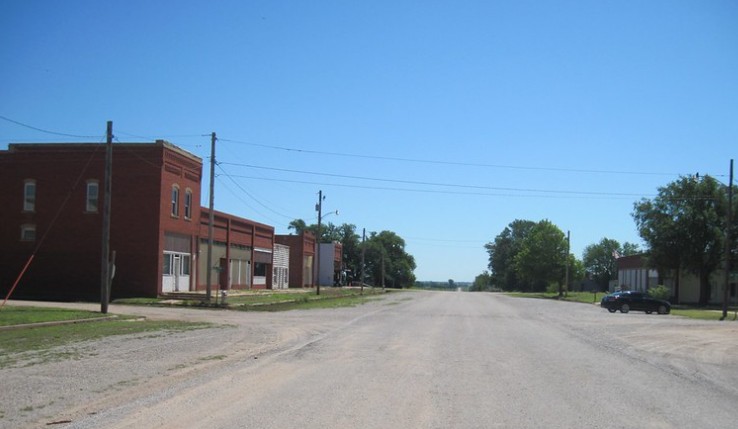
Hazelton, Kansas, is a rather sad story from the beginning, at least where growth is concerned, not unlike other small Kansas towns. Hazelton was started in 1884 and named for Reverend J. Hazelton, a pioneer settler. Hazelton was quickly going backward, even when Miss Ona taught school there, with only a few hundred residents. It went downhill fast numbers-wise.
Today, approximately 60 citizens reside in the area. A few buildings remain of the original community, and they’re all near collapse, with the school abandoned and no longer being used. The Hazelton post office still stands, yet its doors are shuttered.
On the positive side. Freedom Gate Boys Ranch is now located in Hazelton. It’s a spiritually based learning facility for boys having a hard time in public school. I suggest that everyone reading this go to their website and look at what they’re doing. I was impressed.
My 56-year-old postcard had the potential to say much more, but unfortunately, the four Hazelton newspapers died early deaths, making it nearly impossible to find out what went on there in the later years. Hopefully, as time marches forward, folks will eventually start returning. The town name does have a good ring to it!
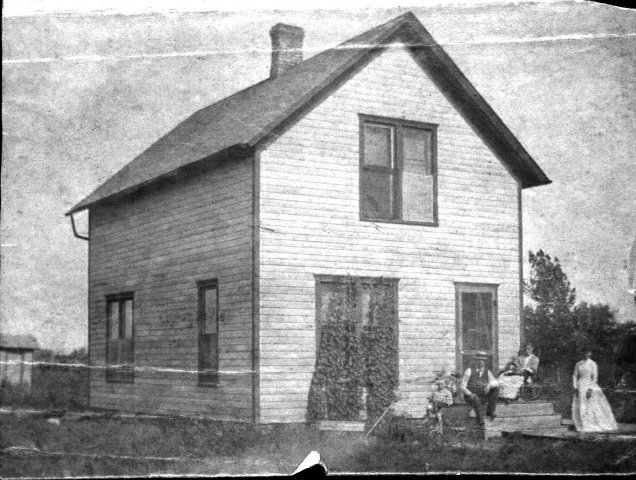
Hazelton Methodist Church no longer standingOld Hazelton home is no longer standingHazelton, Kansas
“Pvt. Mary Charlotte Wallace was one of these valuable personnel.”
A vintage WWII postcard that I came across was mailed from Mitchel Field, Schenectady, New York, to Ottumwa, Iowa. The card recipient, Agnes Dorothy Kittleson, has limited information available regarding her life. She was born in 1894, became a school teacher, and never married. Agnes died in 1973.
Pvt. Mary Charlotte Wallace, the card sender, was born on November 1, 1920, and enlisted in the Women’s Air Corps on November 11, 1943. She worked in the 1st Service Command Unit as a typist and a typesetter. These were important jobs to keep the paperwork flowing, essential tasks in the war effort.
It seems safe to say that Mary was Agnes’s student at one time and also a friend. Mitchel Field was a large training base during the war, and undoubtedly, Pvt. Wallace picked up Miss Kittleson’s card at the Mitchel Field BX store.
Mary Charlotte Wallace composed the following message within it:
“Pvt. Mary C. Wallace
A 702710
1st S.C.U.
Mitchel Field, N.Y.
Dear Kitty,
Decided it was time to let you know where I finally landed.
This is a grand field and I really like it here. My work is very interesting.
Have managed to see part of N.Y. already. There is so much to see.
I hope you are well. I imagine you are plenty busy with everything.
Maybe I will see you when I get a furlough. Charlotte”
Some women became pilots, but Mary wasn’t one of them. Private Mary C. Wallace was honorably discharged from military service in 1945. She was involved in an automobile accident on August 19, 1958, that killed two people. Mary Wallace was not seriously injured.
For the rest of her short life, Mary worked as a secretary for the Standard Oil Company. Miss Wallace died of bladder cancer on December 4, 1964, at the age of 44. She was buried beside her sister, Irene, in New Sharon Friends Cemetery in New Sharon, Iowa.
The Women’s Army Corps (WAC), established in 1942, enabled women to serve in non-combat roles within the U.S. Army during World War II. Members worked as clerks, mechanics, radio operators, and in many other essential positions, freeing men for combat duty and supporting the war effort. The WAC paved the way for greater inclusion of women in the military. Pvt. Mary Charlotte Wallace was one of these valuable personnel.
“Not much was recorded about him after the war ended.”
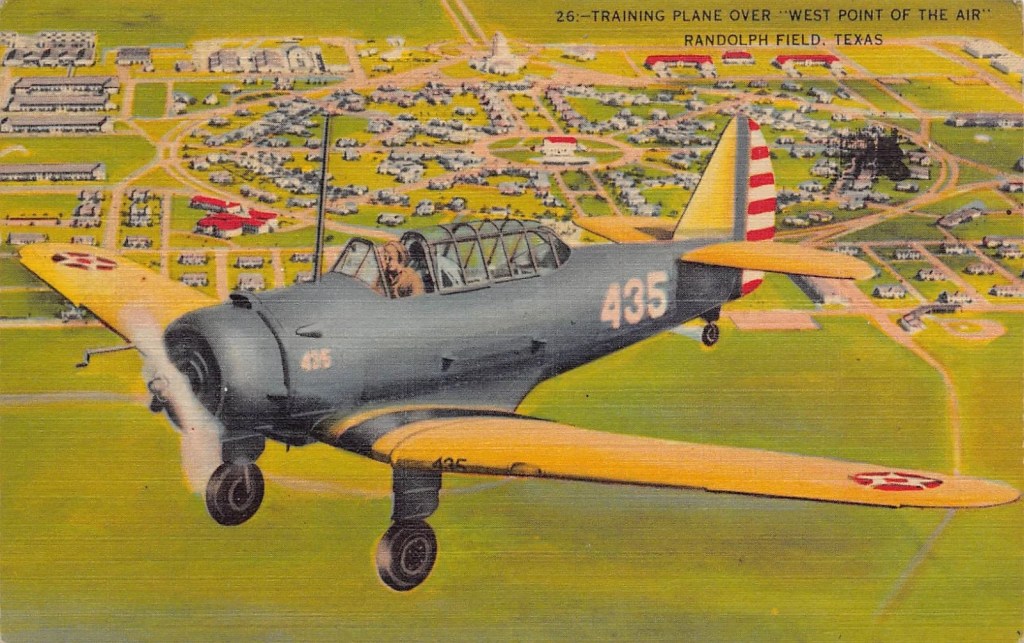
North American BT-9 trainer
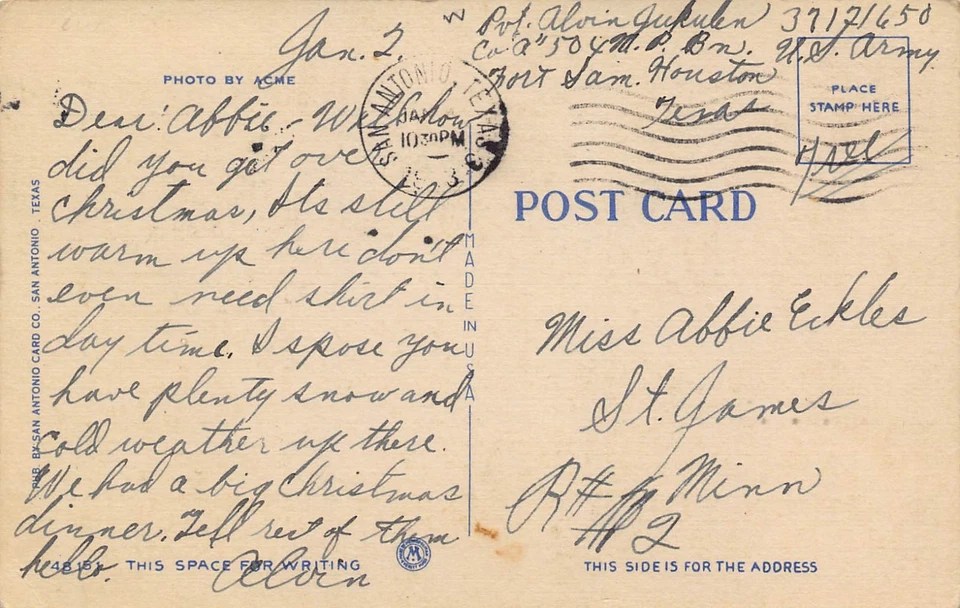
A brightly colored WWII-era postcard sent by Pvt. Alvin Jukulen to Miss Abbie Eckles in St. James, Minnesota, has military significance from two perspectives.
Army Pvt. Jukulen wrote in the address header that he was stationed at Fort Sam Houston, in San Antonio, Texas. The front of the postcard shows an Army Air Corps North American BT-9 trainer flying over Randolph Field. The two bases are 13 miles apart.
Private Alvin Milford Jukulen was assigned to the 504th Military Police Battalion at Fort Sam Houston. Born on June 21, 1911, Alvin Jukulen died on August 2, 1990, in Minnesota.
Not much was recorded about him after the war ended, other than that he married Helen Janda in 1962 and they divorced in 1978. Pvt. Jukulen was given credit for having served in WWII. The soldier’s letter to Abbie Eckles reads as follows:
“Jan 2
Dear Abbie,
Well how did you get over Christmas. It’s still warm up here don’t even need shirt in day time. I spose you have plenty snow and cold weather up there. We had a big Christmas dinner. Tell rest of them hello. Alvin”
Abbie Eckles was born on March 28, 1930. When Alvin wrote her, she would’ve been almost 13 while the private was 31, and it’s easy to jump to conclusions here, yet I found them to be from the same family. On September 12, 1948, Abbie married Burton J. Frederickson and divorced him on June 8, 1959. She remarried and passed away in 2025, at 91, with the last name of Larsen.
More information is available for Fort Sam Houston and Randolph Field over that of the postcard sender and recipient, and that’s how I’ll end this postcard investigation.
Randolph Field, located near San Antonio, Texas, was established in 1931 as a primary training base for U.S. Army Air Corps pilots. Known as the “West Point of the Air,” it became the model for military aviation training in the United States.
During World War II, Randolph Field played a pivotal role by graduating thousands of pilots who went on to serve in theaters around the globe. Its distinctive Spanish Colonial Revival architecture and landmark central administration tower have made it an iconic site in U.S. Air Force history.
Fort Sam Houston, located in San Antonio, Texas, stands as one of the oldest and most historically significant military installations in the United States. Its roots stretch back to the 19th century, but it was during World War II that Fort Sam Houston cemented its reputation as a cornerstone of U.S. Army operations, training, and medical innovation.
As the world descended into conflict, Fort Sam Houston was rapidly transformed to meet the demands of a global war. Already a well-established base by the 1940s, the fort’s facilities and personnel expanded dramatically.
The prewar garrison swelled as tens of thousands of soldiers cycled through the fort for basic and specialized training. The base’s strategic location in the heart of Texas made it ideal for year-round military exercises, away from the vulnerabilities of coastal attacks.
World War II was a catalyst for profound social change, and Fort Sam Houston reflected these shifts. The fort saw the integration of more women into the Army’s ranks, especially in medical and administrative roles, as members of the Women’s Army Corps (WAC) were trained and stationed at the installation.
Additionally, the base was part of the slow but significant process of integrating military units, as African American and other minority soldiers contributed to the war effort despite the challenges of segregation and discrimination.













 I like to write junk...