We walk among people who have lived remarkable lives, yet these folks deliberately go about life unnoticed. Attention and fame aren’t their goals, unlike many in the political or entertainment fields. They have heroic stories to tell, but unless asked about their experiences, they remain silent.
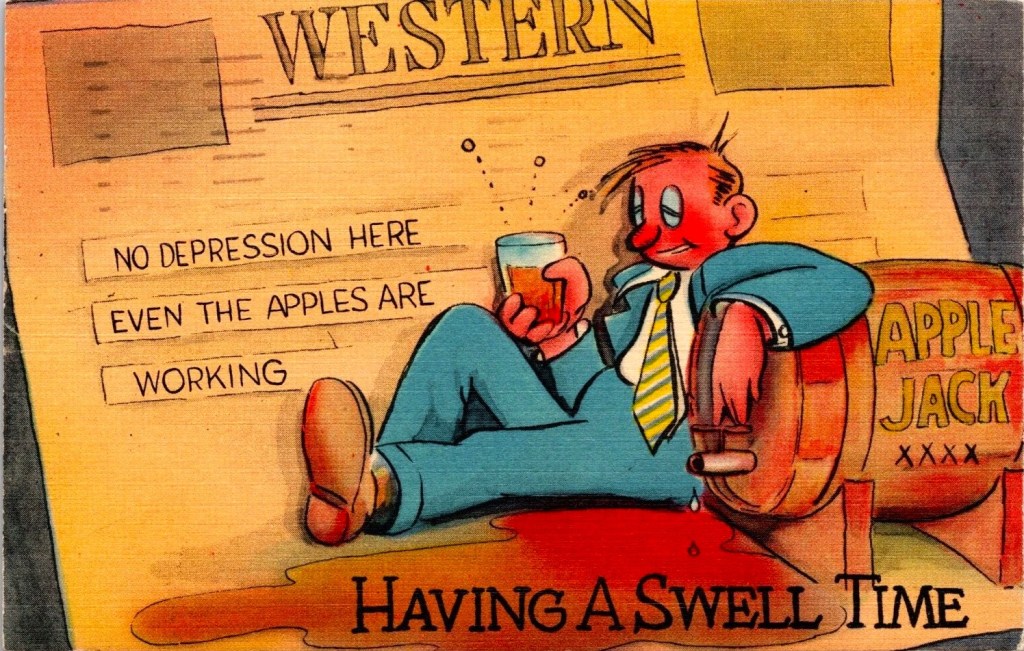
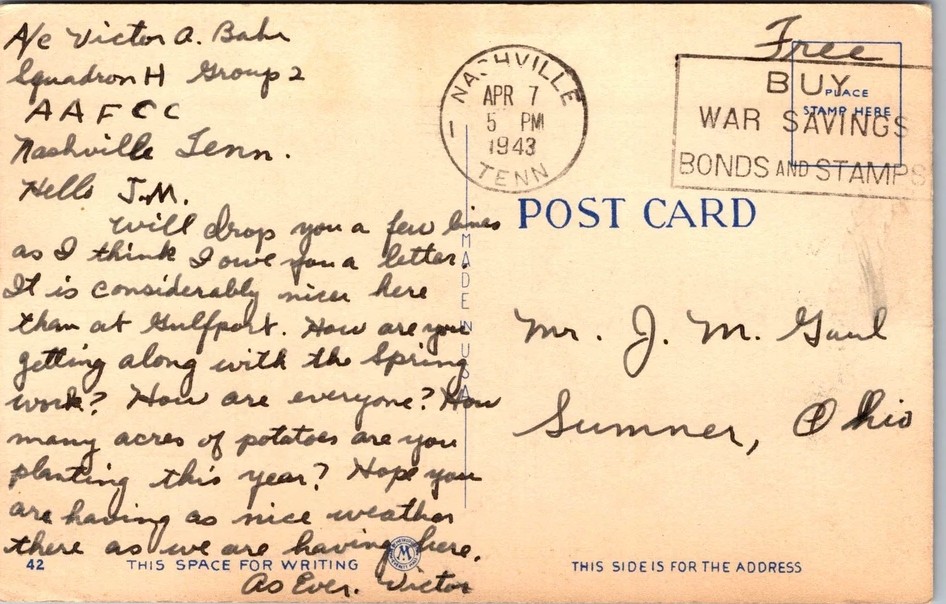
A funny postcard showing a fellow in a suit getting soused on apple juice was sent in 1943 from Nashville, Tennessee, by A/C Victor A. Bahr, to a Mr. J.M. Gaul in Sumner, Ohio. When I first saw the comedic picture on the front, I figured the sender was a jokester, but I figured that nothing of significant interest would turn up on either the sender or the recipient.
The recipient, Jacob Miller Gaul, was a young farmer living in Sumner, born on September 20, 1921. In 1943, Jacob married Mildred Louise Morgan. The couple had four children: Victor, born in 1945; Gloria Kay, who was stillborn in 1946; Patricia, born in 1951; and Vicki, born in 1957. Victor Gaul was most likely named after his father’s friend, Victor Bahr. Mr. Jacob Miller Gaul lived to be 91 years old.
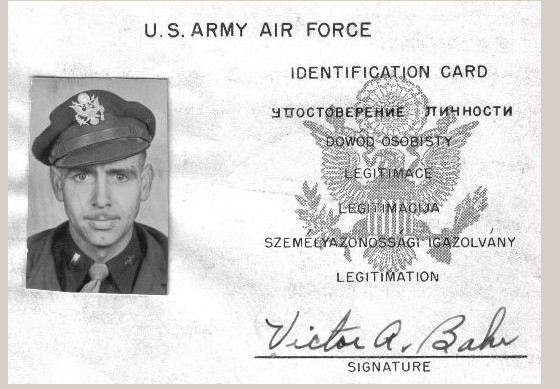
Army Air Corps Cadet Victor Ansil Bahr was being screened by the military in 1943 in Nashville as a possible pilot. Victor’s aspiration was to fly the P-38, a twin-engine fighter considered to be the best in its class back then. The note he sent his friend, J.M. Gaul, reads as follows.
“A/C Victor A. Bahr
Squadron H Group 2
AAFCC
Nashville, Tenn
Hello J.M.
Will drop you a few lines as I think I owe you a letter. It is considerably nicer here than at Gulfport. How are you getting along with the Spring work? How is everyone? How many acres of potatoes are you planting this year? Hope you are having as nice weather as we are having here. As ever, Victor?”
Victor was obviously having a hard time finding the right words, as often happens when writing to someone. One thing quite noticeable is that Cadet Bahr places more emphasis on his friend’s well-being than his own. From my research, that was a trait the man possessed up until his passing.
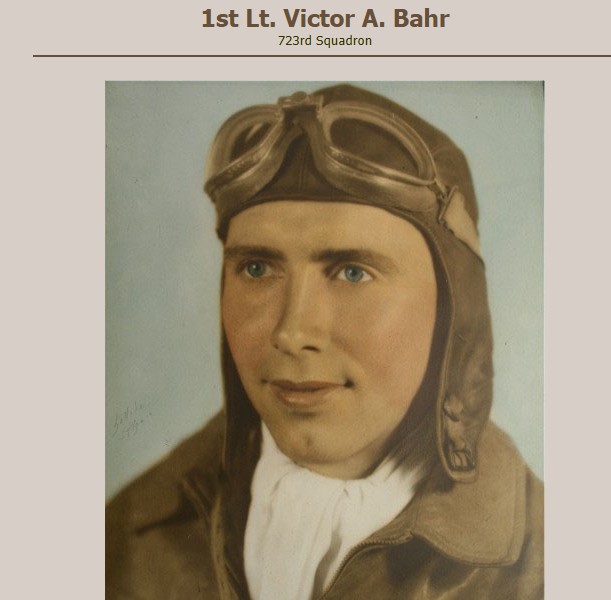
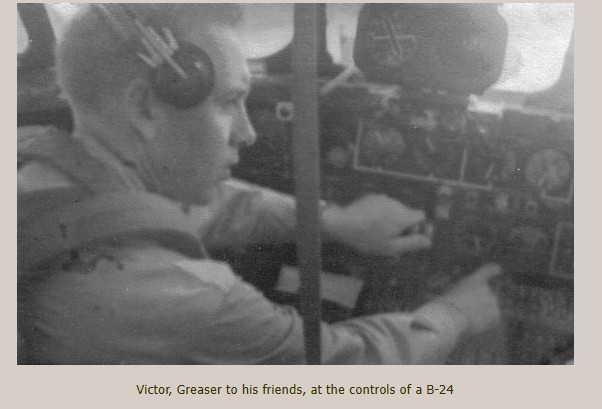
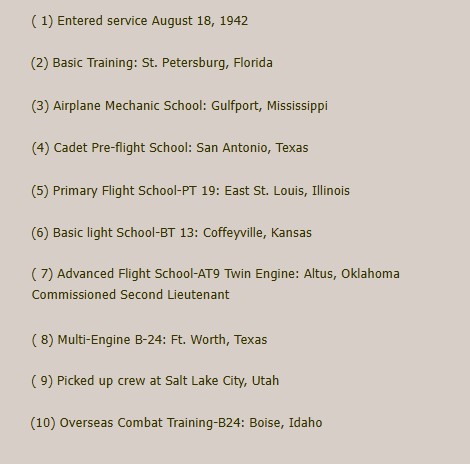
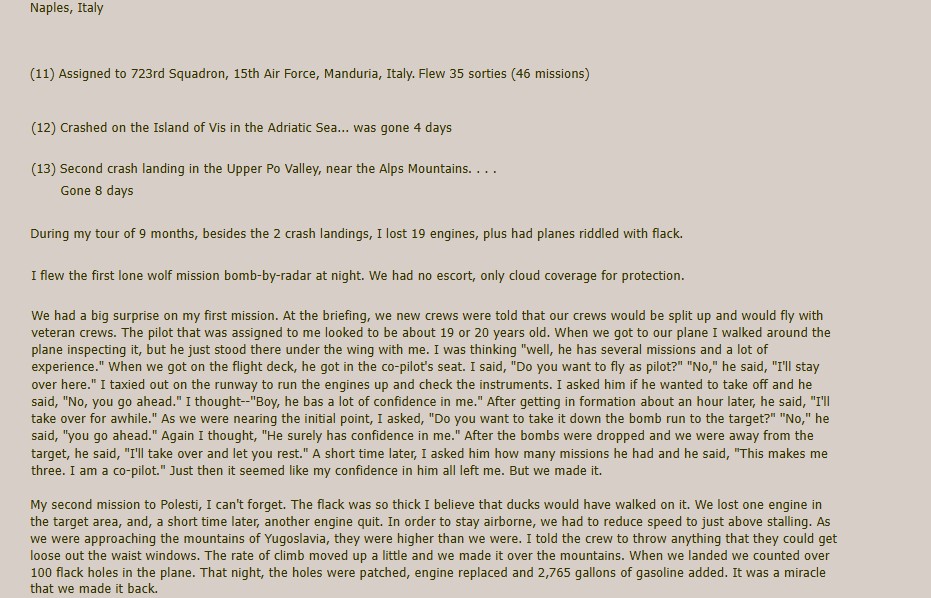
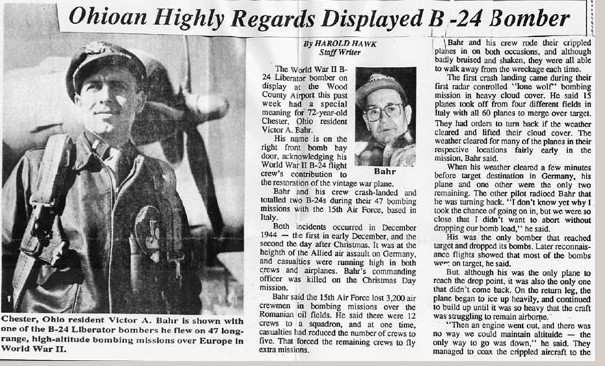
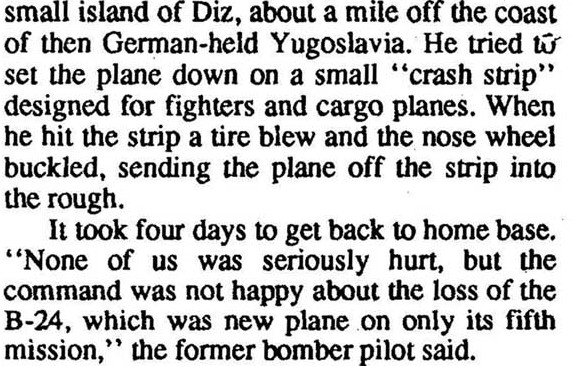
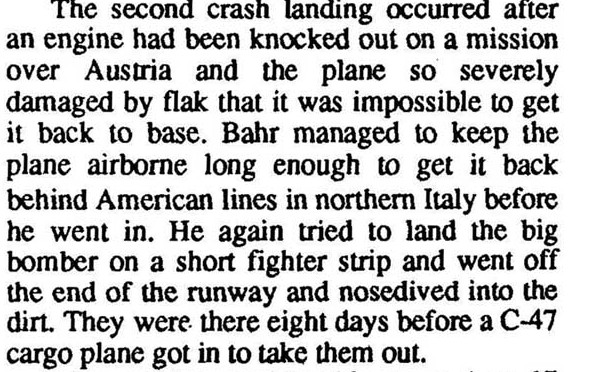
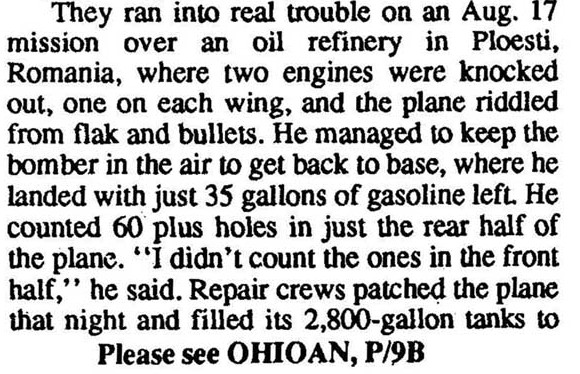
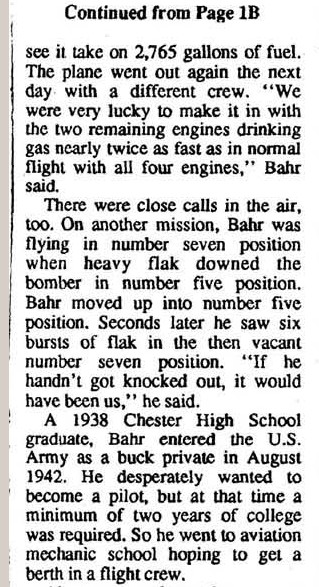
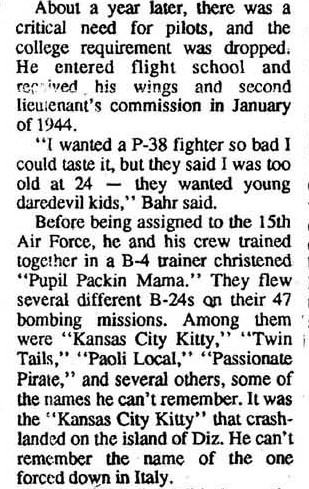
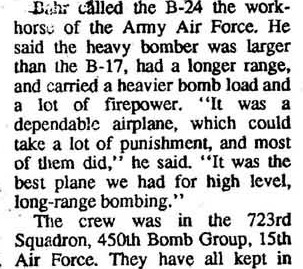
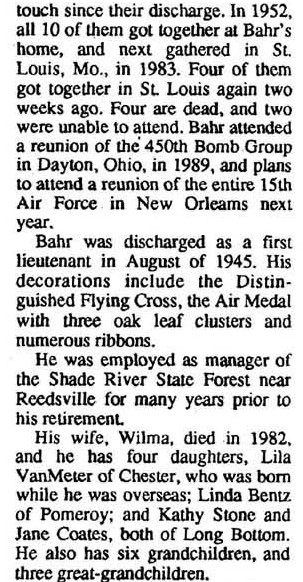
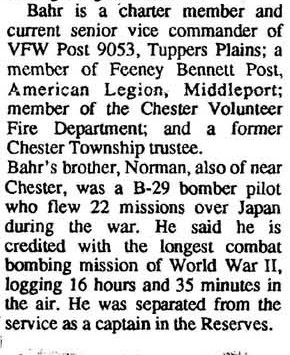
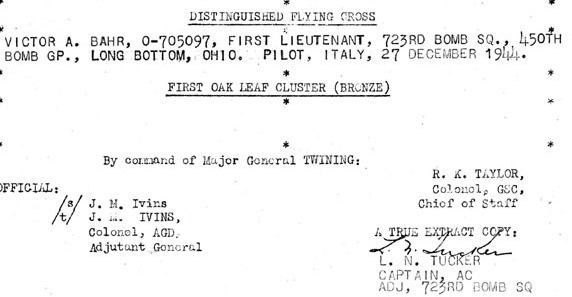
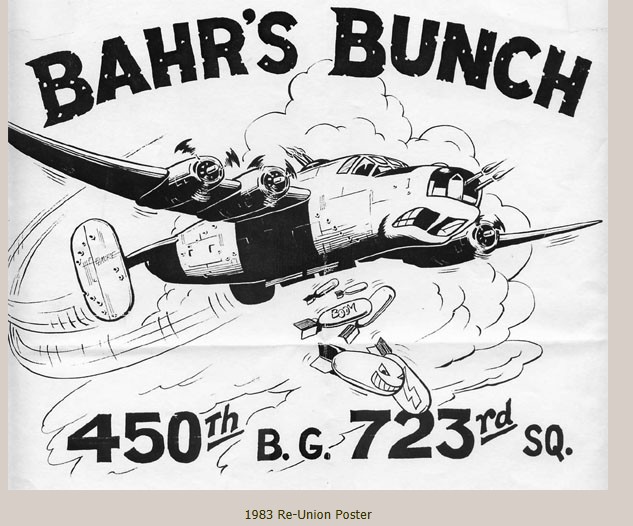
What 1st Lieutenant Victor A. Bahr encountered during WWII is phenomenal. The B-24 bomber pilot was fortunate to return home alive, as was his crew. I found significant material on Lt. Bahr’s military exploits, and rather than butcher this data into small, choppy paragraphs, I decided to share a majority of this information at the end.
Victor Bahr married his wife, Wilma, in 1938, and she passed away on April 6, 1995. Victor died on January 31, 2009, at the age of 88. A portion of his obituary I’ve included below:
“Victor was born June 6, 1920, in Chester, OH, son of the late Ernest W. and Bertha B. Betzing Bahr. He attended Alfred Church and formerly attended South Bethel E.U.B. and was a Forest Fire Warden for the Division of Forestry, a U.S. Army Air Corps veteran of World War II, and a member of the Chester Vol. Fire Dept., which he helped start. He was a life member of the Tuppers Plains VFW Post 9053 and the American Legion 128 in Middleport. He was also a school bus driver for Chester School, a coal miner, pilot, carpenter, and farmer.”
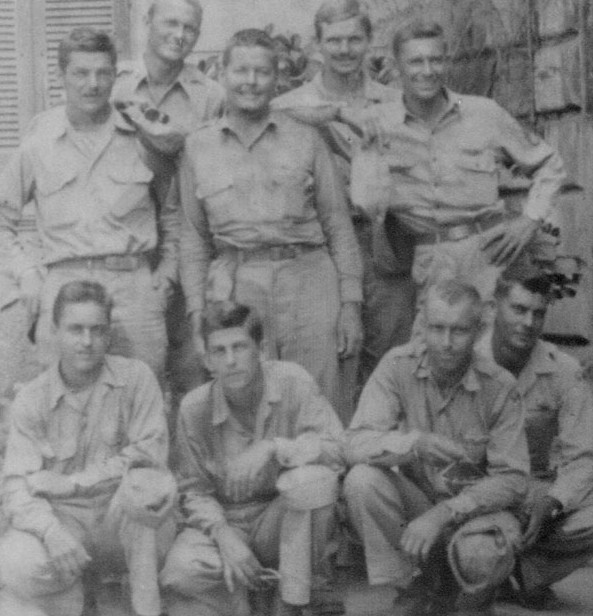
Left to right. Front row. Lt. Victor Bahr is the third one kneeling
“It seems like we saw a sign about tossing bottles overboard right before we chucked ours.”
In 1987, my wife and I took a one-week, island-to-island cruise of Hawaii on the SS Constitution. The SS Constitution was a large ship, 682 feet long, operated by American Hawaiian Cruises and featured on an episode of “I Love Lucy,” as well as in the movie “An Affair to Remember,” starring Cary Grant and Deborah Kerr.
During our cruise, I bummed an empty wine bottle and cork from a couple who had just consumed the beverage. Washing it out and then drying the inside as best I could, a note was written with our Alaska address on it.
I can’t remember what the note said, but it was probably the ship’s name and what we were doing on board. The cork stopper was partially reinserted, and tape was securely wrapped around it.
Walking to the back of the vessel, I undoubtedly glanced around before tossing it, not wanting to get caught littering. It seems like we saw a sign about tossing bottles overboard right before we chucked ours.
Joleen and I always had high hopes that someone would find the message in a bottle and write us. Thirty-eight years later, and we’re still waiting. Perhaps in 100 years, some beachcomber will finally discover things.
On August 23, 1908, 117 years ago, Otto Oren mailed a humorous, yet also prophetic postcard to his 16-year-old sister, Miss Estella Oren, in Upland, Indiana. I seriously doubt he ever dreamed someone would be reading it in 2025 and writing about such. Otto lived in Norborne, Missouri, at the time, some 500 miles away from Estella.
The agricultural towns of both Norborne and Upland play a key part here, as they both had post offices where the card was safely mailed and then safely received, unlike my wine bottle.
Norborne, Missouri, founded in 1868 along the Santa Fe Railroad, is a small town in Carroll County known for its agricultural heritage, especially soybeans. Over the decades, the community has stayed close-knit, celebrating its rural traditions and history.
Upland, Indiana, another small agricultural town, was established in the late 1800s. This community grew as a railway stop and is now recognized for its small-town character and as the home of Taylor University.
A short note on the back of this postcard contains the following:
“Aug 23/08 Norborne, Mo
Say when are you coming over to see us come over and we will take a boat ride on the river and catch a big cat-fish they are catching some fine ones now some that weigh 40-60-80 and up to a 100 pounds come over please from your bro O.O.”
On front of the card shows two women, with one on an antique telephone while the other listens in. The one gal is saying, “Are you there? Take my advice. Don’t sow your wild oats. They are bad reaping.”
I had to look this saying up, with Miss Purdy, my talented AI helpmate, offering up a stellar explanation:
“Don’t sow your wild oats, they are bad reaping” is a warning based on the idiom “sowing one’s wild oats.” Which refers to behaving promiscuously or foolishly in life, with the understanding that this “bad seed” will lead to negative consequences – the “bad reaping” – later in life, such as regret, problems in a committed relationship, or a ruined future. The saying combines this idiom with the biblical concept of reaping what you sow, emphasizing that irresponsible actions will inevitably bring about undesirable outcomes.
It’s most apparent that Miss Estella Oren took her brother’s softly veiled advice, following the Biblical principle in her relationship regarding promiscuity. The Oren family came from a Quaker upbringing, so that had a lot to do with their upbringing.
Marrying Benjamin Harrison Atkinson in 1909, Estella remained with him until Benjamin died in 1965, at 77 years of age. They had one child. Estella “Cattie” Atkinson never remarried, passing away in 1973 at 81.
Otto and Estella had 7 other siblings: Jason, Jasper, Lenora, Bertha, Bruce, Fletcher, Warren, and Charles. For the most part, they all lived long lives, except for Lenora and Charles.
Otto Oren, born in 1873, made it all the way to 1958. He was 85 at this time and lived to be the oldest out of all his sisters and brothers. Several years before his death, Otto and his second wife, Nargaret, moved back to Upland, Indiana, most likely to be closer to family. His first wife, Minnie, died in 1918. Otto had no children of his own from either spouse.
Margaret Oren passed away in 1963. She had 3 children from a previous marriage.
“Dean Donald Pruitt’s Ford Deluxe had special pedals to accommodate his wooden leg.”
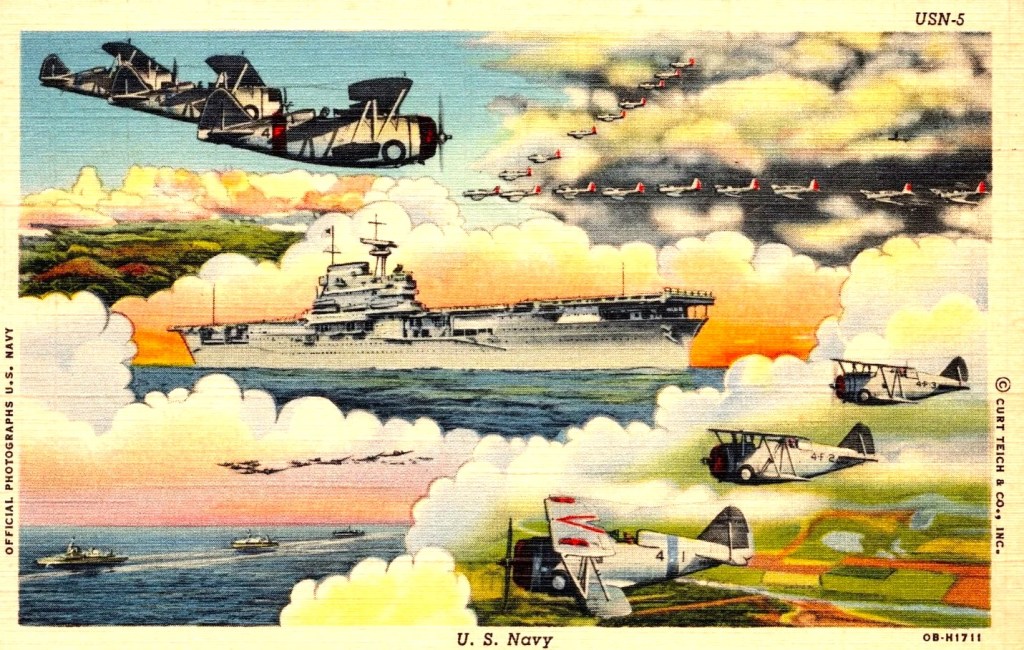
I started to forego further investigation of a 1943 official US Navy postcard on my list of cards to research. Nothing of real interest jumped out at me right away, so it seemed fruitless to continue on.
Deciding that I already had too much time invested, a decision was made to continue forward. It took some real sleuthing to find what I did, with a significant amount of depressing information uncovered. I should’ve stopped when I could.
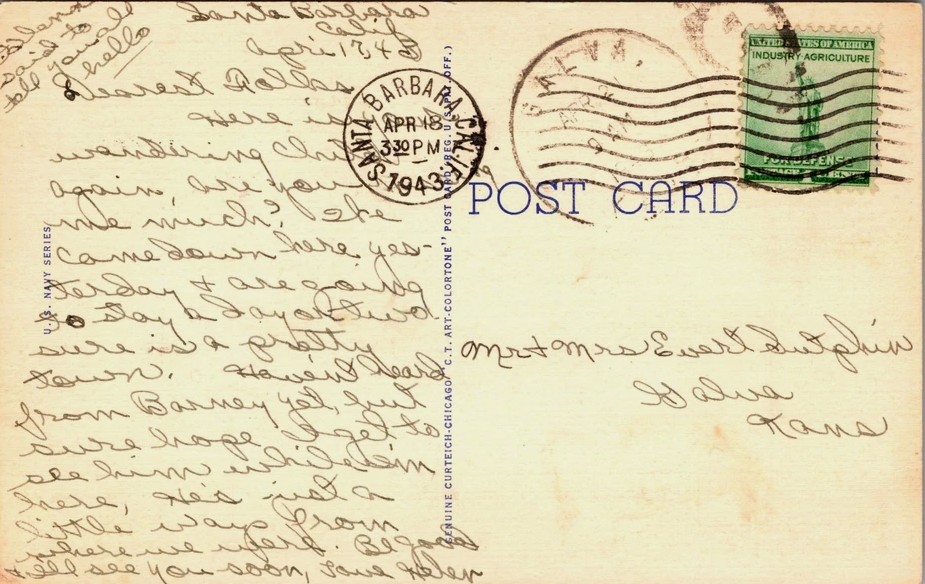
Someone named Helen mailed the colorful card from Santa Barbara, California, on April 18, 1943, to Mr. & Mrs. Evert Sutphin in Galva, Kansas. Helen’s letter on the back of the postcard is dated April 17.
“Dearest folks,
Here is your wandering child again, are you missing me much? We came down here yesterday & are going to stay a day or two. Sure is a pretty town. Haven’t heard from Barney yet, sure hope I get to see him here, he’s just a little ways from where we were. Be good & I’ll see you soon. Love Helen.”
Written in a corner with the same handwriting is another message,
“Malena said to tell you hello.”
Galva is a small town in McPherson County, Kansas, with a population of around 800. The community was originally called Liberty for approximately 10 years. When the railroad was rerouted and didn’t pass close enough to Liberty for a train to stop, townspeople pulled up stakes and moved closer to the rails. This new location was called Galva, named after Galva, Illinois.
Evert Sutphin was Helen’s father. He worked in Galva as a machinist and welder. His wife, and Helen’s mother, Edna, was a stay-at-home mom. Helen had two younger brothers, Richard and Frear.
When the postcard was sent, it’s possible Helen and Malena were attempting to see their husbands or boyfriends off from Santa Barbara before they departed for overseas duty. Malena’s husband, Byron Gilman Swain, fought in the war, as did Helen’s boyfriend, and ultimately her husband, Dean Donald Pruitt. I couldn’t find out if Helen and Dean were married before he left.
Malena’s husband worked for Shell Oil Company before the war started, as did one of Helen’s brothers. That may be how Malena and Byron Swain met. Their families hailed from the same general area of Kansas.
Dean Donald Pruitt was one of the first Marines who went ashore on a beach in Normandy on what’s called D-Day. It was June 6, 1944. Corporal Pruitt was severely injured when a German artillery shell exploded near him. Unfortunately, one of his legs had to be amputated.
Byron Gilman Swain suffered no injuries, and he resumed working for Shell after being discharged from the service in 1944. Dean Donald Pruitt wasn’t as fortunate. Through the Veterans’ Association, he underwent training to become an automotive body and paint specialist. Even with a prosthetic leg, Dean was able to master the difficult trade.
Ford Motor Company gave a couple of injured Wichita vets new vehicles in 1946, as part of an appreciation program for those who served this country and came home disabled. Pruitt was one of them. Dean Donald Pruott’s Ford Deluxe had special pedals to accommodate his wooden leg.
In 1949, while attempting to pass another car, he sideswiped a vehicle with his automobile and crashed. Pruitt wasn’t injured, but those in the two other vehicles were seriously hurt. Dean Pruitt’s Ford Deluxe was severely damaged, and he was cited for drinking and driving.
Eleven years later, in 1961, Evert Sutphin’s wife, and Helen’s mom, Edna, was killed in a head-on collision with a larger truck. Another woman in Edna Pruitt’s vehicle was also fatally injured. Wet roads were to blame.
Mr. Evert Sutphin passed in 1966 at the age of 71. Helen Sutphin-Pruitt died of cancer in 1971 at the age of 64. Her husband, Dean Pruitt, lived to be 58, dying in 1981.
Frear Sutphin passed at the young age of 55 in 1974. Richard Wayne Sutphin passed away in 1984. He was only 57. When it comes to longevity, the Sutphins with Dean Donald Pruitt did not fare so well.
Byron Gilman Swain passed away in 1987 at age 76. His wife, Malena Jane Berglund-Swain, survived the longest, taking her last breath on June 7, 1992, living to be 81. She was the hardest for me to track down, and if it hadn’t been for Malena’s unique name, I wouldn’t have succeeded.
All of this genealogical information was obtained from researching a simple picture postcard!
“I have no regrets about having grown up in Alaska.”
Each day when I walk outside my front or back door here in Arizona, the sky is generally royal blue, and no rain or snow is present. It’s become so ‘the norm’ that I sometimes take Arizona weather for granted.
During the summer months, heat is always present, but I’ve become accustomed to it. There’s nothing like wearing shorts and a T-shirt a full 12 months out of the year. Some residents opt for jackets and jeans during December and January, but being from Alaska must’ve toughened my skin, or warped my brain.
There were times in Anchorage when it rained the full summer, with occasional clear days. On those good days, someone would always say, “That’s why we live here!” I was never one of those folks. The nice days were sweet, but I always remembered that the following week or month could be gray and gloomy.
Snow was great to have when I owned a snowmachine or cross-country skied, yet I’d forego it in a Tennessee minute for warm weather and a swimming pool. Living in Alaska, a person had to enjoy whatever weather came along or they’d be miserable.
I did my fair share of camping and hiking in the rain, but I can say for sure that it put a damper on such activities. Staying inside a tent for two days while it rained cats and dogs did make for some quiet reading and thinking time.
I recall occasions when I dialed up my realtor friend, Randy Randall, in Lake Havasu City, during December or January. He’d tell me he just got back from exploring some mine in the desert, or shooting his gun. I’d be looking out our back window in Anchorage as he mentioned this, seeing that the outside temp was 10 below. “What am I doing here?” immediately popped into my head.
I have no regrets about having grown up in Alaska. I got to see and do things that others living in the ‘lower 48’ never experienced. When I say the lower 48, I mean those states excluding Hawaii and Alaska.
Each winter in our city by the lake, I see more and more Alaska license plates pop up. Making it a point to see who’s driving these vehicles, I find that not all are old retired people like me.
Some of them, like the family owning a second home right around the corner from us, are from Homer, Alaska. They have a seasonal business. Although I’ve never asked, they must view warm temperatures as more advantageous than cold and damp. Many of these Alaskans now stay year-round.
When someone asks if I’d move back to Alaska full-time, the answer is no. Been there—done that—applies to many things, with my nearly freezing to death being one of them. That one experience was when I fell through the ice in Chester Creek in January, when the temperature was 20 below.
My clothes froze solid like a fudgsicle. A friend, along with my brother, quickly got me into a hot shower, clothing, boots, and all. That saved my hide from frostbite. Almost becoming another Frosty the Snowman will never happen again—at least not to me while living in the Grand Canyon State!
“Records show that Mr. Kennah only had a grade school education, yet the Army accepted his application despite this shortcoming.”
Not everyone who sent postcards was literate enough to write them without help. I make this judgment after researching a humorous yet unusual card mailed to Joe Kemper in St. Louis, Missouri.
This card has the address of Pvt. John Kennah, stationed at the US Army – Rocky Mountain Arsenal, in Denver, Colorado, penciled on top. The postmark is September 10, 1942.
It’s easy to tell if it was a pencil by several eraser marks. A fellow named Mike wrote and signed the following message on the back of the postcard, with it appearing that Mike was barely literate himself:
“Pv John Kennah
Rocky Mt Arsenal
Denver Colo
US Army
Hello paper boy how are you. Tell your grandmother I said hello Joe will you get me one of those color paper. How is Charles getting along. Good by Joe and God bless you buddy Mike.”
Delving into John Kennah’s life, he was born on August 19, 1907, with the 1940 census showing he still lived with his parents and 7 siblings in St. Louis. At 32 years of age, John’s occupation was listed in the 1940 census as “paper boy.”
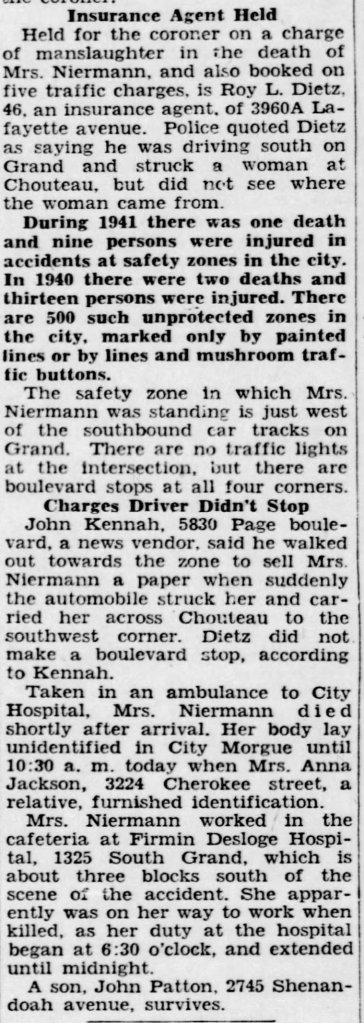
That was confirmed in a January 6, 1942, St. Louis newspaper article, detailing how a woman, Mrs. Niermann, was struck and killed as she crossed the street to purchase a paper from Kennah.
The shock and lingering memory must’ve been horrendous. With World War II underway, John Kennah enlisted in the service six months after the accident, on August 12, 1942. Records show that Mr. Kennah only had a grade school education, yet the Army accepted his application despite this shortcoming.
Joe Kemper was a friend of John and Mike, and, judging by Mike’s letter, he appears to be associated with the newspaper industry as well. Further research showed that Kemper eventually became a barber. Joe appears to also have been an amateur boxer, as well as an amateur baseball player for several local St. Louis teams.
After John Kennah left the service, he worked as a security guard at the Carriage Club for 13 years before retiring. John “Irish” Kennah died at the age of 86 in 1988. Out of 7 siblings, he outlived them all, including his wife, Angeline.
I didn’t find out who Mike is. With so many boys and men called that, it’d be next to impossible without a last name.
“Perhaps this had something to do with William Hunter selling life insurance after leaving the service.”
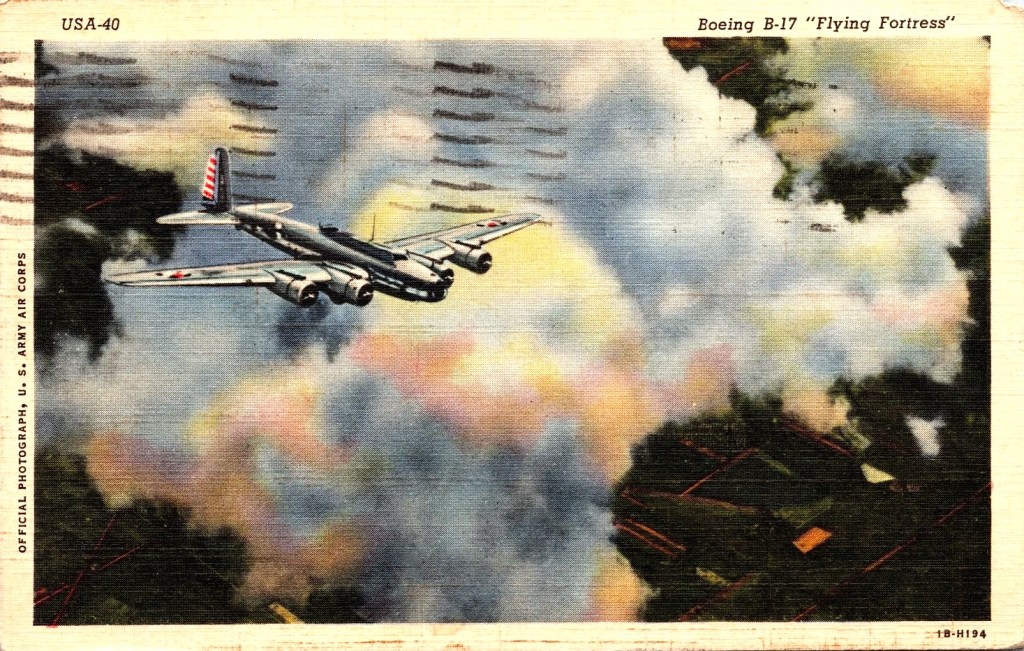
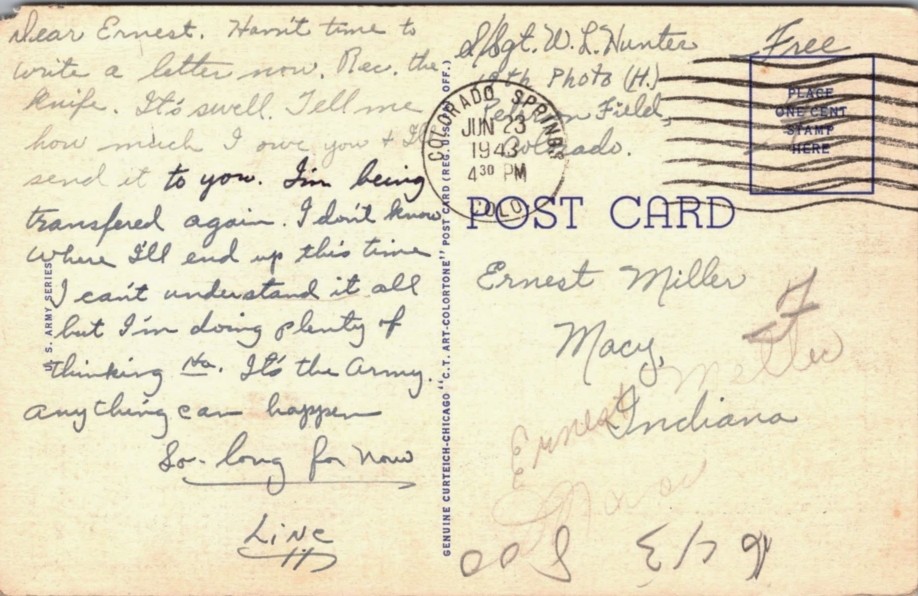
A 1940s WWII era postcard that I own was mailed from Colorado Springs, Colorado, on June 23, 1943, to a person in Macy, Indiana. The card sender was S/Sgt W.L. Hunter, assigned to the 19th Photo Headquarters at Peterson. The picture of the Boeing B-17 “Flying Fortress” on Hunter’s card is an official Army Air Corps photo. His letter to Ernest Miller says:
“Dear Ernest, Haven’t time to write a letter now. Rec the knife. It’s swell. Tell me how much I owe you and I’ll send it to you. I’m being transferred again. I don’t know where I’ll end up this time. I can’t understand it all but I’m doing plenty of thinking. Ha. It’s the Army. Anything can happen. So long for now. Line.”
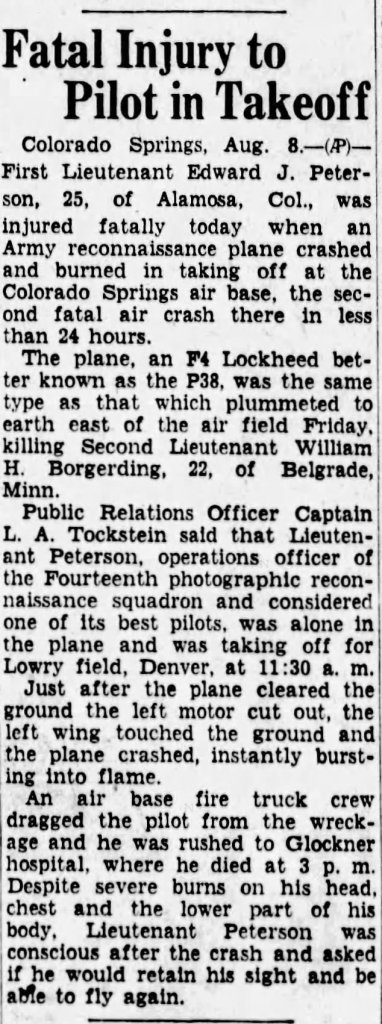
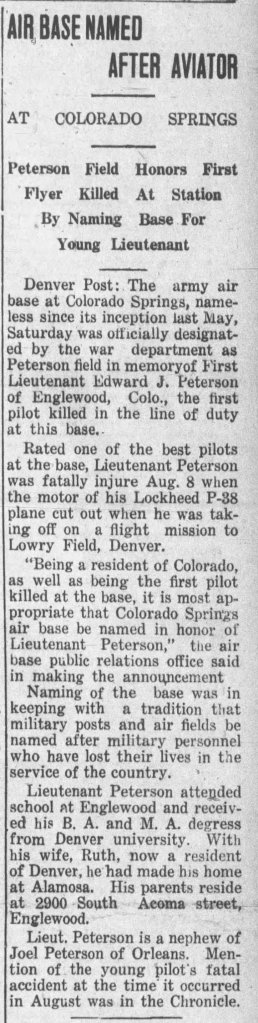
Colorado Springs Army Air Base, located in Colorado Springs, Colorado, was first established in 1942 as a military photo reconnaissance training facility during World War II, and was also used to train fighter pilots later in the war. Toward the end of 1942, it was renamed Peterson Field after 1st Lieutenant Edward J. Peterson.
1st Lieutenant Peterson was assigned to the 14th Photograph Reconnaissance Squadron in Colorado Springs, where he was promoted to operations officer on July 26, 1942. On August 8, 1942, only 13 days after his new assignment, Ed Peterson was seriously injured when an engine on his Lockheed F-4 failed and he crashed shortly after takeoff. An F-4 is similar to the P-38 Lightning.
The pilot was burned over his head, chest, and lower body. Peterson’s last wish before he lost consciousness was that he would fly again. Per his wife’s request, he was cremated and his ashes scattered over Pike’s Peak with an F-4 airplane like the one he flew.
Peterson Field was closed after the war ended in 1945, yet it was reactivated several times for different reasons. Renamed Peterson Air Force Base, it is currently home to the US Air Force Space Command, although that is soon to change. President Donald Trump recently made the decision to move the headquarters from Colorado to the Redstone Army Facility in Huntsville, Alabama.
William Lincoln “Linc” Hunter was born on September 15, 1919. He enlisted with the Army Air Corps on April 13, 1942. S/Sgt. Hunter saw action during WWII, most likely snapping photos from a B-17 aircraft like that one pictured on front of the postcard.
Thankfully, he returned, as many B-17 crewmen didn’t. Perhaps this had something to do with William Hunter selling life insurance after leaving the service. He lived to be 88, passing away on September 3, 2007.
Ernest Miller was a close friend. Born in 1909, he was 9 years older than William Hunter. Entering the draft on October 6, 1940, Mr. Miller was never chosen to serve. Ernest Howard Miller worked as a city engineer before retiring, succumbing to heart failure on August 22,1969, at the age of 60.
“The loss of 41-18335 sent shockwaves through the aviation community.”
XB-29 #118335
A picture postcard mailed from San Antonio, Texas, on May 31, 1946, appears to be nothing more than a typical card sent from a young airman to his family member.
The Boeing B-29 Superfortress serial number #118335 featured on the front isn’t any ordinary old airplane—nor is the Army Air Corps base where the 18-year-old enlisted man was assigned duty.
Kelly Field, as it was called until 1948, first began in 1916 as a flight training center for Army Air Corps pilots and mechanics. By 1921, after WWI ended, the facility was still in operation, more as an advanced training site for skilled pilots rather than new recruits. At the end of WWII, 15,000 civilians were working at Kelly with 16,000 military personnel.
Kelly Field eventually became Kelly Air Force Base, and was a major maintenance and logistics center for the Air Force for many years. That all came to an end in 2001 when the base closed, and all buildings and property were turned over to San Antonio for economic and educational use.
Getting back to Pvt. John McLellan, the backside of his postcard card contains the following:
“Rt. John M. McLellan
45052566 – Sqdn SB 15
Flight 413 3543 RD
AAF – MTC
San Antonio
Texas 30 – May – 46
Hi Ronnie,
Want to swap me one of these for a house? We have today off, the skies are cloudy after the storm last night. So I don’t know if I can take more pictures. I’m sitting outside in a beach chair, keeping away from detail.
So long kid, Jack”
John McLellan sent the postcard to Mr. Ronald D. McLellan in Cleveland, Ohio. It wasn’t hard tracking down their family history. John was 19 years old, entering military service on April 30, 1946, and had only been at Kelly Field for 1 month when he sent the card. The Rt. in front of his name stood for ‘radio technician’, although his real rank was private. I’d say he was trying to impress his brother by foregoing using Pvt.
Donald was a younger brother, although a younger one was yet to come along. John, or Jack as he liked to call himself, did not make a career out of the military, staying in for only 4 years. By the time he retired in civilian life, John McLellan was a mathematics teacher and had a master’s degree in philosophy.
Ronald D. McLellan was 7 years younger than John, going on to be a successful investment banker and eventually the president of Northwest Region III Banking Institution. John and Ronald’s lives were ordinary, based on the biographical information I came across.
The B-29 on the front of McLellan’s postcard suffered far more than the base. Rather than give a brief synopsis like I did with the McLellans and Kelly Field, I’ve decided to include a full history on this airplane, as it was highly important to how WWII turned out. At the time the postcard photo was taken, the B-29 was still in its development stages.
The Boeing XB-29 41-18335 stands as an emblem of innovation, ambition, and technological leaps that characterized the feverish pace of aircraft development during World War II. As one of the original prototype aircraft for what would become the iconic B-29 Superfortress, 41-18335 occupies a pivotal chapter in American aviation history—a tale of aspiration, tragedy, and progress.
In the late 1930s, with tensions mounting on the world stage, the United States Army Air Corps recognized the need for a new long-range bomber capable of traversing vast distances, carrying heavy payloads, and delivering decisive blows to enemy forces. Boeing, already renowned for its work on the B-17 Flying Fortress, was awarded the contract to develop this next-generation heavy bomber.
The result was the Model 345, which evolved into the XB-29 project. The Army ordered three prototype aircraft, designated XB-29, with serial numbers 41-0002, 41-0003, and 41-18335—the latter being the third and final prototype constructed.
The XB-29 represented a radical step forward in bomber technology. Its pressurized cabin, remote-controlled gun turrets, and powerful Wright R-3350 Duplex-Cyclone engines promised performance never before seen in an American bomber. The aircraft featured a sleek, streamlined fuselage, high-aspect ratio wings, and a tricycle landing gear—a significant departure from the tail-dragger designs of previous eras.
41-18335, as the third XB-29, incorporated lessons learned from its predecessors. Each prototype was essential not only for flight testing but also for refining the myriad new technologies integrated into the design.
First flown in 1942, the XB-29 prototypes were subject to rigorous flight evaluations from Boeing Field in Seattle, Washington. Pilots and engineers meticulously examined aspects such as engine performance, cabin pressurization, stability, and the functionality of the remote turrets.
41-18335 quickly became an invaluable asset in these tests, pushing the boundaries of what was possible and revealing both the potential and perils of the new bomber. During early flights, crews faced numerous challenges, including issues with engine overheating—a problem that would persist into production models.
The legacy of 41-18335, however, is indelibly marked by tragedy. On February 18, 1943, during a test flight near the Boeing plant in Wichita, Kansas, the prototype suffered a catastrophic engine fire. The aircraft, piloted by Boeing’s chief test pilot Edmund T. Allen and carrying several Boeing engineers and Air Corps observers, was attempting to return to the field when the fire intensified.
Unable to control the blaze, the crew lost control, and the aircraft crashed into a meatpacking plant just north of the airfield. The crash killed all eleven on board and 20 workers on the ground, including a fireman, making it one of the deadliest accidents in early American aviation.
The loss of 41-18335 sent shockwaves through the aviation community and the Boeing organization. Not only did the tragedy claim the lives of some of the industry’s brightest engineers and test pilots, but it also highlighted the urgent need for further refinement of the B-29’s engines and safety systems.
Investigations traced the accident to a combination of engine overheating and inadequate fire suppression capabilities—issues that prompted a comprehensive redesign of the engine nacelles, fuel systems, and emergency procedures in subsequent B-29s.
Despite this setback, the XB-29 program pushed forward. Boeing, along with the Army Air Forces, redoubled their efforts, determined to honor the legacy of those lost by delivering a bomber that would ultimately change the course of the war.
The lessons learned from XB-29 41-18335 and its sister prototypes directly shaped the design and production of the B-29 Superfortress. The aircraft became the most advanced bomber of its era, featuring a fully pressurized fuselage, advanced targeting systems, and unmatched range and payload.
More than 3,900 B-29s would be produced before the war’s end, and the type would go on to play a decisive role in the Pacific theater, including the historic atomic bomb missions over Hiroshima and Nagasaki. The Superfortress continued to serve in the postwar years, setting records for range and altitude, and paving the way for the next generation of strategic bombers.
Today, the story of Boeing XB-29 41-18335 serves as a powerful reminder of the risks and sacrifices inherent in the pursuit of technological progress. Though the aircraft never saw combat, its contribution to aviation was profound. The lessons derived from its construction, testing, and tragic loss led directly to the improvements that made the B-29 a success.
Memorials and historical accounts continue to honor those who perished in the Wichita crash, and the site remains an important landmark in the annals of American engineering.
The Boeing XB-29 41-18335 was more than just an airplane; it was a crucible of innovation, courage, and learning. Its brief existence and untimely end were instrumental in forging the path toward victory in World War II and reshaping the future of military aviation. Through its legacy, the men and women who strove to build something extraordinary are remembered, and the spirit of their endeavor endures in the aircraft that have followed.
118335 taking off from Boeing Field – SeattleCrash site of B-29 #118335
“The story of the Bank Club begins in the aftermath of the great depression.”
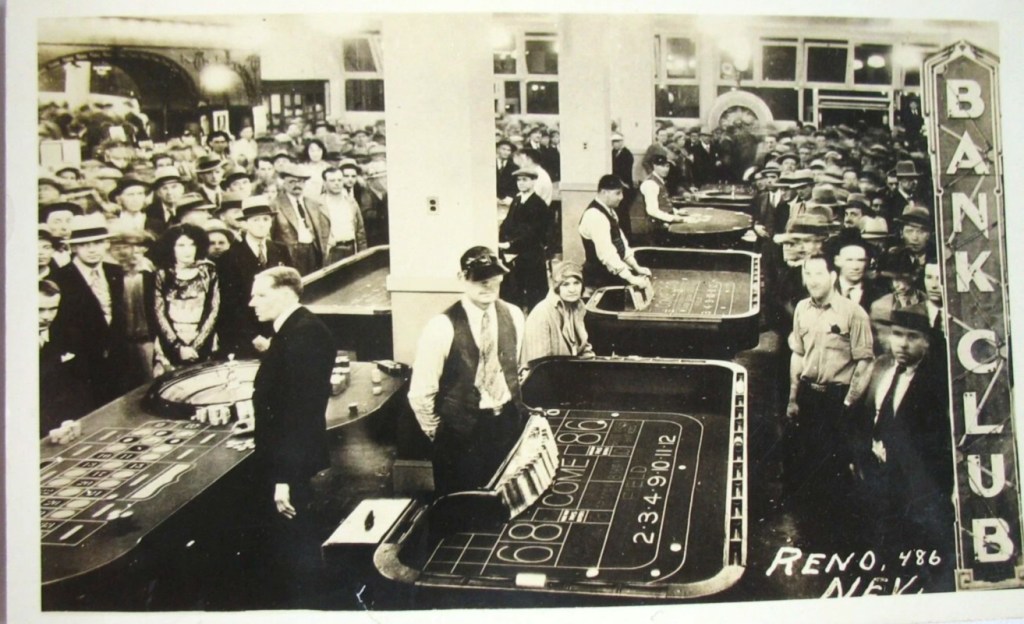
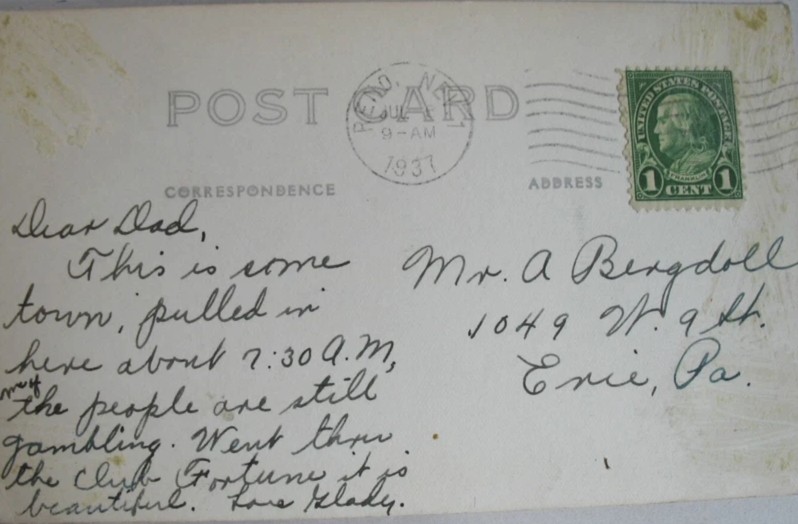
There was much history to be discovered regarding the Bank Club in Reno, Nevada. A photograph of a gambling scene taken inside the Bank Club is shown in front of a vintage 1934 postcard sent to Mr. A. Bergdoll, who lived at 1049 W. 9th Street in Erie, Pennsylvania. Gamblers, mostly men, are standing there staring at the camera like blind sheep. Arthur Sunder Bergsdoll’s daughter, Gladys, mailed this postcard to him with the following short message,
“Dear Dad,
This is some town, pulled in here about 7:30 A.M., some of the people are still gambling. Went thru the Club Fortune. It is so beautiful. Love Glady”
I discovered no hidden secrets or anything controversial about the Bergdolls. Arthur worked as a hairdresser while his wife, Mabel, was a teacher. In the 1940 census report, I assume the person recording the information meant ‘barber’ but, for whatever reason, chose ‘hairdresser’ for Arthur’s occupation.
Arthur Bergdoll, born in 1879, signed up for the military draft in 1942. He would’ve been 63 years old at that time. It seems strange that the military would want a man of that age. During World War II, all men were required to register for the draft, and Arthur complied.
Gladys Bergdoll was born in 1909. She would’ve been 25 years old while visiting Club Fortune and a single woman, undoubtedly kicking up her heels, even though Gladys doesn’t mention this to her father. She married Clarence Martin on June 26, 1945, while Clarence had just returned from overseas duty during WWII.
Gladys’ brother, Jack Richard Bergdoll, was 11 years younger than she. He served as a U.S. Marine during World War II. Fifteen years after the war ended, Jack married Carolyn Mock in 1960. They had 2 children before Carolyn divorced him in 1960 for “gross neglect of duty.” That generally means a serious drinking problem.
The following information I dug up on the Bank Club. There’s far more here than I wanted to include, yet I decided to start from the time it opened until now. It’s amazing that the original casino building still stands!
Nestled in the heart of downtown Reno, Nevada—the city famously dubbed “The Biggest Little City in the World”—the Bank Club stands as a storied relic from an era when the Silver State’s fortunes were inexorably linked to gaming, glitter, and the promise of reinvention. The tale of the Bank Club is interwoven with the rise of Reno itself, mirroring the city’s embrace of legalized gambling, its vibrant nightlife, and its reputation as a hub for both vice and opportunity.
The story of the Bank Club begins in the aftermath of the Great Depression, when Nevada sought bold new paths to economic recovery. In 1931, a pioneering piece of legislation changed the state’s trajectory forever: the legalization of gambling. Reno, already a magnet for those seeking easy divorces thanks to Nevada’s liberal residency laws, rapidly transformed into a playground for adults and a beacon for entrepreneurs eager to capitalize on the newly legal gaming scene.
One of the earliest and most prominent clubs to emerge from this new climate was the Bank Club. The club took its name from its original location: the site of a former bank building at 238 North Virginia Street. The stately structure conveyed an air of legitimacy and grandeur that set it apart from some of the more makeshift establishments emerging throughout the city.
The founders of the Bank Club recognized that Reno’s clientele was not only interested in gambling but also in an atmosphere of sophistication and excitement. The club became known for its ornate art deco architecture, its gleaming neon signage, and its commitment to providing an immersive experience for guests. Unlike many of its competitors, the Bank Club strove to blend the allure of European casinos with the rugged spirit of the American West.
By the late 1930s, the Bank Club had secured its reputation as one of Reno’s premier gaming halls. Its offerings included blackjack, craps, roulette, and the ever-popular slot machines. The club’s high ceilings, elegant chandeliers, and polished marble floors made it a favorite among both locals and tourists. The Bank Club quickly became a centerpiece in the city’s social scene, offering not only gambling but also fine dining, live music, and dancing.
During World War II, Reno continued to attract visitors from across the nation, and the Bank Club thrived. It served as a gathering place for soldiers on leave, Hollywood celebrities passing through, and business magnates seeking both recreation and relaxation. The club’s management cultivated a reputation for hospitality and discretion, making it a preferred destination for those seeking both excitement and privacy.
This era also saw the rise of several legendary figures associated with the Bank Club—colorful personalities who contributed to its mystique. Among them were influential local businesspeople, skilled gamblers, and charismatic entertainers who turned the club into a stage for memorable nights and chance encounters.
Beyond its role as a gaming destination, the Bank Club served as a hub for the Reno community. It hosted charity events, civic meetings, and holiday celebrations that helped to cement its place in the city’s collective memory. Families would gather for brunch in its elegant dining rooms, while friends met for cocktails and lively conversation in its bustling bars.
The club’s location on Virginia Street was ideal, providing easy access for visitors arriving by train or car. As Reno grew and modernized, the Bank Club remained a symbol of the city’s resilience and adaptability. Its walls bore witness to generations of Nevadans seeking fortune, fun, and belonging.
As the decades marched on, Reno’s gaming industry evolved. New casinos, resorts, and entertainment complexes emerged, competing for attention and investment. While the Bank Club remained a beloved institution, it faced increasing challenges in adapting to changing tastes and regulations.
By the 1960s and 1970s, the club experienced a period of decline. Ownership changed hands several times, and the establishment’s original grandeur began to fade. The rise of larger, more lavish casinos on the Reno Strip and, later, in Las Vegas, contributed to a shift in the region’s gaming landscape. The Bank Club, like many smaller clubs, struggled to compete with these new giants.
Despite these difficulties, the Bank Club’s legacy endured. The building itself, with its distinctive façade and architectural charm, continued to attract interest from preservationists and history enthusiasts. Efforts were made to restore and repurpose the structure, ensuring that its historical significance was not lost amid the changing tides of commerce and entertainment.
Today, the Bank Club is remembered as a symbol of Reno’s first golden age of gaming—a tangible link to a time when the city was forging its identity as a place of possibility and adventure. While the club no longer operates as a casino, its influence persists in the lively atmosphere of downtown Reno and the stories shared by longtime residents.
The building itself has found new purpose over the years, housing a variety of businesses and serving as a reminder of the city’s dynamic past. Preservation efforts have ensured that the Bank Club’s architectural beauty remains visible to visitors and locals alike.
In historical retrospectives, the Bank Club is often cited as a catalyst for Reno’s rise as a gaming capital. Its blend of elegance, excitement, and community spirit helped establish standards that were emulated by subsequent establishments throughout Nevada and beyond.
The story of the Bank Club is more than just the history of a gambling hall; it is the story of Reno itself. From its beginnings in a repurposed bank building to its heyday as a glittering social center, the club embodied the optimism and energy of an evolving city. Though the gaming tables may be silent now, the legacy of the Bank Club lives on in the streets, stories, and spirit of Reno.
For those who stroll down Virginia Street today, the echoes of laughter, the flash of neon, and the glamour of a bygone era linger in the air—a testament to the enduring allure of the Bank Club and the city it helped to shape.
The Bergdoll home in Erie, Pennsylvania, as it looks today.
“Homeless people saw it as a shelter out of the storm while also trashing the interior.”
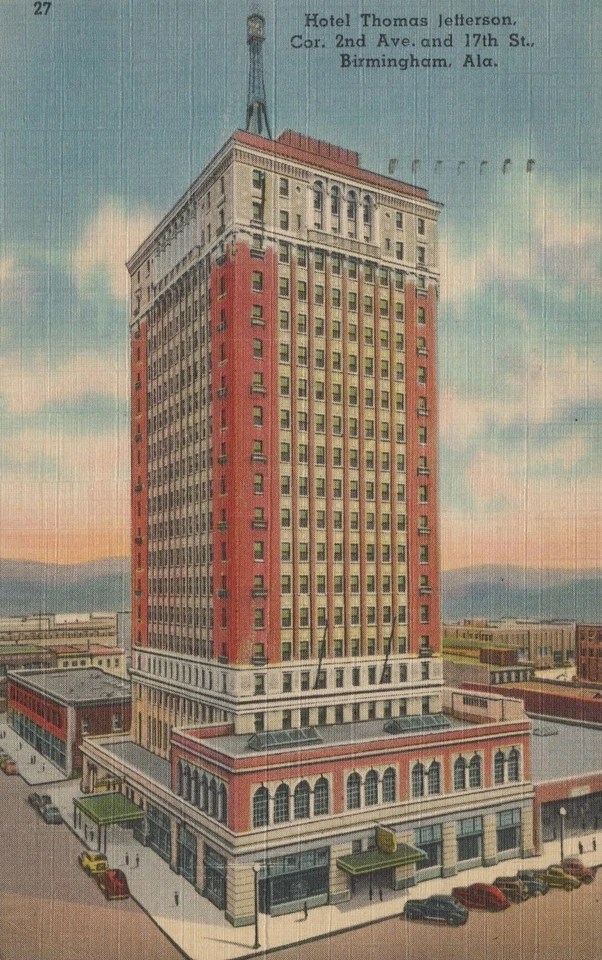
The Thomas Jefferson Hotel, an enduring symbol of Birmingham’s Gilded Age, stands as a testament to the city’s ambitions in the early twentieth century. Located in the heart of downtown Birmingham, Alabama, this grand hotel was envisioned as a premier destination for travelers, dignitaries, and locals alike.
Construction on the Thomas Jefferson Hotel began in 1925, at a time when Birmingham—often dubbed the “Magic City” for its rapid industrial growth—was eager to showcase its prosperity. Designed by the architectural firm Holabird & Root, along with local architect William Lee Stoddart, the hotel was built in the Beaux-Arts style, featuring ornate details, a limestone façade, and elaborate interior spaces. When it opened its doors in 1929, the Thomas Jefferson Hotel soared 19 stories high, making it one of the tallest buildings in Birmingham at that time.
The hotel quickly became the social epicenter of the city. Its luxurious ballrooms, lavish dining facilities, and richly decorated guest rooms attracted celebrities, business leaders, and even United States presidents. It was especially renowned for its vibrant rooftop ballroom and the iconic zeppelin mooring mast, a distinctive architectural feature that crowned the building and became a recognizable part of Birmingham’s skyline.
As the decades passed and the city’s fortunes shifted, the Thomas Jefferson Hotel experienced a gradual decline. Changes in travel patterns, the rise of highway motels, and urban renewal contributed to the hotel’s closing in the early 1980s. The once-grand halls stood empty, and the building became a haunting reminder of Birmingham’s former glory. Homeless people saw it as a shelter out of the storm while also trashing the interior.
Despite years of neglect, the hotel’s architectural significance and enduring charm kept hope alive for its restoration. In the 2000s, preservationists and developers rallied to save the building, recognizing its historical value and potential for revival. After extensive renovations, the hotel reopened in 2017 as the Thomas Jefferson Tower, featuring modern apartments, event spaces, and commercial venues while carefully preserving its historic elements.
Today, the Thomas Jefferson Hotel—now Thomas Jefferson Tower—remains a cherished landmark in Birmingham. Its storied past, architectural grandeur, and successful revitalization symbolize the city’s resilience and dedication to preserving its unique heritage. The building continues to watch over downtown Birmingham, linking the city’s illustrious history with its vibrant present and future.
An old postcard of the hotel from the 1940s shows this stately building before being turned into apartments. A man named Vernon sent the postcard to Mrs. Nina Rhoades in Springfield, Ohio. The postmark date is July 15, 1944. It was mailed from Birmingham.
“Hi Hon,
Don’t think I’ll be back these babes are tops some pumpkins I’d say. Don’t you all wish you was a southern belle. I will probably go on to New Orleans. I got a honey with me from there. bye, bye don’t worry.
Vernon”
Vernon Wesley Rhoades would’ve been 38 when he sent this postcard to his wife, whom he’d been married to for 13 years. Was it a cruel joke, or were they fighting? I tend to believe the former—and I’d bet Mrs. Nina Alice Rhoades had a good laugh over it. After reading Vernon’s bio, he does not come across as a Casanova.
Vernon served two years in the US Army and worked as a machinist for Kelsey-Hayes for most of his life. He belonged to the Knights of Pythias Lodge for 49 years. This is described as a secret organization. It seems reasonable that Vernon was attending a meeting of this group in Birmingham.
Vernon and Nina wed on August 15, 1931. They stayed together until Vernon died in 1987, with Nina passing away in 1991. The couple had one daughter and a son, Judith and James.
“Gust Mihleder lived an adventurous career, staying in the military almost his whole life.”
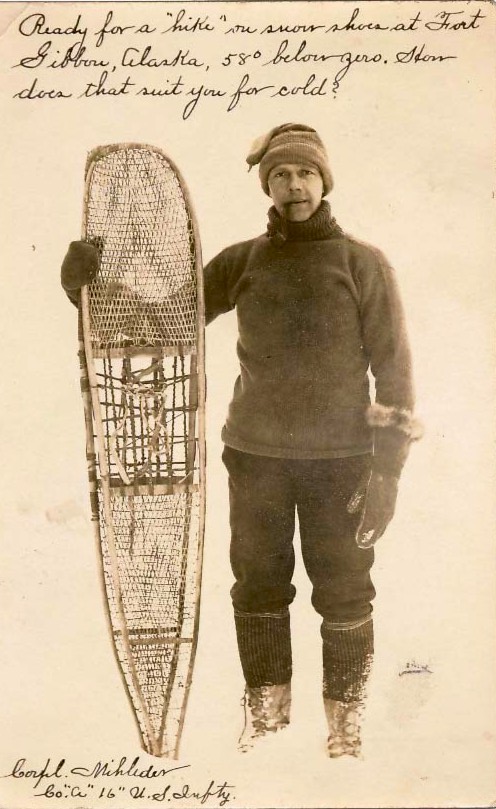
A postcard that I recently snagged was mailed from Tanana, Alaska, on February 10, 1911, to Mrs. J.T. Hoover in Pasco, Washington. On the front of the RPPC (real picture postcard) is a picture of US Army Corporal Gust Mihleder in full Arctic gear, standing beside a pair of tall snowshoes, while smoking a pipe.
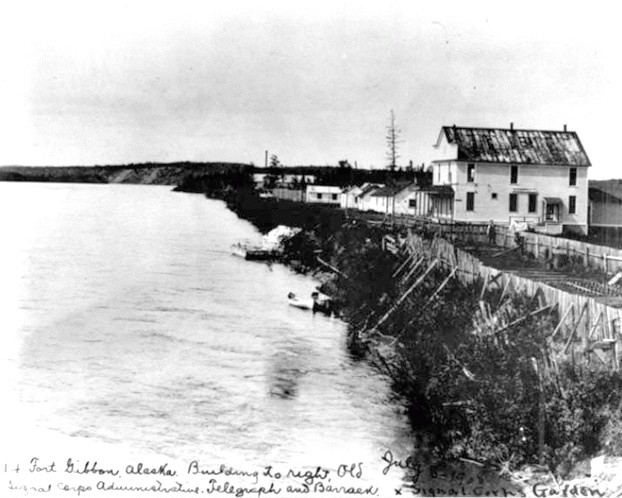
The message on both front and back is most informative. Corporal Mihleder was assigned to Company “A” – 16th US Infantry. The card was mailed from Tanana, Alaska. Corporal Mihleder was stationed at Fort Gibbon near the Tanana village in the Yukon-Koyukuk area near the Yukon River. The following message was handwritten in perfect cursive and flawless spelling on the back:
“8/8/11
Dear Mrs. Hoover: Your card and letter rec’d. Was much pleased to hear from you, and hope you will like your new home, and that the climate way cause Mr. Hoover’s complete recovery. Will write as soon as I can find a moment to myself. What do you think of the Alaskan style of clothing and would you know me in this outfit. All the boys are well and send their kindest regards. Will write in a few days. Sincerely.
Gust Mihleder”
On top of the photo of Gust was written the following:
“Ready for a “hike” on snow shoes at Fort Gibbon, Alaska, 58 below zero. How does that suit you for cold?”
Mrs. J.T. Hoover and her husband were undoubtedly very close friends of Gust Mihleder, and Gust was probably a longtime pal with J.T., as they both lived in Franklin, Pennsylvania, and went to school there. Both the Mihleder parents and Hoover descendants were born in Germany. J.T. Hoover’s mom, Minta,was a school teacher at one time.
Mr. and Mrs. Hoover had only lived in Pasco, Washington, for a short time, one year, having relocated there from Littlerock, Arkansas, because of John Thomas Hoover’s health.
John Thomas Hoover was a successful businessman as well as being involved in the banking industry. He was a senior officer with the German Bank of Littlerock. John married Elizabeth “Lizzie” Ellen Knox on January 29,1899. She chose to go by Mrs. J.T. Hoover, taking her husband’s name as many married women often did back then.
After John T. Hoover passed away on May 6, 1911, at the young age of 39, the body was sent from Pasco to Arkansas, where it lay in the state capitol rotunda until the service. Mr. Hoover’s funeral was attended by a good number of family, friends, and business associates.
Mrs. J.T. Hoover, now a young widow, moved from Arkansas to Oregon to be close to her sister and three brothers. There, she married a much older man named Willis E. McElroy in 1917. He was the music director for the Portland Symphony Orchestra.
That marriage lasted one year before she divorced him for being unfaithful. Elizabeth told the judge that he began cheating on her two weeks after they tied the knot. It would’ve been a short-lived marriage even if they stayed together, as Willis McElroy passed in 1927 from a sudden heart attack.
Having changed her name back, Mrs. J.T. Hoover died in Gilchrist, Oregon, in 1942, at the age of 59. She was buried in Portland with her tombstone saying: Elizabeth Ellen Hoover.
Gust Mihleder lived an adventurous life, staying in the military almost his whole life. He never married. Not only did he serve his country in Alaska, but he fought battles in the Spanish-American War, in Panama, the Philippines, and ultimately, in WWI. With further research, I believe I’d find he received many rewards during his extensive service.
Lieutenant Gus Mihleder began his military career as an enlisted private, was promoted to corporal, then sergeant, first sergeant, and ultimately became a lieutenant. Not many soldiers advanced from enlisted to officer rank without having an exemplary record.
During his foreign assignments, he wrote many lengthy letters to his father, who shared them with a local newspaper. Gust Mihleder was an accomplished writer and storyteller, as his letters attest. Someday, when time allows, I’ll transcribe and print them all.
Passing away on June 22, 1952, at the age of 75, Lieutenant Gust Mihleder is buried with honors at Antietam National Cemetery in Maryland, amongst other war veterans, including those killed during the Battle of Antietam during the American Civil War. It appears that Lieutenant Mihleder’s life is one worthy of a book or movie.











 I like to write junk...