“Ten dollars in 1911 is equivalent to $340.05 today…”
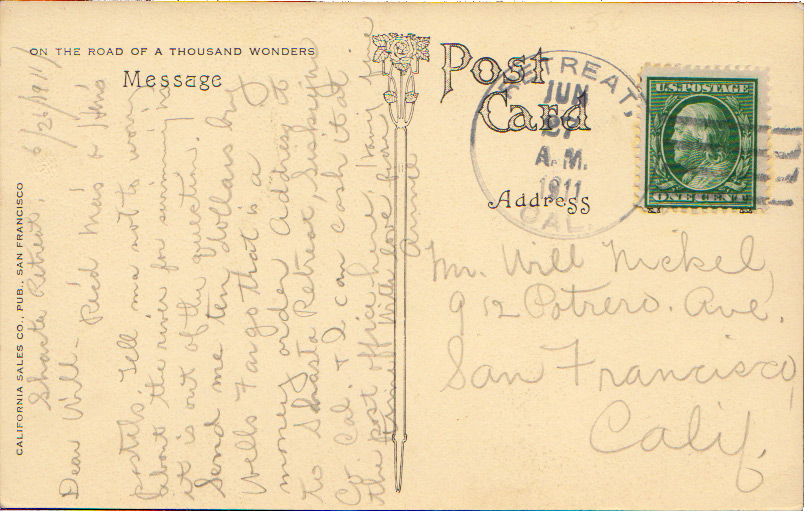
I’ve never heard of Shasta Retreat, California, until I found a postcard with a picture of the railroad stop on it. A caption under the photos says: Train Arriving At Depot. Shasta Retreat, California. A steam locomotive is pulling up with passengers ready to board.
Shasta Retreat was a place that a person named Annie was visiting. I make this judgment based on a short letter written on the back of the card by her.
“Shasta Retreat 6/26/1911
Dear Will,
Re’cd Ma’s and Henry’s postels. Tell ma not to worry about the river for swimming, it’s out of the question. Send me ten dollars by Wells Fargo that is a money order. Address it to Shasta Retreat, Siskiyou Co. Cal. I can cash it at the post office here. Having fine time!
With love from
Annie”
The card was addressed to:
Mr. Will Nickel
912 Potrero Avenue
San Francisco
Calif
It took me a bit of sleuthing to find out who the Nickels were. They hailed from Germany, moving there from Oregon, and then to San Francisco, where the head of the household, Henry J. Nickel, was a cabinetmaker. Johanna was his wife, while William E. and Henry Jr. were Annie’s brothers.
One of the young men, William, worked as a machinist. Henry Jr. took up cabinetmaking like his father. In Annie’s mentioning Henry in the postcard, this person was undoubtedly her younger brother and not her father.
Ten dollars in 1911 is equivalent to $340.05 today, so Annie was asking for a substantial amount of cash. She worked as a dressmaker, so it seems reasonable that money was no problem.
I assume she was staying at some resort or getaway in Shasta. The river that Annie’s mom was so concerned about was most likely the Shasta River. It was a popular swimming spot at that time.
Henry Nickel Sr. passed away in 1922. Oddly enough, his gravestone says: Henry Nickels. Perhaps the stone maker made a mistake? His wife, Johanna, died on August 8, 1945, at the age of 90. She was living with her daughter and a son.
William E. Nickel died in 1969 at the age of 85. Anna “Annie” lived to be 87, dying in 1974. Henry Jr., the youngest, died in 1973. I could not find that Annie, Henry Jr., or William E. Nickel ever married.
This family, like most German people were back then, was hardworking, industrious, and very close to each other. The old English saying, “Blood is thicker than water!” seems to hold true for Henry Nickel Sr., Johanna, and their children.
I could not find that Shasta Retreat still exists. Perhaps it too faded off into eternity!
I’ve come across many unusual postcards during my project, with some of them unreadable, while others seemingly contained secret coded messages that I couldn’t decipher. I’ll look over these types of cards and then pass on writing anything, viewing it as a waste of time.
This unusual card is one of those, except that the message a man sent from Alaska to a single girl in Chicago gets an award for being tasteless, although the sender probably didn’t see it as such.
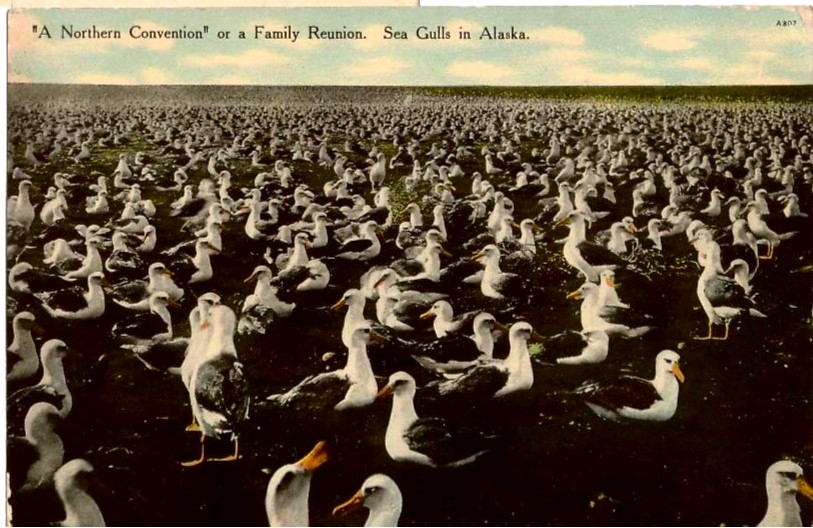
The card, postmarked in Saint Michael, Alaska, shows a flock of white seagulls on a beach with the caption: “A Northern Convention” or a Family Reunion. Sea Gulls in Alaska.
I believe what the gulls are actually doing is mating. Miss Vera Lamb undoubtedly saw things the same after reading the letter, written by someone with the last name of Mohring.
“March 7, 1910
The seagulls reunion is here. A chance for us? At least I hope so.
Yours
Mohring”
Mr. Frederick J. Mohring was the person sending this card, with a 1910 census showing him as a soldier with the US Army stationed at Fort Saint Michael. He was 24 at this time—married—with a child. Rejection is a terrible thing, yet in this case, the single lady made the right decision.
Private Fred Mohring had wed Lillie May Agnew in 1905. A daughter came soon after. Lillie was a native of Wichita, Kansas, and from a good family. Frederick Mohring enlisted in 1904 and was discharged from military service in 1933. Fred must’ve got his act together for them to have stayed hitched to the end. They’re buried together in Pennsylvania.
If Vera had good friends in 1910, they undoubtedly steered her clear of married men. Miss Vera Maude Lamb eventually found a Frederick, but not Frederick Mohring. She became Mrs. Frederick Ralph Corbett on March 10, 1917, and they spent the rest of their lives in sunny southern California.
“They were sometimes sent home in a pine box or strung up by vigilantes.”
Englewood, Kansas
Almost every state has a ghost town, with some having hundreds, like Texas. The Lone Star State tops them all with over 500. Kansas isn’t far behind Texas, with 308 such locations.
Alaska has approximately 100 ghost towns, with me having visited the most recognizable, Iditarod. Add to that Phoenix, Alaska, and Susitna Landing, two sites that most Alaskans don’t know existed. The 100 former Alaska ghost towns also include villages, fishing and cannery sites, military posts, and mining locations.
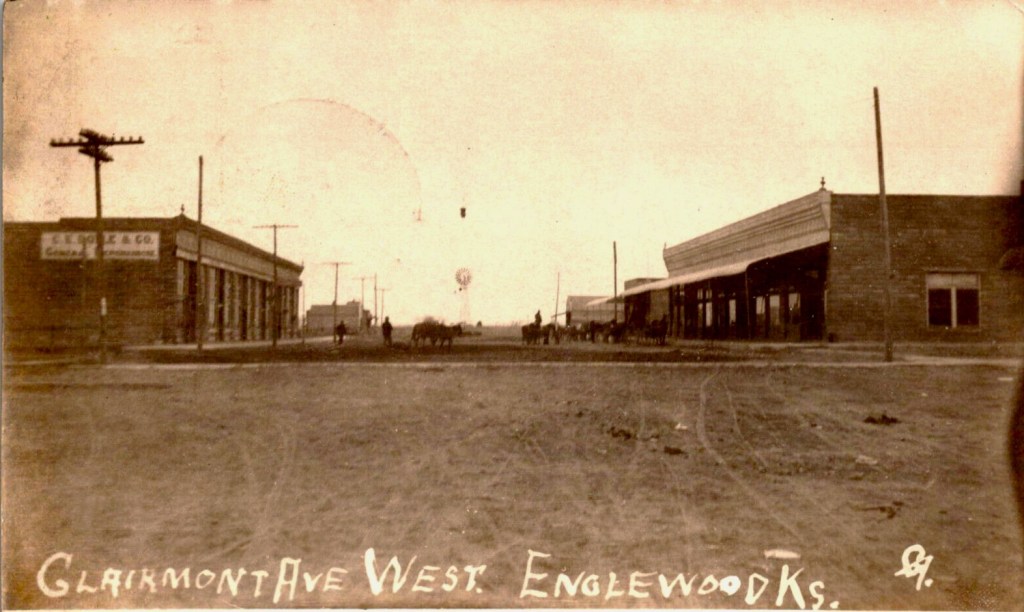
An old postcard I stumbled across isn’t from Texas or Alaska, but rather from Kansas. Englewood, Kansas, still exists, but most of the buildings are vacant or uninhabitable. A video I watched on Englewood shows things to be quite forlorn and void of people. The population in 2025 was recorded as 49, with a yearly decline.
The town organizers of Englewood in 1884 had high aspirations for its success, having “Veritable New Chicago of the Great Southwest” printed in the local newspaper. At one time, there were four dry goods stores located there, three drug stores, two lumber yards, and TheLeader-Tribune newspaper. Part of that success had to do with the railroad passing through.
During the early years, crime was kept quite low, even though Englewood was only four miles from the Oklahoma border. That section of Oklahoma, known as no man’s land, had zero law enforcement, with criminals often coming across state lines to raise havoc in Englewood. They were sometimes sent home in a pine box or strung up by vigilantes.
On July 4, 1885, a drunken cowboy fired his pistol off as part of the celebration. John Sconce was eventually tracked down by the Englewood sheriff, and after an exchange of gunfire, Sconce was shot dead.
During a social dance in Englewood on August 6, 1885, a few women with their chaperones, Charles and W.G. Peck, decided to leave the event around midnight. An inebriated cowboy, Philip Scannon, not wanting to see the ladies go because he still wanted to dance, tried to stop the party from leaving.
When a fracas broke out, the liquored-up cowboy struck Charles Peck over the head with his pistol, inflicting a nasty wound. Philip Scannon was immediately shot dead by the Peck brothers. The Pecks must’ve been found not guilty later on because newspaper articles have them still buying and selling property soon after.
Getting back to my postcard, times were probably not as rough and tumble in Englewood in 1909 as they were in the 1880s. Someone named Leonard sent Miss Margaret Rusco in Great Bend, Kansas, this card from the Englewood post office on August 19, 1909.
A one-cent Benjamin Franklin stamp was hand-cancelled by Thomas Todd, the acting postmaster. Leonard’s short letter reads as follows:
“Englewood, KS 8/18
Dear Margaret
This town is worse than nowhere. Not much of a buy. Am going by coach in morning and drive across to Pratt and will work the R.I. the rest of week. Leonhard”
Research shows that one month later, on September 9, Margaret Rusco became the bride of Leonhard Adler. Despite Leonard’s lack of writing with a romantic flair, the couple stayed together until both passed away in 1966 and 1967.
The R.I. that Leonard mentioned in the postcard is the Rock Island Railroad, which was built through various Kansas towns but not Englewood. A different railroad stopped there. Leonhard Adler was evidently traveling for business when he wrote Margaret.
Leonhard and his wife owned Adler Elevator and Grain Company and were well-to-do financially. Leonhard served as Mayor of Goddard, Kansas, for several terms. They had no children.
The couple lived normal and respectful lives based upon newspaper accounts, which include their obituaries. Those two cowboys, Philip Scannon and John Sconce, along with other desperadoes, would have lived much longer had they merely stayed away from the bottle.
Unfortunately, nothing has really changed where excess drinking and deaths are concerned. The major difference today is that unruly cowboys generally drive pickup trucks rather than ride horses.
“It took significant time and research just to decipher the names…”
I’ve come across many postcards that were never stamped, thus they were never sent through regular mail. Someone either hand-carried a card to the recipient, or it was never delivered. In one of these cases, the sender was killed standing outside a post office. Archived newspaper accounts from back then prove this.
One unique card I came across made me chuckle out loud, especially after researching the sender and recipient. It took significant time and research just to decipher the names, as the sender’s handwriting is shaky at most.
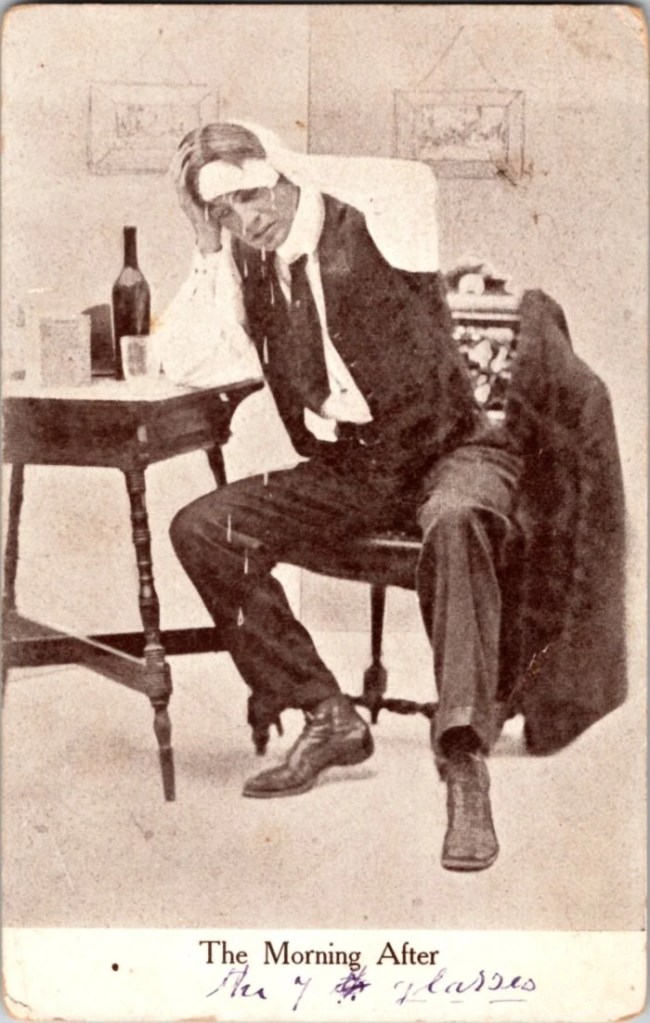
The front of the postcard shows a man sitting at a small table with a towel wrapped around his head. It appears he’s in great pain. A bottle of what appears to be wine is seen on the table along with a glass. Underneath the picture, printed by the postcard manufacturer, the following statement is written: The Morning After. Underneath that in smudged ink, most likely written by the sender, “Has7 glasses.”
The card is addressed to C.E. Owen in Frankfort, Kansas. The sender goes by the initials, E.J.H. Cephas E. Owen is the name of the recipient, while Eliza Jane Harp was the sender. Both Frankfort residents were senior citizens, with Eliza in her late 80s at the time she wrote her shaky message. Eliza composed her letter in reply to one that Cephas sent her. I transcribed things exactly as written.
“Dear Friend – the card you sent me I did not need to keep your memory because it wascertinly all sight first. Regards from one and all again thank, E.J.H.”
Cephas was around 65 when he received it. I make these age assumptions based upon Eliza’s death on November 17, 1909. The card had to have been written up to that time.
Records indicate that Cephas Owen attended the Presbyterian Church in Frankfort, while Eliza Harp worshipped at a Methodist Church. This postcard would’ve been considered risqué or offensive by some church members, yet I tend to believe Eliza or Cephas’ ministers would’ve seen candor in it, especially being sent from an almost 90-year-old woman. I know my pastor would think so today.
Eliza had a sense of humor much like my wife. Joleen loves to send funny cards to family and friends, especially certain cousins, during birthdays. Eliza Harp’s friend, Cephas, must’ve thought the postcard funny; otherwise, it wouldn’t have survived.
For me, this card proves that not all old folks back in the day were stick-in-the-mud or fuddy-duddy, as people often think. They were smart enough to know, “Laughter is the best medicine!” It worked for both of these Frankfort residents as they each lived a full life.
“Perhaps some of John Shaw and William Evans’ stolen silver dollars still wait to be found!”
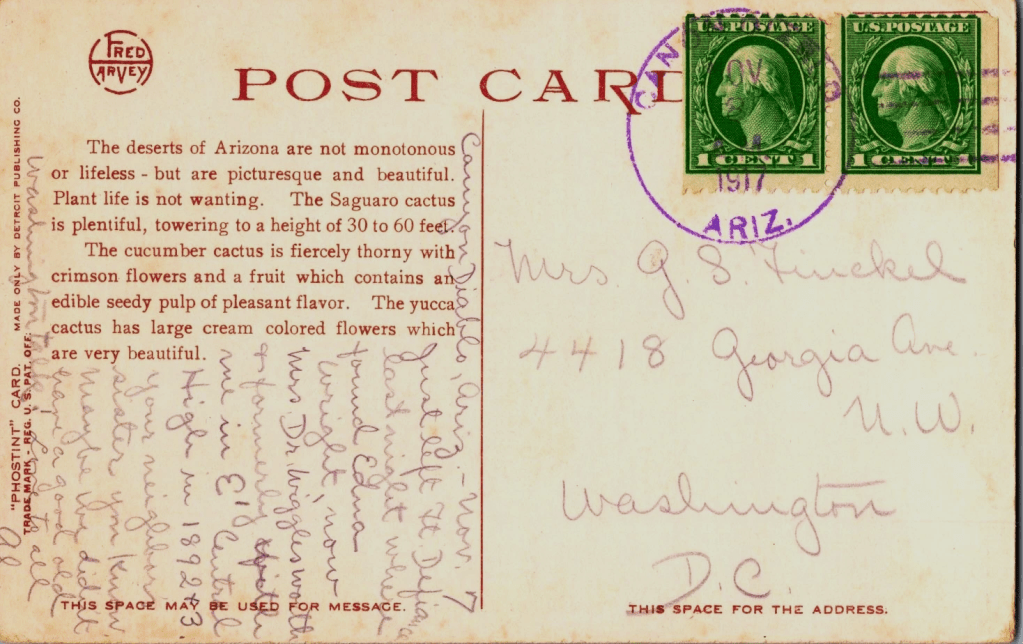
When I first saw a couple of strange names on a 1917 postcard from Canyon Diablo, Arizona, my mind immediately conjured up a law firm. Finckel & Wigglesworth has a good ring to it.
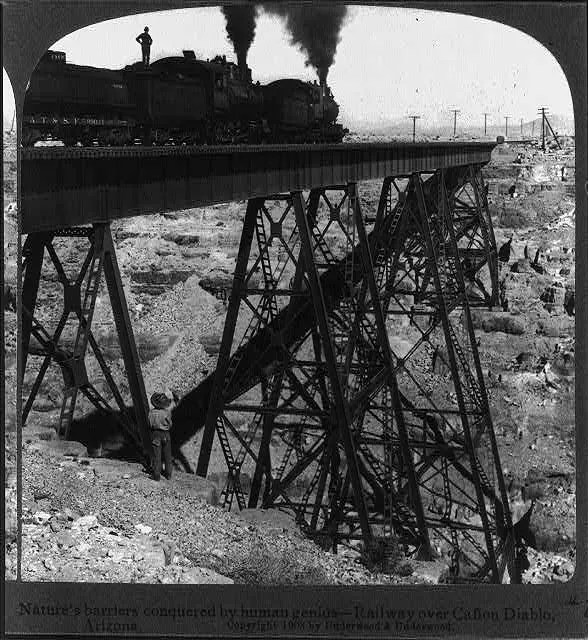
Canyon Diablo is an interesting place in itself. Researching things, the former town was in Coconino County near a canyon called Canyon Diablo. In Spanish, that means “Hells Canyon.” I traced the town’s roots back to a railroad bridge being built over the deep canyon. The railroad community was well and alive in 1880, but died off by the early 20th century. It’s now a ghost town with a few building foundations remaining.
Canyon Diablo is considered one of the most wicked and dangerous Old West communities to ever exist. It had a fair share of saloons, brothels, and gambling houses. Crime was everywhere with no lawmen available, while Main Street was actually named Hell Street.
The first sheriff who put on a tin badge in Canyon Diablo only wore it for perhaps five hours before he was killed. Four others followed him to the grave in a little over two years. It’s claimed that murders were a daily occurrence and that the cemetery quickly filled to capacity. Corpses were then buried wherever open ground could be found.
On April 5, 1905, two bandits, John Shaw and William Evans, held up some gamblers in the Winslow, Arizona, Wigwam Saloon. Shaw and Evans escaped with what’s believed to be around $300 in silver dollars.
Three lawmen, Pete Pemberton, Bob Giles, and Chet Houck, immediately picked up their trail, discovering silver dollars accidentally dropped along the trail. The trio eventually came across the robbers standing outside a trading post in Canyon Diablo.
Telling John Shaw and William Evans that they needed to be searched, the criminals drew their guns first and began firing. The sheriff and his marshals were faster on the draw, with William Evans injured, with John Shaw killed. Sheriff Chet Houck was only slightly injured, with a bullet grazing the outside of his stomach.
William Evans was taken back to Winslow, with John Shaw buried in a wooden coffin in Canyon Diablo. When word reached a group of cowboys about the killing of Shaw, and knowing that he didn’t get to finish his shot of whiskey the night of the robbery, they left Winslow and decided to go to Canyon Diablo and give him one last drink.
Exhuming Shaw’s body from its coffin, the cowboys lifted him out, stood him up, and then proceeded to give the dead man his final shot of liquor. Photos were taken before John Shaw was reburied with the open bottle placed beside him.
There’s much more history to Canyon Diablo, enough so to fill a book. I’ll leave my research at that, moving on to those names written within the old postcard. Before leaving, though, a postmark from the Canyon Diablo post office is quite rare, as it was only open for a few years.
In compiling this story, I picked up the vintage, giant cactus postcard for only $4.29. The person selling it did not know the value of rare postmarks. I only mention this because you, too, can find these bargains by diligently looking at cards on eBay. I don’t mind if you beat me out of one, as it’ll save me a few dollars and make for one less story to write.
My card was sent to Mrs. G.S. Finckel in Washington, DC. The person mailing it from Canyon Diablo was either named Al or those are their initials. Al mentions meeting up with Mrs. Dr. Wigglesworth in Fort Defiance. Dr. Wigglesworth is a person of unique significance in Arizona history. The letter on the front of the postcard is as follows, with no corrections:
“Canyon Diablo, Ariz – Nov 7
Just left Fort Defiance last night, where found Edna Wright, now Mrs. Dr. Wigglesworth & formerly with me in E’ Central High in 1892 + 3. Your neighbor’s sister you know. Maybe we didn’t have a good old Washington talk. Love to all
Al”
Edna Wright went to Central High School in Washington, DC as did her husband, Matthew Albert Wigglesworth. Mrs. G.S. Finckel (Gertrude Seaver Finckel) went there as well. Gertrude’s husband, Paul Finckel, was a patent attorney in Washington, making my prediction right on target for assumed attorneys, Finckel and Wigglesworth.
Paul Finckel was an esteemed musician as well, with Paul playing the cello in many Washington concerts. His wife, Gertrude, was a social butterfly in the community, knowing many distinguished people.
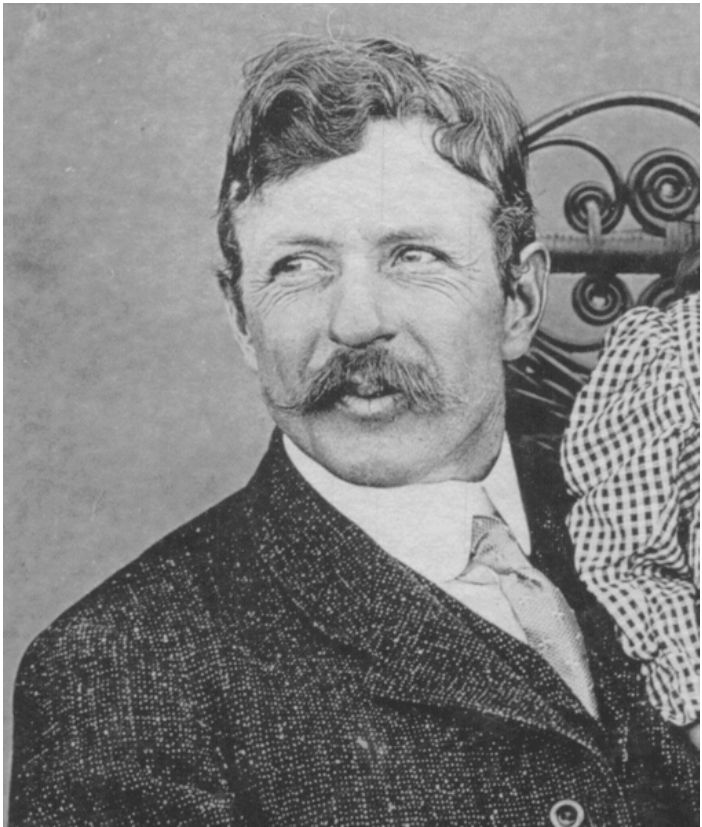
Dr. Albert Wigglesworth was a pioneer doctor and one of the first to devote his medical knowledge to American Indigenous Indians from 1900 – 1925. In his own words, he said the following: “I was the only physician for some 30,000 Indians on a reservation of 16 million acres—almost double the area of Connecticut and Massachusetts combined.”
Fort Defiance, as mentioned by the postcard writer, was one of the Navajo communities where Dr. Wigglesworth practiced medicine. In 1870, the first government school for Navajo children was established there.
There’s so much more to be found regarding Canyon Diablo, Dr. and Mrs. Wigglesworth, as well as the Finckel family. I’ll leave things at this point, believing I’ve given a brief synopsis on all three. Plans for this winter are to visit Canyon Diablo and bring along my metal detector, of course. Perhaps some of John Shaw and William Evans’ stolen silver dollars still wait to be found!
1908 photo of the old bridge over Diablo CanyonNew bridge over Diablo CanyonDr. Albert Matthew Wigglesworth
“There was so much history to this country doctor that I was spellbound reading it all.”
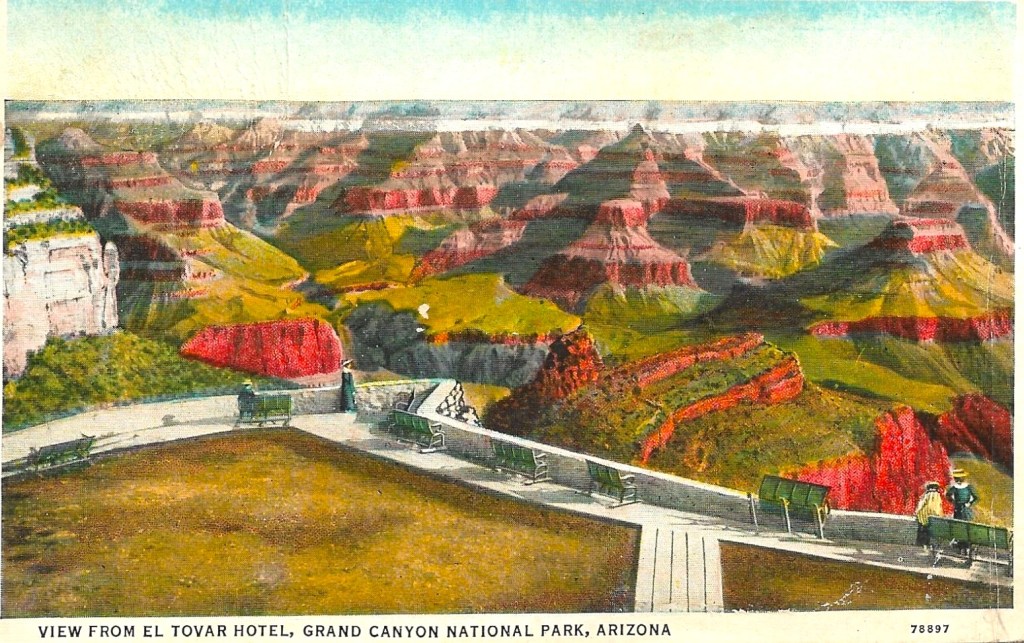
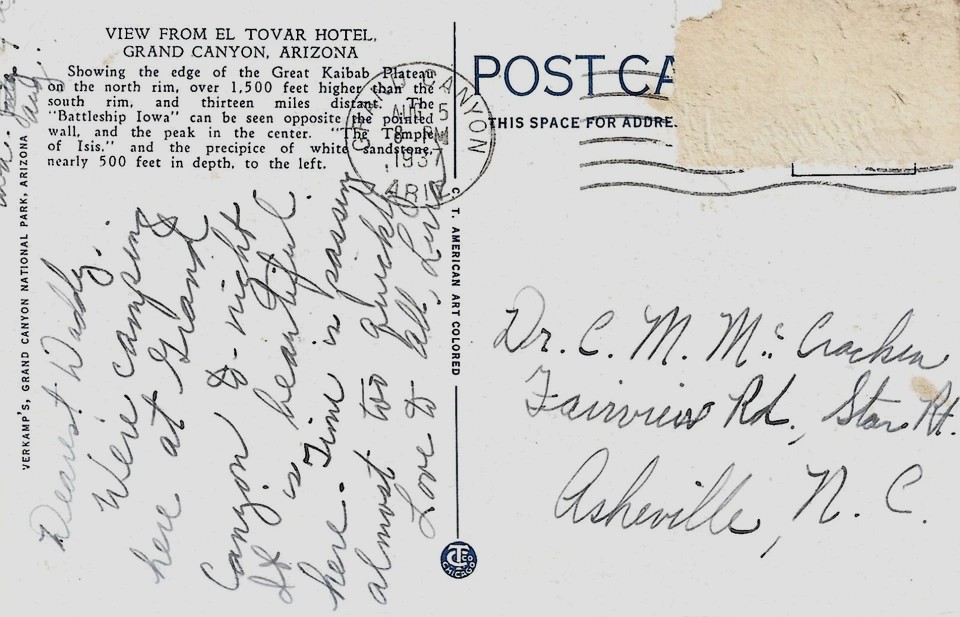
I’ve seen plenty of postcards from the Grand Canyon, and this one, postmarked 1937, didn’t truly excite me. Someone had removed the stamp, making it worth far less from a collector’s standpoint. Carefully looking things over, I wondered if the recipient and the sender might not be people of great interest. My prediction was correct.
Someone named Lura sent it to Dr. C.M. McCracken, Fairview Road, Star Route, in Asheville, North Carolina. Going by the address alone, I knew it was a rural area. The message within immediately told me the sender was a child of Dr. McCracken:
“Dear Daddy,
We’re camping here at Grand Canyon to-night. It is beautiful. Time is passing almost too quickly. Love to all, Lura.”
The postmark date is August 5, 1937; thus, it would’ve still been quite warm for summer. According to the August 12, 1937, “Williams News” newspaper, it was 92 for a high and 57 for a low in Williams, Arizona. The distance is 56 miles from the Grand Canyon to Williams, and the temperature would have been very close to the same.
Researching Dr. McCracken, there was so much history to this country doctor that I was spellbound reading it all. The house where the McCrackens lived was special all in itself, at least now it is.
Rather than try to add a small amount of information to my article, I decided to take what was written in the National Historic Register, word by word, about Dr. Cicero McCracken, his family, and their dwellings. Miss Purdy, my AI helpmate, found a few typos and archaic sentence structures that she kindly took care of.
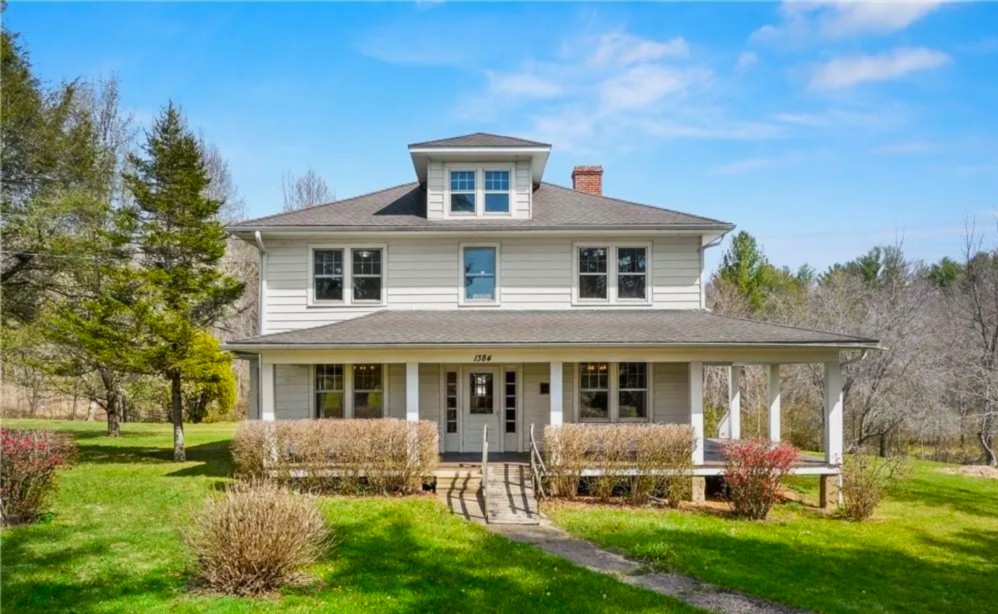
“The Dr. Cicero McAfee McCracken House, a well-preserved Foursquare-style frame dwelling erected in 1924, is important in the history of Fairview and Buncombe County as the residence of a long-time country doctor whose rural practice spanned a period of four-and-a-half decades in his adopted community of Fairview and the surrounding region.
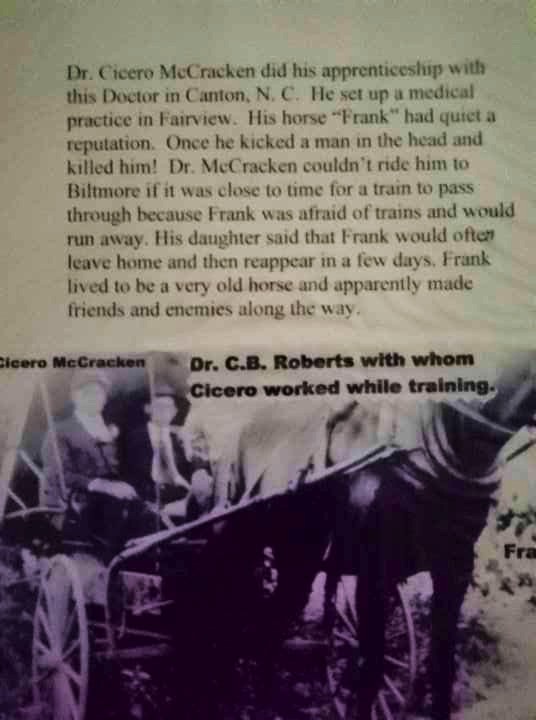
Dr. McCracken (1868-1942), a native of Haywood County and a member of the large McCracken family who resided in and around the Crabtree community, received his medical education in the then-typical combination of reading and work with a local physician, Dr. C. B. Roberts of Clyde, North Carolina, and study at Vanderbilt University Dental School and the North Carolina Medical College where he graduated in 1896.
In the summer of 1896, he located in the small village of Fairview on the Asheville-Charlotte Highway, where he opened his medical office and, in 1897, was married to Helen Lura Clayton (1878-1920). From at least the turn of the century until 1924, Dr. McCracken and his large family lived in houses in the village. For much of this period, he occupied a house immediately south of the Fairview Baptist Church: it was pulled down in the mid-1980s.
In 1924, a widower with seven children, Dr. McCracken, built and occupied a new house, office, and garage on the north side of the Charlotte Highway, opposite the Fairview School campus. Those buildings, surviving to the present, were his home and office until his death on 8 December 1942.
A member of the Fairview School Board (1913-1929) and the Buncombe County Board of Health (1918-1924), he was accorded the tribute of a biographical sketch in the Bulletin of the Buncombe County Medical Society in 1939 and the honor of a large public funeral in the auditorium of the Fairview School from whence his body was carried to Cane Creek Cemetery.
The Dr. Cicero McAfee McCracken House is eligible for listing in the National Register under Criterion B for its association with the productive life of Dr. McCracken and as the major surviving building associated with his career: his practice embraced a territory from Asheville to Rutherfordton and from Black Mountain into Henderson County.
The house is eligible for listing in the area of Health and Medicine for its association with the practice of a well-known and well-respected doctor whose career spanned four-and-a-half decades in Fairview and where he exercised parallel positions of leadership in his church, community, and profession.
Cicero McAfee McCracken (1868-1942), the builder and occupant of the house in Fairview which bears his name, was a member of the large McCracken family of Haywood County, North Carolina. The progenitor of that family, Joseph Cass McCracken (1776-1848), was born on 4 January 1776 in Habersham County, Georgia, the son of David E. McCracken (1750-1812).
On 15 March 1798, Joseph McCracken was married to Sarah Vaughan (1779-1867), the daughter of George and Dorcus Vaughan. The couple’s first child, a daughter named Carey (1799-1866), was born on 13 January 1799. According to family tradition, Joseph McCracken departed Georgia in 1800, together with his wife and young daughter, and removed to western North Carolina, where he settled on a farm on Crabtree Creek in what is now Haywood County.
Over the course of some forty-eight years, McCracken and his family prospered and expanded their holding, and for the remainder of the nineteenth century, the McCracken family would be associated with the Crabtree community. Twelve additional children were born to Joseph and Sarah McCracken between 1800 and 1821: ten of the thirteen children would remain in Haywood County, where they, too, would raise large families.
Russell McCracken (1806-1891), Cicero McCracken’s grandfather, was born in Haywood County on 24 October 1806, the fifth child and fourth son of Joseph and Sarah McCracken. He was married to Margaret Crocket Garrett (1810-1874) and, like his father, he, too, sired a large family. His eldest son, Joseph Franklin McCracken (1829-1913), was to become the father of Cicero McCracken.
Joseph Franklin McCracken was born on 25 April 1829, and on 19 October 1854, he married Julia Ann Howell. Fourteen children were born to Joseph Franklin and Julia Ann McCracken between 1855 and 1879: Cicero McCracken was the ninth child and the fourth son.
The nurturing influence of this large family proved to be important in Cicero McCracken’s life, and it was an influence that shaped both his professional practice and the life of the large family that he, in turn, sired and educated. Cicero McCracken was born on 19 September 1868 at Crabtree in Haywood County and spent his formative years on the family farm and in the companionship of dozens of cousins and other relatives.
He was educated in the local schools and at the Clyde Institute, a private school. In July 1890, he entered into a contract with the committeemen of District No. 5 of Haywood County to teach in the white public school at the rate of $25.00 per month; it is not known how long he served as a school teacher.
It appears that Cicero McCracken was disposed toward medicine from a relatively early age. An account of his medical training, published in a biographical sketch in the October 1939 number of the Bulletin of the Buncombe County Medical Society, outlines the combination of tutorial and formal study by which he gained his medical education:
In 1889, Dr. McCracken chose as his preceptor Dr. C. B. Roberts of Clyde, North Carolina, and for two years he read medicine in the office of Dr. Roberts and went with him on visits to his patients. In 1891, after two years with Dr. Roberts, Dr. McCracken entered Vanderbilt Medical College, Nashville, Tenn. He studied there for one year and then returned to Clyde, North Carolina, to practice with Dr. Roberts again for two years.
In 1894, he entered the North Carolina Medical College, then located at Davidson College, Davidson, North Carolina. He graduated from that school in the spring of 1896. In May 1896, he passed the State Board of Medical Examiners and was licensed to practice medicine. It is unclear at present why Cicero McCracken did not return to his native Haywood County to practice medicine; instead, he chose to locate his practice in the small, growing community of Fairview, then without a doctor, which was located a dozen or so miles to the southeast of Asheville in Buncombe County.
It may have been as well the attraction of the Fairview Academy, a private boarding school established there in 1888, where he saw the potential of educating his future family. Fairview was also located on the main road, passing through Rutherfordton, between Asheville and Charlotte, and was a stop on the stage line which connected the two principal cities in western North Carolina.
In August 1896, he is said to have opened an office in Fairview, presumably in rented quarters. Just over a year later, on 8 December 1897, he was married to Helen Lura Clayton (1878-1920), the daughter of R. C. Clayton of Cane Creek. On 3 March 1899, Elizabeth Ann McCracken (1899-1968) became the firstborn of eight children born to Dr. and Mrs. McCracken between 1899 and 1916.
The other seven children were: Beatrice Helen (1901-1966); Marvin Howell (1903-1974); Clayton Houston (1906-1983); Joseph Franklin (1908); Cicero McAfee, Jr. (b. 1909); Joseph Glenn (1913-1991); and Lura (born 1916).
On 16 March 1899, thirteen days after the birth of his daughter, Cicero McCracken purchased a one-acre tract of land in Fairview Township from Jason Ashworth. It was the first of some twenty-one tracts, mostly in Fairview Township, which McCracken acquired in the period up to 28 March 1917. An examination of the grantee and grantor indexes to deeds in Buncombe County indicates that McCracken was involved in a small real estate business in and around Fairview during the opening decades of the twentieth century, which supplemented his income as a physician.
Five of these tracts, adjoining each other, became the principal house tract of 101.60 acres on the Charlotte Highway (US 74) on which McCracken would build this house in 1924. Whether the parcel he purchased in 1899 was the tract on which he lived in the center of Fairview has not been determined; however, he occupied a two-story frame Victorian house immediately south of the Fairview Baptist Church from around the turn of the century until relocating this house in 1924. In February 1925, the grounds of the house were subdivided into lots. That house was eventually sold and stood into the mid-1980s when it was pulled down.
From the time of his arrival in Fairview in 1896 until he died in 1942—a period of forty-six years—Dr. Cicero McAfee McCracken was a respected leader in the community and a figure well-known throughout Buncombe County. During these four-and-a-half decades, he practiced medicine in now lost offices at Fairview, and later in a one-story frame building erected in 1924, which survives on this property.
Throughout this long period, approaching a half-century, he was one of a small but highly respected group of men known as “Country Doctors.” In the nineteenth century and through the opening decades of the twentieth century, such men were acknowledged as leaders in the community by virtue of their profession: together with ministers, they were the most respected members of their community.
Dr. McCracken and other men in this group were not only turned to for medical advice, but for their opinions on a variety of topics and for civic leadership. According to the biographical sketch published in 1939 and two obituaries in 1942, Dr. McCracken exercised leadership in his profession, his church, and his adopted community of Fairview for the long tenure of his residency there.
In part because of his own difficulty in gaining an education, he was a strong advocate for education in Fairview. The Fairview Academy, a private school, remained in operation until 1913: in 1904, a small frame public school was erected at Fairview for the sum of $525 by A. B. Clayton, possibly a kinsman of Mrs. McCracken.
In 1907, Fairview became the site of one of three high schools established in Buncombe County that year. In 1913, Dr. McCracken became a member of the Fairview School Board and served as a member until 1929. It was during this period that he built this house on the north side of the Charlotte Highway, directly opposite the Fairview School campus.
In 1918, he became a member of the Buncombe County Board of Health and served until 1924. He was a lifelong member of the Baptist Church and a member of the Fairview Baptist Church from the time of his arrival in the community until his death. He was also a member of the Biltmore Masonic Lodge.
With the birth of his eighth child and third daughter, Lura, in 1916, the McCracken household consisted of the doctor, Mrs. McCracken, three daughters, and four sons. Joseph Franklin McCracken, named for his paternal grandfather, was born and died in 1908.
For most, if not all, of the first two decades of the century, the family occupied the house standing south of the Fairview Baptist Church. On 5 June 1920, Helen Lura (Clayton) McCracken died at the age of forty-two; she was buried at the Cane Creek Cemetery at Fairview. For seven years, until his marriage in 1927, Dr. McCracken remained a widower and raised his family, presumably with the help of his two eldest daughters.
In about 1923, Dr. McCracken determined to erect a new house—this house—for his family on an assembled tract of just over one hundred acres which lay on the north side of the Charlotte Highway (US 74) directly across the road from the Fairview School. According to family tradition, this decision was made so that his youngest children would be closer to school.
The lumber for the house was cut from his acreage. Four local builders, Bob Oates, Andy Wright, George Fite, and Jay Hill, have been identified as the builders of the two-story frame Foursquare-style house. These builders also erected the frame office and the garage, now much overbuilt, which stands at the rear of the house. Following a center-hall, double-pile plan, the house is firmly in the American Foursquare tradition, well-built yet simply finished.
It is reasonable to ascribe the unusually plain finish of the interior of the house to the fact that it was built by men for a man, without the refinements that a wife might have encouraged in its construction. Except for the addition of aluminum siding in the mid-1950s, it survives today virtually as built in 1924.
Initially, electric power at the house and office was supplied by a Delco system acquired by Dr. McCracken. He also constructed a reservoir to provide running water for the house’s kitchen and two bathrooms.
On 10 August 1927, Dr. McCracken was married to Johnnie Ruth Turner (1897-1987) of Winnsboro, Fairfield County, South Carolina. She was a graduate of the Charlotte Sanatorium School of Nursing. A daughter, Ruth Brice McCracken, was born in 1928; the family circle was completed by the birth of two sons, John Turner McCracken in 1930 and Julian Woodburn McCracken in 1932.
The first years of the marriage were enjoyed in the prosperity that characterized life in many places in the 1920s; however, after the Crash of 1929, the condition of the McCracken finances worsened. During the late 1910s and 1920s, and the early 1930s, the education of his children was a great expense to the doctor.
His three daughters graduated from the University of North Carolina at Greensboro (then a Woman’s College of the University of North Carolina), and his four sons of the first marriage all attended Wake Forest University, and three graduated from the school. Most of them went on to take secondary degrees, and all took up professions in the fields of public education, medicine, and dentistry.
Although the family garden and certain farm crops would have supplied most of the necessary foodstuffs for the family, together with other items bartered in exchange for medical services, there was a high need for income to meet the educational fees of his children.
On 15 August 1931, the homeplace and its 101.60 acres were placed under mortgage for the sum of $1,500 to the Federal Land. Bank of Columbia, South Carolina. The principal and interest would not be paid off until April 1944, a year and a half after Dr. McCracken’s death.
These straitened circumstances of the McCracken family were not unusual in Buncombe County in the 1930s. The high life of Asheville’s 1920s boom was brought to a cruel, grinding halt in 1930. On 20 November 1930, the Central Bank and Trust Company of Asheville, with assets in excess of $52 million dollars, failed to open its doors, and other smaller banks likewise failed in this period.
Funds and investments of both the city of Asheville and Buncombe County disappeared in the collapse of the city’s banks, and many businesses likewise were forced to close their doors. The depression spread into Buncombe County and to Fairview. The McCracken family would never recover the financial position they enjoyed previously; however, they retained their house and a warm family life, and all of the children received good educations.
In the late 1930s, Dr. McCracken’s stamina began to weaken; however, he continued to practice medicine, and he sometimes saw patients in the northeast corner room of his residence. He became critically ill in the autumn of 1942 and died in the morning of 8 December 1942, survived by his widow and ten children who ranged in age from forty-two to ten years of age.
Obituaries in the Asheville TIMES, the city’s afternoon paper, and the Asheville CITIZEN, the morning newspaper, both lauded him as a “well-known physician” and reported the broad outline of his life. Because of the affection and esteem in which Dr. McCracken was held by Fairview, his funeral was held in the auditorium of the Fairview School, a public hall which could seat a larger number of mourners than the Baptist Church. He was buried beside his first wife at the local Cane Creek Cemetery.
Dr. McCracken’s death, in very reduced circumstances, would eventually force his family to give up their Fairview home. Now a widow, Mrs. McCracken relocated the medical office back to its present position near the house in 1943 and used it as a rental dwelling. During 1943, however, it became clear that she would not be able to remain in Fairview.
Early in 1944, she set about to relocate the family in Asheville. Final payments were made in April 1944 to satisfy the mortgage with the Federal Land Bank. Simultaneously, she sold this house and its 101.60 acres by deed of 28 March 1944 to J. M. and Bertha Anderson of Haywood County, North Carolina. That same year, she acquired property on Woodlawn Avenue in Asheville, and in 1945, she acquired additional property on Montford Avenue in the city.
In the 1944 ASHEVILLE CITY DIRECTORY, she is listed as a resident of 67 Cumberland Avenue. In the 1945-1946 edition of the ASHEVILLE CITY DIRECTORY, she is listed as the proprietor of the McCracken Nursing Home at 199 Montford Avenue. Her eldest stepson, Dr. Marvin Howell McCracken (1903-1974), had his medical offices a few blocks away at 346 Montford Avenue.
For three decades, from 1944 until 1974, the McCracken house was the residence of a series of owners who might also have rented the former medical offices as a dwelling. J. M. and Bertha Anderson held the property until 19 September 1950, when they sold the house and its reduced lot of 21.90 acres to L. H. and Janet R. Holmes.
On 26 May 1954, L. H. and Janet R. Holmes sold the house and its 21.90 acres to Lloyd and Helen Roberson. The property eventually passed into the ownership of Heritage, Inc., which subdivided the acreage that lay to the rear of the house. On 2 August 1974, Heritage, Inc. conveyed the McCracken house, the garage, Dr. McCracken’s former office, and its reduced grounds of 2.96 acres to Julian Woodburn McCracken and his wife, Sarah MaCrae McCracken.
For nine years, McCracken rented out the house. Julian Woodburn McCracken (born October 1932) had been a lad of ten when his father died and, at the age of twelve, he left his childhood home to live on Montford Avenue in Asheville. Like his elder brother, John, he was educated at Christ School, Arden. Following family tradition, he attended Wake Forest University; however, he transferred to Clemson University.
He was married to Sarah Woodward McRae in June 1955: two months later, in August, he graduated from Clemson University with a B.S. degree. He also received an M.B.A. degree from Pepperdine University in 1972. Julian McCracken entered the United States Army and retired in 1983 in the grade of colonel at Fort McPherson, Georgia, after a twenty-eight-year career of service. In September 1983, he and his wife returned to Fairview and occupied the house, which remains their residence to the present.
The historical significance of the Dr. Cicero McAfee McCracken House lies in its association with the life and medical career of Dr. McCracken (1868-1942), who practiced as a physician at Fairview from August 1896 until shortly before his death on 8 December 1942.
From the biographical account of his life published in October 1939 in the Bulletin of the Buncombe County Medical Society and the obituaries that appeared in the Asheville newspapers, it is evident that Dr. McCracken had a rural medical practice that was probably typical in most respects. With his office at Fairview, Dr. McCracken had a wide practice in the broad surrounding region stretching between Asheville and Rutherfordton and between Black Mountain and Henderson County.
His second wife, Johnie Ruth, was a trained nurse, and she assisted Dr. McCracken from the time of their marriage through the remainder of his career. Dr. McCracken prepared many of his medicines in his office and dispensed them to patients: this practice was a common one for rural physicians who were far removed from pharmacies in the state’s larger towns and cities. Consequently, his career cannot be lauded for notable achievements or discoveries in his profession, or for having been the attending physician to some notable personage.
Coming from relatively humble circumstances, he was born to neither privilege nor affluence nor family capital, which might have pointed his medical career in another direction. As a result, he was not one of many doctors in the towns and cities of North Carolina who, in the decades around the turn of the century, opened their own clinics or invested in hospitals.
Such men, including Dr. Richard Beverly Baker (1821-1906) of Hickory, are recalled by hospitals that bore their names before the advent of the corporate hospital industry. Instead, the significance of Dr. McCracken’s career exists as a representation of the lives and careers of a large number of rural doctors, known affectionately as the “Country Doctor.”
It was these men, located throughout rural North Carolina, who provided medical services to the largest part of the state’s population in the nineteenth and early twentieth centuries and who held positions of public esteem and trust in a manner that is absent in late modern life. During the period in the 1920s when there was still but one doctor per 1,210 inhabitants—an improvement over the ratio around the turn of the century—these men were critical to the health of their community, especially in a time when many lives were lost to typhoid fever and tuberculosis.
The medical society sketch of his life, quoted earlier in this report, described the means by which Dr. McCracken gained his medical education and secured a license to practice. That process was probably more typical—and likewise representative of the era—than that of men who might have been fortunate enough to have undertaken a full course of formal medical schooling.
The establishment of medical schools in North Carolina came late in the nineteenth century. A medical school was established at the University of North Carolina in 1879; the North Carolina Medical College was established in Charlotte in 1887, and Cicero McCracken was a student at the school in 1894-1896 while it was located at Davidson. However, these schools struggled in their early years and did not have the prestige of educational programs offered by certain schools, including the University of Pennsylvania, the Jefferson Medical College, and New York University, to which most of the state’s more affluent and ambitious medical students turned in the nineteenth century.
The role of the medical preceptor was a distinguished one in this state’s medical history, and it was these men who served as medical educators before medical schools were formally established in North Carolina. Even with the establishment of the two schools in 1879 and 1887, that important tradition of medical education continued to the turn of the century and probably beyond in the western reaches of the state.
Reading and working under a preceptor, such as Dr. C. B. Roberts of Clyde, not only provided training and insight into the profession and practice, but it also provided experience, which enabled students such as Cicero McCracken to reap the maximum benefit of formal schooling when he entered the Department of Dentistry at Vanderbilt University in 1891 and the North Carolina Medical College in 1894.
Cicero McAfee McCracken graduated from the North Carolina Medical College in the spring of 1896, and in May of that year, he passed the examination held by the North Carolina Board of Medical Examiners and was licensed to practice medicine. The sketch of his life, published in 1939 near the end of his career, recounted the broad outline of his practice in a few simple sentences that probably could have been used to describe the lives of many rural doctors in western North Carolina:
‘In August 1896, he located at Fairview, North Carolina, where he had practiced medicine for forty-three years—sometimes with horse and saddle, sometimes with horse and buggy, and sometimes on foot when the road came to a dead end and horse and buggy could go no farther, and only a path penetrated into the cove or up the mountainside. But good roads into this mountain section in recent years have wrought great changes, and Dr. McCracken has long dispensed with horse and buggy and is privileged to make his calls in an automobile.
Dr. McCracken has had to be his own pharmacist—carrying his medicine with him and often preparing the mixtures necessary for his patients. The Fairview section in recent years has become a popular resort for tourists, and these people have recognized the ability of Dr. McCracken and have not failed to avail themselves of his services when needed. The role and status of the “Country Doctor” in western North Carolina were not restricted to the practice of medicine but included civic leadership.
In the nineteenth and early-twentieth centuries, the country doctor was turned to, time and again, for his opinions on a wide variety of issues, which in Dr. McCracken’s case included local education, good roads, and the advancement of his adopted community of Fairview. His service on the Fairview School Board (1913-1929) and on the Buncombe County Board of Health (1918-1924) reflects the two principal poles of his civic and professional interests.
According to family tradition, Dr. McCracken also assisted young men from the region, with loans or grants, to pursue medical studies. In the absence of a modern history of Buncombe County and a like history of medicine in the county, a final assessment of his career in the context of other doctors remains to be confirmed. That said, however, the best critique of his life’s work might well be the concluding paragraph of the 1939 biographical sketch, which reflects the judgment of his peers.
Dr. McCracken has lived a full and useful life. By his untiring efforts for community progress and his devoted service to humanity, he has endeared himself to all. He has been justly honored by his professional associates and by the community as a capable physician, loyal friend, and good citizen.’
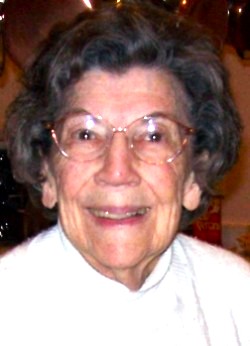
Lura McCracken Marr Roberts sent that postcard to her father in 1937, five years before he died, undoubtedly finding Arizona a place of splendor. Revisiting the Grand Canyon State in 2010, she passed away there at the age of 94. Lura was buried in North Carolina.
The Cicero McAfe McCracken family all went on to be highly educated people and professionals in their various careers. Their old home remained in the family up until 2013, when Courtney Stephens purchased it.
Perhaps one item the National History Register did not focus on as much as it should was the McCracken’s devoted worship habits, which especially included prayer. Their success in life did not come from hard work alone.
McCracken familyMain houseDr. McCracken’s officeLura McCracken Marr Roberts (sent the postcard)
“The Sniders were among the earliest settlers of Kansas, traveling there by covered wagon.”
Nestled amid the rolling prairies of southeastern Kansas, Eureka stands as the proud county seat of Greenwood County. Its name—Eureka, a term meaning “I have found it!”—echoes the spirit of discovery and optimism that shaped its beginnings. From the earliest days of settlement to its present role as a vibrant community, Eureka’s history mirrors the broader story of the American Midwest: resilience, growth, and unyielding hope.
The story of Eureka begins in the mid-19th century, a period marked by westward expansion and the promise of new opportunities on the American frontier. Greenwood County itself was officially organized in 1855, during a time when Kansas was still a territory embroiled in debate over slavery and statehood. The townsite of Eureka was platted in 1867, strategically located along the banks of the Fall River, and was chosen as the county seat due to its central location and access to water.
Pioneers drawn by the promise of fertile land and abundant resources arrived in covered wagons, braving the unpredictable Kansas weather and the challenges of frontier life. Life was hard, marked by the struggle to build homes, cultivate the land, and establish a sense of community in an untamed landscape. The early settlers of Eureka built log cabins, dug wells, and planted crops such as corn and wheat—staples that fueled both survival and growth.
As Eureka grew, so did its infrastructure. The first post office was established soon after the town’s founding, and schools, churches, and businesses sprang up to meet the needs of the burgeoning population. Eureka became a vital trading center for the surrounding rural areas, its economy deeply rooted in agriculture and livestock.
The arrival of the railroad in the 1870s marked a turning point in Eureka’s history. The St. Louis & San Francisco Railroad (often known as the “Frisco Line”) connected the town to larger markets and facilitated the transport of goods, people, and ideas. This connection helped Eureka thrive, attracting new residents and businesses. Grain elevators and stockyards became familiar sights, and local merchants supplied everything from hardware to dry goods.
Despite its promise, life in Eureka was not without adversity. The town endured its share of trials—harsh winters, droughts, floods, and grasshopper plagues that threatened crops and livelihoods. The late 19th and early 20th centuries also brought health concerns and epidemics that tested the community’s resilience. But through these struggles, the people of Eureka demonstrated a remarkable spirit of cooperation and perseverance.
Disputes over land and law occasionally arose, as they did in many frontier towns. The establishment of local government, law enforcement, and civic organizations helped to bring stability and order. The Greenwood County Courthouse, constructed in the early 1900s, became a symbol of civic pride and progress.
The twentieth century brought both change and continuity to Eureka. The agricultural foundation remained strong, but new industries and innovations altered the landscape. Oil and natural gas discoveries in Greenwood County contributed to economic diversification, drawing workers and investors to the region. The Great Depression, like elsewhere in America, posed significant challenges, but federal programs and local initiatives helped the community weather the storm.
Education has always been a cornerstone of Eureka’s identity. The town’s schools, from one-room schoolhouses to modern facilities, have produced generations of graduates who have gone on to make their mark both locally and beyond. Civic organizations, churches, and clubs have fostered a strong sense of camaraderie and service.
Eureka’s downtown, with its historic storefronts and welcoming atmosphere, remains a testament to the town’s enduring character. Annual events—county fairs, parades, and community celebrations—bring residents together to honor both tradition and progress.
Today, Eureka is home to approximately 2,500 residents. While agriculture continues to be a mainstay, the town has embraced new opportunities in tourism, recreation, and small business. The surrounding Flint Hills region, with its scenic beauty and ecological significance, attracts visitors for hiking, birdwatching, and exploring Kansas’s unique tallgrass prairie.
Efforts to preserve historic buildings, stories, and legacies are evident throughout the town. Local museums and heritage organizations work diligently to keep the past alive for future generations. The Greenwood County Historical Society, for instance, maintains archives and artifacts that chronicle the area’s evolution.
Eureka has produced its share of notable individuals—educators, business leaders, and civic figures who have contributed to the town and beyond. The stories of ordinary residents, too, form the fabric of Eureka’s legacy: farmers tending their fields, merchants greeting patrons, families gathering for Sunday dinners.
The town’s resilience has been tested by events such as devastating tornadoes, including one in 2018, which required coordinated recovery efforts and showcased the community’s unity in the face of hardship.
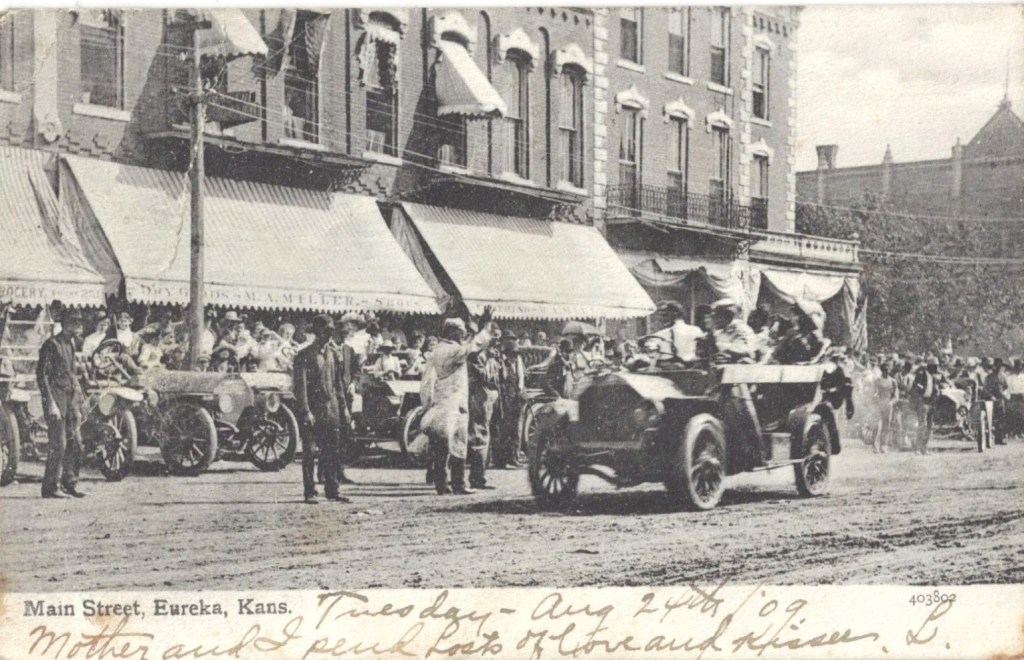
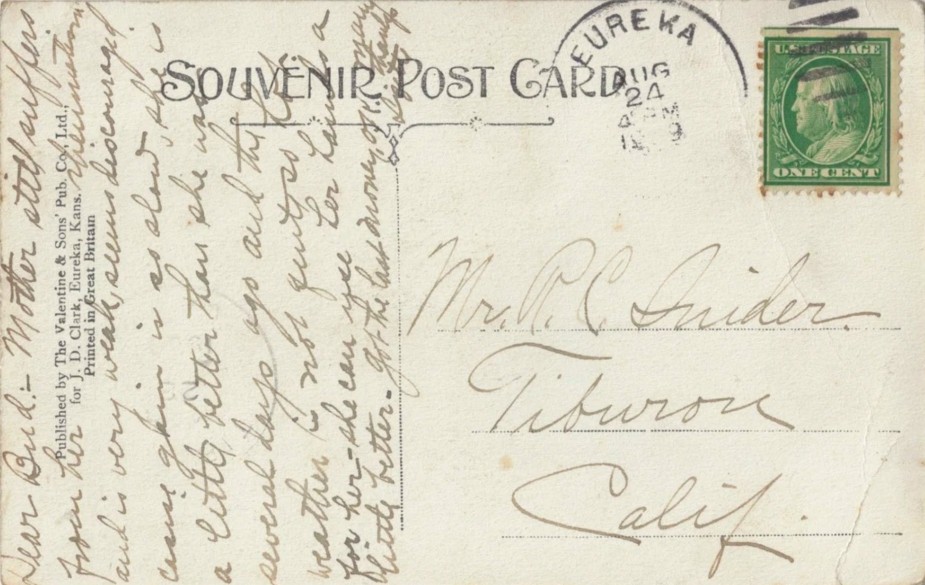
The Sniders were among the earliest settlers of Kansas, traveling there by covered wagon in 1857. An old Eureka postcard I came across mentions members of one of those early Snider families. This 1909 postmarked card was sent to Mr. R.C. Snider in Tiburon, California. The transcribed letter is as follows:
“Dear Bud –
Mother still suffers from her rheumatism and is very weak, seems discouraged because gain is so slow, she is a little better than she was and the weather is not so hot for her – she can use her hands a little better, got the last money, of P. Maury. Thanks. Lisetta”
Bud was a nickname for Randall C. Snider, Lisetta’s brother. The mother she talks about is Esther Arabella Snider. Lisetta, R.C., and Esther had moved to California, specifically to the San Francisco area, sometime in the late 1800s, leaving behind other kin in Eureka and the surrounding areas. They lived together in the same home with Lisetta, 33, and unmarried. Lisetta and Esther were back in Kansas, visiting friends and family, having traveled over on a train.
Esther Arabella Snider passed away in 1916, 7 years after the postcard was sent. She was only 59, having been born in 1857 in Ohio. Her two children, Randall and Lisetta, are also buried in California. Randall worked for the railroad as a painter; thus, he was probably able to get discounted train tickets for his mom and sister. The young man was evidently helping support his ailing mom along with Linetta.
The photo on front of the postcard shows Eureka, Kansas, with some type of celebration going on. Written on the bottom of it is an additional message to R.C. from Linetta, showing how close this family was!
“Tuesday Aug 24th / 09 Mother and I send lots of love and kisses. L.
“A somewhat faded postcard photo doesn’t look anything like the Alabama I remember.”
I came across another old postcard, this one showing a large lake scene with a rowboat. The description says: “Summer in Alabama.” Believing that I was about to read someone’s short note about visiting the ‘Land of Cotton,’ I was in for a rude surprise.
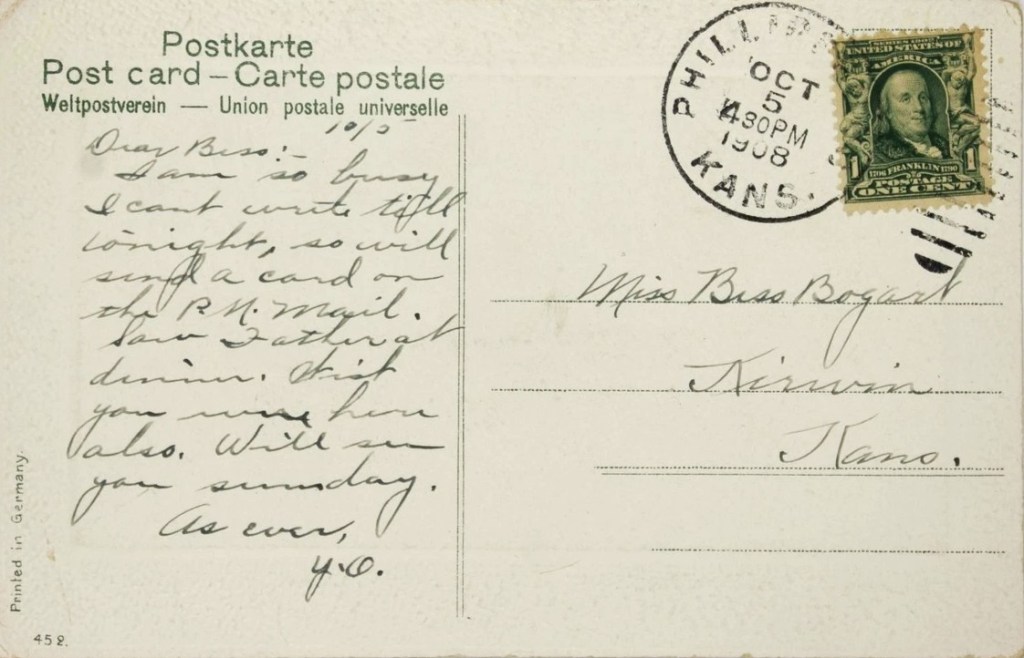
Postmarked in Phillipsburg, Kansas, in 1906, and sent to Miss Bess Bogart in Kirwin, Kansas, the card shows some wear. Looking both towns up, they’re only 15 miles apart. Located in Phillips County and very close to the Nebraska border, neither location had a substantial population, with 139 citizens recorded as living in Kirwin according to the 2020 census.
A somewhat faded postcard photo doesn’t look anything like the Alabama I remember. Carefully looking things over, I saw that the card was printed in Germany. I’d assume that whoever had them made—sent along an actual Alabama lake photograph to copy from.
The problem is, no naturally formed lakes of substantial size existed in Alabama of substantial size in 1906. The Tennessee Valley Authority didn’t come along until the 1930s, with Lake Guntersville being the largest lake built in Alabama because of it. Guntersville Dam, holding back the waters of the Tennessee River, wasn’t constructed until 1939.
Wheeler Lake is the second largest lake, with Wheeler Dam built between 1933 and 1936. It seems reasonable that the card maker used poetic license to come up with their Alabama summer scene.
The sender of the card used their initials to identify themself as postcard writers often do. This makes it hard to figure out just who they are without substantial detective work. So far, that’s been elusive, but it certainly appears to be a family member. I normally start my letters to close friends with, “YO.”
The following short letter was transcribed without correction:
10/5
Dear Bess –
I am so busy.
I can’t write till tonight, so will send a card on the P.M. mail. Saw father at dinner. Wish you were here also. Will see you Sunday.
As ever,
Y.O.”
Miss Bess Floy Bogart was born in 1890 and was just 17 when she received this mail. Records show that she had three other sisters and a brother. Her gravestone shows her born in 1889, but several years of census reports have it 1890.
Bess married Harry Theodore Thurber on June 18, 1913. Not long after the couple moved to Porterville, California, where Harry was a jewelry maker for a short time. They weren’t in the Golden State very long before coming back to Lawrence and then Douglas, Kansas. The Thurbers were deeded property in Cheyenne County, Kansas, most likely an inheritance, yet eventually sold out, relocating once again, to Goodland.
By now, they had an adopted son, William W. Thurber. In 1926, Harry had a sudden heart attack and died, leaving Bess to raise their son. Census records show she paid $10 a month for rent while making a pittance as a bookkeeper.
In 1930, she moved to Wyandotte, Kansas, with her son. Somewhere along the way, she met William McMullen in Boise, Idaho, and married him on May 29, 1939. The couple and child moved back to Goodland, where census records show Mr. McMullen made $30 while working as a gas station attendant for 4 weeks. At the time of the 1940 census, he was unemployed.
Things got better for the Thurbers, as the 1950 census had them living in Ness County, Kansas, where William was a high school teacher. He made $4,825.00 that year. The couple’s son, William Ward Thurber, was no longer living at home.
William McMullen died on December 9, 1958, once again leaving Bess a widow. Before his death, he was a superintendent of schools for the following Kansas communities: Smith County, Bucklin, Hunter, and Kensington. After that, he became superintendent of schools in Waverly, Colorado. He was buried next to his first wife, Anna K. McMullen, who died in 1936.
Eighteen years later, Bessie Flay Bogart-Thurber-McMullen passed away in 1976, in Kirwin, Kansas, at the age of 86. Bess held on to that ‘Summer in Alabama’ postcard throughout most of her life. Hopefully, she eventually got to spend a summer there!
“A Goldroad Bakery token found with a metal detector next to an old stone wall is in my box of treasures.”
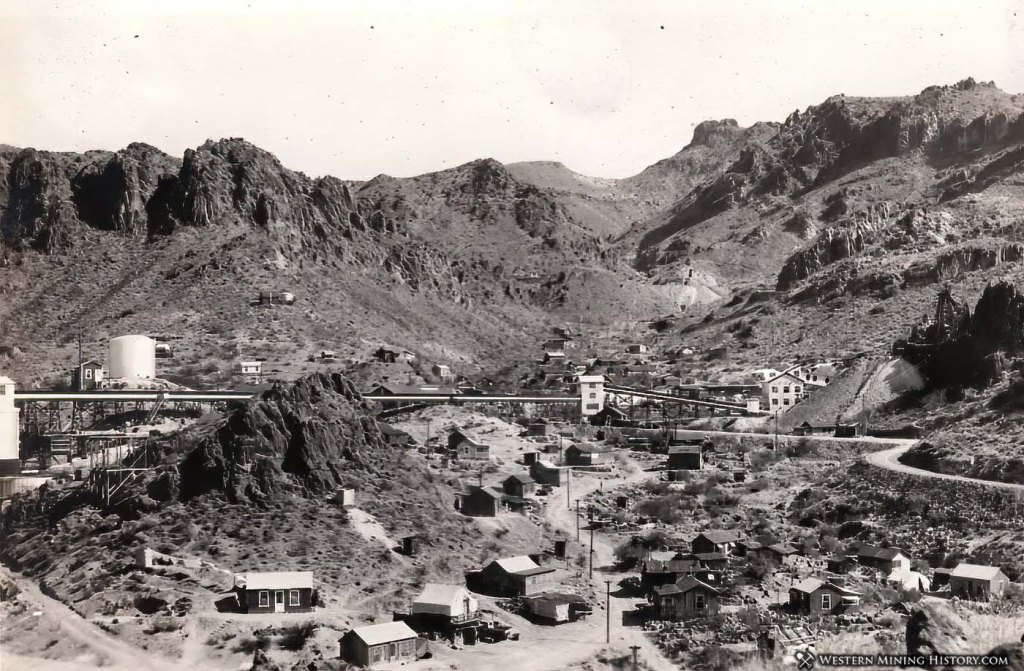
A couple of miles west of Oatman, Arizona, on old Route 66, lies the former goldmining town of Goldroad. There’s nothing left of the original stone buildings other than a commercial gold mining operation still located where they once sat.
Gold was first discovered in the area around 1860, but it wasn’t until 1898 that things really took off. Prospector Jose Perez was walking the area and found quartz rocks with streaks of visible gold in them. He immediately staked a claim along with Henry Lovin, a partner.
A short time later, selling his mineral rights to Lovin, he was paid $50,000, a large sum at that time. Unfortunately, Joe basically drank his windfall away in Lovin’s saloon before going to his grave much too early by killing himself.
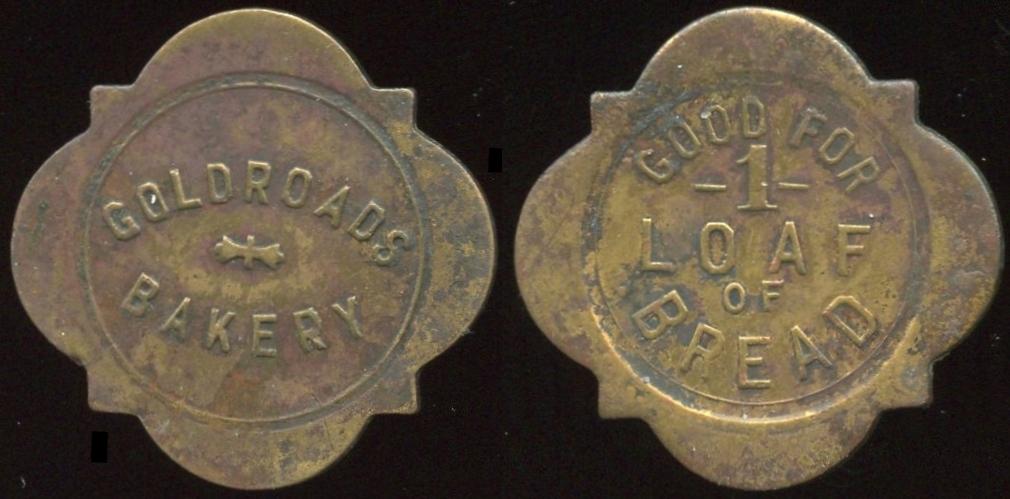
It’s believed that some 375,000 ounces of gold were pulled out of Goldroad. At today’s gold price of $3,360.00 an ounce, this equals 1.26 billion dollars. I have a souvenir of old Goldroad, but it isn’t precious metal. A Goldroad Bakery token found with a metal detector next to an old stone wall is in my box of treasures. It’s worth around $300.
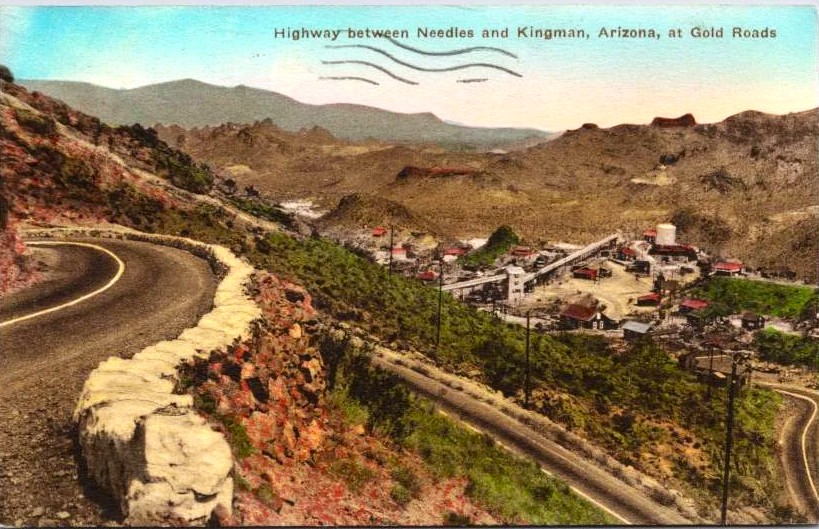
Old Route 66, going through Oatman and Goldroad, was eventually rerouted in 1952. A section of the old highway going through Sitgreaves Pass is undoubtedly one of the most treacherous of “The Mother Road.” That’s the nickname for Route 66. Oatman is now a popular tourist destination.
A picture postcard sent by Nina and Bernard in 1939 to Miss Mary Ahern in Minneapolis, Minnesota, shows both a portion of the road, along with mining activity at Goldroad. This section was so steep and winding that numerous accidents took place there, and still do, especially with motorcyclists.
The message on the postcard written by Nina says the following:
Feb. 22, 1939
My dear Mary – we are staying tonight just a little way from here. These mountains are full of gold mines and very pretty. We will have to hurry if we get home by the first. Love, Nina & Bernard.”
Nina Nelsen & Bernard Franz were most likely on an adventure trip. Only 18 years old at that time, Bernard didn’t know it, but he was just about to enlist in the Army as a paratrooper and glider infantryman.
WWII had just started, and his 13th Airborne Squadron was sent to France. Why he didn’t marry Nina until March 11, 1950, is only known to them. The couple stayed together before passing in 2008 and 2012.
The person this card was written to, Miss Mary Ahern, was a young college student at that time. Her major was nursing, with her attending St. Mary’s Hospital School of Nursing in Minneapolis. Three years after she received the Goldroad postcard, she married William J. Tiffany.
Mary Margaret and William Joseph Tiffany stayed together for 57 years. Both born in 1910, they passed away in 1998 and 1999, respectively. Hopefully, the couple was able to make that same scenic drive to Arizona, as Bernard and Nina Ahern did in 1939.
“That wasn’t unusual in the day, as children often helped their parents out.”
One of the neatest places I’ve ever visited is Dawson City in the Yukon Territory, Canada. It’s been several years now, but the memory remains quite strong. My friends, Doug and Jeff, along with me, had to take a ferry boat across the Yukon River to get there, which was exciting all in itself.
Dawson City was a booming place from the start of the Klondike Gold Rush in 1896 until things began to peter out in 1899. At one time, there were close to 17,000 people in the city; today, the population is approximately 1,600.
Some of the original buildings still remain, with Dawson City a major tourist attraction in summer. When the town was at its peak, gamblers, hustlers, copulation experts, and other unscrupulous people came out at night to prey upon those miners having cash or gold in their pockets.
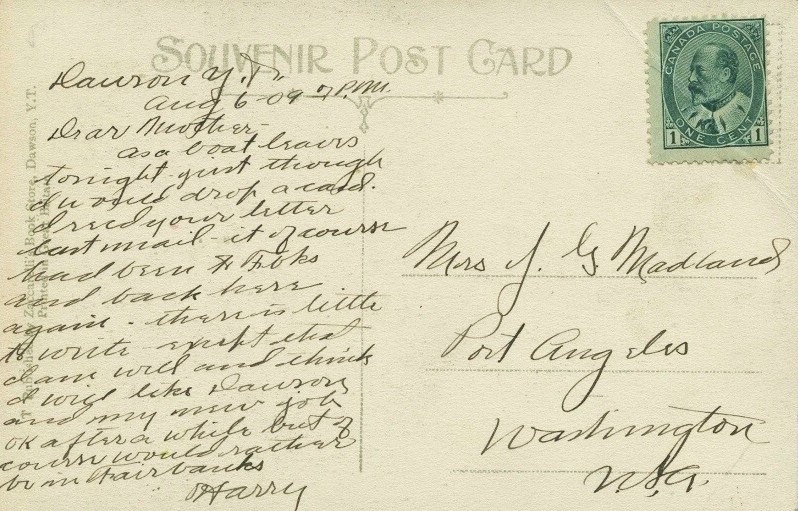
Born in 1892, Harry Madland was in Dawson City on August 6, 1909, as an old postcard proves. He wrote his mother, Mrs. J.G. Madland, in Port Angeles, Washington, informing her of his new job, although he doesn’t go into much detail. Mr. Madland would’ve only been around 17 at this time, quite young to be out on the road all alone, especially in a wild and crazy gold mining town.
“Dawson Y.T.
Aug 6-09 – 7PM
Dear mother –
As a boat travels tonight just thought I would drop a card. I rcvd your letter last mail. It of course had been to Fbks and back here again. There is little to write except that I am well and think that I will like Dawson and my new job ok after a while but of course would rather be in Fairbanks.
Harry”
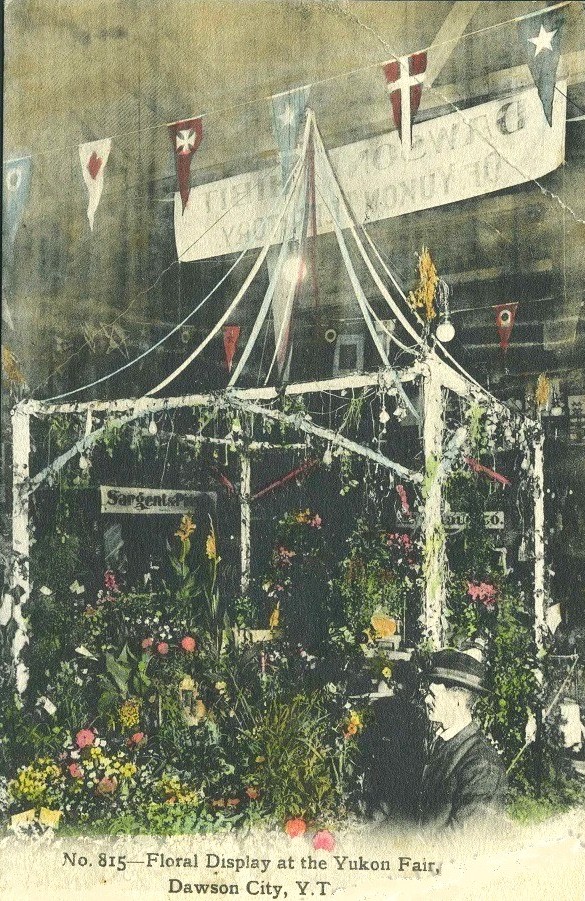
The flip side of the postcard shows a floral display put on by Dawson City, Yukon Territory, at the 1906 Seattle event. A man in a fancy bowler hat is shown looking at flowers.
With the sun staying up close to midnight during the summer months, a boat would’ve been able to navigate the treacherous Yukon 7 PM at night, as Harry indicates. With numerous sandbars and rapids, navigating the river was a difficult and sometimes treacherous task, and would be impossible in the darkness.
My research shows that Jens Gustav Madland was his father, while Harry’s mother was Christine Augusta Madland. He had three sisters and a brother. J.G. Madland evidently had a hard time supporting his family on meager wages, and perhaps lost a sum on a business venture.
The Washington, DC Patent Office patented an invention of Madland’s for a clothes hanger. He’s shown having a partner, J.F. Franck, in a business called Port Angeles Novelty Works. “The Olympic Tribune” headlines an article:
“The Port Angeles Novelty Works is a new infant industry for this place, now being started by J.F. Franck, a well-known citizen, and J.G. Madland, late of Seattle. The first article they are taking up is a tilting and revolving clothes reel of Mr. Madland’s invention.”
Things evidently didn’t work out as planned, as there’s no further information on this company.
After that failure, J.G. Madland sold flowers, tended gardens for people, which involved pruning, spraying, and grafting, along with being hired as a fruit inspector. Records show that he was paid $18 for one of his fruit inspection assignments.
Sadly, in 1913, the elder Madland was found dead in an irrigation ditch, where authorities said that he had committed suicide. That explains his son leaving the nest so early and heading out on his own, as it seems reasonable that he went off to work in order to send money back home to his family.
That wasn’t unusual in the day, as children often helped their parents out. Mrs. Christine Augusta Jackson Madland, Harry’s mother, the one he wrote the card to, died in 1942. Harry, along with the other siblings, most likely helped support her up until the end.
Harry eventually worked for Northern Commercial Company and Seattle Hardware Company, traveling throughout Alaska via dogsled, boat, and eventually airplane, to remote towns like Iditarod, Ophir, Eagle, Circle City, McCarthy, Cordova, and Nome, peddling his wares.
Newspaper records show he visited not only rural towns, but also the larger populations such as Fairbanks, Cordova, Juneau, and Anchorage.
Harry B. Madland married Louise Beaumont on March 19, 1912. Louise is reported to be the first white child born in the Yukon Territory. Her husband was quite successful in his sales ability, as he was employed with both companies for some 28 years.
Eventually, leaving Alaska with Louise, he became sales manager for Pacific Marine and Supply Company. It was while working for this outfit that he died of a heart attack in 1941. Harry was only 59. Louise Beaumont passed away five years later in California.
As far as Jens Gustav Madland’s business partner, J.F. Franck, the well-known Port Angeles resident, died in 1915. Administrators working for the deceased man’s estate successfully won a judgment in court for $326. This was in 1916.
Despite the business failure, it appears that J.F. Franck died a wealthy man and was still making money while his body lay six feet under.
Jens Gustav Madland was actually 65 years old.1941
















 I like to write junk...