DREAMCATCHER

“I’ve even seen them in Walmart, yet with “Made in China” labels, I seriously doubt they’ll catch dreams.”

I came across a 1994 movie the other day starring John Denver, called, “Walking Thunder.” In a nutshell, the storyline’s about a pioneer family, the McKay’s, traveling to California right after the American Civil War. John Denver plays the main part of John McKay, an East Coast shipbuilder looking to move his expectant wife and children west to start a new life.

A large bear attacks their covered wagon and begins destroying it somewhere in the rugged Rocky Mountains, with the wagon ultimately ending up with an unrepairable broken axle. My first thought after seeing this was quite sarcastic, “McKay should’ve purchased a one-ton!”  

Only 10 minutes in, I’d already decided to earmark the film as “hokey.” That’s a word I use to describe movies that hinge on being bogus or unrealistic. Seeing that my wife was enjoying things, I decided to quietly go along for the ride without complaint.

In the story’s beginning, the great-grandson of John McKay, Danny McKay, stays with his grandmother for a few days. Grandma Anne McKay wants her grandson to go through an old trunk in her attic that once belonged to their early McKay relative, Jacob.

Inside this antique trunk is an Indian dreamcatcher, a Colt revolver, and a journal written by Danny’s great-grandfather, Jacob, about the problematic trip to California. From that point on the storyline follows what happened next.

After the bear encounter, the McKay clan befriended a mountain man, Abner Murdock, and his Sioux medicine man friend, Dark Wind. Murdock gives the family some pointers on how to survive in the wilderness as winter is fast approaching. He also tells them what Dark Wind’s dreamcatcher is used for, after seeing that McKay’s two boys, Jacob and Toby, are interested in it.

In simplistic terms, a dreamcatcher is a circular wood hoop with webbing in the middle and feathers hanging from it. The weblike part of the religious item supposedly catches evil spirits and bad dreams during the night, and when daylight comes they dissipate. The feathers retain any good dreams.

As if dealing with a vicious bear wasn’t bad enough, three snarky-looking hide hunters come along, harassing the family and wanting their gold and silver. There were fights galore between the evildoers, McKay’s, and Abner Murdock, yet no one was killed.

Each time John McKay shot at any wild game he missed. It was only because of Abner Murdock having good hunting skills that they survived—although he was never shown killing or butchering any animals. They did eat well indicating that such events happened.

Where family movies are concerned this is a good one, with no f-bombs being dropped, drug use, excess violence, or explicit sexual acts. I seriously doubt this type of film is being made anymore, at least not in Hollywood. That’s a good part of what’s wrong with this country.

Lake Havasu City has a dreamcatcher of its own, although the city doesn’t rightly own it. “Dreamcatcher” is the name the Chemehuevi Indians gave to their Havasu Landing Resort and Casino transportation boat. This sleek-looking vessel transports folks across the water to their California desert oasis numerous times a day, and for only $3.00 roundtrip. Hands down it’s the best deal in town!

Authentic American Indian dreamcatchers are popular tourist items in almost every Native gift store. I’ve even seen them in Walmart, yet with “Made in China” labels, I seriously doubt they’ll catch dreams. Undoubtedly though, they will catch dust.

The opposite of dreamcatcher is dreammaker. I’ve found that lots of things can create dreams, including fatigue, prescription medicines, and certain foods, such as pizza and spaghetti. I’m not the only person claiming that red tomato sauce makes them dream.

It happens to me all the time, especially after eating pizza from one specific location here in town. Don’t get me wrong, their pizza is delicious—I just wish it’d stop giving me nightmares.

With the length and severity of bad dreams, this food creates for me, I highly doubt an average-sized authentic Indian dreamcatcher would snag them all. I’ll need one about the size of a garbage can lid for starts.

There’s no room on our walls for a dreamcatcher this size, so maybe this eatery could be coaxed into placing one in their dining room. It makes sense to me that the bad dreams should be snared before ever leaving their front door!

BAREFOOTIN’

“Everyone must have a different pain threshold, with flip-flops being our saving grace when visiting beaches in Alabama or Florida.”

1910 photograph

Out of pure laziness to not bend over and slip on my sandals, the other afternoon, I decided to walk outside and check the mail while barefoot. Our thermometer showed 109. Knowing that asphalt is a killer in this heat, concrete didn’t seem like it’d be as hot. I made it to the mailbox with no problem yet the return trip had me dancing.

A 1966 song by Robert Parker, “Barefootin’” is about dancing without shoes and socks, yet there’s no mention of it being performed on hot blacktop or concrete. In my younger days, my brother and I often went barefooted in Alabama and Texas, being smart enough to avoid pavement.

I can’t remember us incurring any major problems other than sticker briars. After a summer of going shoeless, feet developed thick callouses that somewhat protected them.

A third-grade class photo I have shows a schoolmate of mine without shoes. I’m sure had Dad and Mom allowed me, I would’ve been barefoot in that picture as well. I view folks at Rotary Beach here in town shoeless or sandal-less all the time, with smoking hot sand being hard for me to take. Everyone must have a different pain threshold, with flip-flops being our saving grace when visiting beaches in Alabama or Florida.

The Arizona town of Salome has a slogan, “Where She Danced.” Many visitors to this small oasis in the desert inquire as to its meaning. There are two explanations. Supposedly, the newly arrived wife of Charles Pratt, co-founder of the town, Grace Salome Pratt, after first removing shoes during summer to try walking barefooted on desert sand, ended up dancing instead.

The second reason has to do with a 1945 movie called, “Salome, Where She Danced,” starring Yvonne DeCarlo. The famous actress plays the part of Anna Maria, a ballerina who escapes Europe during The Austrian-Prussian War after being accused there as a spy.

Immigrating to America, she hooks up with another long-retired dancer, Madame Europe. They’re set to dance together for the first time in a small western town called Drinkman Wells, in a musical play called, “Salome, Where She Danced. The town name is soon changed to Salome, to appease Anna Maria.

The actors and townspeople are robbed by a band of outlaws as the dancing begins, with Anna Maria taken hostage. I watched this movie for free on YouTube and found it somewhat entertaining, yet no scenes were filmed in Salome which would’ve made it better. Yvonne DeCarlo was quite a hottie in this film, unlike the character she played in “The Munsters” as Herman Munster’s wife, Lily.

If the late Gene Siskel and Roger Ebert (Siskel and Ebert) were still rating movies, they’d undoubtedly give the film two thumbs down for plot. It’s highly possible that writer, Laurence Stallings, came up with the screenplay name after visiting Salome.

On a negative side to barefootin’, I see people in town from time to time walking their dogs on hot asphalt in summer, with the poor animals dancing like I had to. A slow form of torturing these pets, I want to say something to the pet owners, yet know that any remark from me won’t help the suffering canines.

Pet owners like that are, unfortunately, a little dense upstairs, with their excuse being, “Well it has to walk and do its business somewhere!” Walking a dog on burning asphalt during summer in this town or any other proximity is never a valid excuse.

Just today, a fellow was out in front of Walmart soliciting money, while his dog lay on hot concrete with its tongue hanging out. My car thermometer read 106. Using crutches or a walker as a prop to garner sympathy is one thing, but bringing along an animal to do the same shows a callous individual. A few snowflakes might say I’m being judgmental here, but I see it as simply being observant.

I’ve had a couple of dogs in Havasu, finding that paw protectors, when soaked with a portable spray bottle full of water help considerably. I sprayed their fur down as well. Of course, having that important cell phone in one hand and a leash in the other makes that impossible for some pet owners.

As our two Pekingese got older and couldn’t take the heat anymore, they weren’t too old to train. I taught them both to do their business in the garage on a pee pad. A little Clorox bleach and water helped clean up any spillage.

Children are much like pets in some ways. Neither have any say in what parents or caretakers they’ll end up with. Some were dealt a good hand while others ended up on the losing end of the stick. Hopefully, my wife and I are deemed by our kids and departed pets as being good stewards where taking care of them is concerned.

One thing’s for sure, we never forced them to go barefootin’ on sizzlin’ hot pavement or locked our kids in a hot car. It doesn’t take a Harvard or Yale scholar to know that these inexcusable acts have serious and sometimes irreversible consequences.

SERENITY NOW

“It’s amazing what can be done in a short period when having a goal, and a desire to accomplish it.”

SERENITY NOW

When I’m involved in doing something tedious or technical, I don’t want outside interference interrupting me. Building an engine for a hotrod is one of those times. Getting distracted, and forgetting to torque one measly connecting rod nut can spell disaster.

I’ve never made that mistake, yet tales of others doing it aren’t uncommon. On rare occasions, rebuilt engines put together by even professionals are prone to such mishaps. All it takes is a phone call, or someone wanting to stop by and chat during assembly for this to happen.

Writing is another area where I like to be left alone, with no distractions. Keeping the thought train going without entering the “Twilight Zone” seems to get harder the older I get. Telephone calls, trying to take care of social media inquiries, and of course, unusual noises such as sirens going off or outside disturbances can bother me to the point of temporarily curtailing a writing project.

There’ve been times when I walked into the kitchen for a specific reason, took an unexpected phone call, and then afterward wondered what was I doing in the kitchen to begin with. Walking back in the living room it suddenly hit me, to get a glass of milk.

In July, I decided to write a book, giving myself one year to finish it. The novel would consist of 49 individual stories about Alaska. My mind automatically went into stress mode just thinking about the tremendous amount of work ahead of me. My year was practically mapped out on other things needing to be accomplished, while undertaking such a large project seemed like overkill.

Deciding that I’d take things one story at a time, and place aside all other communication with the outside world, other than my wife, within 30 days I was finished. That meant burning some midnight oil along with working long hours from morning to evening. I shut down my Facebook account mid-project, so as not to be bothered there. It’s been so refreshing that I don’t know if I’ll return.

There’s still a way to go with tweaking things, but the main part where thinking and creativity is concerned, and typing out the 49 stories is all finished.  It’s amazing what can be done in a short period when having a goal, and a desire to accomplish it.

In my teenage years, cruising was the weekly thing to do in Anchorage, Alaska. Guys, gals, and cars would head out on Friday and Saturday nights with their hotrods, oftentimes ending up on Sand Lake Road for a grudge match.

Doug Miller had a 1967 Pontiac Firebird with a 400-big block engine. Street racing it one night, the engine tossed a connecting rod, destroying the block and crankshaft beyond repair. With a desire to go cruising the next evening, Doug and another good friend, Jeff Thimsen, did a marathon rebuild on a spare engine. They started around 1:00 a.m., removing the wounded powerplant, and by 5:00 the next afternoon a rebuilt one was in its place.

As a senior citizen, I can still accomplish interesting things in a timely manner, such as writing that book, yet mundane chores around the house seem to take me forever. In some cases, I could care less if they’re even finished. A stucco wall I started painting 2 years ago is one of those projects.

Building engines and writing stories, as mentioned, are two areas where I try to stay focused without interruption. Anymore, putting an engine together isn’t done like in prior years.

My number one distraction these days involves driving. I have to be more observant than in the past because peripherical vision has diminished. You won’t find me on the phone texting people as I drive, viewing that on the same level as consuming alcoholic beverages while endangering others.

Daily, I see folks behind the wheel doing their thing with electronic devices in hand as if nothing is wrong. These are generally the people drifting from lane to lane, or going 20 miles per hour slower than the speed limit. I try to stay away from them but they’re everywhere. Hopefully, I never meet one coming head-on.

There is a law in Arizona, that began January 2021, prohibiting drivers from using handheld mobile devices while driving, including texting. Has a ticket ever been given out for such? This law seems to be strictly followed like the speed limit is on 95.

Seeking serenity while living in towns or cities is hard to find. Other than turning off the television, unplugging phones, and installing earplugs, there’s not much else a person can do. Outside noise always penetrates the walls of a home, condo, or apartment. In an episode of Seinfeld, Frank Constanza found calm and peace in New York City by screaming out, “Serenity now!” I’ve tried it a few times finding myself laughing more than anything. Laughter is the best medicine they say.

Famous writer, Henry David Thoreau, constructed a cabin deep in the woods as a place to avoid distraction, compose literature, as well as find solitude from the outside world. It was an experiment of sorts to see if he could exist without perks of the city. The land this cabin was built on, next to Walden Pond, belonged to his friend, mentor, and famous author, Ralph Waldo Emerson.

During Thoreau’s two years of solitude, the most important thing he accomplished in this small cabin, besides writing, was get closer to God. If that was the only thing accomplished in his life experiment, it was a huge success.

In Matthew 6:31-32, Jesus says, “Let’s go off by ourselves to a quiet place and rest for a while.”

For now, my quiet place of solitude, away from city distractions, will have to be our small RV. I’m sure had Henry David Thoreau had the same back in 1845, it would’ve worked for him in achieving his goals, on the same level as that blessed cabin in the woods.

NOTHING

“Many older women lie about their age while we guys stretch things a bit.”

Recently, I asked my wife to come up with an interesting subject that I could write about. It seems like I’ve covered all bases here lately, with my ideas seemingly repeating themselves. Hearing nothing back from Joleen for a couple of days and finally asking, “What subject did you choose for me?” — her response was, “Nothing.”

At first, I wasn’t going to take this subject on, but after thinking about it for a few seconds, the television series “Seinfeld” came to mind. That show was about nothing and it was absolutely hilarious. My favorite episode was when Kramer came up with the idea for a coffee table book about coffee tables. I still chuckle thinking of the harebrained plan.

Out of curiosity, I looked to see if there is such a book and came upon several, one listed for $198 used. A few were going for less but not much less. Seeing that, I tried to dream up a similar idea, coming up blank. There’s no better worthless book than a coffee table book about coffee tables. Whoever wrote that episode is brilliant.

I could ramble on and on about going to the grocery store the other morning, forgetting it was senior discount day, and not having to ask the clerk for my discount. Looking back on things, was that an insult, or were they merely profiling me based on the clothing I had on? Most seniors don’t wear Lightning Bolt tee-shirts so that shouldn’t have tipped them off.

Opening my mailbox the other afternoon and finding nothing inside, which is unusual, could be considered nothing to some, but not to most of us older folks. We’re always getting junk mail such as reverse mortgage offers, credit card offers, offers of a free meal to attend a 3-hour seminar, and best of all, a nicely written and personal advertisement for funeral services or embalming.

That in itself brings up another valid question. How do these undertakers know that we’re reaching that point? Many older women lie about their age while we guys stretch things a bit. I’ve told a few young clerks just for grins that I was 90 just to get a compliment, ‘You sure don’t look that old!” I don’t know about other seniors, but that seems the only way I can get kudos.

A week or two ago I was towing a small trailer while Joleen kept hearing this ringing or dinging sound. Believing it was the radio at first, she turned the volume down. The dinging continued for her but I didn’t hear nothing. Tinnitus has a way of camouflaging certain sounds like that.

Finally getting home, one of the safety chains had fallen off and was dragging on asphalt. It was almost worn flat, indicating that the thing was loose for quite a few miles. Thankfully, the sparks didn’t start a roadside brush fire.

For some folks this is nothing, but for me, that was perhaps the most exciting event happening the whole month of July, besides having our windshield replaced while I watched.

Hopefully, in the coming weeks, a presidential debate or two will take place. That might not excite some but I’m quite entertained watching them. Joleen will nuke a bag of Orville Redenbacher popcorn, and we’ll sit back and make sarcastic remarks about the opposing candidate as if they can hear us. Undoubtedly, we’re not the only ones playing ‘the blame game.’

There are other things to tell, yet nothing tops those I mentioned. A song that I’m very familiar with is “Life in the Fast Lane” by the Eagles. For those knowing the lyrics to this tune, nothing in it really fits my early lifestyle. I strictly like the song title because it relates to hotrod cars.

You might recognize the following two lines from the 1976 hit that fit my current life to a capital T.  They go like this, although I changed words just a bit.

“She said, listen baby I can hear the engine ring, we’ve been up and down this highway, and you haven’t heard a ding-dong thing!”

GRAVEYARDS & NEWSPAPERS

“That ghostly term seems to be going by the wayside, like so many others in this age of political correctness.”

Iditarod, Alaska – Circa 1915

Graveyards and newspapers go together like mashed potatoes and gravy. I’m sure most genealogists will agree with me here. When it comes to researching family history, there’s no better place to find information than old newspaper obituaries. Of course, the information on gravestones helps considerably in getting things started.

Over the years, I’ve relied on both entities to help unlock family mysteries never told to me by my parents. If my grandparents mentioned such, I was much too young or “unorganized” to retain all of the information. When I say unorganized, I mean writing things down and putting this information in a safe place.

Just recently, I was interested in learning more about a person laid to rest in Lake Havasu Memorial Gardens. Searching and searching, I came across absolutely nothing. It isn’t unusual for families to not write an obituary, which I find as being disrespectful to the deceased, including family and friends. Was that loved one not worthy of a few simple lines?

Information on stone tablets goes back thousands of years, while paper data has been around for hundreds. These two venues are now archaic in relation to this digital age. I often wonder how digital will hold up over the ages when a simple magnet or power surge can destroy things. What will genealogists down the road find while seeking information on Cousin Eddie?

Twenty-five years ago, some friends and I came across an unmarked cemetery in the ghost town of Iditarod, Alaska. Some rotten wood grave markers were remaining, yet they were all lying flat in the tundra and unreadable. Who was laid to rest in this desolate place?

There’s an online site called gravefinder.com where a person can look up cemeteries including the folks buried in them. I’ve used it often when writing stories or compiling information on my family and my wife’s. Iditarod Cemetery is not one of those cemeteries listed.

Being allowed to contribute to gravefinder.com, and knowing how much work was about to be undertaken, I hesitantly went ahead and brought the Iditarod Cemetery online.

After many late-night and early-morning research hours poring through archived newspaper obituaries and stories, I was able to add the 23 men, women, and babies buried there. A copy of the newspaper obituary or report on each of their deaths was included, with many of them quite sad, yet interesting just the same.

It was quite a task for tired eyes, but one that I’m now thankful is complete. I believe everyone buried there is now listed, unless, of course, someone was interned and not reported which is possible after 1919. That’s the year the “Iditarod Pioneer” newspaper ceased operation.

Lake Havasu City has a unique story that’s never been told where graveyards is concerned, or at least I’ve never heard anyone mention it. Our city when researched on http://www.gravefinders.com lists four graveyards, if I can still call them that. That ghostly term seems to be going by the wayside, much like so many others in this age of political correctness.

Community Presbyterian Church Columbarium, Grace Episcopal Memorial Garden, and Lake Havasu Memorial Gardens are the three largest cemeteries, combined, containing over 5,000 remains. The fourth, called McCormies Family Cemetery holds just one body. There’s no GPS or physical location for McCormies like the others.

The man supposedly buried in this singular plot is Edwin Glen McCormies. I looked that last name up and found no such listings on the Mohave County tax rolls. A St. George, Utah, obituary showed Mr. McCormies died in St. George in 2002, at the age of 81, with him being born at Glendive, Montana, in 1920.

In my research, I uncovered a disturbing story about McCormies that I won’t discuss. For those wanting to know more, this public information is available by searching an “Oakland Tribune” newspaper dated June 17, 1964 – page 21.

If Edwin McCormies was truly laid to rest in Lake Havasu City, as findagrave.com shows, just whose backyard is he buried in? It looks like another one of those jobs for veteran reporter, Lois Lane, to get to the bottom of!

CONFORM OR ELSE

“The opening program to the 2024 Olympics in Paris, France, is an example of the wicked culture around us.”

Presidential candidate Donald Trump

For the past few months, I’ve posted side-profile photos of my car on Facebook. The photos were taken in several locations, such as stopped at a McDonald’s drive-thru or parked in front of Family Dollar, Safeway Grocery store, Denny’s, Walmart, a movie theatre, including other Havasu and Kingman businesses. No big deal you’d think, other than the fact my vehicle has a portrait on the right rear passenger window, of Donald Trump riding in the back seat, giving a big thumbs up.

That evidently doesn’t conform to Facebook’s community policy, with me getting a notice saying exactly this. I’m currently shut down from posting for 24 hours. When my jail time expires, I always make sure to post another similar shot, and sure enough, another 24 hours in the pokey. It’d be easy to just say adios, yet I keep hoping they’ll “86” me from the site instead. That would be worthy of a medal or blue ribbon at the very least. Some of my friends laugh, saying they can’t believe I’m still allowed on there.

Years ago, I sent editorials to a liberal newspaper in Anchorage, Alaska. The editorial page editor at that time, Michael Carey, eventually shut me down from getting anything printed. When I inquired as to why, he had no answer. Michael is a decent guy, as I’d met him one time. I had to assume he was merely trying to protect me from leftwing lunatics.

There were a few over the years taking a dislike to my opinions. I wore that newspaper “censorship” as a crown, only being outdone by my friend, Jeff Thimsen, for getting his point across without writing or uttering a word.

Jeff has a yellow “Anchorage Daily News” newspaper tube, that is mounted underneath his mailbox. He cleverly replaced the News part to read Lies. When Google Earth, photographed his neighborhood, that part of the picture was intentionally blurred. Jeff told me that people often stopped in front of the house, solely to snap photos of that tube.

It seems that on Facebook, if a person conforms to the left, or what I call the twisted side of things—all is good. Romans 12:2 tells me this: Do not conform to the pattern of this world, but be transformed by the renewing of your mind.” Simply put, this verse says not to be shaped by the wicked culture around us.

The opening program to the 2024 Olympics in Paris, France, is an example of the wicked culture around us. Some non-Christians saw no harm in a bunch of perverted individuals making light of the Lord’s Supper. Had these French citizens done the same regarding the Islamic faith, those actors would have a price on their heads, and rightly so. It’s called blasphemy in their religion.

Facebook seems to be okay with leftist viewpoints being featured here and there on their site without censorship, yet the same can’t be said for articles written from a conservative perspective. The “anything goes” crowd, as I like to call them, seems to be able to get away with posting almost anything.

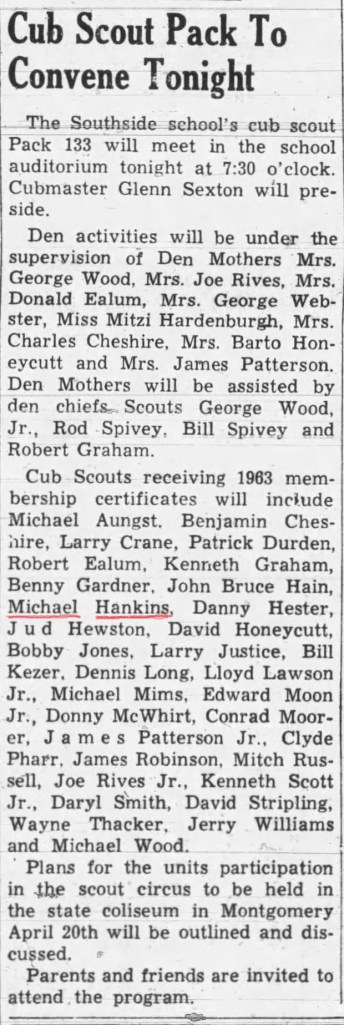
I highly doubt Mark Zuckerberg is sitting back watching what Michael Hankins posts. AI, or Artificial Intelligence, does it for him. These bots have to be programmed what to look for, with it quite evident a leftist slant and a dislike for Donald Trump is part of that programming.

Deciding to change things up a bit, and to be a bit more fair, along with humoring myself, I looked for a similar Kamala Harris photograph to place on the left side of my Jeep. Searching and searching through various venues, the one and only window sticker I came across of her is not flattering. If that’s all there is available, it’ll have to do for this experiment.

My plan is to start all over again, drive to the same places I took “The Donald” and snap pictures from the left side, featuring Kamala. Posting those on my Facebook page, it’ll be interesting to see what Mark Zuckerbot does this time.

All in the name of a laugh, because to me, that’s what Facebook has come down to!

Daily Lies

GOT BEER?

“I kept my share in the refrigerator for years, until Joleen tired of seeing them.”

GOT BEER?

I’ve never been a beer drinker other than root beer. On average, I consume two cans a day of the delicious beverage, sometimes adding it to ice cream. I’m always intrigued whenever I go to a restaurant having a microbrewery and watching their canning process.

The canning machine used at College Street Brewery here in Lake Havasu City is a complex-looking monster, something that appears to need finetuning quite regularly. I suppose it’s the same with all of these mechanical devices.

My first encounter with a local brewery was in Anchorage, Alaska. This was in 1976. A German company, for whatever reason, decided that building a brewery in the All-America City was a wise financial decision. Reports say that 11.7 million dollars were invested to produce Prinz Bräu beer.

Fancy sounding as it was, most Alaska working stiffs couldn’t even pronounce the name. That was an early indicator that things wouldn’t go well. My friends called it Prince Roy just because it was much easier to say.

Prinz Bräu was described as tasting like mud when it first hit the market, with brew meister, Heinritz Reich, slowly perfecting the quality and taste. Unfortunately, by 1979, this brewery was bankrupt, with the equipment sold and the building leased.

My brother and I saw the potential for collectibles here, hitting nearly every liquor store in town, buying whatever stock of Prinz Bräu they had left. We ended up with perhaps three six-packs and only a few glass bottles.

I kept my share in the refrigerator for years, until Joleen tired of seeing them. At that point, I sold or gave them away, still having one unopened can. With it now 45 years old, that aluminum container looks as if it could explode at any moment. I keep it next to a Midnight Sun Beer – Pioneer Brewing Company bottle in my office that dates to the 1920s.

There are now several breweries in Alaska, with Alaskan Brewing Company in Juneau perhaps the most successful. They sell their beer in 25 states. A nonalcoholic beverage called Skagway Root Beer is also made by them.

I show three microbreweries located in Lake Havasu City. Barley Brothers Brewing Company, Mudshark Brewing Company, and of course, College Street Brewing Company. I believe two out of three sell their products outside of the city. I’ve seen them in several grocery stores throughout the state.

My wife’s grandparents, Karl and Josephine Schweitzer, made their own homebrew, with Joleen saying that she got to sample it as a teen. With her Grandpa and Grandma coming from German parents, of course, their beer would reflect such. She said it was dark brown and quite strong. I believe this was more along the lines of an ale.

Mom washed her hair in beer, saying that it helped keep things shiny and soft. Up until she passed away her hair was still thick and colorful. I’m not sure the beer helped but then again it could’ve.

One of these days, I’ll drill a hole in my prized Prinz Bräu can and drain the contents. It seems a waste to dump it down the sink.  I’m not for drinking the stuff, yet pouring a small amount on my head shouldn’t hurt as the damage has already been done.

Had German investors used local people to manage their company in Alaska, instead of relying upon a management team in Germany, and been a bit more diplomatic in dealing with people, I believe that Prinz Bräu Brewery would still be in business.

The large and powerful family that owned Prinz Bräu, the Oetker Group, could’ve learned a lot from the hands-on entrepreneurs starting Mudshark, College Street, and Barley Brothers, here in Havasu.

A good name plays a big part in new products, with these arrogant Germans in 1976 picking a real winner.

TIME PASSAGES

“Oddly enough, not once while we were eating did anyone mention the shooting.”

Certain current events, or hearing a specific old song, sometimes trigger a special or tragic memory in my head. The popular song, “A Whiter Shade of Pale,” by Procol Harum, released in 1967, always conjures up good times I had camping with friends in Alaska.

That tune seemed to always play as my brother drove the Seward Highway to Bird Creek, McHugh Creek, or Hope. Jim was the designated driver because I didn’t have a driver’s license or a car.

An event that just unfolded on July 13, 2024, rekindled two similar horrific occurrences, with me able to remember months, days, and years, although the exact minutes had to be looked up. If you asked me what I was doing at 12:30 p.m. on November 25, 1963, I can tell you without hesitation.

I’d just returned from the Reese Elementary cafeteria along with the rest of my classmates. Within a few minutes, my fourth-grade teacher, Mrs. Hagen, wheeled a black & white television into our classroom, with her telling us that President John F. Kennedy had been shot. Within an hour—the whole school was dismissed because the president was dead.

On March 31, 1981, at 2:27 p.m., Washington D.C. time, I was playing golf with my wife and her brother in Manhattan, Kansas. Because of a time-zone change, it was one hour earlier in The Sunflower State, making it 1:27 p.m.

Lightning and thunder exploded all around us with heavy rain coming down in buckets. Being the only customers at Putt-Putt Miniature Golf that day, we had the course to ourselves. Soft rock music was playing on the outside speakers, with a newscaster suddenly interrupting things with a report about President Ronald Reagan being shot.

The owner of the golf course, sitting in a small building, yelled out the window asking if we’d heard the news and we told him, “Yes.”

With it continuing to crackle and pop overhead, the gentleman informed us he was shutting down for the day, handing out free game cards to compensate for not finishing. Unfortunately, those cards could never be used because the course was dismantled the following year. This valuable property was then turned into a retail shopping complex.

The event triggering those older memories is eerily similar to the last two incidents mentioned. At 6:11 p.m., Pennsylvania time, former President Donald Trump was shot by a sniper as he gave a speech at a political rally in Butler. He was struck in the ear, with three rally attendees also hit, one dying. I knew to the second where I was at this time, and what I was doing, yet didn’t know anything about the assassination attempt taking place.

Joleen and I were sitting in Westside Lilos in historic Seligman, Arizona, eating lunch. Westside Lilos is located on old Route 66 and the place was crowded with customers, many of them tourists from France, Germany, and Sweden.

After eating and then paying the bill, which my receipt shows to be 3:23 p.m., Arizona time, we left and headed for Havasu. Oddly enough, not once while we were eating did anyone mention the shooting, with many patrons looking at their electronic devices.

After driving for almost an hour, Joleen heard a multitude of loud dings and instantly glanced down at her cell phone. She saw text after text from our grown children and good friends, Jim and Pat Brownfield in Prescott. They were all asking if we had heard about Trump.

We’d just left Jim and Pat’s house that afternoon after spending the night, with Donald Trump’s name coming up quite often. Jim and I both thought that someone might try shooting the former president to keep him out of the race. I think a lot of people believed the same.

Listening to news reports the rest of the way and then seeing video clips after getting back home, I started thinking back to those other two shootings so many years ago. Technology has come a long way since then, yet somehow, as we drove on I-40 with cellphone towers visible every few miles, we were in the dark ages for nearly an hour.

I had Sirius satellite radio tuned to channel 16, The Blend, and as we listened to soft rock music, exactly as we’d done in Manhattan, Kansas, 43 years previous while playing golf, not once did an announcer break in with the disturbing news. What’s with that?

It makes me wonder that if a nuclear missile was streaking towards the US from China, intended to totally destroy our country, would Sirius continue to play, “Don’t Worry, Be Happy,” without interruption.

Not intending to end things on such a negative note, the main reason we stopped at Westside Lilos in Seligman that Saturday, was to sample a piece of their world-famous carrot cake. With Joleen and I both connoisseurs of carrot cake, Westside Lilos’ dessert is to die for. On second thought, perhaps a person shouldn’t go that far!

BORDERLINE INSANITY

“The pay was good yet working conditions were horrible.”

Hanging by a rope

Whenever I see workers standing on the roofs of homes or commercial buildings, in blistering heat, I can’t help but wonder, “How do they do it?”

A seasoned roofer and veteran HVAC repairman whom I met in Havasu, told me summers here are brutal to work in. Gallons of water are consumed in the course of a day, and remarkably, they seldom need to use the restroom. Hot bodies mostly sweat it all out in order to stay cool. Straw hats or other types of head coverings, including bandannas, are pretty much mandatory while toiling in the baking sun.

My neighbor is a residential house builder, hitting his job site running before the sun rises each summer day. The guy’s usually back home a little after noon, having put in 8 hours. He’s not the only Lake Havasu City construction worker out there doing this.

A convenience store by my place is often filled with guys and sometimes gals in neon yellow and safety orange work shirts, or company monogrammed apparel, this before 5:00 a.m. An early riser myself, I see them at the coffee machine and loading up on breakfast or lunch sandwiches to go with their brew.

Tow truck operators in town have crazy jobs in summer. When the outside air is 120 Fahrenheit, black asphalt is easily 160 – 200 degrees. I saw one of these guys lying in a paved parking lot trying to attach a chain to a low-strung sports car. He was basically a human steak on a frying pan at this point.

I’ve performed a few crazy jobs in my life, yet nothing in 125-degree heat. Working as a mechanic at the DOT equipment shop in Anchorage, I had to perform certain tasks outside, in -20 weather, such as working on cars, trucks, or heavy equipment.

Long-john underwear underneath my insulated Carhart coveralls, with facemask and gloves on, including clumsy military-style, white “bunny boots” helped keep soft flesh from freezing, but not always.

Working on a runway sweeper in Bethel, Alaska, the wind was blowing 20 miles per hour, with it being 15 below zero. This made for a minus 40-degree wind chill factor. The sweeper was too long to fit in the small shop because I tried several times and failed. It had to be repaired outside.

Having all of the necessary clothing and boots on, I stayed safe by working a few minutes and then ducking back inside to get warm. A large metal panel covered a drive chain on the sweeper, and it was held on by small countersunk bolts. The only way to get the bolts started was by removing gloves and using exposed fingers.

Not having them off for perhaps a few minutes—both thumbs started burning like they were on fire. Recognizing the effects of frostbite, I immediately ran back inside the building and placed my hands under warm water. By then it was too late.

That took place 40 years ago, and to this day, both thumbs are still extremely sensitive to cold and heat. The nerve damage is severed and permanent.

The craziest job I ever performed was traveling to the North Slope for a geophysical exploration company. My job title was “Juggy,” a no-brain task that consisted of walking for miles picking up seismic monitoring cable. The pay was good yet working conditions were horrible.

Towards the end of one season, with most workers packed and headed home, the outfit employing me received a last-minute assignment. My co-worker and I were driven to a remote area in a track vehicle and dropped off each morning. This driver came back in the afternoon and picked us up.

There were no communication devices given to us. Should something bad have happened, we were on our own until that driver returned. This was in February or March, with sunlight only lasting a few hours each day. Because of the constantly blowing wind, the chill factor was significant, with whiteouts occuring without warning.

For miles in all directions, when the sun was shining, all we could see even with sunglasses on to prevent snow blindness, was huge chunks of ice jutting up in various places. Everything else was windblown untouched snow.

Finding out one morning before heading out that we were a few miles offshore, on the Beaufort Sea, this information didn’t make my partner and me too happy. We’d seen water puddling up in places and wondered why.

Our camp consisted of a series of trailers on skis pulled by a large D-8 Caterpillar. This is where we ate and slept. Eventually, we were told by those working in the kitchen on our “cat train,” that there were polar bears in the vicinity.

After learning this, those large ice chunks in the fading light began to resemble enormous white meat eaters. With my co-worker deciding to suddenly quit, and me about to be out there all alone, I promptly joined him. It took a couple of days before a plane could fly us back to Anchorage.

Having to be out in the extreme cold and heat to perform a job is crazy, yet someone has to do it. This afternoon I witnessed something that goes far beyond crazy. Driving back from Bullhead City, and slowly rolling through Golden Shores, three men were working in 125-degree heat, at least 200 feet up a tall metal pole.

They were installing microwave antennas and dishes for communication devices, namely cell phones. The wind was blowing making their job even tougher. One man stood on the platform of a hydraulic lifting device while the other two men had climbed a ladder, approximately 20 feet above him. They were secured to the pole by safety harnesses.

I stopped long enough to hop out of my vehicle and take several photos. Sweltering in the heat myself while trying to get that perfect shot, I couldn’t help but think. “The job these guys are doing isn’t crazy, it’s borderline insanity.”

As my wife sat in the car watching, I told her to think of those brave workers each time she made or received a call. If it wasn’t for folks like them, smartphones, iPhones, and the like would be worthless. I hope those men received lawyer’s wages or better for this task.

I remember years ago while applying for life insurance, the agent said that if I flew airplanes, rode motorcycles, or was a deep sea diver, his company wouldn’t cover me. Strangely enough, there was never any mention of climbing tall poles for a living!

Approximately 200 feet up.

A REDNECK

“For the most part, my generation consists of workers, unlike what seems to be a new generation of folks born with the palms of their hands turned up.”

Uncle Jesse Duke

It’s not uncommon in Havasu to hear the word redneck. For the most part, it’s not about a personality trait, but more along the lines of sunburned skin. I spot rednecks all the time, including red backs, legs, and arms.

Several years ago, a family member called me a redneck, and it had nothing to do with dermatology. The remark wasn’t said to my face or I would’ve laughed at them. It was mentioned behind my back instead. I still chuckle thinking about this.

I only got wind of it after this person was sadly gone. I don’t know if it was said in a demeaning manner, or if the remark was for praise. I suppose there are good and there are bad rednecks. Hopefully, they were identifying me as a good one.

Not sure of what redneck exactly means, with images of Uncle Duke on “The Dukes of Hazzard” television series coming to mind, I initiated a bit of research on the subject. For those readers too young to remember, in “Dukes of Hazzard,” Denver Pyle played the part of Uncle Jesse, an amicable father figure seemingly liked by all, other than perhaps Boss Hogg, the cantankerous sheriff.

In true redneck fashion, Uncle Jesse and the Duke family made moonshine on the side, with the boys eventually busted for hauling it. That to me is the ultimate stereotype for being labeled a redneck, yet is now considered archaic. I doubt many folks are making white-lightning these days in copper stills.

Looking up the word, online dictionaries offered two entirely different definitions: The first one is quite tame. “A working-class white person, especially a politically reactionary from a rural area.”

Example number two is perhaps a bit more offensive. “One living in the countryside in the southern US, who is believed to have prejudiced ideas and beliefs.”

I’m not sure which definition my relative went by. Deciding to bisect each one, word by word, I found several things to be true of me, while others weren’t. Working class definitely fits my persona and I’m proud of it. For the most part, my generation consists of workers, unlike what seems to be a new generation of folks born with the palms of their hands turned up.

Not all of them are this way but a good number fit the mold. I see these younger folks each evening on the 6:00 news, advocating for free this and free that; free college tuition, free housing, and free iPhones appear to be the latest. My generation generally believes that nothing is free—someone has to pay for it.

Going back to that list defining what a redneck is. White person. I take offense to this one because I look nothing like the Pillsbury Dough Boy, other than the chubby little guy wears a hat. My preference is to be called a citizen, with no defining color attached.

Politically reactionary is one of the descriptions of a redneck. If they’re talking about voting, then that’s me. I try to vote in every election along with contributing financially to candidates of my choice. One thing I don’t do is protest in the streets, loot businesses, nor do I set things on fire to make a point. Again, these are things I see on the 6:00 news.

Prejudiced idea and beliefs is another definition of redneck. This is subjective to the person interpreting anyone’s thoughts on such. For many on the left, should I disagree with them, I’m automatically labeled a prejudiced individual. It can work both ways though. I always try to keep an open mind, yet nothing will change my opinion if it isn’t Biblically acceptable. I don’t compromise there.

The last definition of a redneck still has me chuckling. According to each online dictionary example, a redneck can only come from a rural area, for the most part, the South. I’ve lived in rural parts of the southern United States. Most residents there love God, family, and country in that order. This alone makes them rednecks to many individuals, especially those out bashing the US.

After proofreading what I just composed, it was incomprehensible why anyone would call me the R-word, especially a close relative. Perhaps she thought I manufactured moonshine like Uncle Jesse? I made a batch of homemade gunpowder once, but that’s a different story.

Asking my wife to please read my composition, and tell me what she thought, Joleen pondered for a few seconds before replying, “Yes, you’re definitely a redneck, but a good one!”

Redneck