SMART TV

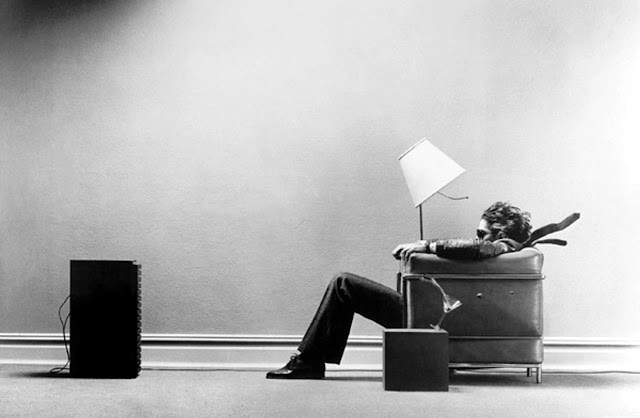
“If abusing that black & white television was a crime—all four of us should’ve spent considerable time behind bars.”

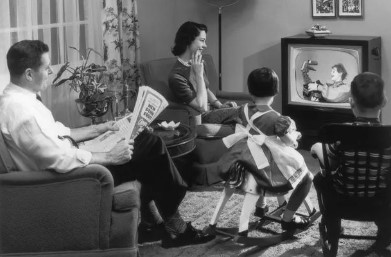
My family owned the same television from 1957 all the way through the late 1960s. It was a black & white model with glass tubes. Dad was constantly removing tubes—taking them to the nearest electronics store and having them tested. Part of our television’s problem most likely came from him trying to repair it.

Whenever the picture went fuzzy or constantly rotated on the screen, my father smacked the top of it with his hand in an attempt to correct things. That generally worked for a while, but the picture would eventually go back to being the same, requiring another hard slap. Frequent pounding over time was undoubtedly tough on fragile tubes and circuits, let alone Dad’s hand.

My brother and I watched him do this and we’d repeat the same when the old man wasn’t around. I’m fairly sure Mom did her fair share of smacking it around as well. If abusing that black & white television was a crime—all four of us should’ve spent considerable time behind bars.

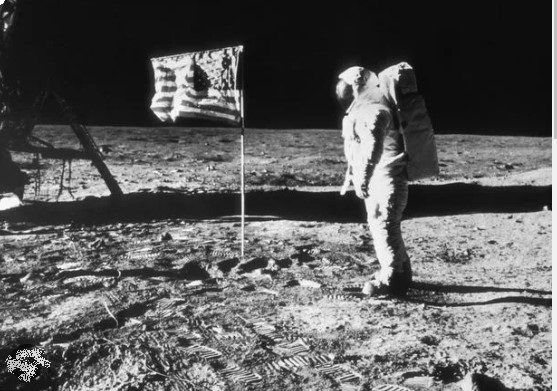
Dad finally purchased a new RCA television right before the United States put a man on the moon. That was 1969. He evidently still couldn’t afford color, because this newbie wasn’t any different than our old one. A good friend of mine had color and I’d often watch favorite shows with him including the moon landing.

Thank goodness the monumental moon walk took place before all of this non-binary gender confusion came out of the woodwork. I can visualize astronaut Neil Armstrong being forced by some woke dictating NASA official to utter the following as millions watch and listen,

“One small step for binary or non-binary being, one giant step for binary or nonbinary person-kind.”

Fortunately, for us seniors, the world was a saner place to live back then and we didn’t have to put up with such. Sadly, not the same case these days for our children and grandchildren.

The flatscreen on our living room wall is going on 16 years old. It still works fine, but in order to gleefully boot overly expensive cable out the front door, we need something called a smart TV. I had to look up the meaning and it’s basically a television with internet accessibility and computer like capability. The plan is to start streaming shows and hopefully save some money.

Our audio-video expert, Charles, knows the ins and outs of streaming, and swears it’s the wave of the future. I told him since this might be our last new television, to please order us a “Big Kahuna” and he did. It isn’t the largest, but where wall space is concerned, this set is as big as we can go. Surprisingly, it cost a lot less than the older Samsung.

I hate to see the old TV disappear, but there seems to be a time for everything to bite the dust in the name of progress. One thing that hasn’t for us are hand-operated can openers. We had an electric one for a short while but went back to using the antiques—they’re faster and can be cleaned without fear of electrocution.

My need for having a television has drastically changed over the years. Initially, as a boy, it was to watch cartoons and westerns on Saturday mornings. Over time, movies took over those two venues along with the evening news and weather.

Now, mainstream news has become so biased and politically selective on what they cover that we no longer go there. From here on out, I’ll be more in tune with streaming church services, as well as listening to music from YouTube on the same device.

Old reruns of westerns on Saturday night will make up the major portion of my TV viewing where movies are concerned. My biggest need for a “big television” is to be able to stream Microsoft Word off the laptop computer and use it as a gigantic screen. From twenty feet away, I should be able to sit on the couch and write without tiring already weary eyes.

We should have our new screen up and running within a couple of weeks. The components are on order and some work needs to be done with routing of wires for the soundboard. Hopefully, this new educated version is built strong enough to last as long as our less intelligent one.

Speaking of planned obsolescence: In 16 years I’ll be 85. What will life be like in 2039? As messed up as this world and people are right now—that thought alone should be more than enough to send shivers down the spine of every breathing, man, woman, boy, and girl. It does mine.

On the other hand, where the average expectancy for males is concerned, there’s a good chance I won’t be here to see what happens come that time.

The same can’t be said though, for that soon to be, Samsung, flatscreen, smart TV.
THE REAL DEAL

“Sitting in back of the room, that Jefferson nickel was burning a hole in my pocket.”

I came upon an accident scene at Mesquite & Lake Havasu Avenue the other day and was lucky to be at the rear of the pack. Debris was still being cleaned off the road, and before anyone had a chance to hem my car in, I was able to make a quick U-turn and drive the other way.

After giving myself a mental pat on the back for still having sharp reflexes, a different route was wisely chosen. For me, being at the tail end of a line sometimes works best, as it did on this occasion.

I’ve always preferred sitting in back of a building, whether it be a restaurant, movie theatre, church, work conference, or the like.  If I feel a need to leave, I want to be able to do so right now.

The word “stealth” plays a key role here. The Biblical definition for stealth is twofold: It doesn’t just mean to do something in secret; the term also implies use of deceit, to be crafty. 

This desire to stealthily disappear without attracting undue attention goes way back in time—64 years to be exact.

The year was 1959 and I lived in Selma, Alabama, with our family attending Selmont Baptist Church on the outskirts of town.  This house of worship was in close proximity to Craig Air Force Base where Dad was stationed—also near Jones Trailer Park where we lived.

In Sunday school, it was customary on your birthday to bring a penny for each year of age.  I’d just turned five and Mom gave me a bright shiny nickel to use as a birthday tithe.  As unbelievable as it sounds, five cents would buy a candy bar back then.

Sitting in back of the class room, that Jefferson nickel was burning a hole in my pocket.  It was also speaking to me in a most devilish manner,

“Michael, you deserve a special treat today!”

The plan to voluntarily give up what I “wrongly regarded” to be my money got harder and harder with each passing second.  After two minutes, I couldn’t stand the thought of doing so.  Faking a trip to the restroom, I kept on trucking and never looked back.

Calculating that R&R Grocery on Highway 80 was a short distance away, I set off in pursuit of the noted candy oasis—heading the wrong direction.

Getting lost is something I was skilled at back then and still am.  I can’t tell you exactly how long I walked, but it must’ve been an hour or more.

When an older couple from our congregation rolled up in a cloud of dust I knew I was in trouble.  Fearing that something bad happened to me, those concerned folks informed me that countless people were beating the bushes looking for my carcass. Perhaps they weren’t that graphic or sensationalistic, but for added “flavor” to this story we’ll just assume that’s what they said.

As the three of us rolled up to the church entryway, standing outside was our pastor and other concerned brethren, who’d been praying for my safe return.  For several short minutes I was hugged and congratulated as being a hero—at least that’s how I viewed things. This perceived fanfare on my part quickly deteriorated as Dad drove us home.

I received a tongue lashing next to none and then the proverbial spanking.  Undoubtedly, to this day, ministers from all over creation use my escape from Selmont Baptist to demonstrate what robbing God of tithes will achieve.

Yes, I learned a valuable lesson that day. It seems each time I hear a sermon on tithing, that blotched attempt at escape comes to mind.

I still sit on the very last pew, yet not for the same reason as in 1959. There’s no need to fake a trip to the restroom these days. If you see me scurrying that direction—rest assured—it’s the real deal.

HAVATUNES

“When you combine rock, rap, country, soul, and south of the border reggae, it’s unlike anything you’ve ever heard.”

I was sitting at Highway 95 and Industrial Boulevard the other evening, when this young guy rolled up next to me with his stereo turned up to “Warp One” plus some. It wouldn’t have been so bad if the car had good quality speakers, which the Nissan Sentra didn’t.

His whole vehicle was rattling and vibrating from cheap tinny speakers, making things sound like a satanic death march. It was way beyond horrible.

Each time the bass boomed, I waited for a window to burst. Unfortunately, that never happened. Whatever music he was playing was lost to my ears. Rock, rap, country, soul, south of the border reggae, I couldn’t tell? One of the first things going through my mind: there must be a lot of loose nuts and bolts on that ride and not just the driver.

I’ve had to deal with overly loud music for the majority of my life as have most older folks still having working ears. Why anyone has to turn their volume up to enormous levels isn’t clear to me, yet I don’t waste valuable time analyzing such trivial things. It is what it is and I’m sure will continue once I’m dead and gone.

Back in my day, the guys I hung around with were more in tune with how cool their cars and trucks sounded, not how loud their 8-track stereos would play out an open window. There were a few squirrels doing such, with us thinking that was a geeky or nerdy thing to do, almost as bad as motorcyclists driving around town having their radios turned up full blast. “Hey, look at me!,” immediately comes to mind whenever I see these clowns.

Simply said though—I suppose those folks are merely trying to show off their sound systems. The guy at this stoplight definitely didn’t have anything to brag about.

Walking the channel at Rotary Park over Fourth of July weekend I had to chuckle. Not just one person was blasting their music, but it seemed everyone had their units turned up. When you combine rock, rap, country, soul, and south of the border reggae, it’s unlike anything you’ll ever hear. The word “Havatunes” sounds appropriate.

There was another older gentleman sitting on a bench, with me stopping and talking to him about that very subject for several minutes. We both found great humor in what we heard and saw.

Years ago, I was working in an auto parts store owned by my late father. Directly above the store was several apartments. One young fellow, an Army soldier, would constantly turn his stereo up to the point where we couldn’t hear customers. As store manager, I’d go up and politely ask him to tone things down, and he’d always oblige.

One Saturday morning, the apartment renter had things cranked to the max, with me heading up the stairs once again, but this time getting no answer at his door. The guy was evidently three sheets to the wind from partying the night before, and oblivious to anything happening around him that morning and the rest of the day.

Remembering that the main breaker to all of those apartments was in our storeroom—I started turning breakers on and off until hitting the right one. The rest of that morning and afternoon was most peaceful.

Before locking up and going home, another employee reminded me that I’d shut the fellow’s electricity off. This was like seven hours later. Walking back to the breaker box, I quickly flipped the switch hearing an enormous “POP” and then silence. I didn’t know what it was, but my co-worker Jerry Warren did, telling me that I’d just blown up the man’s bass speaker.

A couple of days later, this guy walked into the store telling us all about his experience. He didn’t know that I was the one responsible for his power being shut off, and I wasn’t about to fess up. The young enlisted soldier blamed the store he purchased his new high-dollar speakers from, claiming they sold him junk. From that point on, we could still hear his music at times, yet the sound was muffled and tinny, not clear and defined like it had been before.

I wish there’d been an outside switch on that Nissan the other evening like there was to that apartment, because I would’ve reached out my car window and gave it a quick off and on. On second thought—the way his speakers sounded—it appears someone already had.

Installed powerful audio speakers in front door of the car

HAVASTICKER

“London Bridge Shopping Center, much like The Factory Outlet Mall on Lake Havasu City Avenue, sadly rode off into the sunset and never returned.”

“HAVASTICKER”

I’ve never been to either place, but Darwin, Minnesota, and Cawker City, Kansas, have the world’s largest balls of twine. The ball in Darwin was rolled by one person, Francis A. Johnson, while the Cawker City ball is a community effort and still growing.

Lake Havasu City has no similar tourist attractions that I’m aware of, although the London Bridge and London Bridge Shopping Center aren’t far behind. For those laughing at my London Bridge Shopping Center remark, I did too when I first saw it.

Years ago, there was a classy sign visible from Highway 95 dictating that the place actually existed, but wisely, someone has now removed it. At that point, there was maybe ten retail businesses at the most, with Yellow Front being the largest general merchandise store, and Hussong’s one of the busiest eateries in town. A paint store was located in the center as well, until it went up in plumes of black smoke, slightly before the infamous Mexican restaurant did the same.

London Bridge Shopping Center, much like The Factory Outlet Mall on Lake Havasu City Avenue, sadly rode off into the sunset and never returned. On a brighter side, where the London Bridge Shopping Center name is concerned, London Bridge Plaza took its place; a more appropriate namesake by far with a large sign to signify where it’s located.

There’s an eclectic mix of unique shops and eateries in the plaza, with a few survivors from the shopping center days still there. Bump City Music, Lange Veterinary, and Novak Animal Care are three of the old-timers that come to mind. When the second bridge to the island finally becomes reality, London Bridge Plaza will really be ihopping.

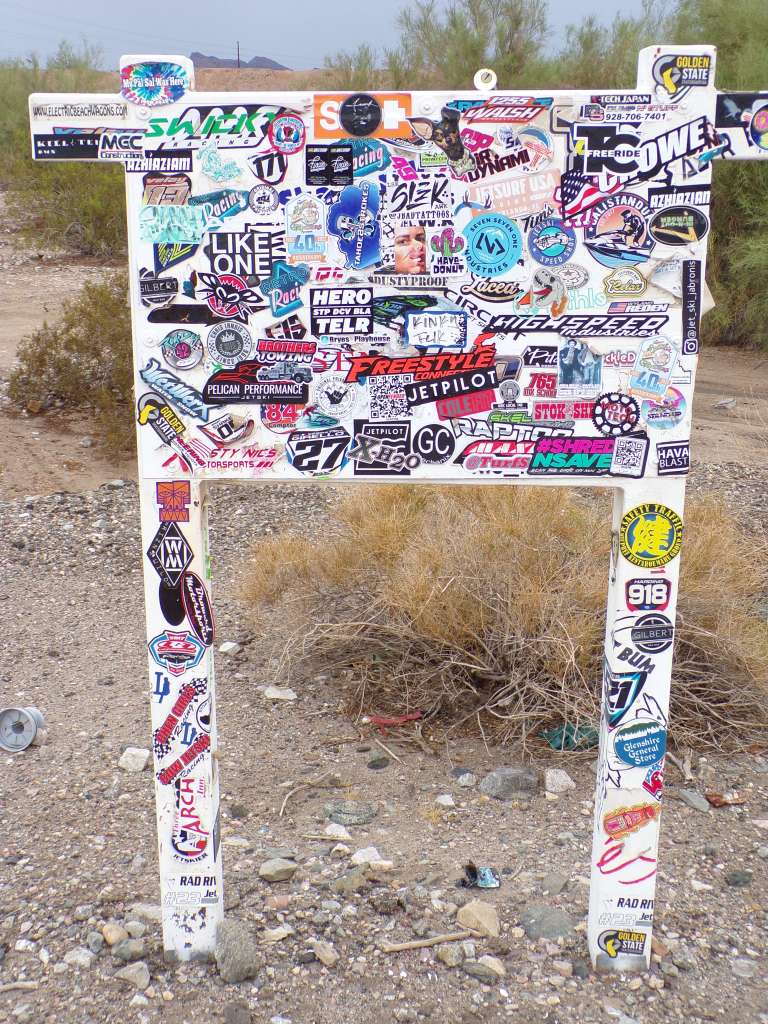
Lake Havasu City does have one unique attraction besides the London Bridge that very few out-of-town visitors even know about, unless they’re jet ski or PWC fans. I’m not sure this enigma even has a name, thus, I simply call the spectacle, “HAVASTICKER,” to go along with my other Hava words, Havaniceday being a favorite.

At the entrance to Body Beach is where Havasticker’s located, and has been for some time. I recall when only a few colorful stickers were on it, but now there’s at least 100.

For the sake of future tourism, and on the same level of honesty as some politician’s use in claiming how many people were in attendance at their last rally, let’s just say for sensationalistic purposes, there are over 1,000 stickers plastered on that billboard.

The Havasticker billboard was originally a wood, handmade sign designating Body Beach, but over time it became a metal bulletin board for PWC manufacturer’s and race teams. There appear to be sticker names on this sign from all over the world, although some might be from Southern California and just look foreign to me; Azhiaziam being one.

Burlington, Vermont, is known for having the largest ball of stickers, and is listed in the “Guinness Book of World Records” for such. I couldn’t find any record for largest collection of stickers on a board—believing we may have the title here in Havasu and don’t even know it.

There’s a need to go even bigger, because that old Body Beach sign is now totally filled. Surely, there’s a construction company in town that could use the significant name recognition on creating a larger one. I’ve thought of doing this myself, but that thought quickly passed after looking at the thermometer, and the price of steel.

What better way for Lake Havasu City to be world renown than having the largest sticker bulletin board located at the gateway to famous Body Beach.

With our attraction being a community project, The World’s Largest Balls of Twine in Cawker City, Kansas, and Darwin, Minnesota, would pale in comparison to Havasticker, and quickly start to unravel where garnering future tourism visitors is concerned.

Largest Ball of Twine – Cawker City, Kansas

THE SAME HERD

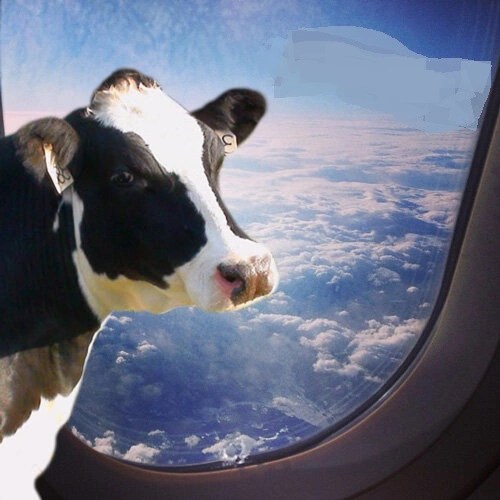
“Years ago, my brother equated passengers boarding airplanes to cattle being herded onto trucks.”

Much like junk mail that’s lucky enough to be sent via airplane instead of by truck, I travel third-class as do most people. That’s always been my mode of travel when flying because of cost. I once flew fourth-class or “cargo status” in a tiny Cherokee Arrow aircraft, sitting on cases of food destined for a rural Alaskan village. There was no seat or seatbelt.

My tail was frigid by the time we arrived—warm flesh becoming well-acquainted with Green Giant brand frozen vegetables before touching down in Flat, Alaska.

A friend tells folks he strictly flies first-class. I once corrected him by saying he actually travels second-class. That upset the fellow and he quickly responded,

“There’s no such thing as second-class!”

I’ve had other friends, family, and acquaintances tell me the same with them all being wrong. By now, you’re probably wondering what is this guy talking about? Keep reading and you’ll see.

I thought I’d flown “first-class” twice in my life, but eventually came to the realization it wasn’t true. The first time I believed this happened was when I transported our Yellow Nape Amazon parrot “Jesse” from Alaska to Arizona.

Alaska Airlines made me purchase a supposed first-class ticket, saying there’d be more room up front where his small traveling cage was concerned. It cost me a few extra dollars to do so but was worth it in the end (pun intended).

The airline should’ve paid me, because Jesse entertained the dozen or so passengers around me from takeoff to landing.

The second time was when a flight attendant politely inquired if I’d mind sitting in the first row. They’d overbooked coach and my seat was needed. Why they picked my carcass I’ll never know. I’m sure it had nothing to do with good looks. Believing that I was flying first-class those two times was actually a misnomer.

Leaning back in my cushy leather seat on that second trip, I was on top of the world. The flight attendant had just brought a steamy hot towel, at the same time, asking what entrée I wanted for dinner—miraculously there was a choice. It was during this second excursion that I “saw the light” regarding what first-class really is.

Glancing around the cabin, I observed what appeared to be business people, yet recognized no celebrities, sports jocks, or politicians. Business folks generally sit up front because of their abundant frequent flier miles and nothing else. Frugal folks like me choose to save a few bucks and join the commoners in back.

On that second, supposed first-class experience—as we waited for a motorized tug to pull the Boeing 747 away from our terminal, I looked out the window spotting something that immediately caught my eye. Several hundred feet away was a red brick, two-story, executive flight facility, with sleek Lear Jets and Cessna Citations parked on the asphalt tarmac in front of it.

“Just one time,” I thought to myself.

As I continued staring, a shiny black limousine rolled up. The driver stopped in front of a short set of stairs connected to one of the executive jets. A man in a suit quickly exited, and then walked to the rear of his limo, opening doors for a middle-aged couple and their two children.

The family looked excited as they boarded their stylish jet. Continuing to stare as the limousine driver unloaded bags, he accepted a tip from what I assumed to be a crew member. That’s when reality slapped me upside the head.

“Now, that’s first-class!”

From that point on, first class on a commercial jet became second-class to me. For those wanting to argue the point, go ahead. Each time I drive by the Lake Havasu City Airport, I generally see a couple of sleek jets parked outside. Without question, this is the ultimate way to fly, and I’m sure the lucky folks owning or leasing these multi-million dollar planes will agree.

Years ago, my brother equated passengers boarding airplanes to cattle being herded onto trucks. That unique thought stuck in my mind and hasn’t let go. On a car show junket several years back, my brother-in-law, Calvin, bellowed like a steer upon entering the cabin. He could imitate this animal sound to perfection. As if rehearsed, another guy standing behind him let out another perfect,

“Mooooooo.”

Several people in line laughed with a flight attendant doing the same. As we slowly moved through the second-class section, not one chuckle came from those folks.

If you were to ask me why, I’d say they didn’t want anyone thinking they came from the same herd!

HAVERTIGO

“My brother, a couple of years later in Lubbock, Texas, coaxed me into riding a mechanical creation called the Tilt-A-Whirl.”

I love it when carnivals come to town. The sweet smell of cotton candy and caramel corn permeating the air takes me back in time. There’s generally a carnival at the Havasu Balloon Festival, and years ago, one came to Lake Havasu City about once a year, setting up on an open lot on Lake Havasu Avenue. I don’t believe it’s been there for some time now.

My family first visited Disneyland in 1957, when there were many more “stress free” attractions for little kids back then. For me, three years old at the time, Disneyland was a large carnival. I liked the Teacups and vintage automobile rides best, avoiding anything beyond that level of excitement.

My late dad’s favorite was a 3-D theatre attraction called: Rocket to the Moon.  This venue was located inside a building which sat opposite a futuristic looking rocket. Ticket holders sat in chairs watching this supposedly realistic movie about a rocket ride to the moon and back. I wouldn’t know—never surviving blastoff. The mere resemblance of motion was enough to turn my stomach inside out. Mom grabbed my sick carcass from a chair just in the nick of time, although someone did have to cleanup the concrete walkway afterwards.

I remember my first carnival roller coaster. It was in Selma, Alabama, either in 1961 or 1962. My brother and I climbed in the front car, and after only a few times around, I was screaming to the top of my lungs wanting out. Mom once again filled me in on the rest. Seeing that I was petrified with fear, she asked the person running this ride to please stop and let me off—which he did. To this day, I’ve refused to get on another roller coaster and never will.

My brother, a couple of years later in Lubbock, Texas, coaxed me into riding a mechanical creation called the Tilt-A-Whirl. He said it wasn’t bad—most likely thinking of scary carnival rides he’d been on before like: The Hammer and The Scrambler. Jim could conquer them all with no problem, including that wild roller coaster in Las Vegas named: High Roller.

Telling myself that I’d be okay that night, I came uncorked before the Tilt-A-Whirl ride ended, sending spray everywhere. I’m sure that wasn’t the first time this happened. From that point on, the only carnival ride I’ve taken part in is a Ferris Wheel. To me, they’re much like a giant swing set and my stomach can handle things with ease.

In 1972, having just graduated from high school, three friends from East High, along with me, late one night went to a small carnival next to the Valu-Mart shopping center. All went well until Jeff, Michelle, and Cathy, decided we needed to ride the Tilt-A Whirl. I wasn’t keen on the idea, remembering the last time I tried such, but didn’t want to come across as being wimpy.

Making it through the whole ordeal without getting sick, I quickly excused myself after getting off, finding a spot behind the generator trailer to hurl. My friends never knew. The next morning around five, noticing my wallet was missing, I drove back to that carnival, checking different Tilt-A-Whirl cars until finding it on the floor of one.

It was probably a good thing, because a former carnival employee told me that after closing, “carnies” have a field day going through all the rides looking for lost change, money, wallets, clutch purses, jewelry, and watches. He mentioned they found others things as well like baggies of pot and coke. This guy said that The Hammer and Scrambler were the worst for robbing people of their earthly goods along with breakfast, lunch, or dinner.

I always wondered why I couldn’t handle extreme rides like other kids, not finding out until age 40 that I have vertigo, along with something called Meniere’s Disease. Without going into a long drawn-out medical explanation, both ailments have something to do with the inner ear. With a carnival slated to return to the Havasu Balloon Festival in 2024, I was prepared to give the Tilt-A-Whirl one last try, just to prove I can master it without getting sick.

After recently reading about a carnival in Canada having one of their Tilt-A-Whirl cars come completely off its circular track when a large pin broke, injuring several people, plans have quickly changed. I’ll still be going to that carnival, riding their Ferris Wheel and eating caramel corn, while pulling sticky cotton candy from my beard and shirt. If there’s a Tilt-A-Whirl, Hammer, or Scrambler at this venue, I’ll give them wide berth while walking past. You see, I don’t want anyone’s spray coming my way.

Rocket to the Moon – Disneyland – 1957

SCHOOL DAZE

“He then quickly walked inside the building and came back out with a pair of small yet puffy boxing gloves.”

I attended public schools for twelve years, those facilities being in Selma, Alabama, Lubbock and San Antonio, Texas—ending things in Anchorage, Alaska. Overall I’d say I got a decent education. Early on, our class would say the Pledge of Allegiance each morning, while at least once a week, all students and teachers walked outside to sing the “Star-Spangled Banner” – this taking place while standing at attention with hands over hearts. The word for such is patriotism.

Disruptive behavior was not tolerated during my school years from 1959 – 1972. Paddling’s were given out for smarting back to a teacher, and as far as I know, no kid was sent to a hospital afterwards. I got my fair share of swats, all of them justly deserved.

While attending grade school at Southside in Selma, I got into a scuffle with another boy on the playground. The man overseeing things that day—I now assume to be a teacher—stopped us from rolling around on the ground as small kids do when they fight. He quickly walked inside the building, coming back out with a pair of small yet puffy boxing gloves.

I know what you’re thinking here, but you can’t make this stuff up. My brother will attest to the truth of it because he was there. The two of us first graders attempted to box, yet within minutes we were tired and ready to call it quits. Those gloves were brought out on more than one occasion, never again for me, but for other boys that didn’t see eye to eye. I doubt anyone ever got seriously hurt while wearing them. Snowflakes would now have that man arrested if this took place, although boxing gloves are much safer than guns in removing pent-up hostilities.

Before I graduated in 1972, a questionnaire was given to students. It asked questions such as: do you believe marijuana should be legalized, and do you think the Vietnam War is justified. The war was just winding down at this time. This questionnaire had three choices: Yes, No, and I’m not sure. I didn’t put two and two together at that time, but they were checking to see how liberal or conservative a graduating student was. I always kept that in the back of my brain.

Several years ago, when Kathy Lee Gifford was a morning talk show host, she mentioned her children quite often. Generally, the praise this Christian mother gave them was for academics or funny things they’d done. Her kids were in private schools, as were the Obama’s, Trump’s, Clinton’s, and other high profile people. That should tell you something.

It was during this time that I came across an article written about the Gifford’s, with forthcoming comments below it most distasteful—some folks skewering her for bragging about her children on television, and then laughing at the woman for husband, Frank Gifford, having an affair.  My late mother told me that some people were born to root against those who are successful in life. She equated it to jealousy.

After seeing that take place with Kathy, I decided to keep my children and grandchildren out of things I write about, that is until here lately, when I started seeing erroneous information coming out regarding school vouchers. I’m a firm believer in school vouchers because I know they work.

My two children went to Christian schools. We had to pay for it as vouchers weren’t available. Not only did we pay, but we still were taxed for public school as well. Joleen and I didn’t complain, and for a while I worked two jobs just to make sure all of the other bills were paid.

Our son, Gunnar, graduated Valedictorian of his class, including being presented with a congressional appointment to the Air Force Academy, where he graduated in 2000. Miranda received scholarships to attend Colorado State University, where she graduated with Magna Cum Laude honors.

Gunnar just retired from the United States Space Force as a Lt. Colonel – with Miranda operating her own business in conjunction with husband Dennis. I’m sure I’ll now be harpooned by my two for doting on them, yet I, like Kathy Gifford, believe that bragging on one’s children is most appropriate, unlike what school psychologists might say. My guess is these self-acclaimed experts on kids don’t even have children of their own.

I want their children, my grandchildren, to attend Christian or private schools, mainly because these educational facilities continue to instill morals and character into youth, discipline, patriotism to their country, and most of all, teach them about Jesus.

If the National Education Administration would stop trying to indoctrinate kids to their liberal way of thinking, like they attempted to do with me during my three years of high school and failed, and if they’d take a cue from private schools on what teaching methods work best, a greater number of students would be academically better prepared once they leave high school.

Vouchers do work and the numbers prove it. If private schools didn’t offer quality education, you can bet your bottom dollar that Bill and Hillary would’ve never sent daughter Chelsea to one!

BEAT THE HEAT

“My experience with heat fatigue came from not being outside, but inside.”

June 29, 1994 Today’s News-Herald

My family was vacationing in Lake Havasu City on, June 28, 1994, when a state record was set for highest temperature. We were staying at the old Holiday Inn on London Bridge Road at that time, now the Hampton Inn.

The wife and kids were hanging out at the pool, although earlier that day we’d rented wave runners for a couple of hours, with the Yamaha I was on ultimately sinking. I’ll save that for another story.

A few years prior to this, Joleen and I purchased the old Lake Havasu Police Department building at 296 London Bridge Road, and on that 128 degree day, I met with the owner of Allstar fencing back then, to see about some fence upgrades on a vacant lot next to the structure.

I can’t remember the gentlemen’s name, but as we stood outside and talked prices, I asked him if a heat record was about to be set as we’d been told by a hotel employee. He paused for a few seconds, looked at the sun, and then spoke,

“Nah, I don’t think so. Once the temp gets over 120 a person can’t really tell anyway!”

The only reason I asked, was that my shoes and feet were getting plenty hot standing on black asphalt. It wasn’t until getting back to Alaska that I looked to see how hot asphalt would’ve been that day. A graph showed between 140 – 150 degrees.

Our biggest problem that trip was that airplanes were delayed getting out of Phoenix because of thin air caused by the heat. We were fortunate in changing schedules to a late night flight. I was more than happy to get back to cooler weather after that experience, although the wife and kids would have gladly stayed.

Since that time, I’ve seen up to 123 degrees on our house thermometer. I’m now wise enough to not stand on asphalt during those warm days, nor outside at all for that matter. My experience with heat fatigue came from not being outside, but inside.

When our Arizona home was finished in 2005, the first thing I did on a two week trip to town was start putting my car lift together. There was no air conditioning in the garage, but I did have a large, useless, portable “swamp cooler.” This was in August and the temperature in that garage at night was barely under 100.

I was close to wrapping things up around midnight, and decided to keep at it as we were leaving early the next morning. By the time I finished tightening the very last bolt, I was wobbly on my feet, having to go inside, strip down, while Joleen sprayed cool water on me. All of this took place as I lay underneath a ceiling fan turned on high.

The next morning, I felt no ill effects after my brush with heat stroke, yet inspecting the lift, I’d mounted the hydraulic pump completely upside down. It was quite evident getting overheated had messed with my clear thinking. I learned a big lesson from both of those trips. These days when it’s above 100, unless it’s absolutely necessary, I avoid working outside. The garage now has A/C so that’s no longer a problem.

This past month, on a daily basis, I observed construction workers toiling away in that Havasu heat. I don’t envy these guys and gals, because over time, it will do irreparable harm to their bodies. They might not think so now, but after several years it’ll start showing up in different places. Just ask any good heart doctor.

For folks not having to work, yet electing to hike, jog, or bike, when it’s way above 100, I suppose they do so in an effort to appear macho. For those unwise people, I figure Havasu heat has already got to their brains.

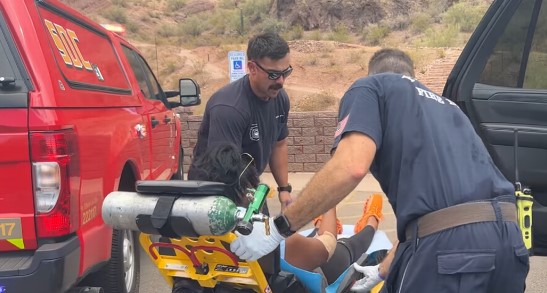
Heat stroke victim

HAVASTOOL

“I’ve never spotted a snow machine on the streets of Lake Havasu City, so there’s a challenge for some brave and adventurous soul.”

Motorized barstool

One thing I like most about Lake Havasu City, is the variety of cool and unusual transportation devices I’ve observed zooming around town on a daily basis. Side-by-side vehicles (SXS) are the most popular, along with Harleys, and tricycle style motorized bikes. On rare occasion, I’ve spotted a vintage 1970s three wheel Honda with large knobby tires destined for offroad use only.

A monowheel, electric-powered gizmo with female rider passed me on McCulloch early one morning— the gal evidently going to work. Was it legal? Who cares! Electric bikes are the latest craze with those folks buzzing around town on them seemingly enjoying the ride.

Lamborghinis, Ferraris, Ford GT40, Porsches, Hellcats, and Corvettes up the ying yang are a common sight, especially on weekends. Muscle cars, lifted trucks, deuce coupes, and hot rods, are as common as pontoon boats on our lake.

Driving down Highway 95 one afternoon I saw an older style speedboat converted into an automobile. Spotted it just as this craft drove by the other direction—with my wife missing out. When I told her she was skeptical, that is, until viewing a photo on Facebook that someone thankfully snapped.

A realtor here in town, Dean Baker, owns an Amphicar. This vehicle, unlike the rolling boat that I saw, was manufactured in West Germany from 1961 until 1968. I’m sure Dean has had his in the lake a time or two.

At one point Segway stand up scooters were seen quite often riding on city sidewalks. I believe there was even a place in town that rented them. Unfortunately or fortunately depending on how you look at it, Segway has discontinued production. They’ve went the way of the Edsel automobile.

Inline rollerblades or skates appeared to be going the same direction as Segway, because they’re rarely observed anymore unlike twenty years ago. In an article I just read on them, the writer said that they’re having a resurgence in, Great Britain, so most likely the same will happen here. I owned a pair when younger, but never used them on neighborhood streets unlike some of my friends. “Bicycle trails” as they were called back then worked best for me because I fell quite often.

Two wheeled electric-powered and foot-powered scooters are still alive and well, looking to be here well into the future, along with skateboards. They’re seen more often in neighborhoods and not main throughfares, although on occasion some daredevil will give it an unsafe try.

When I lived in Anchorage, Alaska, the Harley Davidson motorcycle shop was located directly across the street from us. I’m talking late 1960s here. David “Pappy” Burns owned the place and he also sold Scorpion snowmobiles. Pappy’s two boys mounted wheels to the skis of one Scorpion, driving it up and down Muldoon Road a few times during summer, just because they could get away with such. Highly doubtful they could these days.

I’ve never spotted a snow machine on the streets of Lake Havasu City, so there’s a challenge for some brave and adventurous soul. As long as the machine’s registered with plates and having all required lights, I believe this would even be legal. This is a feat I’d love to do myself, but have already been told no by higher powers.

Another sight I haven’t come across is a motorized barstool rolling down the road. I hear there are some out there, being told a fellow in town has a fast one parked in his garage. Would love to see that stool zipping up and down McCulloch Boulevard during our Thursday night car show. Perhaps even have the inaugural “Havastool 500” staged there each year. Those things should be able to go 500 feet no problem as long as the driver’s sober. Helmets and safety gear required!

Better yet, mount a barstool on a paddle board and take it to the lake. A pair of barstools on connected boards sitting in front of the London Bridge, with Dean Baker towing them with his Amphicar, would definitely make for a photo worthy of local and national attention. Game on!

Segway standup scooter – RIP

GET REALE

“Some misinformed folks still believe that two bits is only worth a quarter.”

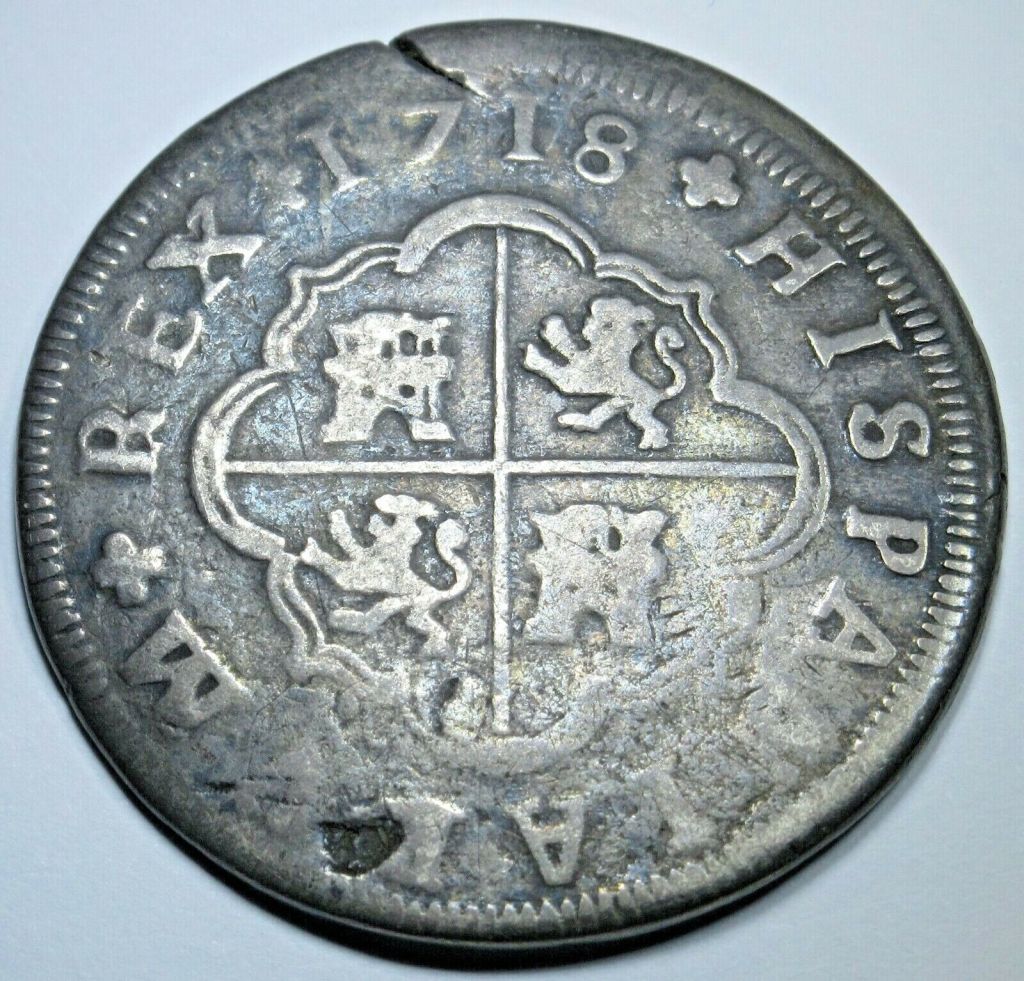
1718 Spanish Reale – one ounce of silver

rough draft – unedited – unfinished

I spent very little time at Rotary Park over the Fourth of July, finding it much quieter, cooler, and safer in my garage. My wife and I did go down for an hour on the third, watching a fellow scuba dive with a metal detector along the shore. Afterwards, he took off his scuba gear and did a little dry sand searching.

Joleen and I have done our share of metal detecting over the years, finding loose change in various areas of town, including WWII 50-caliber bullets and brass cartridges in Standard Wash. We finally ended up with enough change for a raspberry mocha at The Human Bean and found enough lead and brass to fill a toolbox drawer.

I’ve been a coin collector going way back. My grandfather got my brother and I hooked by giving us a couple of real silver dollars. From that point on we were on our own.

In Lubbock, Texas, Jim and I would buy ten rolls of pennies at a bank and go through them looking for wheat pennies, always hoping we’d end up with an Indian head. That never happened and we went through several hundred rolls. I did find one in the backseat of an old car at a wrecking yard in Texas, giving it to a friend, who’s dad owned the salvage yard.

My brother-in-law discovered an 1899 Indian head penny stuck inside an antique door lock on their old farmhouse in Kansas. Some kid evidently slipped it into the large keyhole years ago, with the coin dropping to the bottom and there it sat for almost one hundred years.

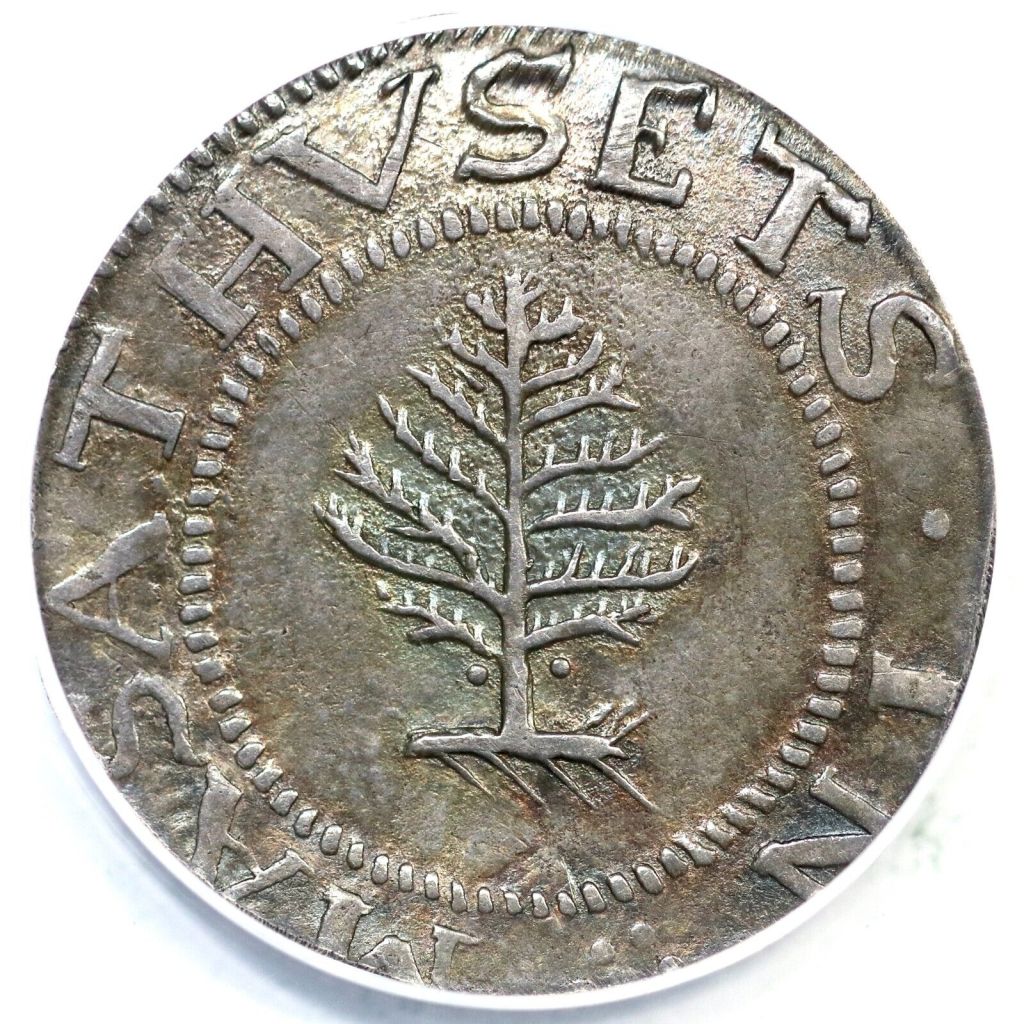
In a Hardy Boys mystery series book I read years ago, there was mention of Pine Tree shillings and pieces of eight being uncovered by Frank and Joe Hardy. I have an authentic piece of eight, but the Pine Tree shilling is a replica that I purchased. An original Massachusetts Pine tree shilling is quite rare and expensive.

Authentic 1652 Pine Tree shilling

Before the United States mint started producing coins, residents used Spanish “Reale” coins. A whole, one ounce, silver Reale was worth one dollar, yet if it was cut eight equal parts, each “piece of eight,” one bit was worth twelve and a half cents. It took eight bits back then to equal a dollar. This value remained in effect up until 1963, when bulk silver finally traded for over one dollar an ounce. At that point a bit increased along with it.

The American colonies produced their own coinage early on, before the US mint started producing silver dollars and lesser denominations made of pure silver in 1796, ceasing production in 1935, this when the “Gold Act” was enacted. I’ve been able to score a Liberty Bust 1799 silver dollar, but never one of the first minted dollars as they’re quite spendy.

My old East Anchorage Highschool cheer, “Two bits, four bits, six bits, a dollar, all for East High stand up and holler!” no longer holds water, even in 1972, with silver worth over two dollars an ounce the latter part of that year. When I graduated, two bits of silver was worth precisely fifty cents if a person wants to count brass tacks.

This catchy slogan was first used in the 1700s, when two bits was worth twenty-five cents. With silver now hovering around twenty-three dollars an ounce, one bit is equal to approximately two dollars and nineteen cents, with two bits double that amount. Some misinformed folks still believe that two bits of silver is only worth a quarter. Those that do are living in the past and I’ll take all the bits have for that price.

In 1965, pure silver coins were eliminated from circulation in the US, and replaced with what is called clad coins. These bi-metal coins have less valuable materials inside such as copper and nickel. Those are the type coins Joleen and I always find. I call it junk money, because there’s limited value where precious metal is concerned, yet it still buys a good cup of coffee.

Before I depart this life I’d love to have a real Pine Tree shilling. It’s doubtful I’ll find a bag of them like the fictitious Hardy Boys did, so the replica I purchased for four bits will have to suffice. When I say four bits here, I’m not talking fifty cents. I paid a little under twelve bucks for it. Chalk this increase in the value of silver bits up to inflation.

If they want to be totally accurate, students attending high school these days should be singing out at pep rally’s and games: Two bits, four bits, six bits, twenty-three dollars, all for (fill in the blank with your school)________ stand up and holler.

Piece of eight or eight bits – one ounce of silver divided eight ways