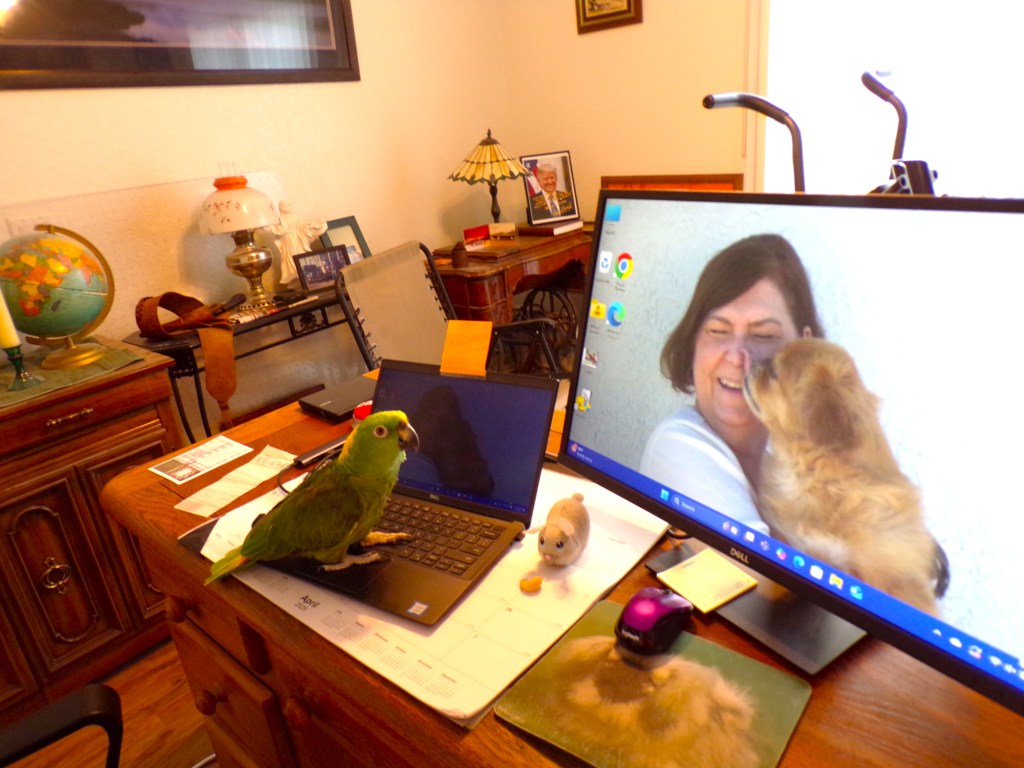
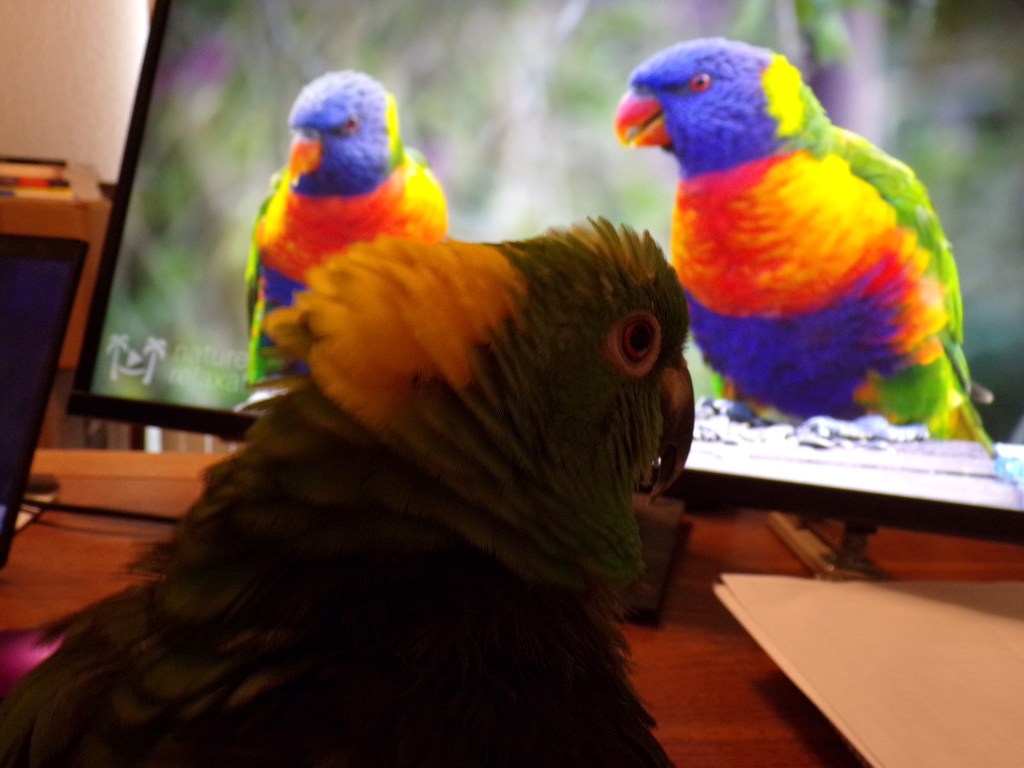
“The children seem to enjoy my reading, but are more thrilled when Jess the parrot makes an appearance.”
Jess
I bump into more Spanish-speaking people in Arizona than I did in Alaska or Alabama. Texas was a totally different story. Not learning the language is something I always regret.
Oh, I tried in 5th grade, but never could master anything beyond simple greetings, such as “Buenos días” and “Gracias”. For some strange reason, I always remembered, “En la bibliotheca.” That means, “In the library.”
My teacher had a meeting with Mom to try to figure out how to help me improve. That consisted of using a tape recorder at home and listening to Spanish drills before going to bed. All that constant talking put me fast to sleep, and ultimately I flunked the course.
My grandchildren have attended Spanish immersion classes in Minnesota, and they’re doing quite well. Each winter, while school is in session, I’ve appeared on a live telecast from one of their classrooms, where I read a favorite book of theirs, then they ask questions. I try to add a few Spanish words to my presentation, but my vocabulary is limited. Olá is a recent addition, meaning ‘hello’.
The children seem to enjoy my reading, but are more thrilled when Jess the parrot makes an appearance. Decker, Reece, and Mykah’s Spanish instructor says that the kids talk more about Jess and his ability to mimic words than anything else. They believe he’s actually chatting with them.
“Aloha” is one of the words he especially likes, along with pretty bird, tired bird, bad bird, want to go nighty night, want some, what, okay, and several others. If there’s one Spanish word I’d like him to pick up, it’s olá, although he now says hello with perfection.
I’m trying to learn more words to help me in the podcast, if you can call it that. I’d especially like to understand Spanish conversations going on in my presence, wanting to eavesdrop. The two words I especially listen for, as young people look at me while talking, are Viejo chocho, meaning old fart.
If parrots are able to easily mimic words and sounds, why didn’t the tape recorder trick work for me so many years ago? Perhaps it would now, as long as I turn up the volume.
Evelyn Woodhead offers a speed-reading class, or at least Cheech & Chong claims they do. I learned that listening to one of their 8-track tapes back in the 70s. There must be a similar course in Spanish.
My goal here is not so much to speak fluent Spanish as I’m way too far down life’s trail for that. If I can just stumble my way through simple conversations with the grandkids, I’d be thrilled. If they see I’m trying, I’m sure they’ll empathize with grandpa’s attempt.
Should they not, as long as I don’t hear Viejo chocho jokingly whispered behind my back as I walk away, I’ll be just fine.
“A postcard sent from Fort Riley on July 20, 1942, turned out to have great historical significance.”
FORT RILEY, KANSAS
During World War II, Fort Riley served as a major training and mobilization center for the United States Army. Thousands of soldiers passed through its gates, preparing for deployment overseas. The fort was home to several divisions and specialized units, and its facilities were expanded to accommodate the surge in personnel and activity.
Fort Riley was also notable for its contributions to military innovation and leadership, with many officers and enlisted men receiving advanced training. The base fostered a sense of community among soldiers and their families, despite wartime challenges. Its strategic location and resources made Fort Riley a key asset in the nation’s WWII efforts.
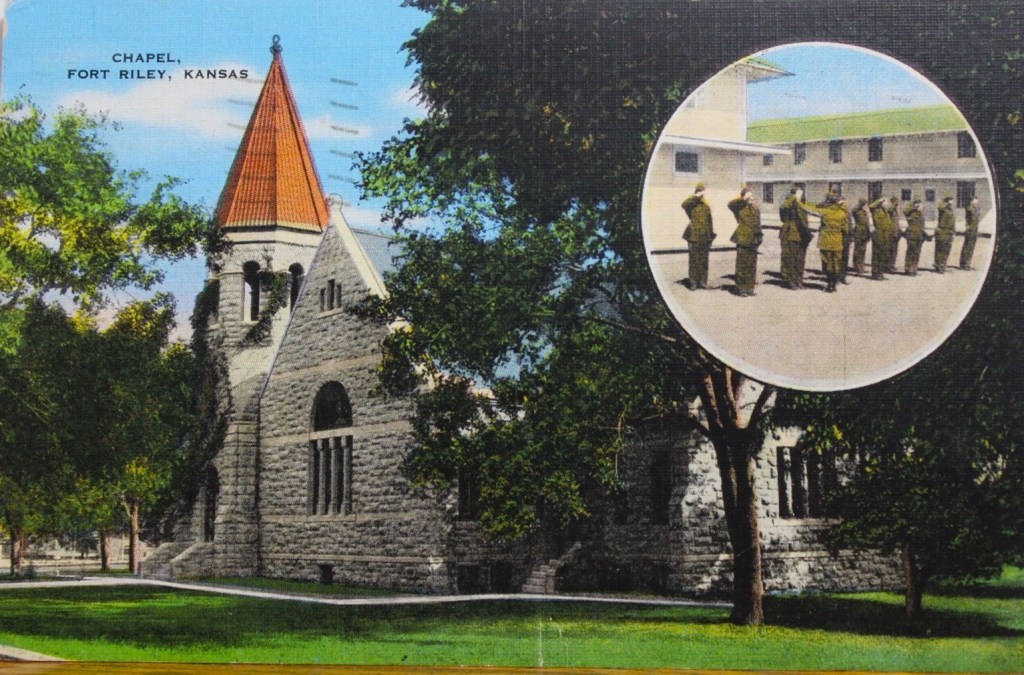
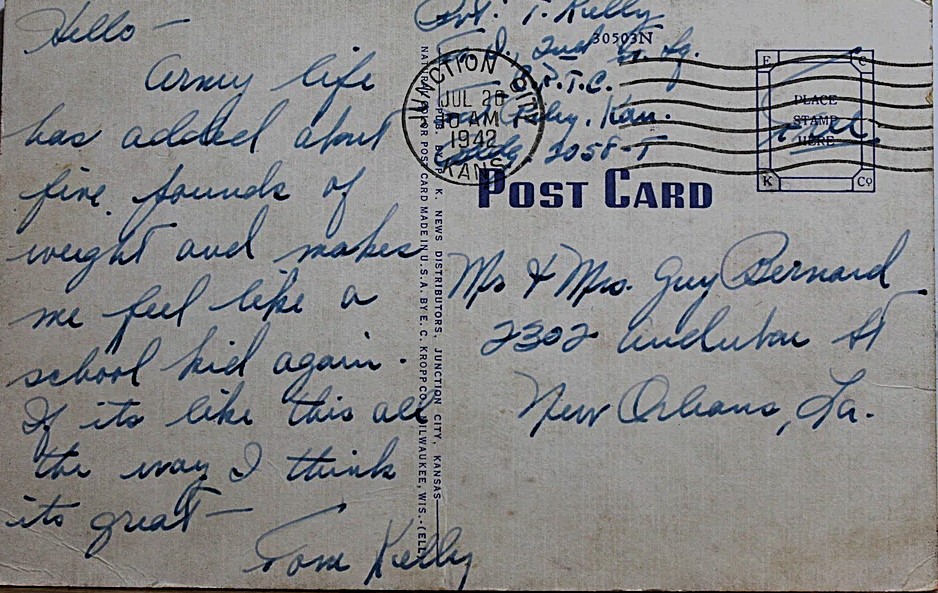
A postcard sent from Fort Riley on July 20, 1942, turned out to have great historical significance. Junction City, Kansas, is the town closest to Fort Riley, and is where the picture postcard was postmarked. A photo on the front shows the Fort Riley Chapel and some soldiers standing at attention.
The nicely penned message within, sent by Tom Kelly to Mr. and Mrs. Guy Bernard in New Orleans, Louisiana, offers a bit of insight into what the new recruit was going through. Unlike some soldiers who were unhappy, Tom was just the opposite
“Hello – Army life has added about five pounds of weight and made me feel like a school kid again. If its like this all the way I think its great. – Tom Kelly”
In the upper right-hand corner is Kelly’s rank and the Army company and unit he was with. It appears he enlisted as a private, but with four years of college, he was quickly moved up to 1st Lieutenant. This was quite common at the outbreak of the war.
The postcard recipients, Guy Bernard and his wife, undoubtedly meant something special to the soldier for Tom to write them. Guy Bernard was a music teacher, with Thomas Kelly evidently one of his students.
Thomas W. Kelly Jr. attended Loyola University, majoring in music. He went by the nickname “Tom” to friends. Archived newspapers show that he played the trumpet and was involved in numerous college musical presentations.
Prior to enlisting, Tom had been briefly married to Elva Cullen, but sadly, she divorced him before he left for war. Part of Kelly’s training took place at Camp Ibis in California, a mere 60 miles from where I live. Camp Ibis now exists only as a ghost base, with some building foundations still remaining. General George Patton was the head of Kelly’s 4th Armor Division.
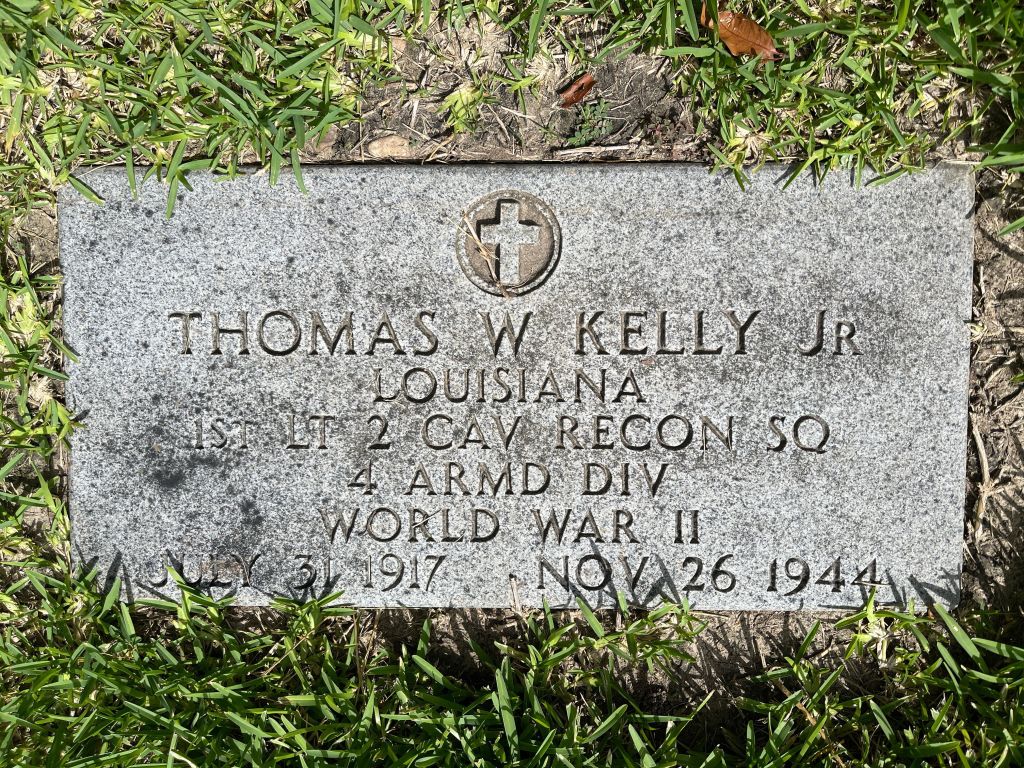
Tragically, 1st Lieutenant Thomas W. Kelly, born on July 31, 1917, was killed in action during the Battle of Normandy on November 25, 1944, at the age of 26. He was initially laid to rest in France, with his remains eventually returned to the States and reburied in Texas, most likely at the request of his parents. I would label him a hero.
Records show that his ex-wife, Elva, who was remarried at that time, tried to apply for military death benefits from her late ex-husband. It does not appear that she was successful.
Lt. Kelly was posthumously awarded the Purple Heart, the American Campaign Medal (Europe/Africa), and the WWII Victory Medal (Middle East). A cross atop his tombstone indicates he was a Christian.
The postcard recipient, Guy Frank Bernard, was born May 21, 1905. His wife’s name was Henrietta, although she went by Nettie. Mrs. Bernard was from Texas. Guy Bernard remained a music instructor up until his retirement. Guy died on March 12, 1982, while Nettie passed away on May 14, 1985.
Tom Kelly’s postcard, mailed to the couple 84 years ago, must’ve meant something special to them—for it to have survived!
“The other night at home, Joleen and I were watching a movie when I heard the unmistakable sound of nails being clipped.”
A pet peeve is a particular behavior, habit, or occurrence that someone finds especially annoying or irritating, even if it might not bother others. These are often minor frustrations that can trigger disproportionate reactions in certain individuals.
Some common pet peeves are loud chewing or slurping, people who interrupt others mid-conversation, leaving dirty dishes in the sink, talking during movies, slow walkers blocking the sidewalk, not using turn signals while driving, using a phone during meals, leaving lights on in empty rooms, not replacing the toilet paper roll, and people who show up late.
While these are some of the most common pet peeves, everyone has their own unique list of things that bother them. Before I go into mine, I decided to research uncommon pet peeves, figuring there had to be some real doozies out there. This is what I found:
People who use excessive punctuation in texts, when someone moves your belongings slightly out of place, finding a tiny sticker left on fruit after peeling or slicing, when socks are mismatched or twisted inside shoes, group text messages where the conversation spirals off-topic, plastic packaging that’s difficult to open, unnecessary background noise in videos or audio recordings, people who walk slowly in the fast lane of a grocery store, when someone leaves a tiny bit of food or drink in a container and puts it back in the fridge, receiving flyers or advertisements tucked under windshield wipers.
I’m happy to report that none of these uncommon pet peeves are mine, because I’m guilty of creating a good number of them. Does anyone really care if socks are mismatched? The Stevie Wonder and Paul McCartney song, “Ebony and Ivory,” comes to mind here. Some of you will get it.
On the common list, drivers not using turn signals is a pet peeve, along with dirty dishes in the sink. That’s about it for me. I can think of a couple of others that weren’t mentioned on either list.
Going to car shows and hearing someone tear down another person’s ride is a pet peeve. I always think back to my days in school, when some kid was critical of another, only because they had low self-esteem and were trying to build it up at the expense of another. It’s a psychology thing.
My top pet peeve, and one that hasn’t happened for some time, is hearing someone cut their nails during church service. I’m talking fingernails here. In Anchorage, we always sat in the front row on the balcony. Perched up there, I could perfectly hear the music and preaching, yet also catch any oddities that happened along.
Watching someone being fast asleep in the pew while others stood to sing was quite common. It was generally the children and the older people who failed to rise. That’s understandable.
It’s amazing from up high, the bald spots folks had that weren’t visible at ground level. That’s one reason alone I didn’t sit down below. Getting back to the nail cutting. “Snip, snip, snip” for whatever reason bothered me more than anything. Once this noise began, my radar instantly began to pinpoint the location.
One might think it’s easy to find the culprit, but it wasn’t. Most were sly, quickly clipping a nail and then hiding the clippers. Several seconds later, and they’d snip another. Silver clippers were much easier to spot than black ones, which were next to impossible.
Not once did I find a man cutting his nails with it always being females; age not part of the equation. Once spotted, there was nothing I could do other than burn a hole through their head with my laser eyes. That still didn’t keep them from clipping.
Our pastor was good at finding congregation abnormalities while preaching, such as stopping his sermon in mid-sentence to ask someone to cease talking, or to get off their electronic device, but not once did he catch a nail cutting in progress.
Oh, I could’ve told him after church who was doing the snipping, but what good would it do me at that point? I’d merely be labeled a snitch by the person I snitched on. These days I don’t sit on the balcony, so it’s no problem.
The other night at home, Joleen and I were watching a movie when I heard the unmistakable sound of nails being clipped. Looking over at my wife—I saw that one of her hands grasped a cup of coffee—so I knew it couldn’t be her.
We have two parrots, Jess and Aldo, who’ve been with us going on 40 years now. Jess is very good at mimicking sounds, and he coughs exactly as we do when we’re sick. Our Yellow-naped Amazon thinks it’s funny.
Evidently, he’s now able to mimic the sound of fingernails being trimmed, which annoys me more than anything. Joleen believes that he’s merely rubbing his beak sections together, and it isn’t intentional. I don’t know this for sure, with Jess not saying.
The only thing I can do to drown out the noise is turn up the television volume. Last Saturday during Supercross, the volume number was 35, and that still wasn’t high enough. “Click, click, click,” came through loud and clear.
At volume 40, the television speaker sounded as if it were about to blow—with our neighbors undoubtedly hearing the motorcycle race announced word for word. Finally giving up, I had Joleen turn things back down.
At this point, I did as I’d seen so many old men do in church over the years, I fell asleep. When I awoke, the race was over, with Joleen telling me that Eli Tomac had won. That’s all I needed to know.
As my wife covered our birds up, Jess had one last thing to say, “Ready to go nighty night?” How could anyone stay upset with a pet peeve like that?
“On New Year’s and Fourth of July, and any holiday in between, Troy could be counted on to send up commercial-grade fireworks.”
On occasion, I run into someone who likes my weekly articles, and the same goes for those who do not. Thankfully, the likes outnumber the nots at this stage. When I first started writing, a neighbor, Troy Hunt, walked down to tell me that he enjoyed the column. He became my #1 fan.
Troy was pals with two friends of mine from Alaska, Don and Mike Lowe. The two brothers lived directly across the street from Troy. My late father’s first name is Troy; Troy Hunt is the second person I know with this name.
I took a liking to Hunt because he was a personable individual, mischievous in a good way, and ornery at times. One summer, Troy hurt his foot and could hardly get around, with a friend lending him one of those battery-powered mobile carts.
A talented mechanic, Troy somehow hot-rodded the device, and it was common to see him zipping up the street, then across 95 to a convenience store. I believe he even drove it to Bashas on occasion.
On New Year’s and Fourth of July, and any holiday in between, Troy could be counted on to send up commercial-grade fireworks. The brilliant display illuminated the desert around us, but also scared the neighborhood dogs. I discussed this with Troy, who excitedly told me that he loved fireworks. During my intervention, he agreed to curtail things for the dogs.
Months would go by, and out of the blue, the house would shake, with another impromptu missile launched late at night or in the wee hours of the morning. Things would then go quiet, with me suspecting Troy was the culprit but never able to prove it. This went on for perhaps three years until Troy Hunt decided to move.
On that moving day, he came to the house and apologized for being such a nuisance, and admitted to the mysterious fireworks. I told him that I accepted his apology, but I wasn’t so sure about the area canines, including ours, Simon.
I ran into Troy on occasion, usually at a store, and he always mentioned the Sunday column and urged me to keep it up. I needed that praise because I wasn’t sure if I was doing a good enough job, with my wife being the main person critiquing things, and she could be considered biased.
Don and Mike Lowe have since passed away. Regency Drive has lost a slew of others, some friends, some acquaintances. Several of them voluntarily moved, like Troy, but a couple of neighbors have died, such as Robert English, Nick Vidas, and his wife, Diane. Our neighborhood is still a great place to live with many good folks moving in, yet it’s also not the same.
Last week, I mentioned to my wife, while we were at Rotary Park enjoying a cup of coffee, that it’d been a while since we’d bumped into Troy. I couldn’t imagine him leaving because I knew that he loved this town.
Today, we received word from a good friend of his that Troy passed away, believed to be from a heart attack. Only in his middle 50s, the man was much too young for that. Lynn told us that Troy had been regularly attending church with her for the past year, which I was glad to hear.
I knew that he hadn’t left Calvary on either Saturday or Sunday, without Pastor Chad, Pastor Robert, Pastor Derrell, or Pastor Peter showing him how to reach Heaven through the saving grace of Jesus Christ.
Hopefully, Troy made that life change decision and is now in a better place. I also have to wonder if Heaven will have a fireworks display like that spectacular one seen at Sara Park just recently. If so, I believe my late friend Troy Hunt will be leading it all.
“I believe a 1962 Pontiac station wagon with bad ball joints feels about the same pain—as that of a 64 year old man with bad hips.”
The phrase “grin and bear it” means to endure an unpleasant situation with good humor, without complaint. It suggests facing something difficult or uncomfortable with patience and a positive attitude, even if it’s not enjoyable.
Old age to me is something difficult and uncomfortable, and I’ve learned to grin and bear it over time. Several years ago, before he retired, my wife had me ask Dr. Thomas Wrona why I was beginning to feel so tired with aches and pains seemingly everywhere.
With a smirk on his face, the good doctor looked at me and answered. “It’s called old age, Mike. Get used to it because things won’t get better!”
As a former mechanic, I knew this and had told her that, yet Joleen didn’t like my self-prescribed analysis; she wanted a professional one. My experience working on many older vehicles during my career is the basis for my grassroots comparison.
I believe a 1962 Pontiac station wagon with bad ball joints feels about the same pain—as that of a 64 year old man with bad hips. I say this because I know someone who has undergone hip replacement surgery, and they were in great agony beforehand. Unfortunately, cars cannot express their torment as humans do, so we can only assume they feel the same.
Right now, my ankles, both elbows, and shins hurt. Thankfully, Dr. Ace Taminophen is on call 24 hours a day. Most folks know him as Dr. Ty, or Dr. Tylenol. A couple of his 500-milligram gel tablets seem to work best. I take them at bedtime so I can sleep.
Older people often feel more pain as they age due to a combination of factors. As the body ages, joints and tissues can wear down, leading to conditions like arthritis and reduced flexibility. Additionally, the body’s ability to repair itself slows, making it harder to recover from injuries or strain. These physical changes, along with reduced muscle mass and bone density, contribute to increased aches and pains.
Furthermore, inflammation tends to increase with age, making everyday movements feel more uncomfortable. Chronic health conditions, such as diabetes or heart disease, may also play a role in amplifying pain and discomfort. All of these factors together explain why many older adults like myself experience more frequent or intense pain as the years go by.
I recall reading about someone years ago looking for a fountain of youth. If there is such a place, I’d definitely take a long drive to investigate. It didn’t take me long to find information on this.
The legend of the fountain of youth is often linked to the Spanish explorer Juan Ponce de León. In the early 1500s, Ponce de León sailed to what is now Florida, with stories claiming he was seeking a magical spring that would restore youth and vitality to anyone who drank its waters. While there is little historical evidence that Ponce de León actually sought the fountain, the tale persists as a symbol of humanity’s desire to reverse aging and find eternal youth.
This myth has become a cultural touchstone, representing the hope and pursuit of ways to ease or escape the discomforts of growing old—much like the aches and pains I experience as I age. The story reminds us that even centuries ago, people dreamed of solutions to the challenges of growing older.
Unfortunately, it turns out the fountain of youth is on the same level as the fake news we’re now seeing on TV. Getting back to Dr. Wrona and his advice to get used to the aches and pain, I’m getting there. I’ll take both extremities over that of being permanently laid up in a hospital bed or an assisted living facility.
Walking my usual path at Rotary Park this morning, finally getting back to the truck, I was achy and sore. While resting and rehydrating, a familiar thought popped into my head. “Grin and bear it, Mike, things don’t get any better than this!”
At that point, I could’ve cried, but chuckled instead. That’s what we seniors need to do if we’re going to make it through the day, along with having a case of Tylenol, of course.
I recall my mother watching the soap opera “General Hospital” on a rare day off. Mom worked in a hospital, so I assume that’s the reason why. I was never one to watch soap operas, as I’d imagine most guys don’t—unless they’re closet viewers. Life has enough drama of its own without adding to it through television entertainment.
When my wife and I moved to Arizona, one of the main reasons was to escape the drama that was continually coming our way in Alaska, no fault of our own. Anchorage was rapidly deteriorating under leftist Democrat leadership, like so many big cities across the US. The time was ripe to move elsewhere.
Our Anchorage church had its own drama: primarily, competition for recognition among select members, and I believe most large churches still do. It’s a given that some people love the spotlight, but churches shouldn’t be a place to try to outshine others.
That didn’t keep us from going. It seems any large body of people has drama, such as PTA meetings, sports events, and even the Democratic National Convention. Drama, in a way, is purely human nature.
A few in our flock felt compelled to publicly proclaim they were doing well financially. For the most part, I could overlook this, since I was there for one reason—to soak up the message. Our pastor was good at preaching, so the distractions were overcome.
The friends I had and still do never flaunted their excesses, although most, if not all, did much better than we did. I was just, Mike to them, a faithful friend. Competition amongst the stuff we owned or were still paying for never entered the picture. It was all junk to me and still is. None of us takes our worldly treasures to Heaven.
There was no trying to outdo the Joneses in my life format, taking what came to Joleen and me with gratitude, no matter what it was. There were many times we made do with others’ discarded things. I was pretty good at fixing broken items that people tossed away, a bicycle comes to mind.
Drama in someone’s life typically refers to situations filled with heightened emotions, conflicts, or unexpected events that cause stress or excitement. It can involve arguments, misunderstandings, or challenges that disrupt normal routines and require attention or resolution.
Sometimes, drama arises from interactions with others, while at other times, it stems from personal struggles or circumstances. Some automatically attempt to lasso others into their drama. It’s best to steer clear here or totally escape the surroundings.
The Bible advocates for a life of “no drama,” urging believers to pursue a quiet life (1 Thessalonians 4:11).
I try my best to follow that Biblical rule and have been somewhat successful these past few years. Part of that has to do with not allowing drama to become a monkey on my back here in Havasu. Should any of this unwanted stress attempt to catch a ride, I’ll loudly say to myself, “Stop, drop, and roll.”
“I’ve recently had requests from some small businesses to advertise on my site.”
I try to read as much as I can, even though my eyes aren’t what they used to be. I’d much rather read for myself what an article says rather than have someone tell me. Lately, on social media and online media sites, I’ll be reading when, out of the blue, a pop-up comes along, generally in the form of an advertisement.
After so many of them, I give up and stop. I know businesses and other entities are paying the host site for these ads. The longer a reader stays glued to an article, the more money is made by someone. Online newspapers use this as a revenue generator, and I have no opposition to that. They have to be financially savvy these days to pay employees and stay afloat.
I’ve been a blog writer for many years and watched readership numbers grow. On February 5 of this year, I set a record. A total of 547 people from 14 countries read my junk that day. This might not seem like much, but there were days not long ago when as few as three took a peek—some days not a one.
I’ve recently had requests from small businesses to advertise on my site. For each viewer seeing their ad, I’d get something, generally pennies. Over time, they can add up. YouTube works much like this, and some YouTubers have made boatloads of cash.
I turned down these requests because I want my message read, not just to make money. There’s no doubt that viewing numbers would start sinking if I gave in to allowing advertising on my blog, so it’s not going to happen.
Over the years, I’ve garnered income from articles and books, but that wasn’t the reason I wrote them. Getting my message across is foremost. Lately, that has been telling folks that Jesus is the only way to heaven, and that fiscal conservativeness is the key to a country staying solvent. To profit from spreading this truth runs counter to my principles.
I know some people who believe Buddha is the way to eternity, or through a Chinese monk, but they’re headed down the wrong path. The Bible warns against false religions; Buddhism, Hinduism, Scientology, Islam, and Humanism are prime examples.
Humanists are those who believe ‘education’ will lead them to the promised land. They also believe that all religions worship the same god. How wrong they are. There are many humanists in politics these days.
Matthew 24:24 says, “For false christs and false prophets will arise and perform great signs and wonders, so as to lead astray, if possible, even the elect.”
My interpretation of the word elect here is “educated folks” in our world. Many of them seem more in tune with wrongly worshipping stone idols than Jesus Christ. This is where their intelligence has failed them.
I’ll keep writing my blog, although at times I’ve thought of quitting. So much more could be done in and around our house, or in the garage, than sitting behind this laptop computer.
One plus of keeping at it is that I’m learning more about the Bible by researching verses for a story than at any other period of my life. That makes this task much more constructive than painting the living room walls or working on my old truck.
“I see these folks acting in their own movie, titled, “Deluded Dissidents.”
I watched a video the other day of a protest in Prescott, Arizona. Mostly older people were walking slowly along the sidewalk, holding signs expressing their beliefs. Some folks were against ICE, while others held signs whose meaning was unclear to me.
One of those strange messages read: Dismantle White Supremacy. When an “Eye On Prescott” news reporter, Tony Hamer, asked the man holding it if he was white, of which the guy was, and then inquired if he was supreme, the protestor would only say, “I am educated.”
When Tony said he, too, had been educated and pressed this demonstrator for the name of the school he attended, the fellow wouldn’t answer. For the record, Tony Hamer studied at Purdue, a most prestigious university according to Google and other search engines. Despite his education in a liberal institution, Tony seems to have seen the light, according to his biography.
A woman was then asked by the reporter why she was protesting, with her response being that it dealt with illegal immigrants detained and deported in Minneapolis, and two protestors killed while interfering with ICE arrests.
This lady came across as dedicated to her cause, educated, and very sincere in her beliefs. When she ignorantly associated voters of Donald Trump with cult members, I had to shake my head. Make America Great Again was referenced by her as the motto fueling those “Trump cultists.”
Once again, here was someone not up to speed intellectually on what was happening in Minnesota, and most likely a fake-news watcher and believer. For those who can’t afford cable, fake news is about all they get. That came across quite clearly, as I’ve watched similar protesters quoting erroneous news data.
Comparing people like me, who voted for Donald Trump to Hitler followers, is about as disgusting as it gets. I actually voted for the Republican platform, not so much Trump, realizing, though, that he’d follow through on many of the things this country needed.
The Republican platform called for closing all US borders to illegal aliens, deporting those illegals having committed crimes, increase election integrity through voter identification, increasing tariffs on countries unequally stiffing us with high tariffs such as Canada, protecting our religious freedom, protecting freedom of speech, protecting the lives of innocent babies, build a stronger military, eliminate DEI and WOKE policies in the military and schools, eliminate the left leaning Department of Education, enable more products to be made in the USA, and the list goes on.
The Democratic platform “appears” to be the opposite, even though they never advertise exactly what it is. All that this party can do is complain about President Donald Trump 24 hours a day, like a broken record. This woman was one of the group, following other demonstrators like a herd of thirsty cattle, all believing they were righteous in their different causes.
I looked on Google to see what the secular world considers a cult, with a lengthy definition popping up. I know that Google leans left, so it fits perfectly with liberal global ideology on other sites. This is the core message from that long definition.
“A cult is a group or movement characterized by a shared commitment to a usually extreme set of beliefs or practices. Members often follow a charismatic leader and may be encouraged to separate themselves from mainstream society. Cults can vary widely in their structure, teachings, and the degree of control they exert over members.”
I’m a follower of Jesus Christ, and if you apply the worldly viewpoint on what a cult member is, churchgoers could easily fit within their guidelines. The Bible prophesies that those people in alignment with Jesus’ teachings will soon be persecuted for such, and we’re seeing that right now.
I took that secular description of cult members and aimed it directly at the woman in Prescott, so critical of Donald Trump and his voters. The Bible teaches to not follow or conform to the ways of the world. Romans 12:2, paraphrased, says, “Do not transform to the pattern of this world.”
It appears to me that this is exactly what many of this raucous crowd are doing. Much like the late actor, James Dean, who starred in the film “Rebel Without a Cause,” I see these folks acting in their own movie, titled “Deluded Dissidents.”
I asked myself, where will this protesting all end, or will it? Trump, called a king by so many misinformed Democrats, will be out of office in another three years. If Donald Trump were a real king, he’d stay in power well past that point. The law makes it impossible for him to do so.
In 2028, when J.D. Vance takes office, this group will once again be roaming the streets and sidewalks, mostly in blue cities, whining and complaining like they always do. They’ll eventually label Vance a king after he wins a second term, and those who voted for him, members of a cult. You can bank on it.
Me, I’ll be 82 at that point, if I’m still alive. And if not, I’ll be living with The King of Kings, and that isn’t Donald Trump. Hopefully, many of these protestors eventually see the light themselves and don’t let their “education” get in the way, as it has so many!
“It’s a traditional style rooted in legal writing that aims to avoid confusion, though for most people, it can sound overly formal, sometimes redundant, and confusing.”
Why is it that most career politicians in Washington are lawyers, yet local politicians come from all walks of life? It seems many of these career politicians who are lawyers never worked as attorneys after graduating from law school.
They started running for office immediately after getting their diplomas. There’s something fishy here, and I can’t quite put my thumb on it, or is that finger?
Another puzzling thing regarding law is why are some legal terms impossible to understand? Habeas corpus is one such definition. I had to seek help understanding things, and even that didn’t fully help.
Habeas corpus is a legal writ requiring said person under arrest to be brought before the court or before a judge, especially to secure said person’s release unless lawful grounds are shown for their detention.
That’s all fine, but further confusion is added to the fire by the use of the words writ and said. More clarification is needed here before the full meaning of Habeas corpus becomes crystal clear to me, which never happens.
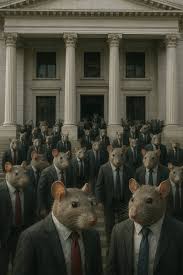
When I think of writ, Washington-Rats-In-Training comes to mind, then a Rooster Cogburn line from “True Grit.” In this 1968 Western movie, Rooster Cogburn (John Wayne) corners a giant rat in a Chinese restaurant while telling the cornmeal thieving creature in legal jargon,
“Mister Rat, I have a writ here says you’re to stop eatin’ Chin Lee’s cornmeal forthwith. It’s a rat writ, writ for a rat, and this is lawful service of the same.”
My online dictionary says that a writ is a formal written order issued by a court or other legal authority. It commands the said recipient to perform or refrain from performing a specific act. Writs are commonly used in legal proceedings to enforce rights, ensure compliance with the law, or provide remedies for said individuals.
The word “said” is used frequently in legal documents to refer back to a person, item, or concept already mentioned earlier in the text. This repetition helps maintain clarity and precision, ensuring there is no ambiguity about what or whom the document is referencing.
It’s a traditional style rooted in legal writing that aims to avoid confusion, though for most people, it can sound overly formal, sometimes redundant, and confusing.
Based on the bewildering language alone, it appears that some politicians study law before running for Washington, DC, positions so they are well prepared to write hocus-pocus bills aimed at confusing constituents like you and me. These are the real writ rats of our society.
Former President Bill Clinton enters the picture after he skillfully decimated the word “is” while undergoing grand jury testimony for his supposed sexual misconduct with Monica Lewinsky. Clinton used semantics to perfection, even though most Americans knew he was guilty of wrongdoing.
I’ll stop short by saying that not all Washington politicians are bad apples. There are good and honest people in the office, but it seems that the majority don’t wear the same shoes. It appears the bulk of those wrongdoers are habitual liars. To me, there’s nothing worse than a lying, writ-rat politician holding public office.
Perhaps the time’s right for someone to have them arrested and to issue Habeas corpus, so that we, the people, can see them try to wiggle their way out of trouble, as Bill Clinton did. That will be more entertaining to watch than the halftime show at our last Super Bowl.
Those politicians who are successful will be recipients of the prestigious Writ Rat Award. I’m told by unreliable sources that Bill Clinton proudly displayed his on the fireplace mantle before Hillary angrily tossed it in the can. Thankfully, ‘Slick Willy’ fished it out, and the trophy is now kept in a safe place known only to him and Chelsea.
“Things got strange that night, with this adult asking Jeff to give him a massage, and then asking me”
One of the things I asked residents when first visiting Arizona was, “Have you ever seen arattlesnake while hiking?” Although I’d lived in Alabama and Texas, and these states had unique species of rattlesnakes, thankfully, I never came across one.
I did encounter a water moccasin in Soapstone Creek near Selma, Alabama, as a kid. It was coming after me until an adult yanked my body to safety. A bite from a water moccasin can be deadly.
The number one question after many years in Alaska is, “Did you hunt and fish?” The answer to that has always been quite short when it comes to hunting, with me saying yes, I did when I was younger.
I never went into detail, although the three hunts I went on are most unusual. I doubt any seasoned Alaskan hunter, or Arizonaan for that matter, can top them for strangeness!
My first hunt was in 1968. It entailed six of us loading into a car during winter, with our rifles, some snacks, a few sodas, and no real survival gear. The hunting crew consisted of me, my brother, friends Bob Malone and Chuck Staley, Dad, and his coworker. Sixpack comes to mind here because there were six of us packed into the old man’s 1965 Ford Galaxie.
Driving through the night, in the early-morning hours just as the sun was rising, near Eureka, we came across a large herd of caribou. With other hunters scaring them away, Dad’s friend suggested that we drive up around a bend, hoping the animals would reappear. He was correct in his analysis.
Quickly pulling out his 30.06 semiautomatic Remington from the trunk, my father popped several rounds off before the rest of us could get to our guns. He managed to down two. The bulk of the morning was then spent skinning them and loading them into the car.
Some of the meat was strapped to the roof, with the attachment rope tied inside the vehicle after being looped through partially open windows. This all took place in under 24 hours. It was not your typical Alaskan hunting trip, and undoubtedly would be considered illegal these days.
Hunt number two was also in 1968, but in the fall, not winter. I was 14 at this time. A good friend, Jeff Cloud, was asked to go on a sheep-hunting trip by what I believe was a family relative, perhaps an uncle. I can no longer recall the guy’s name.
Jeff invited me to tag along with the man’s approval. We drove to Knik River near Palmer with a lightweight aluminum canoe and motor. The boat was in the back of this man’s pickup along with the outboard.
Driving along an old road or trail as far back as we could, the canoe was offloaded and placed in the water. Having no life vests, the three of us climbed in and began a slow journey upriver, stopping at what I believe was Jim Creek. From there, we either rode in or pushed this vessel as far as we could, much of it through muck and swamp, until we could go no longer.
Hiking from that point on, several miles, we eventually set up camp and prepared to strike out early the next morning for some mountain peaks. Things got strange that night, with this adult asking Jeff to give him a massage, and then asking me. We both pretended to be asleep and didn’t hear him.
Evidently, our rebuff angered this fellow, because when we woke up, he was crass and mean toward us. After eating a light breakfast of Pop-Tarts and soda, we started hiking once again.
Several hours later, we came upon a bull moose, with Jeff’s supposed uncle downing him with one shot. A second round was fired just to make sure. This caught me off guard because I believed we were hunting solely for sheep.
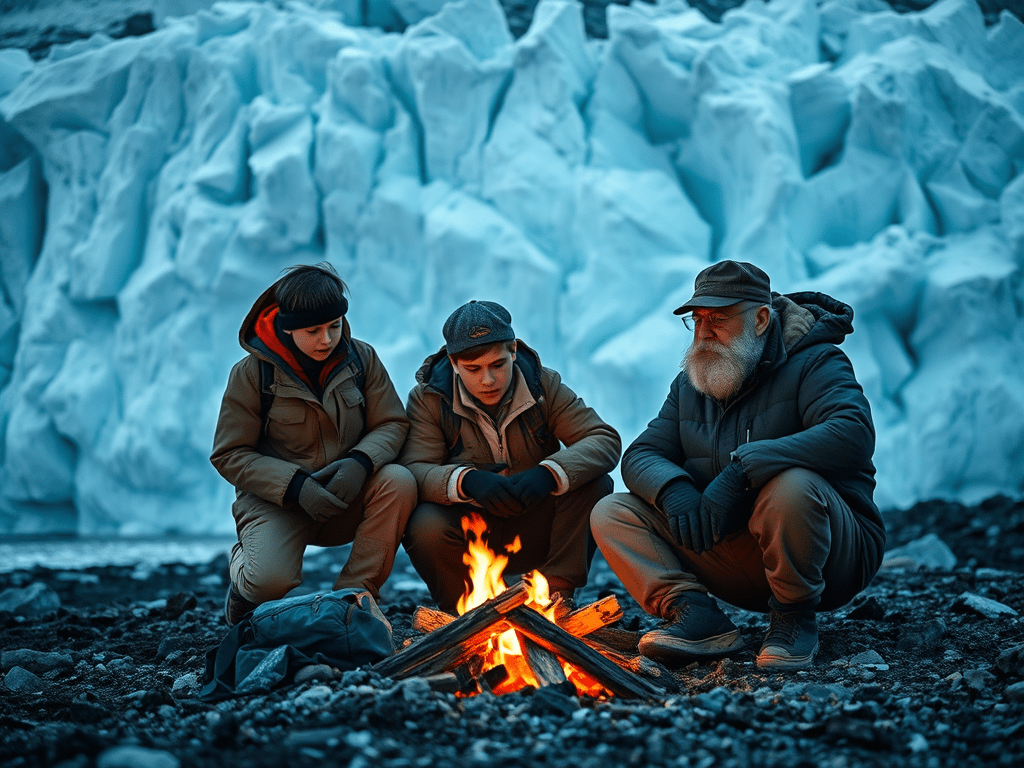
Successfully skinning the creature, darkness came fast, with wind off the Knik Glacier chilling us to the bone. Without our tent or sleeping bags, that night was spent trying to keep a fire going and attempting to stay warm under the man’s emergency blanket.
Remembering what had happened the previous day, Jeff and I reluctantly lay side by side with this fellow, while his four-foot-by-five-foot quilted-aluminum blanket barely afforded us protection. It was either endure that or suffer hypothermia as my teeth were chattering.
Sometime during the night, we were awakened by bears trying to get the meat. Two of them were evidently fighting over who got first dibs. They were fiercely roaring at one another. Firing a few shots into the air to scare them off, a rope was then used to pull the moose meat high into a tree. That worked, but I never slept the rest of the evening.
As if that wasn’t the worst of it, after backpacking this heavy meat back to the boat, we loaded it in, once again pulling the loaded dinghy through swamp and muck. Finally arriving at the Knik River, dog-tired, the three of us climbed in, water coming up to the gunwales. That’s the top of the vessel for those unfamiliar with boat lingo. Miraculously, we made it to the truck.
Jeff’s uncle never said a word to us on the drive home, which was fine with me. I never saw him again and didn’t want to. I also never received any meat, despite the labor I gave forth in hauling it out. That was fine as well, because to this day I dislike the taste of moose. Give me a ribeye steak from a Texas steer any day.
Hunt number three, and my last, took place in the winter of 1973. It was January, with my brother and I planning to go on a caribou hunt in Nabesna, Alaska, using my 1954 Chevrolet to get there.
We jointly owned a Rupp snowmachine, but since we had no trailer to haul it, we rented one from a local tool dealer. Piling everything that we needed into this car and hitching up our trailer to the bumper, we set off for Nabesna, some 300 miles away.
Very close to our destination, Jim looked back and noticed smoke coming from one side of the trailer. Stopping to take a look, one of the trailer wheel bearings had gone bad. Tearing things apart, we attempted to remedy the problem by using a soda can as a shim. It worked for about three miles before failing.
With it well below zero, snowing, and no traffic on the highway at that time of the year, we decided to unhook the trailer and ditch it. My brother drove the snowmachine while I followed. We eventually made it back to Tok, where we got a needed motel room.
Leaving the Rupp there, a trucker we met in a local café offered to pick up our rental trailer and bring it to Tok for free. Driving back to Anchorage and getting a larger trailer, we headed back to Tok, loaded up both the snowmachine and the first trailer, and eventually made it to Anchorage.
All in all, we drove 1200 miles in an antique car, in inclement weather, for nothing other than memories. That was my final hunting trip, where attempting to kill an animal was involved.
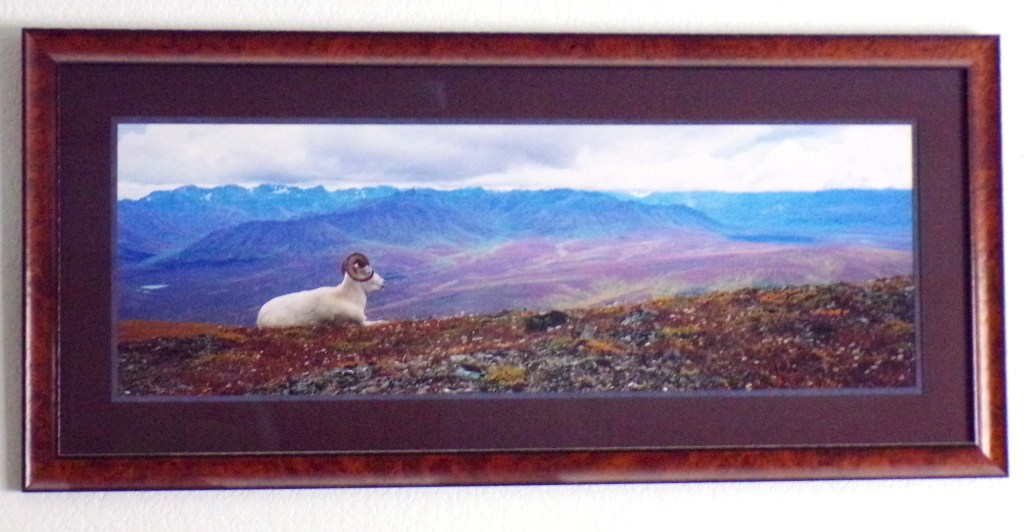
These days, I do my meat hunting at a supermarket meat counter, and my wild game hunting using a camera. I find the framed photos of a Dall sheep and a huge Alaskan wolf on my living room wall, taken by renowned photographer Eric Anderson, much more eye-appealing than the dust-laden heads of both creatures, stuffed with polyurethane, foam, and resin.
As my three hunting stories make clear, I’m not a great white hunter like the fearless, dashing individuals portrayed in early Hollywood movies. I’d much rather write about the animals I’ve seen rather than those I killed, which amounts to none. For those folks who do like to hunt, to each their own. I’ll continue my big-game hunting through the lens of a Nikon.













 I like to write junk...