“Exactly what life accomplishments to place on a two-foot by two-foot chunk of granite took some serious pondering, being that I have so many.”
Life accomplishments
A letter specifically addressed to me arrived in the mail the other day, and I had to chuckle after reading the following message inside:
“A grave marker is how people will remember you long after everyone you know has passed, so you’d better make it good. When done well, it can provide a sense of one’s style in life. The epitaph should be pithy, the shape and style memorable. You could go for the classic granite slab, or opt for something a little more memorable.”
Of course, this advertisement was from a statewide monument manufacturer trying to coax me into preordering one before my time. No one else would claim that a grave marker is a person’s living legacy. It had me thinking of what would be the ultimate gravestone for a jokester. Of course, I’d definitely want one “a little more memorable” as the letter mentioned.
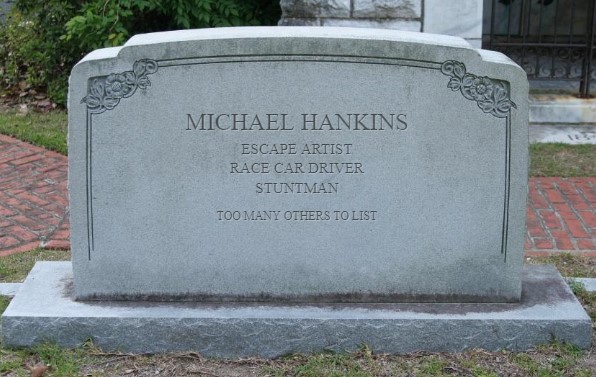
The ultimate tombstone would be one with a list of my life accomplishments chiseled into stone, so that those folks walking through the cemetery, after stopping and reading, would think more highly of Michael Hankins. Exactly what life accomplishments to have engraved on a two-foot by three-foot chunk of granite took some serious pondering, being that I have so many.
Early on, at five years of age, I escaped Sunday school one morning by faking a trip to the restroom, and then walked a couple of miles only to be caught. I’ve never bumped into anyone else having made it that far. At least I survived my escape unlike those three men trying to leave Alcatraz Island in 1962. This story alone would take up the whole stone so I’d just have to say: Escape artist.
At one o’clock in the morning, as Dad drove our family from Texas to Alabama, I accidentally shot my camera flash into his rearview mirror causing the old man to drive off the road without crashing. To simplify things on my memorial it would simply read: Photographer.
While on vacation in Lake Havasu City, and riding a rental personal watercraft on the lake, I popped things into reverse doing forty just to see what would happen. Catipulted a good twenty feet as my son watched, I survived other than having the wind knocked out of me. I’m definitely not the only person having done that but most likely one of the first. A simplistic description here for my marker: Stuntman.
Accruing nine speeding tickets before turning eighteen, and not losing my license or insurance thanks to there being no computers back then to log data equates to: Racecar driver.
Having my first checking account and not taking into consideration the balance didn’t reflect some checks not clearing made me a: Bouncer.
Playing catcher on a church softball team and having the crotch totally rip out on my weathered jeans, yet continuing to play while folks I didn’t know silently laughed: Exhibitionist.
Getting lost in a Phoenix parking lot after walking out of a large mall, and not being able to find my rental car for over an hour: Discoverer.
There’s many more accomplishments, yet I believe the stone’s now full. In fact, there’s not enough room left for month, day, and year. Perhaps, preordering a tombstone with that in mind isn’t such a bad idea after all?
“I elected to name it “Gibson” after retired United States Marine and Alaska State Trooper, the late Sergeant Dale Gibson.”
Thanks for the memories!
In 1970, Crosby, Stills, Nash, and Young came out with a song titled, “Almost Cut My Hair.” It was a favorite tune of mine for several reasons and still is. Some lyrics fit perfectly back then, especially one in particular, and even today this line still rings true although not as much as back then.
“It increases my paranoia,like looking at my mirror and seeing a police car.”
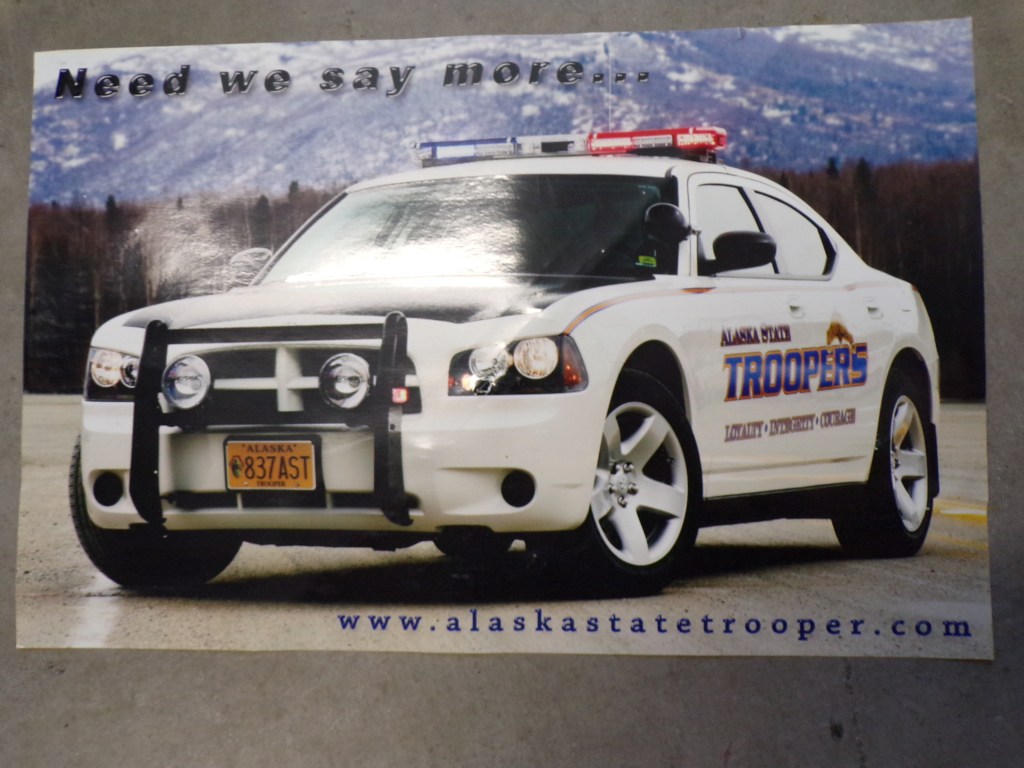
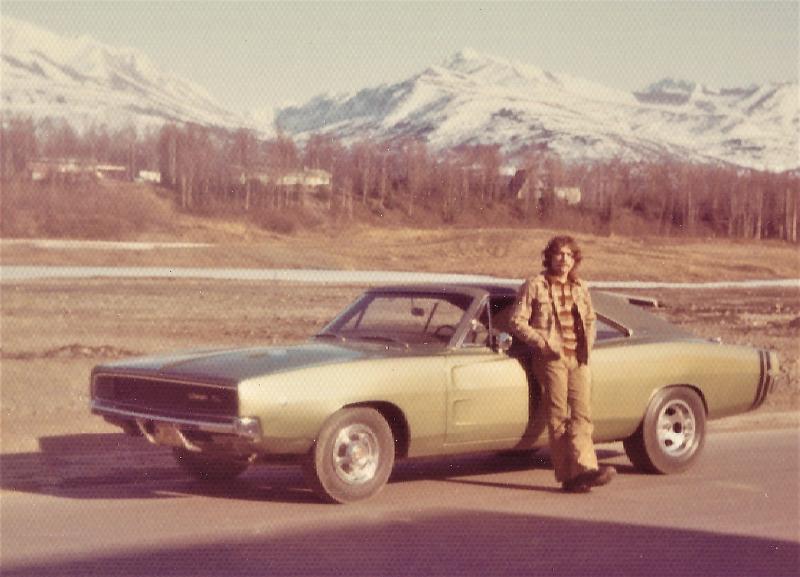
Being a car guy starting in the late 1960s, and into fast ones, it wasn’t uncommon to be driving my 1968 Dodge Charger and find that to be the case. Black and white Alaska State Trooper pursuit vehicles seemed to always be in the rearview mirror, oftentimes with red and blue lights flashing. With a slew of speeding violations tacked on my driving record, the F8 green Charger I drove with black tail stripes was well known throughout the Anchorage, Alaska, vicinity. During the heyday I even had my own nickname amongst fellow car enthusiasts, “Mopar Mike.”
I was pulled over on several occasions for nothing more than having long hair, at least that was my belief back then and still is. Of course, long hair in the ’70s was synonymous with pot use, while drugs and alcohol were things that I never took part in. I began to cop an attitude towards the law because of this, failing to see that my less than stellar driving record had a lot more to do with being pulled over than anything else.
I couldn’t park my car without police being attracted to it like bees on honey. There was one occasion when I met up with a friend, leaving my Dodge in a church parking lot while we took his Chevrolet. Stopping back by a couple of hours later to retrieve it, an Anchorage city policeman was walking around shining his flashlight inside, most likely looking for drug paraphernalia that was nonexistent. We circled the block waiting for the guy to leave.
On two occasions I was driving home and got pulled over for nothing. One trooper turned around and lit me up, saying that he clocked my car doing eighty in a fifty-five-mph zone. That one I beat in court when the trooper didn’t show up. I doubt I was going that fast because it was on a sweeping curve, and early Dodge Chargers were heavy cars and horrible in the handling department.
The other time I’d been out rock climbing with friends at McHugh Creek, not returning home until early the next morning. A trooper going the other direction on the Seward Highway turned around and pulled me over. Seeing my bloodshot eyes he evidently though I was high, making me walk the line as I like to call it. Passing the test with flying colors, he asked what I was doing out at four o’clock in the morning. This was in Alaska during July and the sun was already brightly shining.
“Climbing rocks!,” I told him. “And as soon as you’re finished hassling me I’m going home and climb into bed!”
He gave me a ticket for going six miles over the speed limit which was probably spot on. I might’ve gotten away with no ticket had I been a little more respectful. My smarting off didn’t help matters.
Flash ahead fifteen years: Now working for the State of Alaska as a mechanic, of all things, State Trooper cars were some of the vehicles I wrenched on. During that time I had amble opportunity to meet these law enforcement officials, greatly changing my tune on how I once viewed them.
When I mentioned to long time trooper, Sergeant Bob Vickers, about my old green Charger, he said that he remembered the Dodge quite well, having stopped it and arrested a couple of young guys for marijuana possession. Asking what year, Vickers told me around 1976. At that point in time I didn’t own the car, having sold the vehicle to a long haired kid in Eagle River. Evidently this fellow didn’t let the police down where stereotypes are concerned.
Alaska State Troopers Michael Opalka and Dale Gibson were a couple of troopers I came to respect while working at DOT. Hearing stories of what they went through on a daily basis in dealing with the public, gave me much empathy towards those working in this profession. As Trooper Gibson once told me, “We don’t make the laws, we only enforce them!” I’ve remembered that statement ever since when dealing with police.
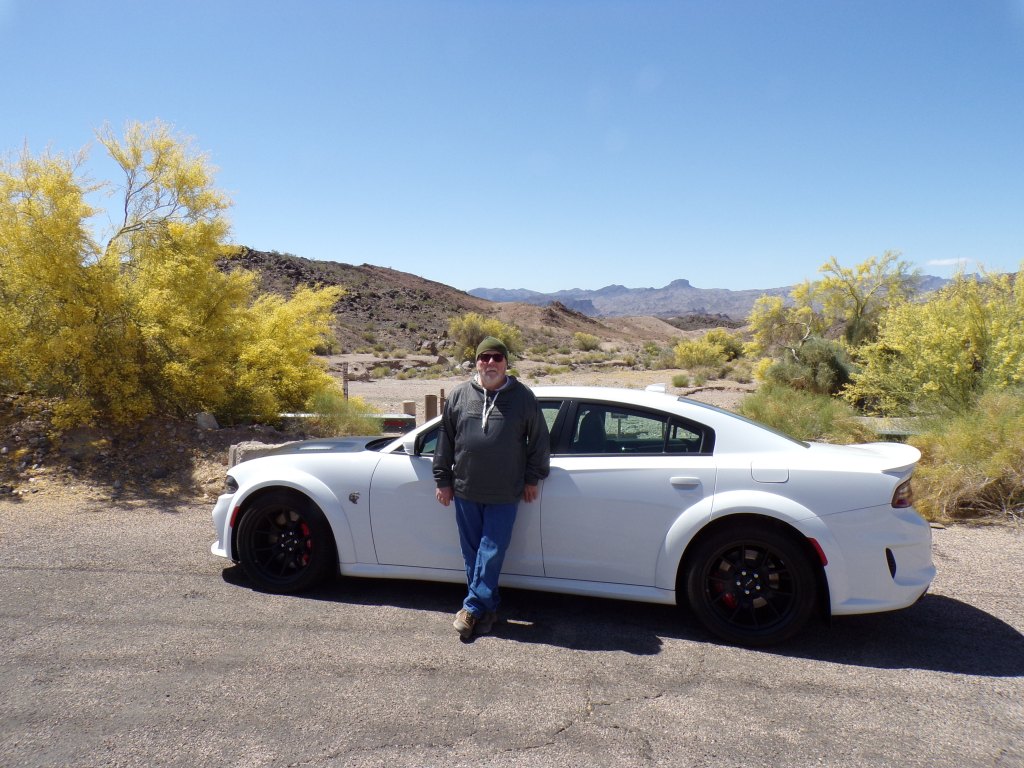
One item on my bucket list was to own another Dodge Charger. Chrysler Corporation was manufacturing a four-door version and I wasn’t sure that was the way to go, although the Alaska State Troopers were using them with great success. In 2021, Dodge announced that they were going to build a special Hellcat Redeye Charger with 797 horsepower. My wife along with friend and Dodge connoisseur, Bob Frederick, convinced me to purchase one.
I was all set to place an order for another F8 green which was still available. At the last moment I changed that to an all white Charger with black hood, identical to the ones that Alaska State Troopers still use. On New Year’s eve in 2021, the car showed up at our Arizona home after being trucked from Pennsylvania. I officially signed the shipping papers on January 1, 2022.
Reasons for the the color change partly has to do with that Crosby, Stills, Nash, and Young song, along with my checkered past where driving was concerned. Rather than looking in the mirror and seeing a black and white, I wanted to be behind the wheel of one.
This car is reportedly good for 202 mph but will never see that speed with me in the drivers’ seat. With only ten 2021 Hellcat Redeye Chargers manufactured with the Alaska State Trooper color combination, I elected to name it “Gibson” after retired United States Marine and Alaska State Trooper, Sergeant Dale Gibson. As fearsome a driver as he was, I doubt there’s enough horsepower under the hood to have suited his taste. One thing I never got to tell the guy was,
“Thank you for your service!”
My primary reason for writing this story was to send it to Dale Gibson in Pahrump, Nevada, and complete the mission. Unfortunately, I didn’t learn he passed away until the day I finished writing. That’s how it seems to go with us older folks.
In literary terms, black and white also has specific meaning: If something is black and white, it’s defined as clear and distinct via Webster’s Dictionary. That especially holds true for seniors.
Here today, gone tomorrow seemingly creates more paranoia for the majority of us older folks over that of seeing a police car in our rearview mirrors!
“Mopar Mike” with “Gibson”1968 Dodge 4-speed 440 Charger R/T – “Mopar Mike” – Photo taken 1972 in front of Cheney Lake (Anchorage)
“I’m also one of those people you see in the checkout line grabbing additional items such as nail clippers and candy bars before leaving.”
I’ve been asked by several people, okay, make that one friend and my brother, if I have any tips on writing a book. That question was best left to a professional writer, yet I tried answering things in layman’s terms, which is the politically correct definition for someone who doesn’t know what they’re talking about.
I just finished my fifth book, with this friend telling me that if I keep writing them, maybe I’ll eventually get one right. He said that in jest although there’s much truth to it.
Everyone’s writing style is unique and mine’s no different. I equate it to a car having bald tires trying to get across a muddy field. This vehicle spins and twists its way through the mud, eventually, after much effort, arriving at the other side. The key here is never get stuck which is akin to giving up. I believe this holds true for all writers, professionals and amateurs alike.
Where writing a book is concerned, a person first has to ask themself, “Why do I want to write it?”
I suppose there are many answers to this, with a couple of them being: I’d like to sell a lot of books and make gobs of money, or, I have something of relevance to share with others regardless of the monetary payback. My reasoning fits within the latter explanation.
Time is the biggest factor in putting a book together and people have to be willing to give up a big portion of it. I find there are more fun things to do besides sitting behind a computer, but also realize that whatever I’m needing to compose will never get accomplished down at the lake, which is where I’m headed right now.
Having someone look over your composition is a must. I’ve went through several of these people, now former friends, throughout the past few years. I learned a bit too late that you can’t expect them to do something for nothing. If it’s a book you’re having folks look at, make sure to at least give your volunteer a free copy, plus lunch or dinner.
On magazine, newspaper, and smaller articles, a simple lunch is most appropriate for having them review the work, although fast food might not cut it for some. I still owe one proofreader several tokens of appreciation at the golden arches, namely my wife.
Don’t fret over typos, misspelled words, sentence structure errors, misuse of abbreviation, or anything of the like at the start of your book. That stuff can all be corrected once the manuscript is complete. If I tried writing “letter perfect” from beginning to end I’d never finish. This initial composition is called the rough draft by some while I refer to it as an outline.
Where lengthy manuscripts are concerned, never edit your own work. I learned that early on as well. Countless hours were spent doing so, only to send it to a professional editor and have them find mistake after mistake, ones that I’d repeatedly overlooked.
For a first book, I suggest using a vanity publishing outfit over that of total self-publication. These firms have inhouse editing employees along with graphic arts professionals for designing the cover. There are many writers that will disagree with me here, but we’ll just have to agree to disagree, or something to that effect.
There are a good number of reputable publishing houses to choose from, but check their reviews first before submitting your manuscript. I’ve used three so far and all were excellent. My reasoning for using Palmetto Publishing this last go-round is only because their company logo is a palm tree which gives it a Havasu feel. Shooting from the hip like that is how I make important decisions. For whatever it’s worth, I’m also one of those people you see in the checkout line grabbing additional items such as nail clippers and candy bars before leaving.
My last two pieces of advice are highly important. Number one: If I can write a book, anyone can. Being a mechanic by trade, and not a very good one at that should tell you something. Just take the time and do it as Nike would say.
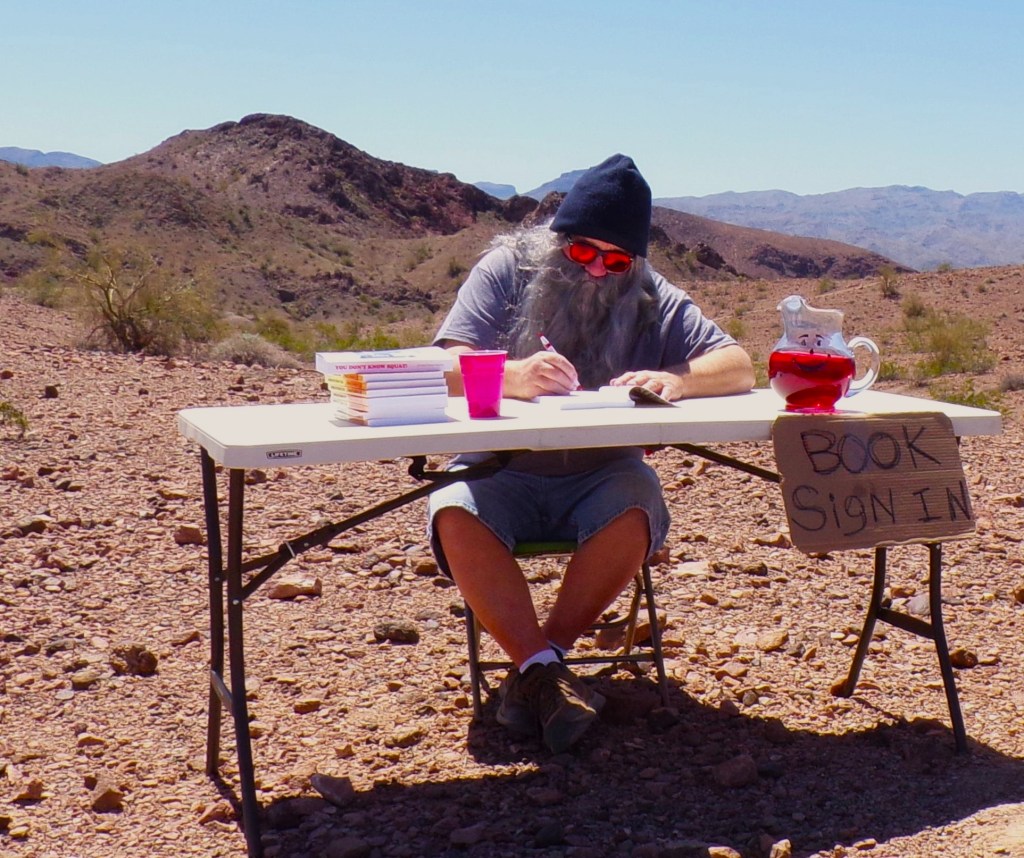
Number two: Once your book is finished some people will request a signed copy. Before doing so, practice writing your name on a sheet of paper, cursive style, several times before signing the author page. Trying to use arthritic fingers, my handwriting now resembles a caveman’s or doctor’s. Currently having no books to sign, I’ll work on number two a bit longer myself, that is, once I return from the lake.
“Writing non-fiction is definitely harder, because making stuff up and trying to pass it off as truth is something only career politicians are good at.”
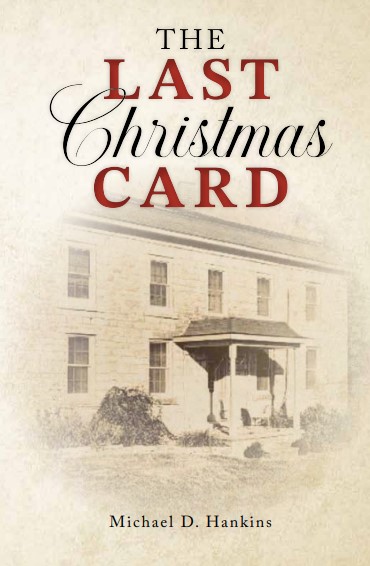
I first started writing The Last Christmas Card in the winter of 2009 – just now wrapping things up where publishing is concerned. Fourteen years passed with the manuscript securely digitized on an antique floppy disc, including being stored upstairs in my noggin during that time. Not sure if I wanted to complete things, my wife, Joleen, persuaded me to one year ago after she read several of the book’s beginning chapters.
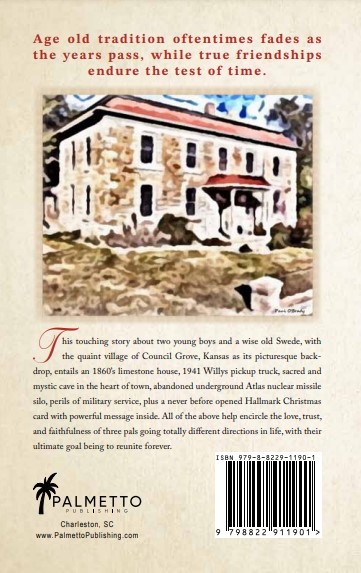
Always knowing where I wanted to start and end this tale, yet not having a specific town where things were supposed to take place was a major problem. Lake Havasu City wouldn’t work because it was much too young. The location I chose needed to have a limestone house, as stucco and a tile roof just wouldn’t cut it.
This is my first foray into writing fiction and I like it. A fair amount of research still needed to be done, yet when a roadblock suddenly came up all I had to do is make junk up to get around it. Writing non-fiction is definitely harder, because making stuff up and trying to pass it off as truth is something only career politicians are good at.
Visiting Council Grove, Kansas, I found that location to be picture perfect. For those having never been there, Council Grove is akin to an oasis in the prairie, first discovered by American Indians going far back in America’s history. An abundance of water was a magnet to wildlife of all type, with the indigenous natives following them. Starting in the mid 1800s, Council Grove became a major stopping point on the Santa Fe Trail. Now a major tourist attraction, “Hay’s Last Stop Store” built in 1850 still stands.
Many of the events in my book are ones that I played a role in, with other family members and friends doing the same. The Atlas missile silo mentioned in the story is approximately one mile from my wife’s Uncle Lee and Aunt Joan Mills’ farm. Joleen’s cousins, Randy and Larry Mills, took me there in 1975.
A humorous horseback ride talked about chronicles one that my family, including Uncle Noel and Aunt Gay, with cousins, Randall and Cheryl McDaniel, went on in 1964, at Buffalo Lake in Lubbock, Texas.
An 1860s limestone house mentioned is exactly like one in Manhattan, Kansas, that my wife and I were prepared to purchase, at least I was, but didn’t for unusual reasons, one of them being the home sat on County Road 911. A 1941 Willys pickup truck which is a key part of the story is a takeoff from a 1938 Willys that Joleen’s brother owns.
The “Freedmen” Cemetery is in the same town, Dunlap, Kansas, where my wife’s late father, Herman Freeman, was an elementary school principal for several years. This cemetery holds emancipated slaves going back to the American Civil War. Dunlap was a designation for African-Americans wanting to escape the pain and horrible memories of enforced bondage. I could go on and on but won’t. Palmetto Publishing is wrapping things up, with the official release date – May 23, 2023.
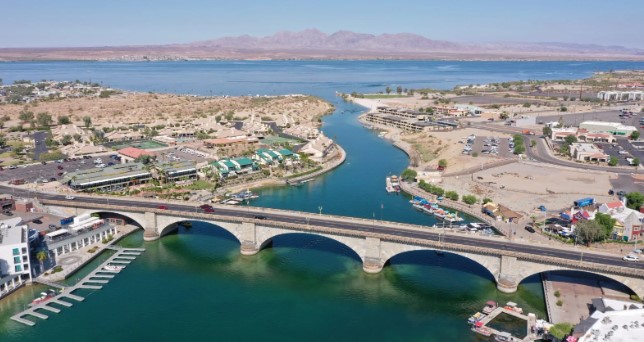
Another fiction book is rolling around in my head and this time Lake Havasu City will be featured, with The London Bridge as the main subject. I can’t wait another fourteen years to finish this one because at that point, I’m not sure I’ll be able to see the keyboard!
“It would be akin to dropping off Grandma Moses, who’s living in your home, at a convenience store for several days so that you can go on vacation.”
I remember questioning my mother about some of the quirky things she did in life and her response back to me was straightforward and simplistic,
“Young people will never fully understand us older people until they walk in our shoes!”
I got her drift, yet basically thought it was just another cliché that senior citizens use. I heard them all the time from aged family and friends. Nowadays, after finally walking in an older person’s shoes, I totally understand what she and others meant.
My wife and I have basically put our lives on hold for our aging Pekingese dog, Simon. We’ve been questioned about such, but those younger people doing the questioning seem to have a different grasp of the word, commitment.
Just like children, pets are dependent on their owners in more ways than just sliding a bowl of water and food under their noses. One of those areas is being sensitive to their needs when they too get older. A true pet lover will understand what I’m saying here, while those folks just owning pets won’t. There’s a big difference between the two personas.
On the flip side, those not having cats and dogs, and never wanting an animal, will think it’s just foolish talk. I’ve run into more than one of those people over the years, and sadly, they don’t know what they’re missing out on in life.
At this point in Simon’s life, he doesn’t want to travel all over creation seeing the country and leaving his mark like younger dogs. Our fur baby is more at peace being at home in surroundings that he’s accustomed to. To now abandon the poor guy with strangers would shorten his already fragile life considerably. It would be akin to dropping off Grandma Moses, who’s now living in your home, at a convenience store for several days so that you can go on vacation. There are some self-centered people in this world that would do exactly that.
Being true pet lovers, our commitment to Simon is to do all we can to make his last days on earth as comfortable as possible. It’s no more different than what a person should expect for their ailing parents or grandparents.
What many younger people don’t understand, is that pets help fill a big void after children have left the nest. Animals will never totally replace them where flesh & blood is concerned, but they do become family and are important. Most of us seniors see our pets on a daily basis, whereas, it might be weeks, months, or even years before the kids stop by.
I recall when my mother reached that same stage as Simon. She didn’t want to venture far from her church, doctors, grocery store, and little apartment. The thought of being twenty-miles away from any one of them created stress and anxiety, things that someone with a heart condition should avoid. When my brother asked her to travel around the state of Alaska with him, Mom basically told Jim to have at it, she’d hold down the fort.
Dad had a different way of looking at adult decisions than Mom. While some didn’t always agree with the quirky decisions he made, my father’s philosophy was quite simple like Mom’s. I believe this is how he would explain things if he were still alive:
“I’ve been calling the shots where decisions are concerned for most of my life, some of them right and some of them wrong. In spite of the errors, I’ll continue making my own decisions until the day I die!”
I’ve picked up a bit of both parent’s reasoning here. Like Mom, I’m a homebody and can find great joy going absolutely nowhere. Being a military kid, I had my fill of traveling, living in Florida and California, plus a couple of states in between. I’ve always been able to entertain myself doing crafty things around the house and still do. Dad and I are birds of a feather in certain areas, but I would add three significant words to his statement where making adult life decisions is concerned.
“I’ve been calling the shots where decisions are concerned for most of my life, some of them right and some of them wrong. In spite of the errors, with God’s guidance, I’ll continue making my own decisions until the day I die!”
One of those quirky decisions I’ve made is spending as much time with our little doggie as possible. If that means curtailing all vacations until he’s gone then so be it. Grandma Moses and my mother would definitely understand!
“I’ve moved on, thanks to Mr. Lewis’s way of looking at screwups, never forgetting that incident and the lesson he taught me.”
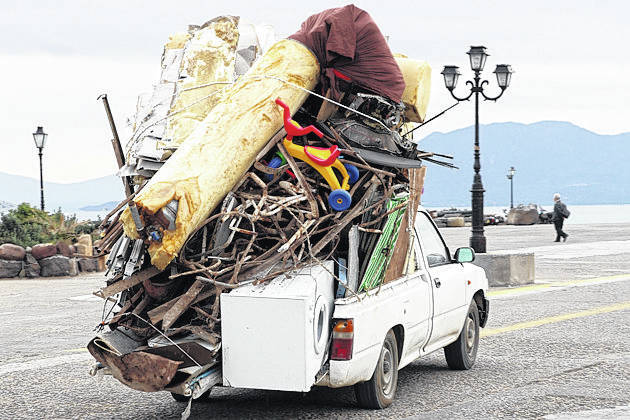
Loaded to the gills.
The year was 1970, and I was sixteen years old. When school let out, I worked parttime each evening at a Texaco gas station in Anchorage, Alaska, for my father and his business partner, Isaiah Lewis. You’d also find me there on Saturday’s pumping gas and repairing tires, plus “all assigned duties” as Dad liked to say.
Having a driver’s license, one of my jobs was to take a vintage 1950s Willys Jeep truck and daily fill the bed with garbage from numerous trashcans in the garage, then drive it to the city dump once the enclosure was full. This dumping chore was usually performed early on Saturday mornings, at least once a month.
The bed on this four-wheel-drive Jeep had raised sides enabling it to carry a substantial amount of garbage. On one particular trip, I stacked rubbish to the brim, deciding to forego climbing up on top and fastening a tarp down. It was winter, with snow coming down quite heavy most of Friday night plus Saturday morning, making things slippery up there. That was my excuse back then, although now I believe it was most likely due to pure laziness.
Wanting to back out of the parking spot before brushing any snow off, I hopped in and fired the engine up. Placing the manual gearshift lever in reverse, the old Jeep rolled a few feet before its engine died. Thinking that tires were perhaps spinning on ice and then grabbing solid ground, I revved the engine up and let out the clutch. It moved several more feet before once again coming to a halt.
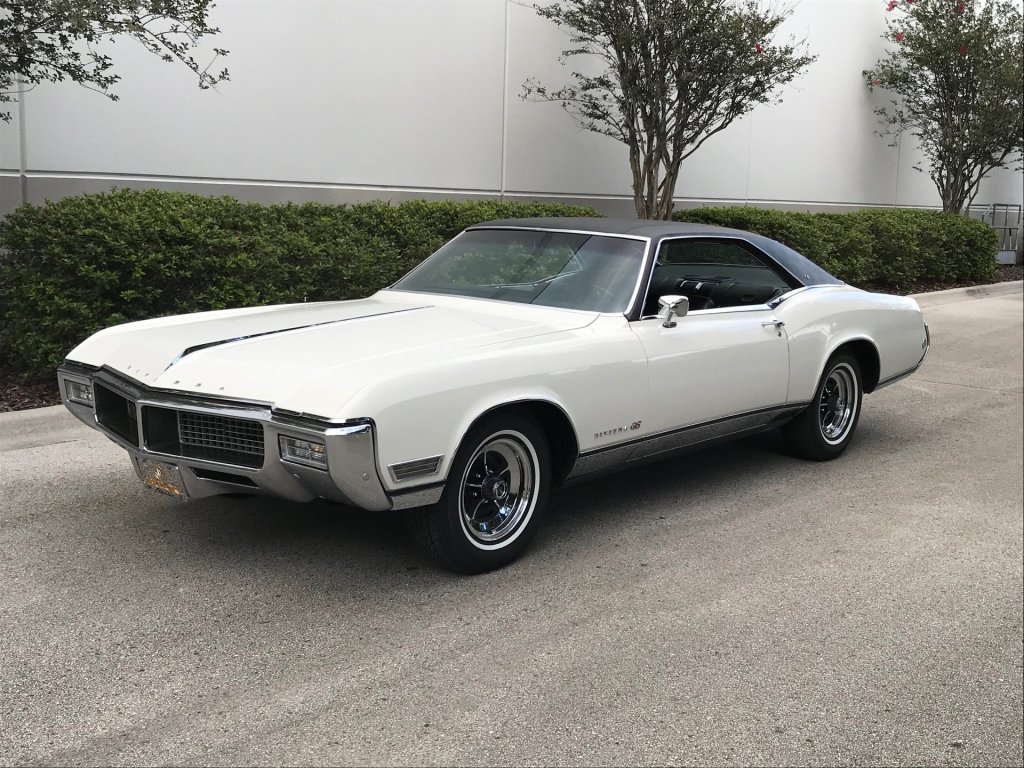
I kept this up for at least six times before glancing out the passenger side window, which was the only one void of snow including both side mirrors. Spotting Isaiah Lewis, hands on hips, glaring at me, I stepped out of the cab, quickly noticing that I’d skidded his beautiful 1968 Buick Riviera a good twenty feet, sideways. Telling him that I was sorry, Mr. Lewis, with a cool and calm voice responded,
“It’s time for damage control!”
That’s the first time I remember him using that term, although Captain Kirk and Scotty on Star Trek said it all the time. I’m sure their meaning was much different than my boss’s, especially where the Starship Enterprise was concerned.
Back then, after doing stupid things, which still happens to this day, I let it be known to myself and others by moaning, sighing, or sometimes even crying, that I was upset with my actions. I’ve moved on, thanks to Mr. Lewis’s way of looking at screwups, never forgetting that incident and the lesson he taught me. My boss’s plan for damage control at that point was take his Buick to a body shop and simply have it repaired. He saw it as no reason to cry over spilt milk because the damage had been done.
Figuring it best to finish my job before maybe he did explode from pent up anger, I quickly took off for the city dump feeling bad about what happened. On my way back to the filling station, garbage was strewn along the only highway in and out of Anchorage similar to that trash I’d just offloaded, mainly, empty Texaco oil cans.
Because the road was icy, it was extremely hazardous to stop and try picking this stuff up, so I kept on trucking. My trail of debris went a considerable distance along the Glenn Highway ending at the starting point, Wonderpark Texaco. Now feeling as bad about this incident as the first, I tried using my boss’s reasoning to ease a troubled mind,
“Time for damage control!”
Unfortunately, damage control would have to wait until spring, with groups of volunteers walking along the highway picking up what I and others had littered over winter. They bagged tons of roadside garbage each year, and I’m sure in 1970, those folks picked up a slew of oil-soaked paper towels and empty oil cans.
In Lake Havasu City, just the other morning, driving to Lowe’s for some needed items, I ended up behind a commercial pickup truck pulling a trailer loaded to the gills with landscape debris and stuffed garbage bags. Large palm leaves were blowing out of it like crazy while I did my best to keep from hitting them. A flashback to 1970 instantly came to mind, except this time around I wasn’t the one doing the littering.
Hoping to pull alongside this truck and yell out that perhaps the driver should look in his rearview mirror and see what he left behind, wisely I didn’t. Two beefy looking guys sat inside and neither looked extremely happy. Without doubt, they wouldn’t have been receptive to any uncalled-for advice.
Damage control was practiced in this case by merely keeping my mouth shut. Using control before damage is always the best route to follow!
“The realtor, a longtime resident, asked why we’d ever want to live in this place.”
I recently came across an interesting article on the city of Scottsdale, Arizona. It seems they’re looking for enthusiastic citizens in that community to become volunteer town ambassadors. The job’s top priority is promoting the area to newcomers thinking about living there, as well as welcoming tourists. There’s nothing like receiving a “big welcome” when you first visit a strange place.
Bishop Auckland, a town in northern England, has a similar program and I’d bet that Scottsdale’s is modeled somewhat after theirs. I believe at one time Lake Havasu City had an unofficial town ambassador. The gentleman’s name is no longer remembered by me but I do recall reading about him. Appropriately dressed in royal attire, he voluntarily spent countless hours under the London Bridge greeting people. My family came across this man several years ago in the English Village area, but unfortunately didn’t get to chat. He already had a small crowd gathered around.
Lake Havasu City is also actively seeking tourism ambassadors and they’re expected to do pretty much the same as town ambassadors do. This new program is simply named: Lake Havasu Tourism Ambassador Program. Information about this program is available on their golakehavasu.com website.
My family came across three LHC town ambassadors early on, and they probably don’t even know they held the title. First coming here to visit in 1978, we didn’t know a soul. My brother, Jim, living in Blythe, California, drove us over one Saturday and we fell in love with the place; Lake Havasu City that is, not Blythe. After spending a day taking in the sights, we left, only for Joleen and me to drive back a few days later wanting to purchase a residential lot, mainly as an investment.
Walking into the Century 21 office, we met the nicest person, Diane Carlson. Diane could see the enthusiasm on our faces and drove us around town pointing out several parcels within our price range. During that time, she gave us an upbeat history of the city even cruising by a home owned by Pearl Bailey. Diane was excited for us, and when I asked if she liked it here, her reply was, “My husband and I absolutely love it!” That positive statement on her part meant a great deal to us.
We’d recently been in Abilene, Kansas looking to purchase a lot or small home there. The realtor, a longtime resident, asked why we’d ever want to live in this place. He went on a horrific spiel detailing how he wished he’d stayed elsewhere but was now locked in. Needless to say, we left his office with a sour feeling and no longer had an interest in pursuing things further.
After Diane Carlson showed us around that day, we told her that one particular lot on Injo Drive especially held our interest. With Jo being my wife’s nickname, Injo seemed like an omen of sorts. I can’t remember all of the particulars, but believe for eighteen-thousand, twenty-five hundred down, and the sellers carrying a note for the balance amortized over fifteen years at eight percent interest, we became proud Havasu land barons. The following year Diane sold us the adjoining piece of Injo property for nearly the same sweet deal. If she’d been like that gloomy realtor in Abilene, I tend to think we would’ve left town after our first visit and never returned.
The second town ambassador we encountered was a fellow named Dennis Smith. I may have some of the facts rearranged here, after all it’s only been some forty years, but believe it was at a Long John Silver’s restaurant where we first met him. I do recall it being a franchise seafood place.
It was late one evening and the restaurant was winding down. A man walked over and introduced himself as the business owner, with me asking him to join us at our table. Dennis talked about owning several restaurants in California and having just sold them. Retiring in Lake Havasu City, he opened this new one against his wife’s wishes. When I asked the friendly gentleman if they liked it here, his reply was the same as Diane Carlson’s, “We love it!” Over the next several years we’d stop by and talk to him, the last time in a KFC restaurant he’d just started. Dennis Smith always told us that we shouldn’t wait as long as him in moving.
Randy Randall is the last town ambassador on my list. Randy worked for Harold Johnson Realty and that’s how we became acquainted. We made property transactions with Randy just like Diane, yet for the most part, talked more about other things, such as him asking what it was like living in Alaska during winter, with Joleen and me questioning him about the scorching summers in Lake Havasu City. He never had a bad thing to say other than check your shoes for scorpions before slipping feet inside, and watch where you stick your fingers. Randy and his wife Sharon, who worked with him in real estate, were always positive about the town just like Diane and Dennis had been.
There’ve been other unofficial town ambassadors we’ve met since these folks, with John and Suzannah Ballard, Richard and Beth Pagliero, and Ron and Terri Claspill being other such recipients.
I’ll add Joleen and my name to that ambassador list as well, with us now having told many people over the years about the qualities of Lake Havasu City. It’s not hard being an ambassador at all. All one has to do is smile and have a positive attitude about the place they live!
I’ve always tried to be a good neighbor. My wife and I are not ones to have noisy parties, junk up our front or backyard, nor have we become a public nuisance by flying up and down the street in our vehicles. I can’t say the same about some folks living around us.
The neighbor to the north of us had been a pain in the neck going way back. Frank was hooked on opioids, and it showed. At times, he was menacing and threatening, one time telling my wife that he’d shoot our dog claiming it was defecating in his yard. Joleen always had Simon on a leash so that was impossible. I took Frank aside one day and had a talk with him. I won’t mention exactly what was said, but from that point on the man never bothered us, in fact, he was most cordial.
Frank told me that he was injured years ago while working at a prison facility. The damage to his spine was so bad that he relied upon drugs to ease the constant pain. I listened, telling him before leaving that I’d pray for him.
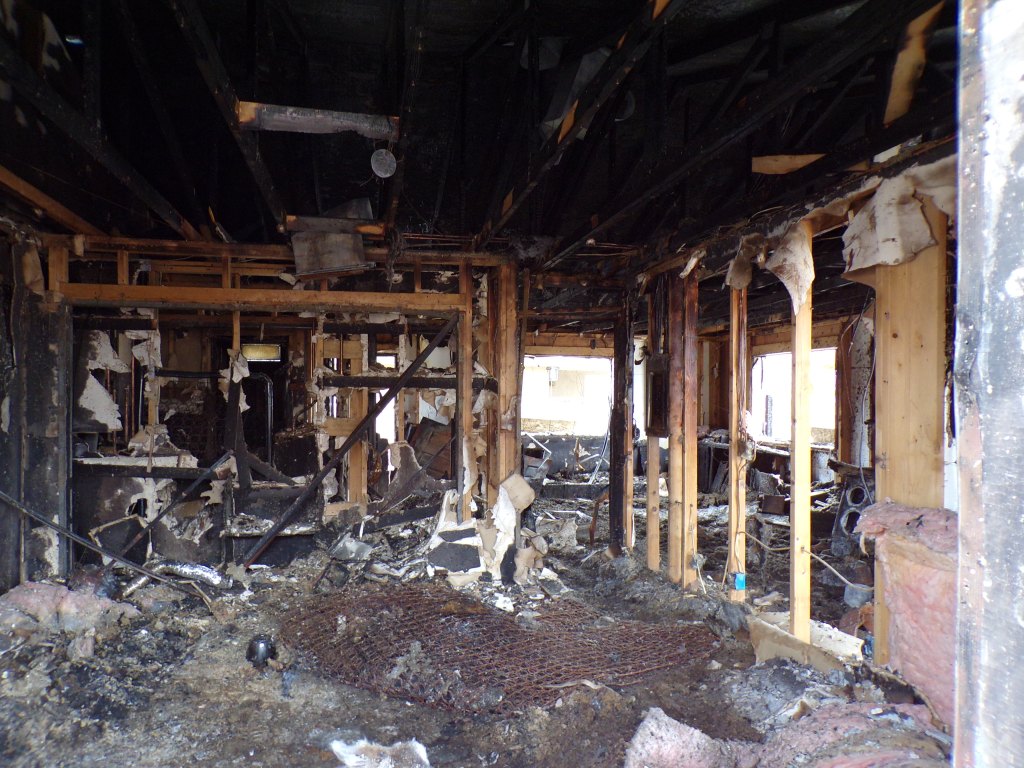
Approximately one month ago, Frank snapped, intentionally setting his home on fire. The fire trucks arrived within minutes, but before the blaze was totally extinguished his place was destroyed. Police were then called in, and they arrested the man for arson in an occupied dwelling, a felony. He’ll most likely never leave prison after this, yet having three square meals a day, great medical care, and top-notch entertainment, in Frank’s confused state of mind is undoubtedly the best place for him.
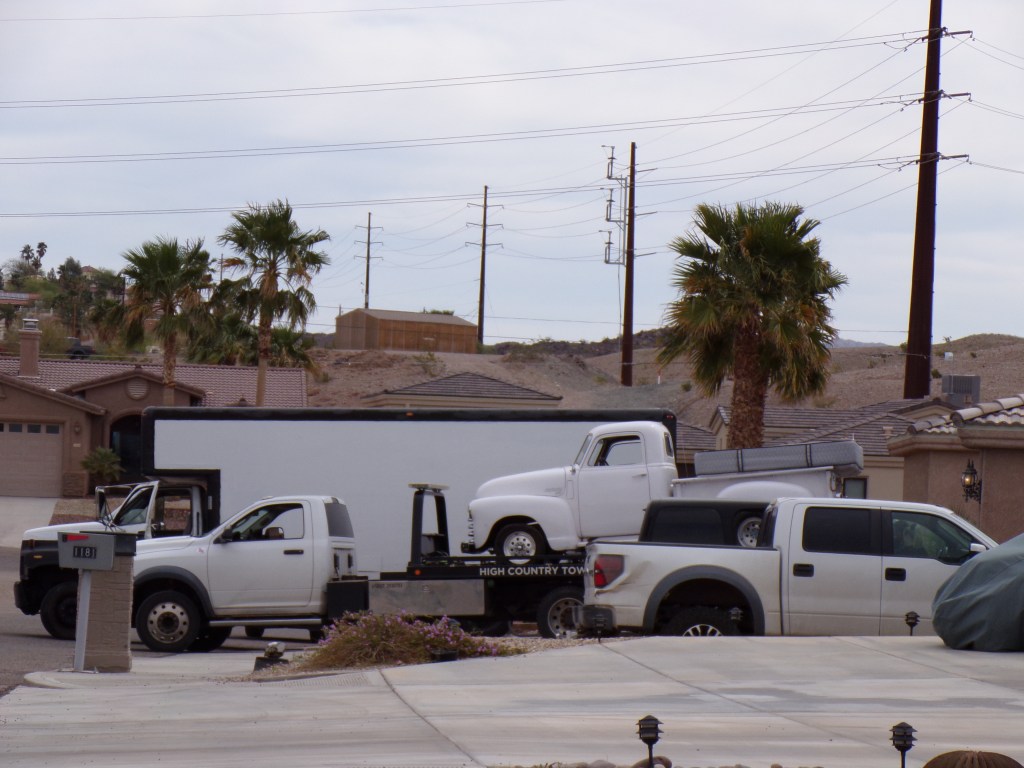
Our neighbor to the south is a different story. A nice woman purchased the house with us believing that she’d live there, but she rented the place out once everything closed which is fine. A couple quickly moved in bringing their commercial business with them. Heavy trucks with backup alarms came and went during all hours of the day and night. I didn’t say anything out of trying to be a good neighbor. One morning, I fired my old hot rod up to drive it to a car show and that evidently upset them. I apologized, saying that there were only two shows a year where I did such.
The renter has let this place go, with weeds flowering up all around like it’s a desert garden. Some of them are scorpion weed which spreads like wildfire. So far, our weed control agent has kept from them encroaching on our property, but the days are numbered. Being a very patient person, I elected to bite my lip on saying anything.
This morning I heard a loud commotion, with me hurrying out the door to see what was up. A moving truck was at this place along with a contingent of other vehicles. Miracles do happen, because these folks are relocating to the Phoenix area. Who’ll take their place and what kind of people they’ll be at this time is unknown, as you just never know. The new renters could turn out to be good neighbors, or neighbors from, well, you know the other word!
I’ll mosey over there soon after writing this piece and bid them farewell. Afterall, that’s what good neighbors are supposed to do!
“For over sixty years now, I still enjoy a cold glass of this beverage, especially cherry flavor.”
Meet the author!
The late cult leader, Reverend Jim Jones, can be partially blamed for all of the bad publicity regarding Kool-Aid. Head of his own created church, Peoples Temple, the egotistical, charismatic maniac, convinced a good number of followers on November 18, 1978, to drink cyanide laced grape beverage as an accelerated means to get to Heaven.
In Jonestown, Guyana, where he had established a huge cult compound, over 900 of his congregation committed suicide that muggy day by consuming several gallons from a huge vat, with 304 of them being children. I remember things well, because it was front and center in newspapers and on television for what seemed like months. Photos showed bodies lying on the ground unlike anything I’d ever seen.
A misnomer was created by the press during these reports, because it wasn’t Kool-Aid that these folks drank, but something called Flavor Aid instead. The damage was significant to Kraft Foods, owner of Kool-Aid, because they lost a tremendous amount of business from bumbling of the facts. There was little effort to correct things, and to this day “drinking the Kool-Aid” refers to unwisely following a person or belief, metaphorically speaking, over a cliff.
My brother, Jim, and I grew up drinking Kool-Aid, with mom finding it an inexpensive beverage for us to consume. She even froze the stuff in special plastic popsicle molds, and on scorching days either in Alabama or Texas, the frozen treats were a Godsend.
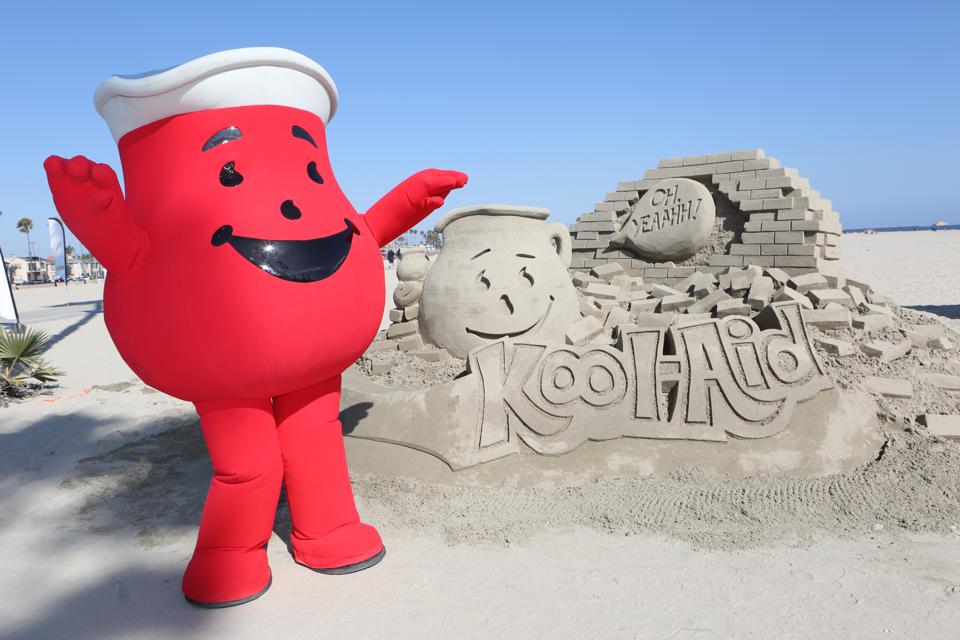
For over sixty years now, I still enjoy a cold glass of this beverage at lunch or dinner, especially cherry flavor. Why don’t restaurants serve it is beyond me? I’m tired of the same old selection of drinks that most of them offer. The profit for a glass of Kool-Aid over that of all the others would make it a sensible thing to do. Flavors could be changed on a daily basis unlike carbonated beverages.
The next time someone sarcastically says to me, “You must be drinking the Kool-Aid!,” with this generally happening during an argument over presidential candidates, I’ll know immediately they’re not up to speed where facts are concerned.
If I’m feeling my Wheaties, I’ll bluntly reply back knowing this person won’t have a clue. “Yes, I am, but at least I’m not drinking the Flavor Aid like you!”
“Flo wanted me to let you know that she’ll be a few minutes late!”
Jeep Grand Cherokee
Two years ago, my wife and I started looking for a new vehicle. Our little Chevrolet HHR SS panel had over one hundred thousand miles on the odometer, and it was time to give the thing some slack where every day driving is concerned.
Joleen wanted a Jeep, so off to Anderson Chrysler Dodge Jeep Ram we went. Instead of buying a Jeep Wrangler as intended, we opted for a Grand Cherokee. I especially liked this rig because of it being an “Oscar Mike” special. Knowing what Oscar Meyer represented, I wasn’t exactly sure what Oscar Mike stood for but it sounded cool. Turns out this is military lingo for: On The Move. That fit just perfectly with me, because I can never stay home for very long.
The Gray Jeep came with a huge star on the hood and small American flags on the bottom of each door. I was okay with that as well and so was Joleen, with both of us quite patriotic. This Grand Cherokee to some folks evidently resembles a police vehicle, because people start to whiz by and after seeing that star, quickly hit their brakes. The other day this happened, and after the woman driving a BMW noticed me behind the wheel, she put pedal to the metal and quickly disappeared.
At a gas station near our house, almost every Saturday or Sunday morning, a contingent of motorcyclists assemble for a “run.” I suppose they’re either heading to Parker or perhaps Oatman, with both being popular biking destinations. I’ve been wanting to do something for some time now regarding motorcyclists, yet never found the courage. Last week that all changed while in this Jeep.
Slowly driving by and seeing at least twenty cycles off to the side of this station, with their riders comfortably talking and drinking coffee, I rolled up beside them with my window down. Motioning to one fellow wearing a leather jacket that I had something to say, he walked over, and in a loud enough voice for most everyone to hear, I said,
“Flo wanted me to let you know that she’ll be a few minutes late!”
The muscular looking fellow gave me a most puzzled look before replying back,
“Flo?”
I repeated what I originally told him, then gave the guy a thumbs up. He acknowledged me, evidently believing that I was sincere. Keeping a straight face helped in that department and being on the move got me out of harm’s way. I’m sure seconds after I left, a light bulb suddenly came on, because others standing behind him had already caught the humor.
Had I not been a senior citizen I wouldn’t have tried such. Smart alecks pulling jokes on perfect strangers sometimes aren’t looked at as being funny. In this case, it seemed like the right place and perfect opportunity to pull things off. I’m sure Flo thought it was hilarious, that is after she finally got there.






 I like to write junk...