“Joleen and I aren’t pushing things to get to #19, but we’re ready at the same time.”
Looking back on where we’ve been
I wrote a humorous article regarding a semantics class I took with a friend in 1972. The subject word for my story was junk. I gave examples of associated words our teacher used for junk, with stuff, items, things, and crap heading up the list. I’m still chuckling because my Microsoft Word program flagged that last one as being potentially offensive.
To mechanics like myself and others, crap can equate to the rusty, oily junk floating around in antifreeze and other liquids. The words crud and gunk have similar meaning. I suppose to a bean counter, it could represent something entirely different.
Evidently this word’s now accepted in the medical community, because a Navage commercial on television called mucus in someone’s nose exactly that. Personally, I find abortion offensive yet Microsoft Word must not.
Semantics include more than single word interpretations. Phrases, sentences, and text have areas where semantics enter the picture. Two phrases used by semantics teachers for demonstration purposes are: last stop and final destination. They can mean the same thing, yet also have totally different interpretation for various people.
When my wife and I relocated to Lake Havasu City, Arizona, we figured this would be our last stop after a multitude of moves. Some towns and cities that Joleen and I lived in over a period of 68 years, in alphabetical order, without naming states are:
Adelanto, Alma, Anchorage, Chapman, Dunlap, Emporia, Grinnell, Kingsdown, Lake Havasu City, Longford, Lubbock, Pensacola Beach, Salina, San Antonio, Selma, Vernon, and Victorville.
That amounts to 17 moves amongst us both. Those locations were merely destinations at one point in time.
It’s looking more and more as if Kingman, Arizona will be added as #18 to our list for a final stop, at least where travel in this life is concerned. We’re tired of moving, believing we’ll have just enough energy for one more. Kingman won’t be our final destination though.
Joleen and I aren’t pushing things to get to #19, but we’re ready at the same time. Something tells me that semantics won’t be needed up there!
“When the two of us were together, oftentimes our juvenile brains subconsciously inserted the wrong meaning just for kicks.”
One man’s junk…
Fifty years ago, I took a semantics’ class in high school along with friend, Jeff Thimsen. Our reasoning on taking this class was that it sounded easy. That turned out not to be the case. The basic definition for semantics is:
Meaning for a word, phrase, sentence, or text.
In simplistic terms, words can have various interpretations to different people. Mrs. Hutchinson was our semantics teacher in 12th grade. Jeff and I were two of her favorite students. On the first day of class, she used the word junk as a semantics’ example. She must’ve had ten variations including this one,
“One man’s junk is another man’s treasure!”
Junk to me is the same as stuff. I like to write junk. Junk to another person might be crap or things. Crap or things is often equated to a large accumulation of junk, such as items worthless or items valuable. A dog owner might use crap in describing things deposited in their yard by Rover. Dung is another version of crap and junk. A socially offensive word for all of them also starts with s. As a child, I had to brush my teeth with soap if I was caught using that word.
I’ve never been one to curse and neither was my friend. We remembered Mrs. Hutchinson’s uncensored examples and often chuckled when we heard junk used out of context. It was left up to us to put things into perspective. Depending on our frame of mind at the time, that could sometimes be a hoot.
When the two of us were together, oftentimes our juvenile brains subconsciously inserted the wrong meaning. Close friends think alike. We’d hear someone innocently use the junk word and not be able to stop laughing. People around us suddenly looked, not understanding the inside joke.
When a pastor mentioned that he needed a group of volunteers to help clean up junk in a church member’s yard, we couldn’t hold back the tears. This woman had dogs, yet preacher wasn’t referring to people cleaning up after them.
Having the same mindset, Jeff and I pictured our congregation walking around with shovels and bags while holding noses. We laughed until it hurt. Even if he’d meant dung, it’s hard to fathom exactly what word pastor would’ve used to describe such.
Awful, terrible, and bad are great examples of semantics where vehicles are concerned. Telling someone that a car is awful or terrible means the automobile is crap to my pals. Pile and heap have the same meaning. Saying that it’s bad is just the opposite. Whenever hot rods are built, we always strive for bad. That’s the epitome of getting things right.
Semantics seem to be more at play these days automotively speaking than ever before. Whereas sick used to mean physically or mentally ill, it can now be used to describe something bad, like a blown Hemi ’32 Ford coupe. For English scholars, automotively is my own creation and not a typo.
Going back to junk. There’s another misused definition of this word that I purposely left out. Most mechanics use it to describe a car or truck that can barely move up the road. This four-letter word actually comes from the word turtle. Turd is much more representative of a pokey car or truck than turt. I believe Mrs. Hutchinson would concur!
When a friend asked if I thought complete strangers would want to read a book about my early life, I replied, “No, they’d be more interested in hearing what a trailer park refugee has to say about theirs.”
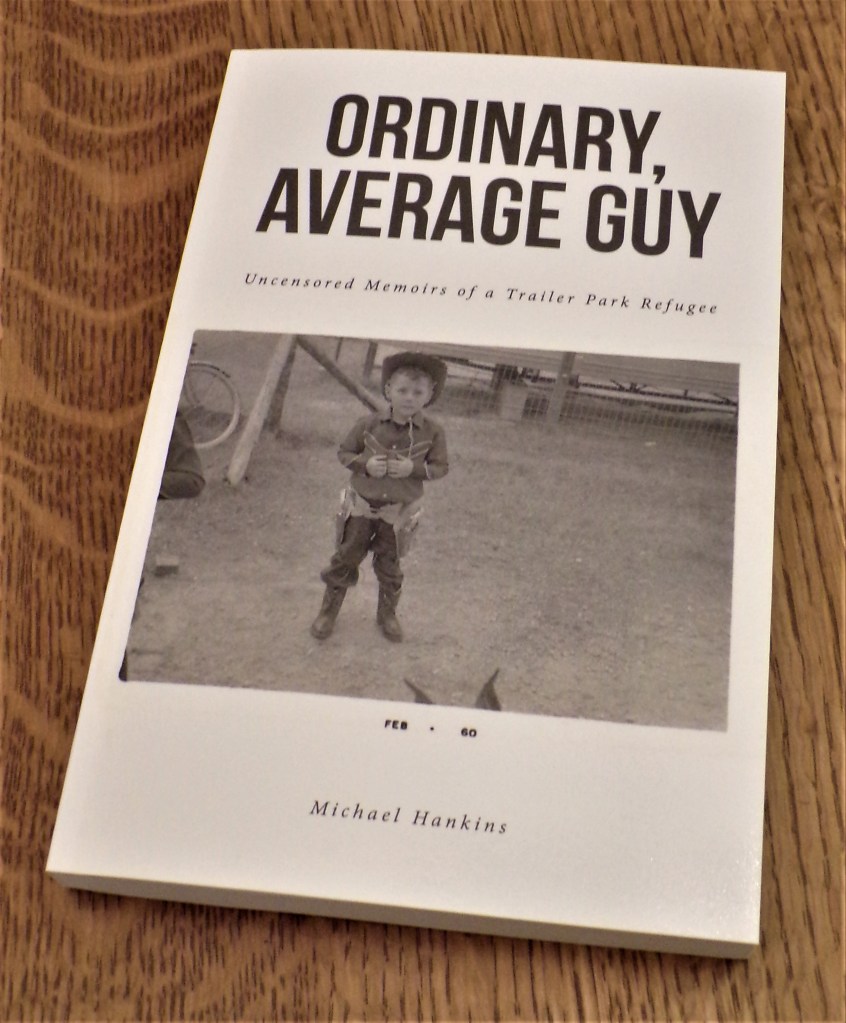
1960 photo – Selma, Alabama
My latest book was officially released today after several months of tedious revision. Covenant Publishing Company representative, Renee Barnhill, says it’s the most unique, personal narrative she’s had the pleasure of publishing. If that’s the only accolade received, I’ll be happy. I’m sure my manuscript didn’t follow etiquette on how personal narratives are supposed to be arranged. It’s definitely unorthodox in composition, totally intentional of course.
I didn’t compose this memoir solely for profit and attaboys. The project was designed for the enjoyment of friends, family, and especially those precious grandchildren. Ultimately, folks I’ve never met will read it more than anyone.
I tried to touch base on significant events happening in my world from 1954 thru 1974. Some of the occurrence’s will never be repeated because of ever changing lifestyles. Telephone party lines come to mind. Hopefully the contents evoke a laugh or two. There’s a serious tone as well.
When a friend asked if I thought complete strangers would want to read a biography about my life, I replied, “No, they’d be more interested in hearing what a trailer park refugee has to say about theirs!”
For some odd reason, many people having never lived in trailer parks are inquisitive about such. I believe the dogmatic stigma, trailer trash, provokes this curiosity.
A fellow I worked with years ago evidently thought there was something seedy and sinister about trailer park living. I say that because he used the words trailer park people in a demeaning fashion. This misinformed soul would’ve undoubtedly purchased my book for dirt alone. Oh, there’s dirt inside, but not of the sordidness he’d desire.
A micro definition for refugee is: to flee. Generally, it’s fleeing another country to avoid persecution. Some literary critics would claim I misused the word. My family lived in a total of seven trailer courts. One of them, Dad and Mom fled for increased trailer space rent. The other was vacated for sanitation reasons; sewage leaking into yards. Poetic license gives me authority to use refugee in each case.
My original title, ORDINARY, AVERAGE GUY – Memoirs of a Trailer Park Refugee, didn’t cut it. The wording needed salsa to make things pop.
ORDINARY, AVERAGE GUY –Uncensored Memoirs of a Trailer Park Refugee, did the job. When Joseph Magnolia, Covenant Publishing Company agent first saw the title, he asked if my manuscript was full of obscenities. I had to chuckle, reassuring him that there wasn’t one cuss word inside.
Amazon, plus Barnes & Noble, have agreed to carry the paperback and digital (Kindle) versions. The company employs people that review new releases for racist, anti-Semitic, or other offensive criteria before accepting. Mine passed with flying colors. Other venues will offer it as well in the coming days.
Amazon ad
Over time, search engines will eventually key upon ‘trailer park refugee’. That’ll take a couple of years or longer. Being that I don’t have the services of radio talk-show host Dennis Miller, or late-night television star, Jimmy Fallon to plug things, I had to be creative in finding a title that’d make folks voluntarily pick up a copy. Magazines do such all the time by using catchy photos on front covers.
I’ve read several highly-touted biographies, praised by television personalities and celebrities alike for interesting content. A good many were duds in my opinion. They were mentioned as being enlightening yet turned out to be stuffy and full of repeated bragging. Those books, written by highly recognizable names were hawked strictly for financial gain and bravado. Hollywood stars are faithful in patting each other on the back. Some folks will buy anything if Oprah Winfrey claims it’s good.
On the flip side, I’ve encountered numerous, from the heart, good reads, by unknown authors. They just didn’t have the push or publicity needed to put them on a best seller list. Most of these manuscripts I found on a mark down table in a secondhand store.
My goal is to sell 101 books. That same friend asking who’d want to read my book jokingly informed me I’d be lucky to peddle 100. I want to prove him wrong. Uncensored in conjunction with trailer park refugee should nudge it past the century mark.
“Last week, I gave myself a haircut and was interrupted by a phone call before finishing.”
Barber pole
It’s rare that I hear the word barber anymore. It seems to have gone the way of stewardess or waitress. Stewardesses became flight attendants and waitresses were renamed servers for whatever reason?
I prefer barber over that of hair stylist. I’d never tell friends that I was going to the salon and have my hair styled. Sissy comes to mind here. For many years I went to a barbershop and still would if I had enough on top.
That remaining hair is now cut by my own hands, using two mirrors and rechargeable clippers. In a way, I’ve become an unlicensed barber of sorts. If I were applying for a job, I’d put that on my resume along with motor-doctor and chef.
Early on, I had several barbers. A friend’s dad in Selma, Alabama named John Dennis cut my curly locks a few times. “Jimmy the Barber” in Vernon, Alabama did the same. For the most part, with Dad being military, my brother and I visited the local base barbershops. That could be a frightful experience.
Generally, a base barbershop had at least eight barbers lined up each Saturday morning. After walking in, I immediately took a number from a stack hanging on the wall. It’d take an hour or longer to get called, because there were always oodles of people ahead of me.
The waiting room reeked of cigarette smoke, Old Spice cologne, and talcum powder. I believe military barbers used talcum powder back then to soothe cuts and nicks. It was guaranteed that I’d end up with several each trip.
One barber in particular had clippers so dull that they randomly pulled hair instead of cutting. I remember this like it happened yesterday. The man apologized, saying that he needed a new set of blades. After that harrowing and bloody experience, I cringed each time I went in, praying that I wouldn’t get him again.
What I can still visualize regarding military barber shops was the amount of hair lying on a linoleum floor. Barbers took turns with a broom sweeping it into a huge pile. I’m talking large garbage bags full of the material. A friend of ours, Randy Coggins, claimed companies used hair to stuff pillows and mattresses. For years I believed him.
Flattops were popular during my era. My brother and I wore this style, using plenty of crew wax to keep them standing tall. Mom had to constantly wash our pillow slips because of the grease.
Mohawk haircuts were the rage for some guys. Only cool or vision impaired parents allowed their boys to have them. Some 101st Airborne soldiers during WWII sported Mohawk’s to try and intimidate the enemy.
When my brother came home one Saturday morning sporting a Mohawk, he was ordered to go back and have the stripe removed. Mom was especially mad because they charged him for another haircut. I believe that was seventy-five cents back then plus tip.
I noticed that we have at least six barbershops in Lake Havasu City. Good for them! There’s nothing more American than seeing a red, white, and blue barber pole hanging outside a building. I’ve always been mesmerized by the revolving colors.
Last week, I gave myself a haircut and was interrupted by a phone call before finishing. Late that evening my wife mentioned that I’d missed a section. Looking in the mirror it was precisely in the middle of my head. Mohawk came to mind.
I left it that way for a couple of days as an act of rebellion. Sadly, Joleen didn’t notice, or if she did, nothing was said. When I finally whacked it off, perhaps a teaspoon of gray hit our sink. I watched as water washed it down the drain.
Sooner or later a giant hairball will appear and Drano will be needed. It always happens at the most inconvenient time, like when we’re out of Drano.
I’ve used a homemade snake made out of a piece of wire on more than one occasion to remove this crud. I suppose that makes me a plumber. That’ll go on my resume as well!
“Perhaps that’s why I chose not to get close to people right away.”
I’ve had my share of neighbors over the years. Coming from a military family, like clockwork, we had new ones every 36 months. That made it tough as a child, making friends and then losing them to a reassignment. Neighbors and friends seemed to come and go like traveling carnivals back then. Perhaps that’s why I chose not to get close to people right away. Eventually, with time, I came out of that shell so to speak.
In later years, things improved considerably. Most of our neighbors hung around for a spell. One of them did meet an untimely fate shortly after we’d purchased our first home in Alaska. Grayson Maroney built many of the houses in Elm-Rich Subdivision including his own. I only briefly chatted with the man, finding him very personable. His sons and daughter went to the same school as me.
When I learned that Grayson was killed in an auto accident not far from our residence, I was sad. This friendly gentleman always waved as he drove by. Simple gestures like that make for nice neighborhoods.
Some neighbors became lifelong friends. Bill Devine was our neighbor for close to 35 years. We’d visit and shoot the breeze almost weekly. When he became ill and eventually died, our ‘hood was no longer the same. That’s one of the reasons Joleen and I packed up and relocated. Our old stomping grounds became quite depressing with Bill, Grayson, and other old-timers gone.
I’ve had neighbors that moved, passed away, and last but not least, were hauled away. Thankfully, the latter only occurred once. This young man took out our mailbox with his car because of a constant inebriated condition. When police attempted to stop him one evening, he drove across numerous lawns and mowed down several fences trying to escape. The guy almost hit some small children in the process. He was immediately handcuffed and transported to the pokey. I never saw Tom again after that.
We’ve had more neighbors move away in Lake Havasu City than any other place combined. I’m told that’s because this is a retirement community. That might be the case, but nonetheless it doesn’t make for a happy neighborhood. Nine neighbors have disappeared in 15 years, and that doesn’t include those living in apartments. It gives me flashbacks to my former military brat days. For those never hearing such, military brat is the child of a service member.
We just recently learned that we’re losing another neighbor and good friend. I won’t mention her name, because I’m sure it’s as hard on her to leave, as it is on us seeing her go. All a person can do in cases like this is shed a few tears and wish them the best. I told my wife that perhaps we should pack up and follow her north. Having spent close to 50 winters in Alaska, Joleen quickly reminded me that she’d had her fill of ice and snow.
Having no particular place to go, it appears we’ll stay put in Arizona for a while longer. Joleen’s tempted to take an atlas, blindfold herself, and then stick a pin somewhere on the map. We’re not going to that extreme!
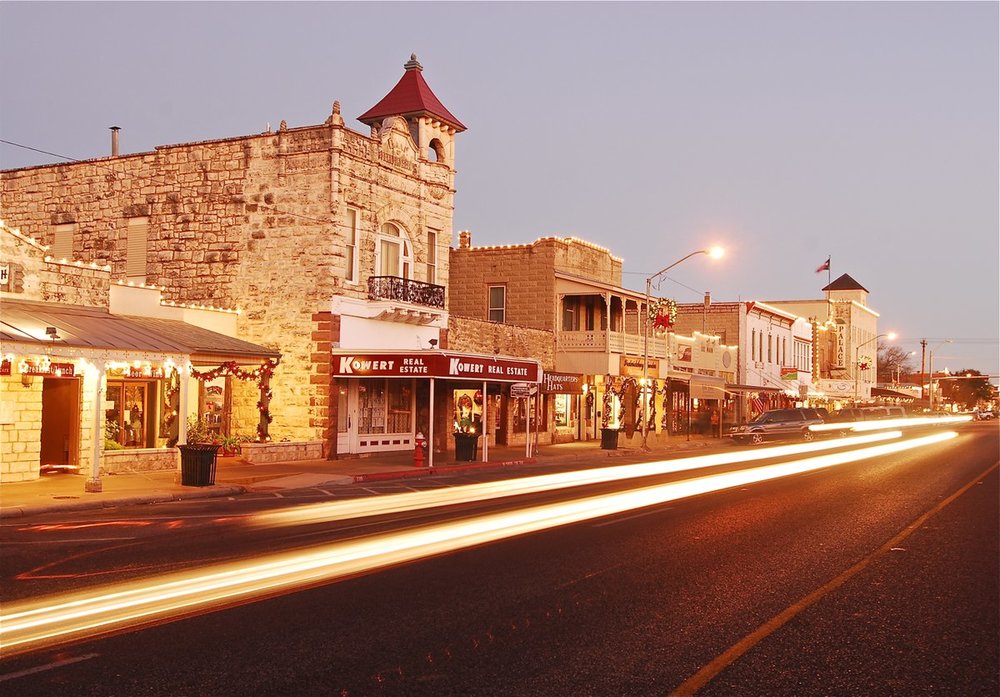
I recall a song about some exotic locale in Texas where folks migrate when life gets them down. I’m all for giving Luckenbach, Texas a try. It can’t be bad if Waylon and Willie say so. If them boys turned out to be our neighbors, hopefully they’ll stick around for a bit. I’d be ticked after moving there, finding that they’ve already gone!
“American Motors Corporation tried to emulate the new 1966 Dodge Charger with their Marlin, but failed miserably.”
1970 SD-455 Pontiac GTO
For close to 18 years, my family lived in a mobile home. Dad, being in the military, towed it from base to base every 36 months. The way I viewed things back then, cars and trailer parks went together like Chevrolet and apple pie. Guys in trailer parks were always working on their vehicles, and I eventually joined them.
I was blessed to grow up during the muscle car era. With Dad eventually being part-owner of a gas station, the opportunity to drive many of the hottest vehicles Detroit offered came my way. This journey started in 1969. My passion for fast cars began a few years earlier at Clark Junior High, when I discovered Hot Rod and Car Craft magazines in the school library.
Another kid and I spent so much time reading automotive periodicals that the librarian removed them. She evidently didn’t consider them as educational material. While Dad was in the Air Force stationed at Elmendorf Air Force Base in Anchorage, Alaska, he worked evenings at Marswalk Texaco, located on DeBarr Road and Boniface Parkway. Isaiah Lewis and Doug Sizemore were also employees of this business. I loved talking to these older guys about fast cars.
One afternoon, when I was hanging around the station, Doug Sizemore offered me a ride in his 1963 Ford Falcon. It had a built 260 V-8 under the hood with a 4-speed transmission. He banged all four gears while I held on for dear life. I was instantly hooked on hot rods.
A young military couple in the trailer park where we lived owned a 1968 Dodge Charger R/T. It was blue with white tail stripes. Most of the time, the wife drove this car. They were on my paper route. Her name was Gigi, yet I don’t recall the husband. Gigi was originally from France and was a very beautiful lady. At times, she was hard to understand, her thick French accent making common words sound totally strange.
When Gigi rolled by in her rumbling Dodge, she’d smile and wave at us guys. We’d always return the gesture. I’m sure the lady thought we were checking her out, but for me, it was mainly the car. I was in love and wanted one like it. Eventually, they packed up and moved to another base as military families always do, taking their precious Charger with them. I was heartbroken.
In 1969, my father, having retired from the Air Force, teamed up with Isaiah Lewis. The two men purchased Yeager’s Texaco on Taku Drive and changed the name to Wonderpark Texaco. I was hired at $2.00 an hour to pump gas, clean floors and windows, plus other assigned duties. It wasn’t long before I was changing oil, lubricating chassis parts, turning wrenches, and of course, taking the necessary test drives. Life was good!
Richard Watts was a fledgling employee of Carr’s Grocery in 1969. He had a ‘69 440-powered Plymouth GTX at that time, and must’ve been making good money. I idolized this young man for his vehicle and cool personality. To Richard, the GTX was just another mode of transportation, yet not to me. The Plymouth was like a flaming chariot of sorts.
One day, Richard stopped by to have his vehicle serviced. He had to work that morning, so “Lewis” asked me to drive him to the Carr’s grocery store on Gambell. I was elated finding I’d be piloting the GTX. It was a moment that changed my life. Most likely, Chuck Yeager felt the same when he first took the yoke of a jet fighter. I became addicted to Chrysler products because of that one driving experience.
A fellow named Tom owned a 1964 Pontiac GTO. It had a 389 with a single Rochester carburetor. Tom wanted three, two-barrel carbs installed like some GTOs came with. Lewis told me it was one of the man’s final wishes, as he had a serious health problem. Lewis made sure that happened. I got to test the car afterwards and found it quite peppy. Only a few years later, Lewis informed me that Tom passed away. I remember him as being a super nice guy.
Tom’s 1964 Pontiac wasn’t as fast as a 1970 SD-455 HO GTO owned by an Army soldier named Anthony. We called him “Bob” for unknown reasons, as it should’ve been “Tony.” I test drove Bob’s emerald green Pontiac on a damp, rainy day. Going about 50 mph on the Glenn Highway, I punched the throttle to see what this car would do. Bob’s GTO immediately went sideways. Thankfully for me, I was able to keep it under control and out of the ditch.
Months later, I got to drive Bob’s GTO on dry asphalt. To this day, I believe it was faster than Richard Watt’s Plymouth GTX. It’d smoke the tires at will. Dodge Challengers and Plymouth Barracudas were coming in for service all the time.
One 1970 340 Challenger belonged to a young fellow in Mt. View named Roscoe. I still remember transporting this car to a seedy trailerpark on the outskirts of Anchorage. “Cisco Kid” played the whole time on an 8-track tape player; seemingly, the song never ended. Yeah, Cisco Kid was a friend of mine as well. Only those having heard this tune will know what I’m talking about. This car was quick and would easily burn rubber.
Lewis said the young man was a dealer. At first, I thought he meant a car salesman like those working at Chevy or Ford. Lewis had to further explain things to me. “Oh,” I said, after hearing what the dude actually did for a living. That’s why all those pine tree air-fresheners hung from his rear-view mirror. I recall being nauseated by their sweet smell. It was sickening to be inside that Dodge, so I always drove with the windows down.
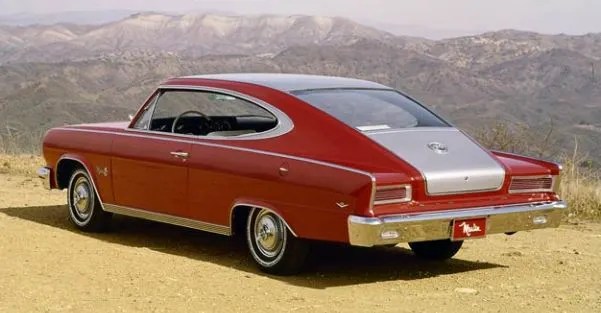
A customer living in Manook Isle Trailer Park owned a 1967 American Motors Marlin fastback. I believe it’s the ugliest car I’ve ever sat in. The owner informed me how fast his Marlin was, saying he’d beat a Camaro or two around town. I never believed him. American Motors Corporation tried to emulate the new 1966 Dodge Charger with their Marlin, but failed miserably.
I transported this slug to Action Locksmith on Fifth Avenue for new keys. The Marlin was absolutely gutless in the power department, with an engine not have enough horsepower to spin tires even on a wet road.
I cringed that day, thinking someone from high school might see me. This was the type of thing that could ruin a car guy’s reputation. It was common to drive through a trailer park and see automobiles and trucks sitting on cinder blocks in driveways. That’s exactly where this Marlin belonged and eventually wound up.
The ugly AMC sat there for a couple of years before being towed away for scrap; its metal undoubtedly shipped overseas. I suppose that Marlin’s still around, reincarnated as a Toyota or Nissan.
One important thing I learned regarding my gas station days is that I should never take my vehicle to a shop where young guys do the servicing and test drives. I’m sure that had Roscoe, Bob, Tom, and Richard Watts known how I’d treated their rides, they’d all agree!
“Jim dared me to yell ‘Fore’ and then smack the ball.”
Children learning to putt
My brother and I took golf lessons when Dad was stationed at Reese Air Force Base in Lubbock, Texas. I believe this was 1964. I would’ve been 10 and Jim 14.
The base Youth Activity Center arranged things and we were eager to participate. Dad and Mom weren’t golfers, so they had nothing to offer us where golfing tips were concerned. Reese A.F.B. Golf Course provided loaner clubs, while we purchased our own balls for good reason. Students were instructed to write names on them with a marker.
I was lousy at hitting from a wooden tee. Most younger kids had a hard time getting balls to merely sit on top of them, especially when the wind was blowing. The wind always blows in Lubbock.
This was mid-summer and Texas heat was unbearable. Reese’s Pro Shop had a dispenser on the wall next to a water cooler. The machine provided free, salt tablets. I believe those tablets were meant to keep golfers from sweating too much. Kids were downing the pills like candy until someone stopped them.
We were all lined up around a hole one day practicing putting. Our instructor was on the opposite side demonstrating the correct procedure. Jim dared me to yell ‘Fore‘ and then smack the ball. I drilled it all the way across the green directly into the man’s knee.
Some kids thought it funny, but our golfing instructor didn’t, warning me not to do that again. Fearful of being kicked out, the fellow didn’t have to tell me twice.
At the end of our weeklong practice session there was a tournament for different age players. Jim was in the older boys bracket and me in the younger. We were provided score cards and pencils. After numerous lame attempts to reach the ninth hole, some players resorted to cheating in order to win. I don’t recall their names, but it wasn’t Jim or me. Those self-determined winners probably went on to be successful attorneys or politicians.
I haven’t played golf since that time other than miniature golf in Phoenix and Colorado Springs. My wife, Joleen, golfed for a while in Anchorage, Alaska with good friend, Pam Franger. Our kids and their spouses play, as well as grandsons, Decker and Kevin. I’m happy they chose a sport that isn’t dangerous, unless of course you’re the instructor.
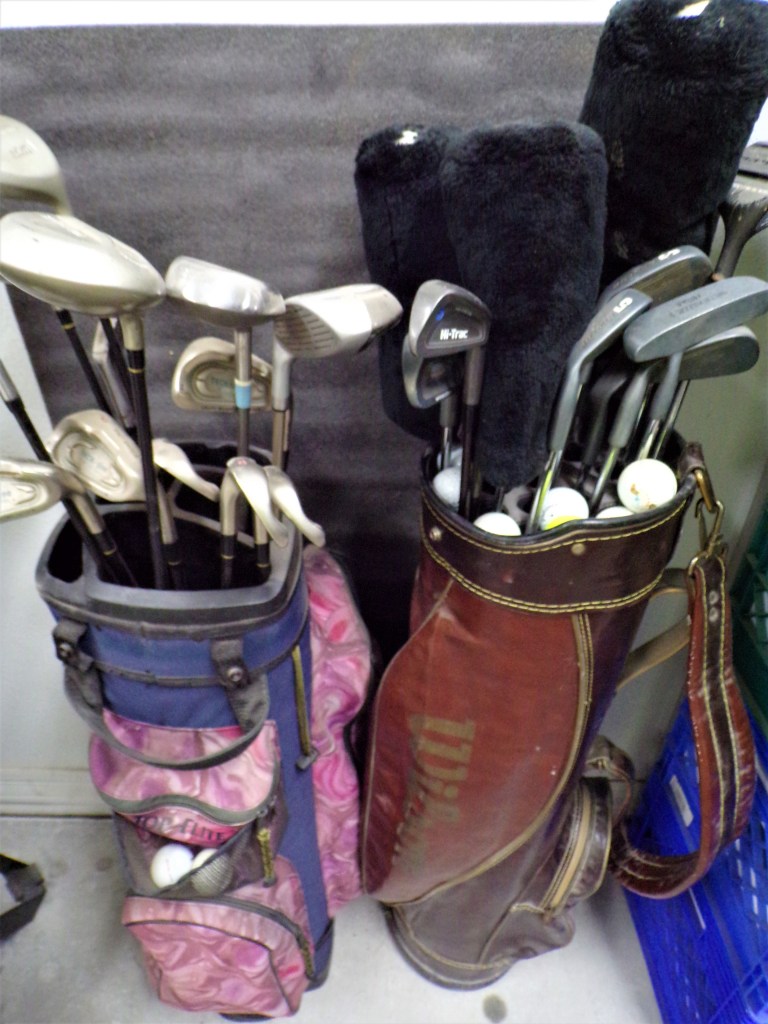
When Joleen and I moved to Lake Havasu City, we purchased two sets of used clubs from the local Hospice Store, along with vintage golf bags. Total for everything was $30.00 including several balls. We’ve never used them and I don’t intend to. I bought mine solely because the player’s names on some putters are now ancient history. One of my antique putters currently makes for a nice walking companion. I’ve carried it on occasion when my back’s out of whack.
I no longer look at them as clubs or putters, now viewing the relics as inexpensive canes. We have enough metal walking sticks to last us a lifetime!
“Hey, even the great Samuel Clemens wasn’t an error free writer.”
You’re Busted!
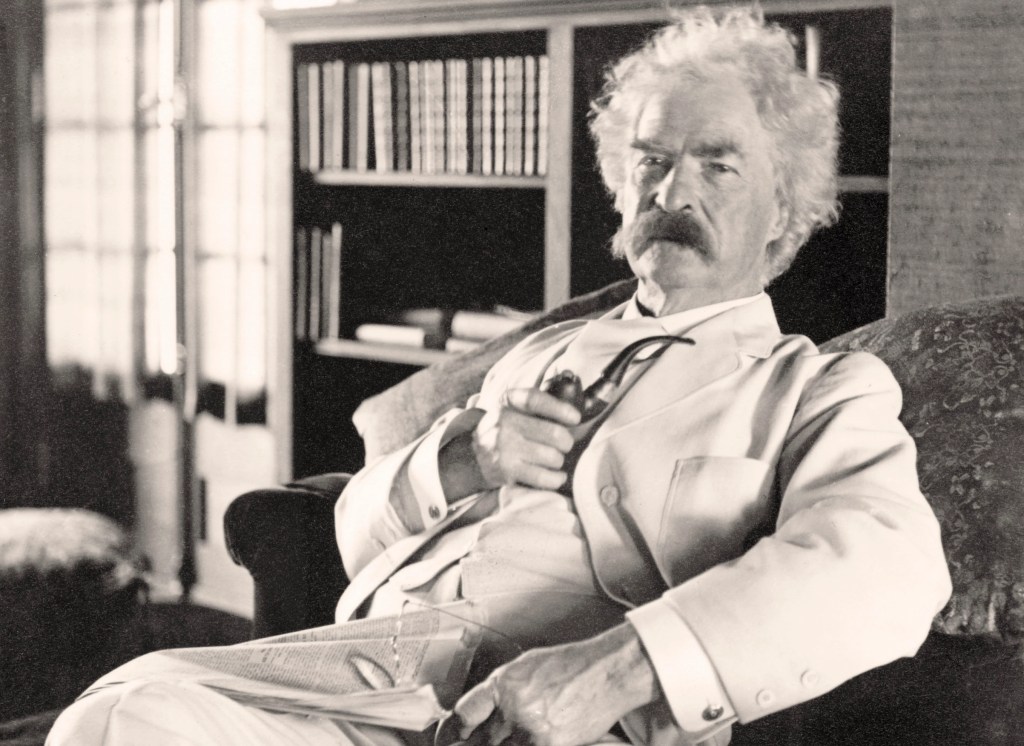
I’ve been busted by the grammar police a time or two. It generally happens on Facebook or while arguing with someone on a political forum. English was my major in college, yet that doesn’t mean I’m Mr. Perfect where not making typos is concerned. Hey, even the great Samuel Clemens (Mark Twain) wasn’t a word-perfect writer. A good many of my blunders unlike Mark Twain’s correlate to spellcheck software. I need a scapegoat and this is as good as it gets.
For the most part, Microsoft Word spellcheck is the police vehicle flipping on red lights. A friend calls it Microslop Word because their software isn’t totally mistake proof. I’ve found this to be true many times.
The other day I was writing something and was stopped short of finishing a sentence. I’d wrote that my hand held a bottle, and Microsoft automatically ran words together making things say, handheld a bottle. Each time I corrected this mistake the red error sign popped up. Other such incidents have occurred.
The word laundromat kept transferring to Laundromat. I don’t care what Google says, that’s not correct unless of course laundromat has a business name in front, like Havasu Laundromat.
Checking things out, Westinghouse obtained a trademark on Laundromat in 1930. Their trademark expired in 1957 and Westinghouse didn’t renew. Why some believe they still have to capitalize this word I’ll never understand. A laundromat to my friends is simply a place to wash clothes. If some English experts want to capitalize Laundromat, they might as well do the same for Washeteria.
Years ago, I was taught to add an apostrophe after a number merely as a separation point, not to show possessive. In the 1980’s, a group of English nerds evidently got together and declared this a problem. The apostrophe was dropped making 1980’s incorrect and 1980s the preferred choice. Being a Rebel in my own mind, I’ll continue writing 1980’s as a way of getting back at them, whoever they are.
Recently, I came across a clever poem written by author, Jerrold H. Zar. It deals with spellcheck problems.
“Ode to the Spell Checker”
Eye halve a spelling checker. It came with my pea sea. It plainly marks four my revue miss steaks eye kin knot sea. Eye strike a quay and type a word and weight for it to say, Weather eye yam wrong oar write. It shows me strait a weigh as soon as a mist ache is maid. It nose bee fore two long and eye can put the error rite. Its rare lea ever wrong. Eye have run this poem threw it, I am shore your pleased to no. Its letter perfect awl the way. My checker told me sew.
Eye do my best to compose accurate sentences free of mistakes. The way eye see things, if you can reed what eye just rote, eye’ve been successful. What more can a guess rider ask for!
“There’s nothing for me to prove these days regarding stamina or athletic ability.”
Not Superman
An older mechanic once told me to treat my body like a vintage vehicle. “Never push things to the limit or it’ll break!” Martin Allen was actually referring to himself.
I was never Superman in my younger years, yet could do my fair share of chores in a day. It wasn’t unusual to work 10 hours and then come home to mow front and rear lawns, plus bag the grass.
Staying up into the wee hours of morning working on projects was routine. My father called this, “Burning a candle on both ends.”
Long Alaskan summers allowed for plenty of hiking and biking. Adding those events after a day at the shop amounted to a full workout. I could seemingly motor along without ever getting fatigued. Youth has it’s virtues.
I’ve slowed down considerably since turning 60. I can still do most of the same things as before but at a more leisurely pace. Mom always preached, “Listen to your body when it’s trying to tell you something!” I do that religiously after having an afib episode.
I don’t push myself like I used to. There’s nothing for me to prove these days regarding stamina or athletic ability. The late Jack Lalanne loved to demonstrate how many pushups he could still do at 90. This was partly because he was hawking books or selling his miracle “Power Juicer.”
If anyone should be called Superman, it’s Jack Lalanne. Regardless of Jack’s superior physique, the man died at 96. Cigar smoking, exercise-exempt, comedian George Burns lived to be 100. Go figure?
Everyone will die sooner or later. Some will outlive others and I suppose for a few there’s bragging rights here. I’m not one of those few. The important thing to me is that I made a decision back in 1973, on where I’ll go when my heart stops beating. Hopefully, Jack and George did the same.
“I’m thankful we didn’t have e-mail or text messages back then, otherwise I wouldn’t possess this wonderful keepsake.”
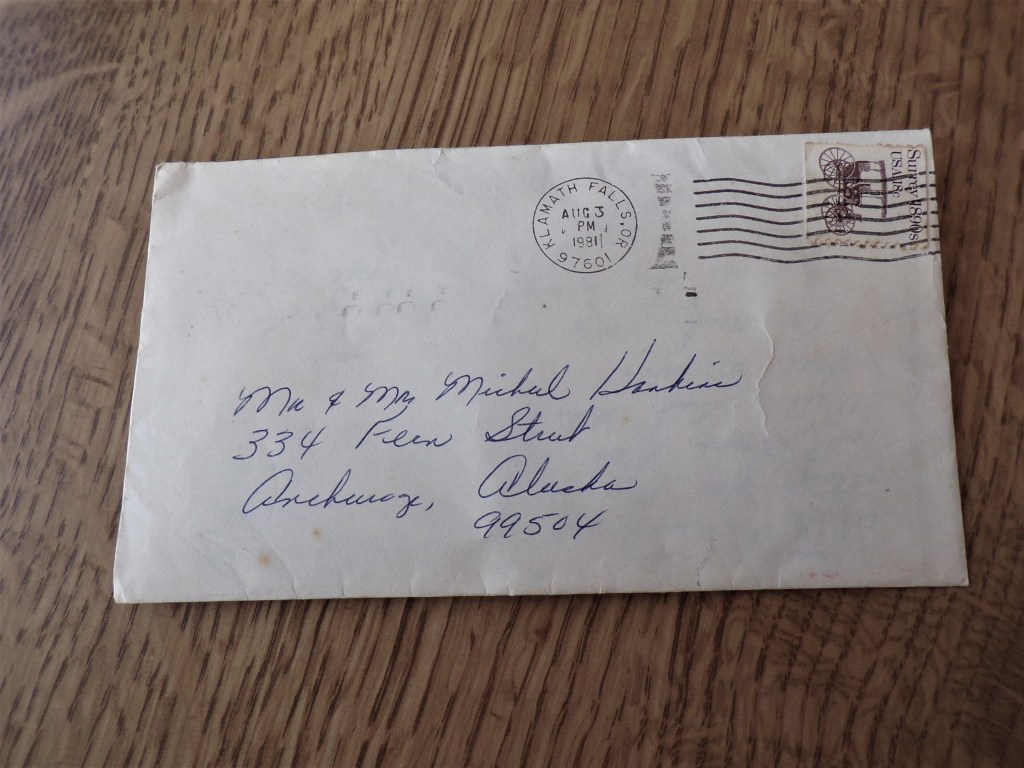
August 3, 1981 – Klamath Falls, Oregon
My mother’s been gone a little over 12 years now. Not a day goes by that I don’t think of her or Dad. I was looking through some paperwork in an old toolbox of mine, and came across a letter Mom wrote going on 41 years.
The envelope is slightly yellowed yet the letter inside is unblemished. I’m thankful we didn’t have e-mail or text messages back then, otherwise I wouldn’t possess this wonderful keepsake. Mother composed this while on the road as her and Dad searched for a K.O.A. campground to purchase. That was always my father’s dream.
In this correspondence, she mentions places they’ve been and seen, an episode with her little Shiatzu dog, “Trinket”, encounters with homeless people, folks traveling from Florida and California, and other humorous observations. Mom was always good at keeping us informed when they traveled.
On August 3, 1981, our son Gunnar was in kindergarten, while daughter Miranda was barely one year old. I was managing one of my folk’s automotive parts stores during this time, while Joleen was in charge of payroll at D.O.T.
I’ve transcribed things as written. This piece of family history went into my safe afterwards.
We’re in Burns, Oregon. Good name for area – my whole body was burning time we stopped. We got into here after 2 p.m., didn’t think we could make Bend, OR. before late. High desert country – you can mark Idaho, Utah off my list. Pocatello was neat town but still in rolling desert land. We looked at K.O.A. campground for sale. Went on to Brighton, Utah to look at another K.O.A.. Both was nice and one at Brighton was more our style and price but so hot during day. Nite was hottest winds blowing, at Pocatello cool off at night. My headache about killed me and my nose was running like faucet – Must be bad country for sinus.
Page 2
Brighton was all Cherry Orchard, Peaches, Apples, Plum, Apricot, plus Corn, but all farms was irrigated. I didn’t realize Idaho, Utah was all desert land, so much bare land, sage grass, tumble weeds – kept thinking must see wagon trains, Indians on war path – really what reminded me of. Burns is desert also. Ontario, Oregon – Idaho (Border). H’way 84-20 – is Onion Country, never see so many onion acres in my life. Last nite we stayed at Mountain Homes, Idaho, met this young man traveling by Bike from San Diego, going Yellowstone, then on to Illinois – said had 18 gears on bike – still didn’t see how got up down some these Mt’s and passes. – today we was mostly in canyon –
Page 3
Talk about Alaskan H’way winding. H’way 20 got it beat. Did I write about Trinket and her water jar – well she ride in car so have to keep her water, started out with one Miranda baby food jar, then somehow switched to jelly jar. She refused drink til I poured into baby jar. She almost went to Doggie Heaven in Utah – guess heat really threw her loop. We’re headed into Bend, Or. – then down 97- We hope find cool spot and hold up while. Wheel seal going out on Ford – thinking of trading it for smaller car.
Sat. a.m.
Having car fixed
Page 4
Knew people were weird but sure met some variety – can tell some people not all there – peoples minds so confused just roaming around. Fla. people moving out because too crowded, Calif. too many people. Some just not knowing what they want. Really don’t know anything write. I’m ready find hole stay for awhile. Would like to go in some Nat. Forest for least a week. But that not Hank’s ball of wax. No need say I love you so very very much. I pray to Jesus every day for all of you. Give my babies a hug, kiss.










 I like to write junk...