When I was a child, I looked forward to visiting my grandparents. It was always an exciting and adventurous occasion. Generally we traveled at night, and often times came upon road construction sites along the way.
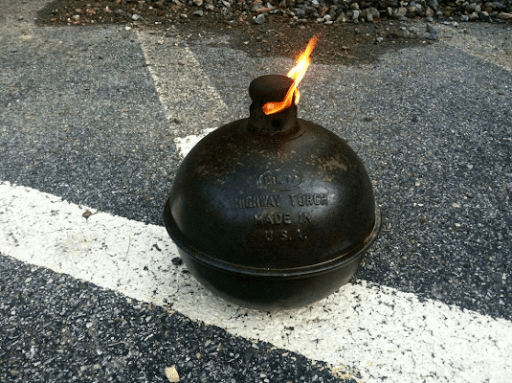
Back then there wasn’t battery-powered warning lights on the edge of the highway advising folks to slow down. Construction crews used black “smudge pots” as dad called them to alert drivers. These pots were round in shape and contained kerosene and cotton wicks much like lanterns and lamps. To me they resembled bombs.
As we slowly drove through these areas the soot-laden-pots flickered in the night much like sinister candles. The smell of burning kerosene permeated the air. It’s an eerie scene that’s never left my head!
My brother and I deserted our television and toys in Selma when we ventured to Vernon. That’s the name of the rural Alabama town where both set of grandparents lived. Neither of them had TV’s or electronic gadgets to keep us entertained. Smartphones and computers weren’t invented back then. Jim and I relied upon our imagination to keep from getting bored.
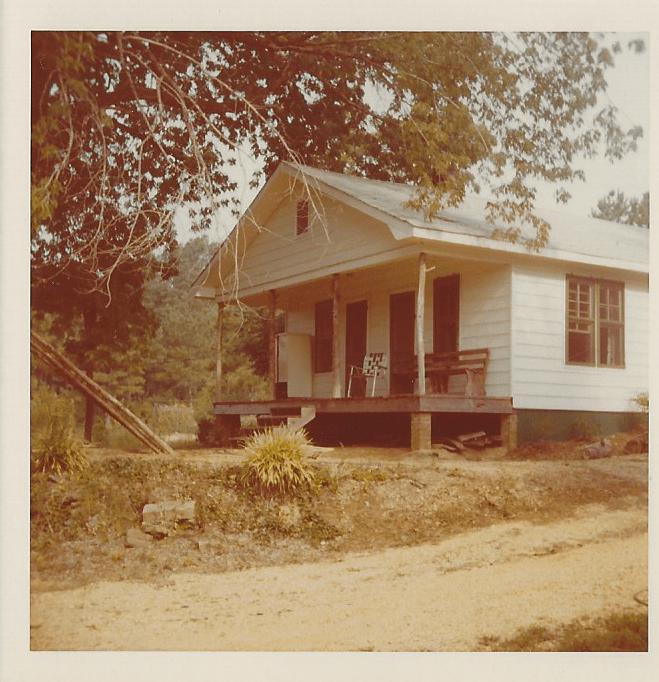
We’d bring along BB guns, comic books, and our own digging utensils. We used these tools to build an underground fort at Papa and Mama Haynes’ place. It turned into quite the structure with tin roof and wooden door, until a tornado totally destroyed our creation. It was good we weren’t inside at the time.
Papa & Mama Haynes’ home – Vernon, Alabama (1974)
My grandparents on both sides would take time to sit and talk to us about their early years. I was always eager to hear what they had to say. A few of their tales I still remember while most of them I don’t. One that’s never left my brain is a bizarre story that Grandma Hankins unexpectedly shared. I’m sure she was chatting with my parents when I accidentally overheard her words.
Grandma said that a fellow she went to school with had recently ate some Red Devil Lye. This product is highly poisonous and no longer sold in grocery stores. The FDA banned it for good reason. Too many little ones were getting into the toxin and innocently ingesting it. Back then lye was popular for cleaning.
The caustic powder evidently destroyed this poor fellow’s stomach. Grandma said that doctors removed the useless organ and transplanted a goat’s stomach in place of it. For some strange reason I found that fascinating.
Each time we visited I wanted to hear the tragic tale. More and more as she repeated it I had to know more. Finally things got to the point where on one trip I asked,
“Grandma, why did this man eat Red Devil Lye?”
To the best of my knowledge she never answered that question. I’m pretty sure Grandma and my parents knew, but most likely they believed I was too young to understand.
With the horrible story still rattling ’round inside my skull, a year ago I decided to investigate. Using http://www.newspapers.com it didn’t take long to find the answer.
It wasn’t uncommon back then for folks to commit suicide by swallowing lye. Doing so wasn’t always an instant death. Instead, it could be slow and painful. Evidently this former classmate of grandma’s elected to take his own life for whatever reason? Grandma said he didn’t live long after the transplant.
Not all of my grandparent’s tales were so macabre. As I mentioned earlier, this Red Devil Lye tale wasn’t meant for my ears to hear.
The events I still recall basically dealt with good things. Stories like my grandma and grandpa walking to school, wading or swimming in a stream, working in the fields, or going to church each Sunday in a horse-pulled wagon. Grandma said they’d not return home until late evening. Evidently it was customary back then to visit friends after a sermon.
When it was time for us to leave and return to Selma, Jim and I never wanted to go. We had too much fun there in spite of having no television.
I now have to wonder. Could children these days endure such an ordeal?
I’ve had my share of heroes over the years. Daniel Boone, Davy Crockett, Admiral Richard E. Byrd, Amelia Earhart, General Chuck Yeager, Colonel Norman Vaughan, to name a few. Hollywood actors or sports heroes have never been folks that I wanted to emulate, other than perhaps, Tim Tebow.
I’ve always admired adventurers. The late evangelist Billy Graham is at the top of my list although most wouldn’t call him an explorer. He was to me where exploring the Bible is concerned.
Of the seven names mentioned, I’ve only met one in person and that’s Colonel Norman Vaughan. The colonel was a close friend of my Fern Lane neighbor, Bill Devine. Bill invited me to a lecture by the famous dog musher and explorer. I was mesmerized by what this gentleman had to say. Norman had a captive voice that was easy to listen to.
Colonel Norman Vaughan
Vaughan told the packed auditorium that evening only a very small portion of his near century-long-life which is truly remarkable. He was born into a wealthy family in Massachusetts, yet chose not to pursue business endeavors like his parents wanted. He desired to be a dog musher instead.
When Norman mentioned going to Antarctica with Admiral Richard Byrd, he had me by the gizzard. What Vaughan was able to do in his life were things I only dreamed of. The stories he told that night at Alaska Pacific University had everyone on the edge of their seats. When the talk ended I wanted to know more.
As he sat at a table signing books I had several questions to ask. While others shook his hand and thanked the man I patiently waited for my chance. After the last person walked away, Bill Devine introduced me.
He slowly stood to shake my hand with a noticeable hunch, yet his grip was stronger than most young men. The always smiling Norman was more than happy to chat. He filled me in a bit more on his military career, including a few funny things regarding neighbor Bill that I’d never heard. I eagerly purchased one of his manuscripts before saying thank you and goodbye. Colonel Vaughan inscribed on the inside front cover of my book,
“To Michael – Dream big and dare to fail! Norman Vaughan.”
Before meeting Norman Vaughan that night I’d read about his exploits along with those of Admiral Byrd in a book titled, “Little America: Aerial Exploration in the Antarctic the Flight to the South Pole.” I have a copy of that 1930’s hardcover book signed by Richard Byrd. It’s not unusually rare because most every book he peddled contains a signature.
During Admiral Byrd and Norman Vaughan’s Antarctic trip, the admiral named a mountain after his much younger accomplice. In 1994, at the age of 88, Norman Vaughan was finally able to scale Mt. Vaughan. The mountain is 10,301 feet tall.
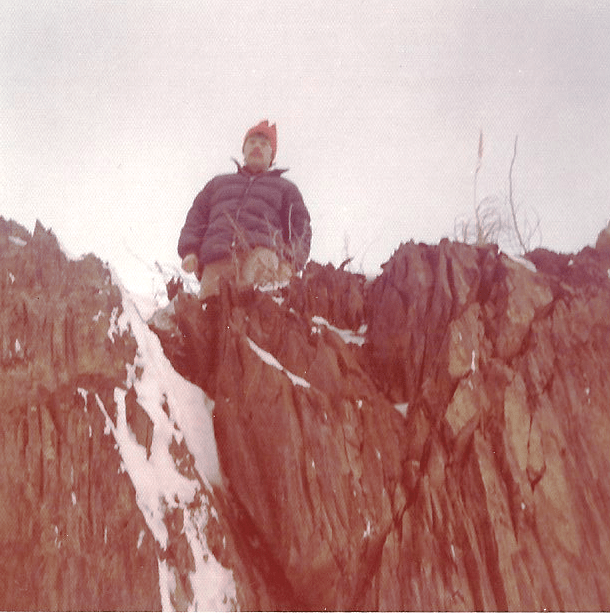
In memory of his feat, a group of us at work constructed a metal and cloth tribute on top of a huge snow hill. A photo of it was featured in the “Anchorage Daily News.” Colonel Vaughan made a special trip to our workplace to view the creation along with extending thanks to everyone involved.
Monument we built commemorating Norman Vaughan. That’s me standing next to it in top photo.
I’ve done my own exploring over the years with friends and by myself, yet nothing on the scale of Byrd or Vaughan. Through the reading of books written by explorers and adventurers, I’ve accomplished more dreaming than anything. During early school years, I daydreamed to the point where one teacher thought there was something mentally wrong with me.
She called my parents in for a special talk. It dealt with my staring out the window during class. I still find myself doing such out the living room or kitchen window. The same teacher brought dad and mom in again because I’d fall asleep at my desk. That was only because I stayed up late each night reading “The Hardy Boys”mystery series.
Back then it was easy for me to imagine being inside a homemade submarine constructed from 55-gallon drums. I’d actually drawn up plans for such but thankfully my folks wouldn’t allow the coffin to be built. On other days, my mind would take me deep within hidden caves in search of buried treasure. Sometimes I was an explorer lost in the wilds of Alaska or a pilot breaking the sound barrier. My imagination was endless and still is. It got me into trouble several times where practical jokes were concerned.
Books took me to remote places that I’ll never set foot on. An avid reader, I won an award the summer of 1965 for reading the most books at our local library. My total for three months was well over 100. The prize being of all things; a non-fiction book titled,“Kon-Tiki”, by Thor Heyerdahl.
“Kon-Tiki” is an adventure story about a group of men building a raft out of balsa, and then attempting to cross the South Pacific. I made a copy of their fledgling creation with Popsicle sticks and Elmer’s glue for a school project.
Thor Heyerdahl’s book was the perfect prize because it dealt with something that my brother, Jim, and I had already constructed in Alabama. Unfortunately, our crude raft came apart soon after it was launched.
I still have my “Kon-Tiki” book minus front cover thanks to one of our dogs. It was either, “Brutus” or “Ringo”, although after so many years I can’t recall exactly which one. Recently, I saw where aHeyerdahl book in good condition is worth upwards of $150.00 unsigned. The one I have was signed until that valuable portion was consumed.
When my wife saw the title to this story, “Byrd, Vaughan, and Hankins”, she had to chuckle.
“You can’t put yourself on the same level as a Richard Byrd or Norman Vaughn!”
I knew she’d say that and Joleen was right. I figured that’d be the comment of friends and strangers as well. Some might even say,
“That’s mighty vain of him!”
My reply is simple: I believe we’re all explorers in one way or another. A person doesn’t have to climb mountains or hike across frozen Alaska glaciers to lay claim to the title. Visiting an antique shop, historic cabin, or museum is exploration on a different scale. Walking along a meandering stream or through a meadow of blooming Fireweed is the same.
If Norman Vaughan was here I believe he’d say,
“Never stop dreaming or exploring no matter how old you are.”
Placing my name next to Byrd and Vaughan on this article is merely a symbol of where I’d like to be as an explorer. Nothing more. According to Norman Vaughan, there’s no harm in dreaming and setting our goals high!
Norman never stopped dreaming until he passed away at age 100.Michael D. Hankins
“Our cheerleaders took no offense because any cheer for East was a cheer to win, no matter how obnoxious.”
“Air ball” falling way short
When I think of basketball I flash back to the classic song by Cheech and Chong titled, “Basketball Jones.”
The 1970’s tune tells of a young man stricken with basketball fever. He has it so bad that he sleeps using a basketball as a pillow. Evidently that’s what gave him severe neck and spine problems later on in life.
I’ve never been a basketball fanatic like some of my friends. Because of this lack of interest I stunk at playing the sport. During PE class when teams were picked, I was generally the last guy standing. That didn’t bother me.
At Clark Junior High, friends talked me into staying after school and playing intramural basketball. Why I gave in to them still remains a mystery. I had a newspaper route delivering the “Anchorage Times” and on those game days the paper was late.
I viewed basketball more as a fancified version of hot potato than anything else. When the ball popped into my hands I quickly passed it off to another player. On occasion, just for kicks, from thirty feet back, I’d toss it towards the basket hoping for a miracle. That never happened.
Most if not all of my shots became air balls falling way short of the rim. Team members became disgusted with my lack of seriousness, and eventually left me standing on the sideline. That was okay with me.
It was later on in high school that I found my calling as a bleacherloud mouth. My voice has always been good and strong. When needed it was so overbearing, that I often drowned out the cheerleaders. Our cheerleaders took no offense because any cheer for East was a cheer to win, no matter how obnoxious.
One thing I developed to perfection was yelling“shoot” when an opposing player got the ball. I can’t tell you how many times I shouted that word. I’d say 50% of the time they’d let it fly after hearing the command. Opposing coaches gave me the stink eye.
If a player missed, I received admiration from fellow fans. On rare occasion the shooter would make a seemingly impossible 3-point shot. During those miscues I’d quickly slink down in my seat.
I rarely got to attend high school basketball games like some kids, because of having to work for my pop after school. Dad and another man owned Wonder Park Texaco and I pumped gas there.
The perhaps 10 games I was fortunate to see are memorable. Young fans loudly rooting for their respective teams sticks in my mind. Continuous stomping of feet on bleachers especially so. Those wooden structures must’ve been built extra-strong. In a way it was reminiscent of fans at Lone Star Wrestling events. More on that later.
It was sometime during either the year 1970 or 1971 when East played the Dimond Lynx. Dimond High is where my wife went to school. She believes she might’ve been at this particular game, yet doesn’t remember the climatic ending like I do.
Time was running out and East was ahead by a point. Dimond had the ball with perhaps 20 seconds left on the ticker. The Lynx were coming down court like a runaway freight train. When a Dimond player clutched the ball well before the three-point line line, I stood and yelled,
“Shoot!”
He instantly reared back and let go with it falling way short of the rim. East grabbed the rebound and ran out the clock.
Had replay been available in the 1970’s Ishould’ve been given the game ball. Unfortunately, my winning shout never received merit from Coach White or anyone else for that matter. That was fine with me.
My son and daughter, Gunnar and Miranda, played basketball during their school years at Muldoon Christian and Heritage Christian. I’d told them the unbelievable East vs Dimond story countless times. I always hoped for a little sympathy on their part yet none ever came.
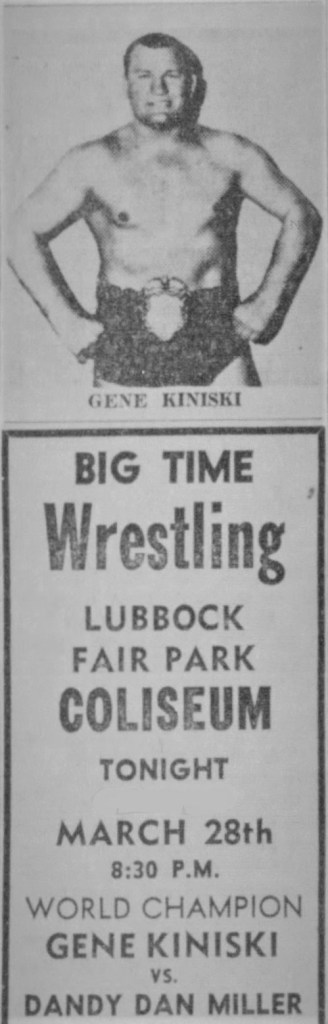
Miranda once asked how come I was so loud and boisterous at sporting events when other parents weren’t. The only explanation I could give her, was that my brother Jim and I attended Lone Star Wrestling events when we lived in Lubbock, Texas. Dad took us there on Wednesday, Friday, or Saturday nights. They were the highlight of our week!
Where I learned to cheer (ad circa 1964)
Lone Star Wrestling was much like the WWF is today. Texas wrestling fans were loud and rowdy at these events. I suppose they still are. I continued emulating them long after we left the state, believing that was the proper way to cheer on a competitor or team.
During one of Gunnar’s last basketball games, the score was tied with only a few seconds left. I’d been quite vocal while watching them go up and down the court but not obnoxiously so like my East years.
When it appeared things would go into overtime, and the opposing team held the ball with maybe 5 seconds left, I decided a Lone Star yell was needed,
“Shooooot!”
He did. The ball swished in as the buzzer sounded. The other team won. I couldn’t get out of the gymnasium fast enough. A couple of parents gave me the skunk eye.
You’d think I learned a big lesson that night and I did.
For the rest of the time until Miranda finished school at Heritage, I’d sit on the opposing team’s bleacher and root. I’d yell to my heart’s content and get disgusted looks from strangers instead of folks I knew. That didn’t bother me.
Lone Star Wrestling fans back in Lubbock, Texas would’ve been proud!
“Any leprechaun with half a brain should be able to figure this out!”
Happy-GO-Lucky
St. Patrick’s Day is quickly drawing near and I can happily report,
“I’m ready!”
My wife and I aren’t Irish or Catholic, yet that doesn’t stop us from joining in the festivities with a plate of corned beef and cabbage. Joleen prefers to stuff green peppers with these ingredients and then bake. I love the delicacy although it doesn’t love me. What is it about some foods and gas?
Several years ago at Wal-Mart I purchased a bright green tee-shirt with “Happy GoLucky” printed across the front. It’s only worn on special occasion. Afterwards, the garment is neatly folded and carefully placed in a bottom-dresser-drawer. I never wash it because the label says 100% cotton and I’m afraid it might shrink. Regardless of not being cleaned, the shirt seems to have shrunk each time I put it on.
St. Patrick’s Day for some folks means green beer. I don’t indulge. I’ve often wondered what’s done to make beer that color? For those that drink the stuff it’s probably best not to know! The beer I consume has root in it. A&W’s still my favorite, although the homemade brew at Mr. D’z Route 66 Diner in Kingman is right up there.
When I was a kid, if a student didn’t wear green to school on St. Patrick’s Day they were pinched; mostly by girls. A friend of mine intentionally never wore the Irish color because he craved female attention. His pinching session quickly terminated whenever someone shouted,
“You should see Larry’s underwear. They’re green plus other colors!”
I might’ve made the remark a time or two out of jealousy.
Four-leaf clovers are symbolic with St. Patrick’s Day. They’re supposed to bring luck to a person finding one. Over my 65 years I’ve searched and searched yet never came up a winner. I sometimes wonder if they naturally exist? It’d be easy to counterfeit such with a bit of glue and an extra leaf. I know for sure they don’t grow here in Lake Havasu City, Arizona.
The closest thing we have to four-leaf clovers are four-bump green-bell-peppers. Say that with a mouth full of popcorn. The grocery stores are generally low on this variety for a reason. Did you know that bell peppers with four nubs or bumps on the bottom are females? I didn’t either until perhaps two years ago.
Before I became educated on bell peppers I’d always brought home a three nubber. Three was the late Dale Earnhardt’s race car number so that’s probably why. After one shopping spree Joleen gave me unneeded advice. I think she might’ve been watching Martha Stewart that day.
“Always buy the ones with four bumps because they’re females and are much sweeter!”
Who would’ve known? Her statement seemed sexist at the time.
These days whenever I’m in a supermarket, I stroll by the bell pepper section out of curiosity. On many occasions there are only three nubbers to choose from. The unlucky females had been carted away by savvy customers.
In my way of looking at things, a three-bump green-bell-pepper is just as lucky as a four-leaf clover; perhaps luckier where survival is concerned. Any leprechaun with half a brain should be able to figure this out!
When St. Patrick’s Day rolls around on March 17th, I’ll be bringing home a lowly male pepper regardless of what my wife says. This’ll be an experiment of sorts.
Perhaps eating the less-sweet version stuffed with corned beef and cabbage will help ease my gas problem?
“If I can’t find a buyer, I’ll hang on to it until death do us part.”
“Bunker Hill” by, Howard Pyle, showing British “Redcoats” lined up with Brown Bess muskets.
* The followingstory was composed strictly so that the history of my musket is never lost.A copy of this manuscript will be attached to the weapon.
As a small boy I dreamed of one day owning a “Brown Bess” musket. I’d read of the legendary gun in stories regarding George Washington, The Revolutionary War, and Daniel Boone. Wikipedia offers a simplistic explanation of what a Brown Bess is:
“Brown Bess” is a nickname of uncertain origin for the British Army’s muzzle-loading, smooth bore, flintlock Land Pattern Musket and its derivatives. This musket was used in the era of the expansion of the British Empire, in battles during the American Revolution, and acquired symbolic importance at least as significant as its physical importance.
It’s believed that Brown Bess is slang for, Queen Elizabeth I, although there’s no definite proof of such. Once again, Wikipedia provides a plausible explanation:
“Brown” came from an anti-rusting agent put on the metal that turned it a brown color. “Bess” came from either the word “Blunderbuss” or “arquebus,” both early types of rifles. “Bess” came from the nickname for Elizabeth I. The “Brown Bess” is just a counterpart to an earlier rifle that was called “Brown Bill.”
I’ve never heard of a “Brown Bill.” There’s something about this name that doesn’t turn me on historically speaking. It sounds more like a nickname for some fellow that easily tans.
To me, a Brown Bess musket is a symbol of this country’s heritage and freedom. A good many of these guns were captured from the British by Continental Army forces, and used against them during the American Revolution.
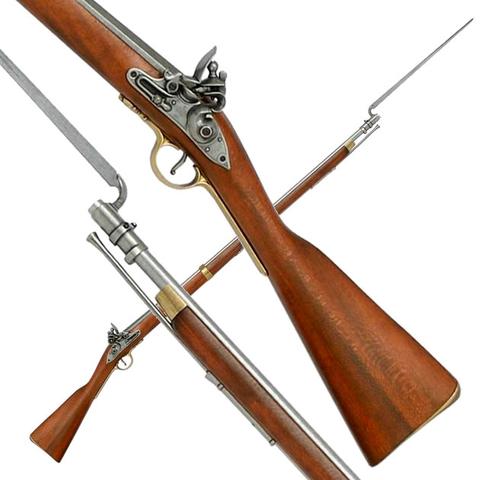
1777 Brown Bess musket
A Brown Bess that I’m in possession of is a Type 3 India Pattern version with 39 inch barrel. It was purchased from a dealer in Old Scottsdale, Arizona. This businessman acquired it from the late gun expert, Norm Flayderman. The story behind the musket is quite interesting.
According to Norm, a high ranking Army officer owned it up until he passed away. Part of the estate sale stipulated that this person’s name remain anonymous. The family didn’t want to be bothered. Somewhere along the way, an inheritor of the collection lightly inscribed a social security number on all of the antique arms. The number is so light that I had a hard time using a powerful magnifying glass to read it.
Someone having a little pull with government officials should be able to decipher things and figure out exactly who this person is. That might tie it in to the original owner. I tried and failed.
The social security number (578-60-3258) is on a portion of the brass trigger guard. The first three numbers (578) signify that he was living in the District of Columbia at the time of SS issue. When I show this to people they shake their heads. It could easily be removed but I personally find it adds uniqueness to the Brown Bess’s overall 200-year plus history.
According to what Norm told the dealer, this firearm was in sad shape having much surface rust after years of neglect. It was brought back by the military man from England after WWII ended. This indicates to me that it was a re-captured weapon by the British.
A New England gunsmith familiar with antique weapons carefully removed the rust, and restored things back to firing condition. All identification marks and numbers would’ve been unreadable had he not done so. Military soldiers are taught that a gun should always be spotless and in proper working order, and the original owner made sure this one met that task. Thankfully, it wasn’t converted to percussion as so many were.
Some original markings were brought back to life in the restoration and I believe some were unable to be salvaged. Most noteworthy: is a somewhat hard to see number 65 on the barrel. I believes this designates it was used by the 65th British Regiment but could be wrong. The renown 65th regiment saw duty at Bunker Hill during the beginning of the American Revolution. This makes the musket exceedingly rare if true.
Also visible is the maker, Wilson. The initials RW (Richard Wilson) is faintly readable as well, along with what appears to be other marks that I’m not familiar with. Evidently, the area where the year was located was heavily pitted as nothing remains. This weapon was one of several in the late gentleman’s collection. A brass identification tag attached to the trigger guard has 001 stamped on it.
Sometime in its early life, the gun became property of the fledgling United States Colonial Army, as two distinctive US surcharge markings are visible. When weapons were confiscated from the British this US mark was stamped on either wood stock or metal components.
The following information on Type 3 Brown Bess muskets came to light during my research:
“Noted historian and collector Dale Anderson states that the Smithsonian Institute is now certain that Third models like this one appeared about 1777, and that the National Park Service has a complete Third model confiscated from the British at Yorktown. There is also some evidence to show that captured Third models might have been stored in Federal armories after the war. It’s known that simplified India pattern type furniture was used on privately made British firearms before and during the Revolution.”
The Third Model Brown Bess served, to a degree in the 1777-1784 conflict but most certainly did so in the War of 1812, when the British burned the White House. However, its most famous success was as the British Line Musket that defeated Napoleon at the Battle of Waterloo in 1815.
I’ve had my Brown Bess for close to 40 years. It was a significant purchase and only through an understanding wife was I able to procure it. Early on, she knew that I had a list of certain oldthings that I wished to acquire, and this was one of the top items. That list is now complete.
Time has arrived that I sadly deem it wise to say goodbye to all such worldly goods. Hopefully, someone else appreciates this musket as much as I did. If I don’t find a buyer for “Brown Bess,” I’ll hang on to it until death do us part. At that point, one of my children or grandchildren will have to deal with getting rid of the relic. I cringe thinking of it being left at a secondhand store. One thing I won’t do for sure, is inscribe my social security number anywhere on it!
“Each time I handle this artifact I sense an aura of death.”
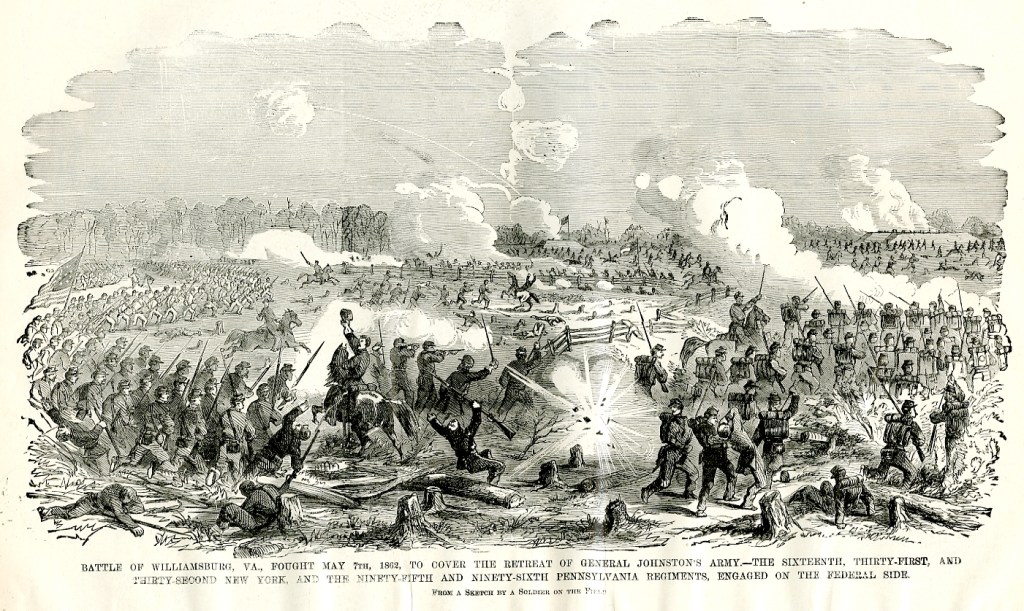
In this Battle of Williamsburg rendition, the soldier in lower middle of sketch holds what appears to be a Springfield Model 1861 rifle. The unfortunate man’s been struck by shrapnel from an exploding cannonball and knocked backwards. This artwork was created by a Union soldier who actually observed the battle.
I’ve been an antique aficionado going way back. Mom said as a child I drove her and my grandparents crazy asking questions about this and that. I wanted to know anything and everything there was to know about “old things”. I believe all surviving relics have a story to tell. Unfortunately, not all of their stories are accurately told.
I recently came in possession of a Bristol kerosene lamp. It’s beautiful and has nary a blemish. The person I purchased it from said it’d been in his family for over 130 years. There was no one left to pass it down to so he regretfully sold it to me. Holding this jewel in my hand, I sensed that in the beginning, going back to 1890, the lamp was a most cherished item by its initial owner.
Other family members had painstakingly became caretakers of it from generation to generation. The antique talked to me in an unspoken way, whispering that I also needed to give it special love and attention.
A flint hide-scraping-tool discovered in Kansas has significant meaning. It lay untouched many years until I picked it up alongside a dirt farm road. The Indian losing it probably felt as bad as we do after misplacing a wallet or phone. He had to painstakingly chisel out another one before skinning his next buffalo. Holding this artifact in my palm, I realize that 150-years-ago some warrior’s hardened hands held the same.
Papa Haynes had a double-barrel shotgun hanging on a store wall. Papa’s firearm kindled my interest in antique weapons and related accessories. Vintage long arms and pistols talk to me the most. I don’t mean they speak in a vocal fashion. It’s more of a sensual, braille like dialogue. Shouldering an old Sharps or Winchester rifle allows my mind to wander back in time; the same with holding a western era Colt revolver. For the most part all antiques have something to say. You just have to take time and listen.
Perhaps the one item I stumbled across that speaks to me loudest is an 1861 Springfield Civil War musket. Spotting it in an antique shop, I traded a pristine condition Model 1816 Springfield musket for the treasure. My 1816 musket was in far better condition with a clear cartouche on the stock. A cartouche is a branded section in the wood identifying the person inspecting the gun. This pristine musket evidently spent its early years in some government arsenal never seeing action. Because of this pampered life it didn’t have anything exciting to say.
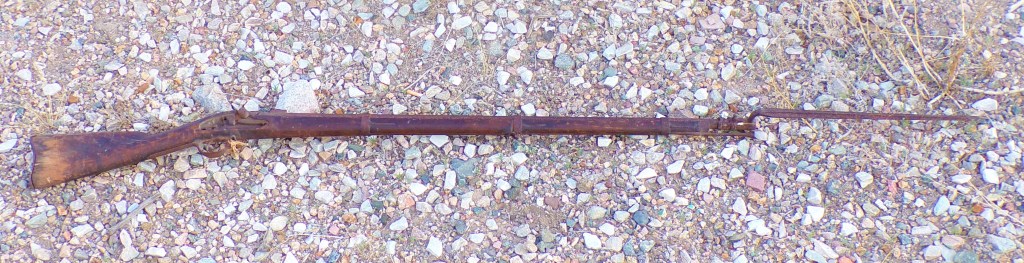
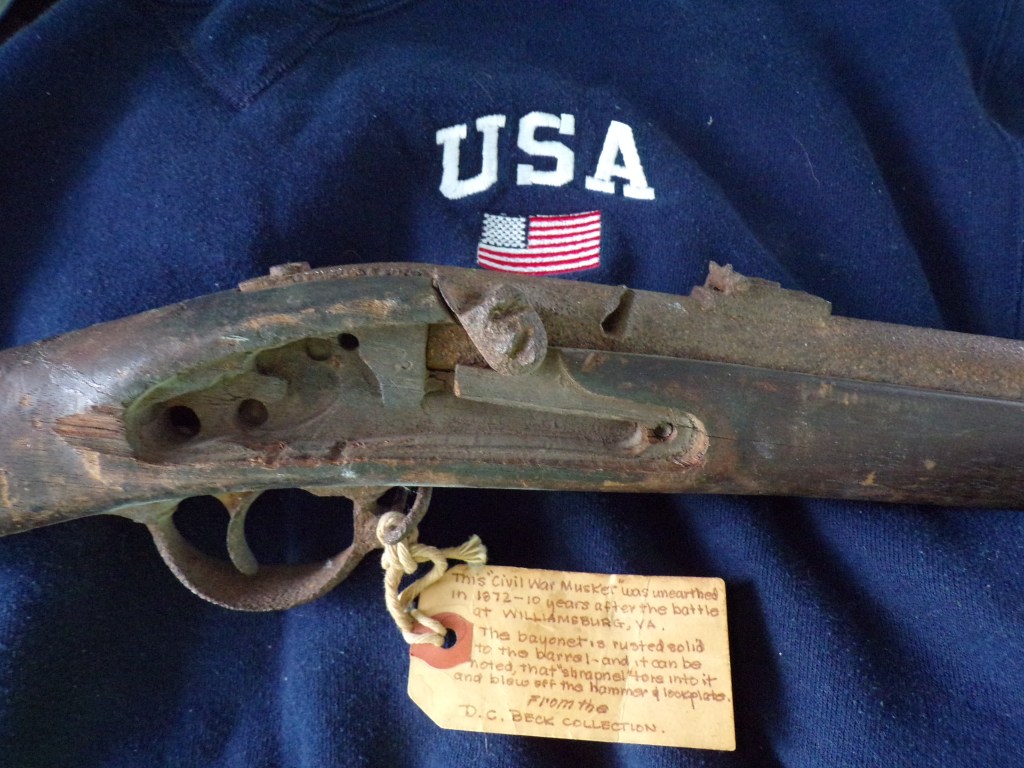
The 1861 Springfield incurred a much harsher life. It was excavated at the site of The Battle of Williamsburg in Virginia. An old hand written tag attached with yellowed string reads as follows:
This “Civil War Musket” was unearthed in 1872 – 10 years after the battle at Williamsburg, VA.
The bayonet is rusted solid to the barrel and it can be noted that shrapnel tore into it and the hammer and lockplate.
From the D.C. Beck collection.
An imposing weapon at 74″ long with bayonet.
Several times I’ve looked down the barrel using a bore scope. It appears a mini ball is still wedged inside. I believe the soldier most likely was on the move, charging forward with gun to hip.
The only way shrapnel could’ve struck the barrel in that location, was if the Springfield was perpendicular to the soldier’s body. If that were the case he too would’ve inflicted serious wounds from the explosion. Each time I handle this artifact, I sense an aura of death. It’s easy to visualize the broken weapon lying on blood stained ground, with the unfortunate infantryman near by along with others; Confederate and Union. Hand to hand combat was common during this horrific melee.
Note the indention in metal barrel just under USA flag to the left. It took a terrific explosion to leave that mark in hardened steel.
There were 3,965 Union and Confederate soldiers killed during The Battle of Williamsburg. Ironically, a pencil drawing of the battle created by a soldier having fought there, portrays an infantryman being blown backwards when a Confederate shell explodes in front of him. It appears the man’s carrying a Springfield Model 1861.
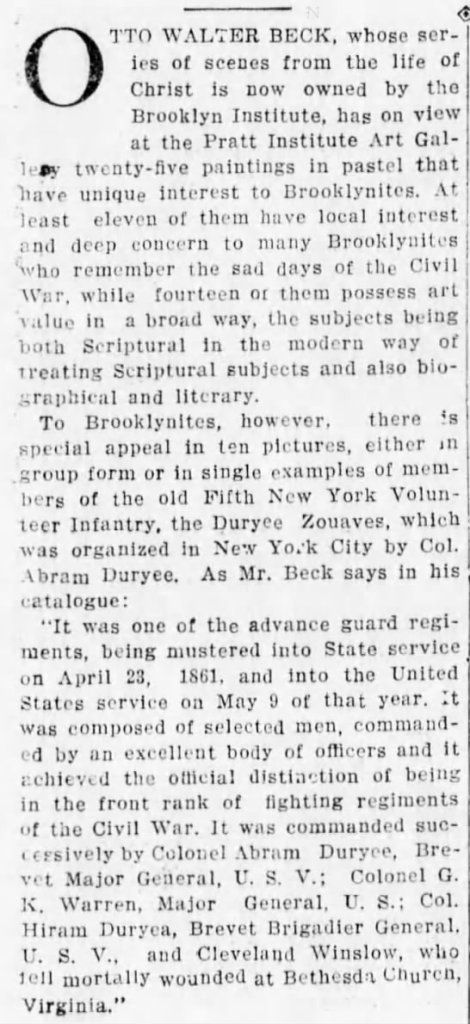
My relic once belonged to famous artist Otto Walter Beck. Walter was a Civil War historian known for his renditions of surviving war veterans. He painted many Biblical pieces of art as well. Walter and his wife Marion created the Innisfree Garden in Millport, New York. This magnificent garden is still blooming and open to the public.
Walter Beck’s excavated Springfield, along with tintype and daguerreotype photos procured from war survivors were part of his Washington D.C. Civil War display during the early 1900’s. Some of Beck’s military paintings still reside within the Smithsonian.
Article on Walter Beck from the December 14, 1913, “The Brooklyn Daily Eagle.”
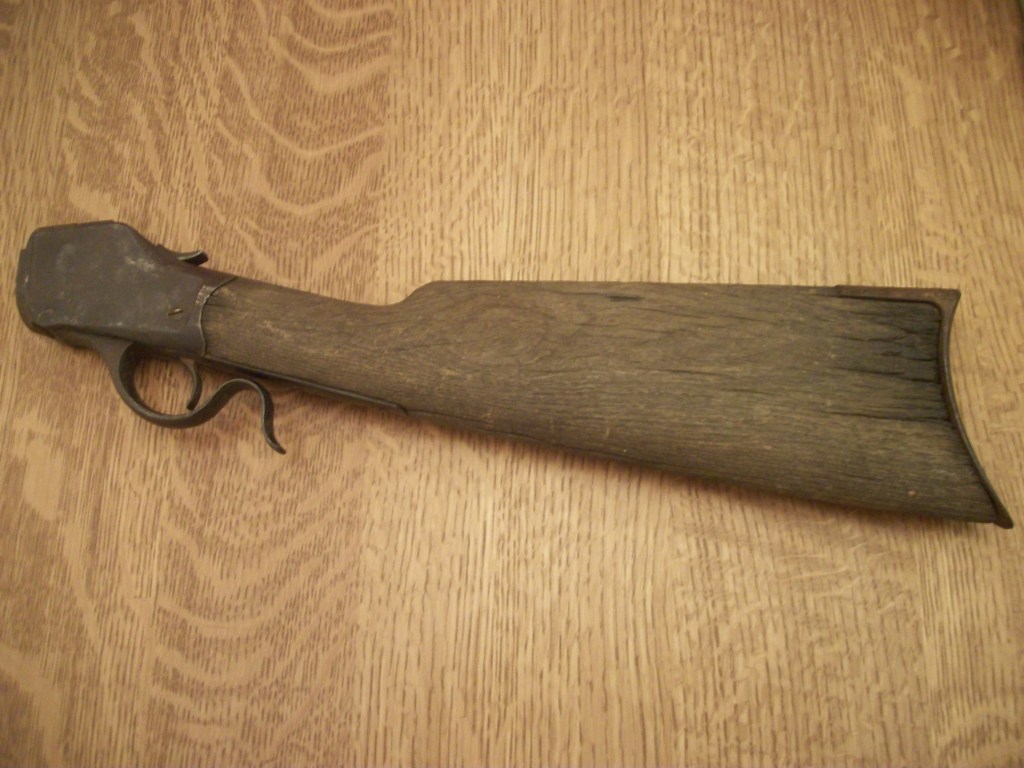
One of the more interesting guns that talked to me took some doing before it’d say anything. Alaska resident, Larry Boyd, discovered the rusted and rotting section of a Winchester lying under floorboards of a decaying miner’s cabin near Dawson City, Yukon Territory (Canada).
Larry gave the relic to my friend Jeff Thimsen. Somehow I ended up with it. Jeff believes the area where it was found is actually more near the ghost town of Forty Mile, Y.T. A serial number on the lower receiver should tell a person exactly where it was sold. This is available by sending that number to the Bill Cody Museum. Unfortunately, only a portion of the number on my artifact was visible. The unseen number was totally obliterated with rust.
Good friend, Tom Doupe, offered to help me uncover the missing link. A pal of Tom’s worked at the Alaska State Troopers Crime Lab in Anchorage. Using special techniques developed by the FBI, this professional offered the use of such to try and recover my missing number.
The process works like this. Whenever a piece of metal is struck with a number or alphabet die, the molecular alignment of material underneath the impression is also changed. Using muratic acid to remove the initial layer of rust, he then lightly touched the spot with a file. A high strength magnifying glass allowed him to make out the missing 7. He then photographed it with with a camera.
The completed serial number showed it was an 1885 Winchester – 22 short caliber – “low wall” rifle. This gun was sold in Seattle in 1896. That year was the start of the Alaska Gold Rush. Miners boarded ships in Seattle during that time for the long voyage north.
A 22 short in Alaska is a relatively worthless bullet. It’d be good for shooting small birds or ptarmigan and only those at close range. The barrel on this particular rifle unscrews from the receiver. It can be converted to a larger caliber simply by switching barrels. I believe the owner may have had that in mind. Perhaps if Larry Boyd had searched further the barrel would’ve been found?
After Gold was discovered at Forty Mile, a larger strike was made near Dawson City. Virtually overnight, the town became deserted, with miners quickly scurrying up the Yukon River to stake their claims . One thing this gun did tell me was that the owner wasn’t struck by a cannonball. It didn’t tell me was what happened to the fellow?
My hunch is a young miner placed the Winchester under floorboards of his log cabin with intents on coming back for it. I like to think he hit it big in Dawson City. At that point, the gun became yet another rusty reminder of year’s gone by.
Not all weapons found in the ground have graphic or interesting stories tell. An 1851 Colt Navy pistol I purchased from renown antique firearms expert, Norm Flayderman, was discovered in an area of Texas where no recorded Civil War battles were fought, nor skirmishes with Indian warriors. The weapon lay under soil for some time because all wood was gone as well as the thin steel trigger. A portion of the brass trigger guard was pushed in as if it struck something hard. I asked Norm what he thought happened.
“It’s something all of us do from time to time. It’s called the dropsies.”
He finished his statement by saying some cowboy must’ve been riding through the area and his Colt accidentally fell out of its holster. It lay undiscovered for over 100 years before someone found it.
It’s really no different than dropping a set of keys from your pocket. Because this surviving relic had little to say I quickly passed it on to another collector. There’s no telling if the new owner put a more climatic spin on his tale when he showed it to pals.
That’s what happens to so many such artifacts. Without credible provenance, their story grows bigger and larger with time!
Lower section of an 1885 Winchester “low wall” rifle found in a crumbling miner’s cabin.
“The only refrigerator with fast freezing Sanalloy Froster and Eject-o-Cube Ice Trays.”
Refrigerator similar to the one my Grandma Hankins owned. File photo.
The other evening my wife mentioned that she’d never own another stainless-steel refrigerator. That was strange for her to say because Joleen picked it out for our Lake Havasu City home several years ago. I’ve never cared for the brushed stainless look. It reminds me of an extinct DeLorean automobile.
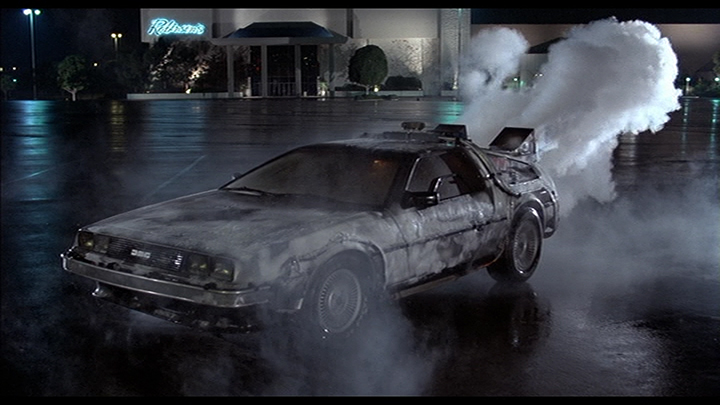
The no-longer-made Delorean’s have a stainless steel exterior much like our fridge. These peculiar looking vehicles never turned my crank. Car guys will know what I’m talking about here.
A DeLorean featured in the movie, “Back to the Future”, was converted into a time machine. I found this portion of the film cool, although I believe an early Dodge Charger would’ve worked much better because of its sleeker lines. Forgive me as I’m straying off the story line.
Professor and Marty’s DeLorean “Time Machine”
Grandpa and Grandma Hankins had a small white refrigerator in their 1920’s manufactured rental home in Vernon, Alabama. How do I remember it as being white? I don’t. That was pretty much thestandardcolor back then.
Grandma’s refrigerator was rounded at the top with a chrome pull-lever on the door for opening. I’m not sure of the exact manufacturer as I last saw it 60-years ago. I’d guess it was a Westinghouse, because that’s the brand my parents preferred.
A 1936 ad I stumbled across in a Stockton, California newspaper, mentioned early Westinghouse refrigerators offering something that other refrigerators didn’t. The advertisement described this device in what I suppose was high-tech language for those days. It read:
“The only refrigerator with fast freezing Sanalloy Froster and Eject-o-Cube Ice Trays.”
These fancy Eject-o-Cube trays had a lever on top that you pulled upwards to remove the ice. Grandma’s had this feature for sure. I’m sure her damp fingers stuck to the metal handle quite often. I read this was quite common until plastic trays came along.
Eject-o-Cube in action
What I remember most about Grandma Hankins’ fridge was that it never had an abundance of food inside. My grandparents were not wealthy people. When we came to visit, dad and mom always made sure to stop beforehand and pick up groceries. That memory hangs with me more than anything. Regardless of such, our visits were always fun.
Grandma’s refrigerator had a tiny freezer section in the very top. Inside of it were the aluminum ice trays mentioned earlier. There wasn’t room for much else. Grandma would take one of the trays and remove the cube dividers. She’d mix up a glass of milk, sugar, and vanilla extract, and then pour it in.
After coming close to freezing, this mixture became an ice-milk-pudding of sorts. It never froze solid. I believe alcohol in the vanilla extract had something to do with it. Grandma referred to this delicacy as ice milk. It was her special treat for my brother Jim and me.
During our near 43-years of marriage, Joleen and I have owned tan, black, and mustard-yellow refrigerators. I believe the ugly yellow one was given to us by someone that didn’t appreciate the Heinz look. At that time we were young and struggling financially; so who’s to look a gift horse in the mouth. That last line basically means don’t complain about something if it’s given to you.
I asked Joleen the other night what color refrigerator did she want next?
“White.”, was her reply.
That’ll be okay with me. In one aspect it’ll be similar to Grandma’s. I recently saw where companies are now making retro Eject-o-Matic aluminum ice cube trays. We’ll definitely have to get a couple.
When the grandchildren stop by, I’ll mix up some of that ice milk concoction that Grandma Hankins made, although it won’t be quite the same with her not in the kitchen. It’s sad I can’t strap the kids into a time machine and fly them back to 1962. That would be like adding a cup of sprinkles to their pudding!
“Hang on to this as it will prove invaluable down the road!”
John Ballard
When my wife, Joleen, and I had a house built in 2004, Lake Havasu City resident John Ballard was hired to oversee the construction of it. We were in Alaska at that time. John was an expert in all phases of home development. Sometime during our hassle-free working relationship, we became very good friends.
Because of John’s vast expertise, several times he caught sub-contractors trying to cut corners and not follow building code. A few didn’t like it when he made them correct their mistakes. One burly framing contractor in particular challenged John’s suggestion to use hurricane straps on our garage.
Hurricane straps are metal strips used to connect roof trusses to wall top-plates. They help the roof stay in place during high winds. When John pulled out a copy of the local building code showing they needed to be there, the guy grumbled having no choice but to add them.
Another time he discovered the builder was not planning on installing LP Tech Shield® in our walls and roof. Tech Shield is a condensed-foam temperature barrier that’s quite costly to add. When John pulled out a copy of our contract showing it was part of the package, the man quickly changed his tune.
Something that John Ballard told me regarding workmanship stuck in my mind. He mentioned that he could tell the quality of a retaining wall before it was ever built. His comment made me curious enough to ask.
“How’s that?”
“I drive by a work site where a block wall’s about to be built and look at the amount of steel rebar that’s been dropped off. Pallets of concrete blocks sitting around without bundles of steel rebar is a sure sign of cost-cutting. There’s a wall in your neighborhood constructed that way.”
He pointed to a vacant lot just up the street with a gray concrete block wall. Several years after he said this, a large gust of wind blew the ill-designed structure over. John was right on the money in his analysis.
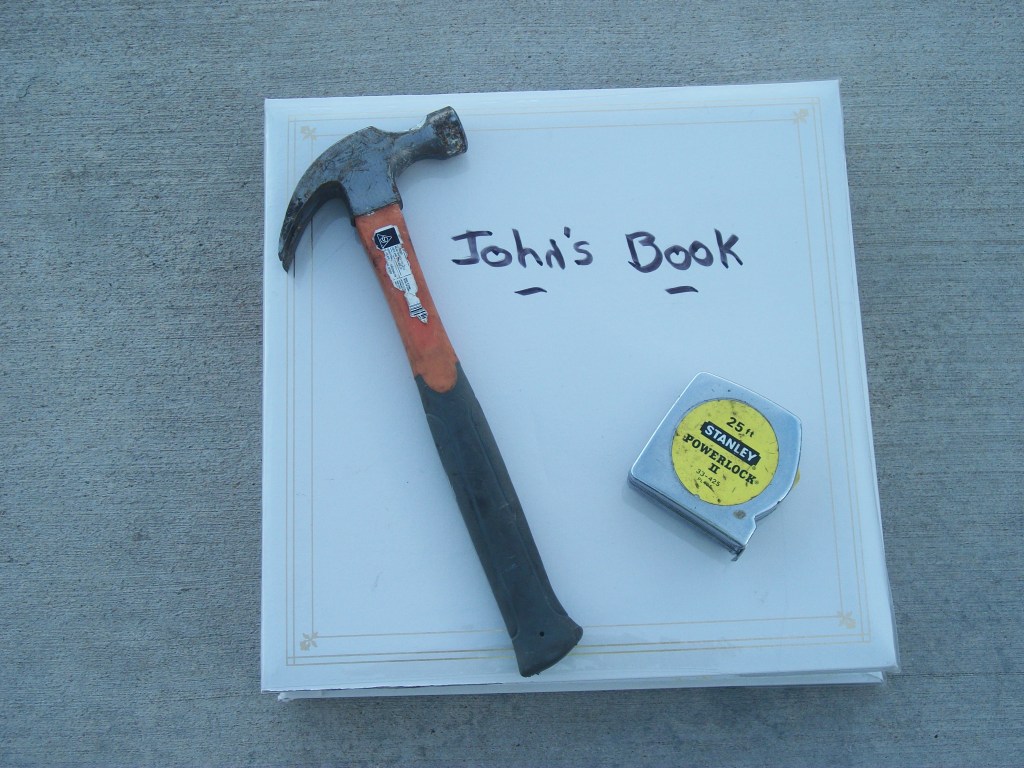
Over a 12-month period, John compiled a book of photos of our project from start to finish. It’s nearly four-inches thick with at least 1000 photographs. Joleen calls it “John’s Book”. I candidly refer to it as, “The Book of John”.
My friend once told me as we thumbed through the album,
“Hang on to this as the pictures will prove invaluable down the road!”
He was correct. They’ve done so time and time again when we needed to see what lay behind sheet rock, or under the ground, before updated home modifications were made. Little did I know the album would come in handy on a new house project.
The whole construction process was meticulously documented
The first thing needed on our latest endeavor is construction of a retaining wall. I instantly turned to John’s book for information. Color photos taken by him in 2004, show plain as day, that our old wall has plenty of steel in the footings. The images specifically identify how the rebar was to be bent and tied together with wire. Showing our masonry contractor these photographs, I informed him it needed to look like this. The man nodded his head in approval.
Unfortunately, John is no longer with us. He passed away in 2017 at the age of 79 from mesothelioma. Having this book at my side makes me feel as if he’s still around overseeing yet another job.
John told me that should we ever sell our Lake Havasu City home, we should leave the book behind to help new owners. John Ballard was always looking out for other people whether he knew them or not.
I’ll follow through on his suggestion, yet won’t give the original away. That one goes with Joleen and me to our new place. I’ll have a duplicate made instead.
John was very meticulous and organized in everything he did. As I mentioned throughout this story, he did so with the construction of our home. I plan on emulating him as close as I possibly can with this latest dwelling. Through John’s teachings, I know more on what to look for in the construction of a house than I ever did.
Pity the poor framing contractor that decides to forego hurricane straps. I have the building code printed and ready to go. John Ballard would be proud!
Close to four inches thick with over 1000 photographs.
“Our hopes are that living in a vegetation free canyon at a slightly higher elevation will solve my nagging, yet serious problem.”
“Desperado”
This is a slightly revised story from the one titled, “Desperado”.
I never thought we’d leave Lake Havasu City. It’s a beautiful place to live although my wife and I don’t call it home. We always think of our stay as an extra-long-vacation.
For the past seven years, like clockwork, I developed bronchitis during the winter season. Bronchitis is a serious infection for older people because it can lead to pneumonia. Just recently, doctors discovered I’m highly allergic to sage which grows abundantly in the Mohave desert, especially in the Colorado River basin. The weed as I call it blooms and then spreads like wildfire. Pollen from this bush irritates my bronchial tubes, causing inflammation and ultimately a nasty congestion.
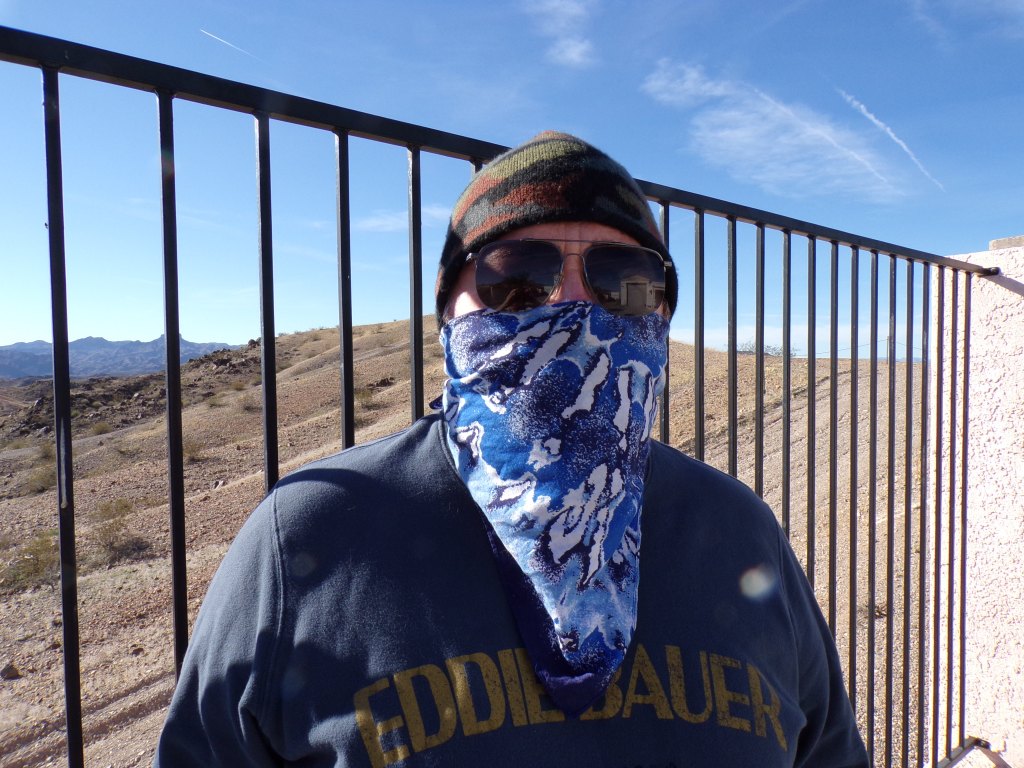
During windy days, I wear a bandanna over my face while outside much like cowpokes do to filter out dust. There’s no way I’m going to be seen sporting one of those paper hospital masks. Joleen claims I look like an urban terrorist of sorts. I view it more as a desperado, because I’m extremely desperate to overcome scratchy eyes and a constant dry cough. Folks with allergies know what I’m talking about. If it takes a scarf over my nose and mouth to overcome such – so be it.
One of my physicians suggested I move elsewhere as there’s nothing she can do to make things better. Pills and shots failed miserably. Where would we go? I suggested Alabama, but Joleen is deathly afraid of tornadoes and hurricanes. Alaska is definitely out of the picture. Been there. Done that. We put up with cold and dark Alaskan winters for many years, along with endless rainy days in summer.
Good friends, Jim & Pat Brownfield, suggested we relocate to Prescott, Arizona where they recently purchased a home. We seriously considered it, until I found out the place is crawling with juniper trees. That’s something the medical tests showed I can’t be around. It’s worse than sage.
Last week, we decided to take a drive and discuss the problem. Picking up lunch from FIVE GUYS BURGERS in Kingman, we chose a small canyon near Cerbat Cliffs to eat. The place is beautiful with huge red rock and cliffs much like those viewed in western movies. Joleen and I came to this location approximately 14 years ago by accident. Back then, we thought it would be a killer site to build a house, but there was no property for sale. We elected to live in Lake Havasu City instead.
This trip to the rugged canyon was different. A newly placed sign sitting on a large piece of property at the bottom of a flat-top-mesa advertised the land as being available. It appeared the sign hadn’t been there for long. We called the listed phone number, and after a couple of days of negotiating with owner, Pat Carlin, a deal was made. Joleen believes God led us to this spot for a reason. I tend to agree.
Recently, I mentioned to a friend about our plans to leave Havasu. His initial comment was,
“So you intend on building your dream house?”
That thought never crossed my mind. What I didn’t tell him is that our dream home is already constructed. It’s actually a mansion perched high above the vibrant-blue Arizona sky.
Our new pad in Cerbat Canyon is simply going to be a place to shed our shoes until heading on to higher ground. The dwelling will be small and easy to clean with wide doors just in case. All new houses should be constructed with wheelchair access. Having to add such changes afterwards can be a major undertaking.
Our hopes are that living in a vegetation free canyon at a slightly higher elevation will solve my nagging, yet serious problem. Just driving to Kingman I can tell the difference in my breathing. The cooler Kingman summers will be a relief as well. To put icing on the cake, the home site’s only two miles from Kingman Regional Hospital where Joleen goes for cancer treatments. Our closest grocery store will only be one mile away.
Last weekend we were able to meet our neighbors to be, Scott & Rhonda. The couple are also Lake Havasu City refugees. They’re extremely nice people with much of the same ideology as us. When Scott told me one of his reasons for moving to the canyon, his comment brought a smile to my face.
“We came here to get away from allergies!”
It seems Scott had problems with dust and pollen in Havasu much like I do. Since relocating, his problem disappeared. That was great news to hear!
It’ll take at least a year to get the house built. That’ll work perfectly with the time we need to pack our goods, sell the old place, and hit the road. Joleen and I are looking forward to our new adventure in Kingman. I’m especially elated to be leaving all the nasty Havasu dust and pollen behind!
“This world ain’t my home, I’m just a passing through!”
Cerbat Canyon property
I never thought we’d leave Lake Havasu City. It’s a beautiful place to live although my wife and I don’t call it home. We always think of our stay as an extra-long-vacation.
For the past seven years, like clockwork, I developed bronchitis during the winter season. Bronchitis is a serious infection for older people because it can lead to pneumonia. Just recently, doctors discovered I’m highly allergic to sage which grows abundantly in the Mohave desert, especially in the Colorado River basin. The weed as I call it blooms and then spreads like wildfire. Pollen from this bush irritates my bronchial tubes, causing inflammation and ultimately a nasty congestion.
During windy days, I wear a bandanna over my face while outside much like cowpokes do to filter out dust. There’s no way I’m going to be seen sporting one of those paper hospital masks. Joleen claims I look like an urban terrorist of sorts. I view it more as a desperado, because I’m extremely desperate to overcome scratchy eyes and a constant dry cough. Folks with allergies know what I’m talking about. If it takes a scarf over my nose and mouth to overcome such – so be it.
My physician suggested we move elsewhere as there’s nothing she can do to make things better. Pills and shots failed miserably. Where would we go? I suggested Alabama, but Joleen is deathly afraid of tornadoes and hurricanes. Alaska is definitely out of the picture. Been there. Done that. We put up with cold and dark Alaskan winters for many years, along with endless gray rainy days in summer.
Good friends, Jim & Pat Brownfield, suggested we relocate to Prescott, Arizona where they recently purchased a home. We seriously considered it, until I found the place is crawling with juniper trees. That’s something the medical tests showed I can’t be around. It’s worse than sage.
Last week, we decided to take a drive and discuss the problem. Picking up lunch from FIVE GUYS BURGERS in Kingman, we chose a small canyon near Cerbat Cliffs to eat. The place is beautiful with huge red rock and cliffs much like those viewed in western movies. Joleen and I came to this location approximately 14 years ago by accident. Back then, we thought it would be a killer site to build a house, but there was no property for sale. We elected to live in Lake Havasu City instead.
This trip to the rugged canyon was different. A newly placed sign sitting on a large piece of property at the bottom of a flat-top-mesa advertised the land as being available. It appeared the sign hadn’t been there for long. We called the listed phone number, and after a couple of days of negotiating with owner, Pat Carlin, a deal was made. Joleen believes God led us to this spot for a reason. I tend to agree.
Recently, I mentioned to a friend about our plans to leave Havasu. His initial comment was,
“So you intend on building your dream house?”
That thought never crossed my mind. What I didn’t tell him is that our dream home is already constructed. It’s actually a mansion perched high above the vibrant-blue Arizona sky. I also didn’t mention that this world ain’t my home, I’m just a passing through. All of us are for that matter.
Our new pad in Cerbat Canyon is simply going to be a place to shed our shoes until heading on to higher ground. The dwelling will be small and easy to clean with wide doors just in case. All new houses should be constructed with wheelchair access. Having to add such afterwards can be a major undertaking.
Our hopes are that living in a vegetation free canyon at a slightly higher elevation will solve my nagging, yet serious problem. To put icing on the cake, the home site’s only two miles from the hospital where Joleen goes for cancer treatments. The closest grocery store is one mile east of us.
Last weekend we were able to meet our neighbors to be, Scott & Rhonda Johnson. The couple are also Lake Havasu City refugees. They’re very nice people with much of the same ideology as us. When Scott told me his main reason for moving to the canyon, the comment brought a smile to my face.
“We came here to get away from allergies!”
It seems Scott had problems with dust and pollen in Havasu much like I do. Since relocating, his problem disappeared. That was great news to hear!
It’ll take at least a year to get the house built along with a shop. That’ll work perfectly with the time we need to pack our goods, sell the old place, and hit the road. Joleen and I are looking forward to our new adventure. I’m especially elated to be leaving all the nasty dust and pollen behind!














 I like to write junk...