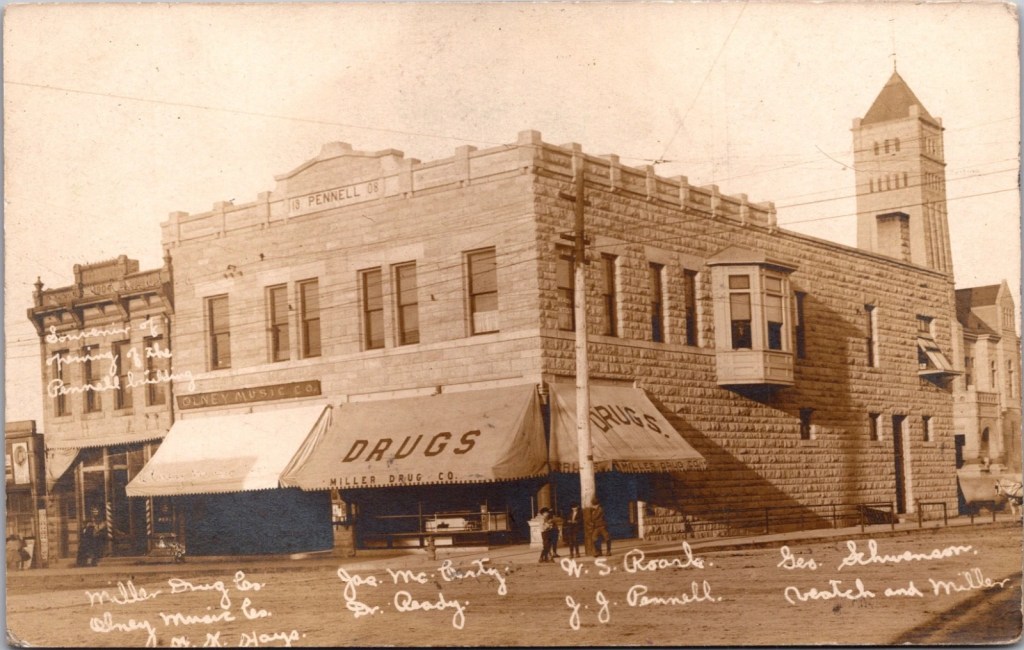
An interesting old 1910 postcard I came across is actually a celebratory announcement of the opening of a new commercial building in Junction City, Kansas. The card sender was Maude K. of Junction City, with the recipient, Mr. Francis Bowman of Chapman, Kansas.
Given my familiarity with this structure and my wife’s birth in Junction City, I felt it was worthy of a full historical review of both entities. I’ll get to the biography of the sender and recipient at the end of my writing.
Located in the heart of Junction City, Kansas, the Pennell Building stands as a testament to the city’s commercial evolution and architectural heritage. For over a century, this structure has witnessed the ebb and flow of local history, entrepreneurship, and community life, earning its place as a cherished landmark in Geary County.
Junction City, founded in the mid-19th century at the confluence of the Republican and Smoky Hill Rivers, blossomed as a hub of trade and transportation thanks to the arrival of the railroad. As the city’s population and economic ambitions grew, so did the demand for more commercial square footage. It was against this backdrop, in 1887, that the Pennell Building was constructed.
Commissioned by William Pennell, a notable local entrepreneur and investor, the building was designed to be a prominent fixture in the city’s burgeoning downtown district. Its construction reflected both the optimism of Junction City’s business community and the Victorian architectural trends sweeping the nation during the late 1800s.
The Pennell Building quickly distinguished itself through its stately brick façade, tall arched windows, and intricate ornamental details, features that set it apart from the simpler wooden storefronts common at the time.
Upon completion, the Pennell Building became a prime location for a variety of businesses. Its ground floor was home to general stores, mercantile shops, and other retail ventures that catered to both locals and travelers passing through Junction City by rail or stagecoach. The upper floors housed professional offices, including lawyers, doctors, and real estate agents, further cementing the Pennell Building’s reputation as a commercial nucleus.
Throughout the late 19th and early 20th centuries, the building evolved alongside the city’s changing economic landscape. As Junction City grew, so too did the diversity of enterprises within the Pennell Building. It became home to everything from specialty boutiques and financial institutions to printing presses and small manufacturing companies. The building’s adaptability mirrored the resilient spirit of Junction City itself, which weathered economic booms and busts, wars, and periods of rapid growth.
Beyond its role as a commercial center, the Pennell Building played an integral part in the social and cultural fabric of Junction City. Its upper floors were often used for meetings, gatherings, and even small performances. Community organizations, fraternal orders, and social clubs found a home in the building’s spacious rooms, making it a lively gathering place for local residents.
The Pennell Building’s location on Washington Street, one of Junction City’s main thoroughfares, made it a focal point for parades, celebrations, and public events. Its distinctive architecture provided a charming backdrop for photographs and festivities, endearing it to generations of townspeople.
Its original brickwork, decorative cornices, and grand windows are characteristic of Victorian commercial architecture—a style that emphasized both function and beauty. Over time, the building underwent several renovations, but much of its historic character has been carefully preserved.
Local preservation efforts in the late 20th and early 21st centuries recognized the Pennell Building’s significance. When many historic structures in small-town America faced demolition, Junction City’s leaders and citizens rallied to protect their architectural heritage. Restoration projects ensured that the building’s façade remained true to its 19th-century origins, while interior spaces were modernized to accommodate new businesses and offices.
In recent decades, the Pennell Building has experienced a renaissance, reflecting broader trends in downtown revitalization across the United States. Its street-level spaces have been home to a range of businesses—from cafes and antique stores to local service providers and boutiques—each contributing to Junction City’s vibrant small-business ecosystem.
All upper floors, once the domain of professionals and organizations, have been adapted for modern offices and, in some cases, residential lofts. This adaptive reuse has breathed new life into the historic structure, attracting entrepreneurs and residents who value its unique blend of old-world charm and contemporary amenities.
Today, the Pennell Building remains a cornerstone of Junction City’s downtown district. Its red-brick silhouette continues to evoke the city’s storied past, while its bustling storefronts and renovated interiors signal a commitment to the future. For longtime residents and newcomers alike, the Pennell Building is more than just an old structure—it is a living symbol of the city’s resilience, adaptability, and sense of community.
Few buildings in Junction City encapsulate the city’s history as completely as the Pennell Building. Over more than a century, it has weathered fires, economic challenges, and changing urban landscapes. In doing so, it has provided a sense of continuity and identity for the community.
Its preservation is a testament to the dedication of local citizens who recognized the importance of maintaining connections to their shared heritage. Educational tours, historical exhibits, and community events held in or around the building continue to foster appreciation for the city’s past.
The story of the Pennell Building is, in many ways, the story of Junction City itself. Born of entrepreneurial vision, shaped by the currents of commerce and community, and preserved through collective effort, the building remains a vital part of the city’s cultural landscape. As Junction City grows and changes, the Pennell Building stands as a reminder that history is not only something to be remembered but something to be lived—brick by brick, generation after generation.
From its prominent architectural features to its ever-changing roster of businesses and its enduring role as a community gathering place, the Pennell Building exemplifies the rich tapestry of Junction City’s evolution. Its walls have witnessed the ambitions, struggles, and celebrations of countless residents, and its continued presence ensures that the city’s heritage remains a living, breathing part of daily life.
A message on my vintage postcard, written to Francis Bowman, reads as follows:
“November 28, 1928
Dear Cousin – Please tell those people that we will be out Thursday if it does not storm for the turkeys. Guess me will find you. And oblidge.
Maude K.”
Born on April 16, 1873, Mr. Francis Bowman was a farmer living in the Rinehardt agricultural area of Chapman. Several wealthy ranchers and farmers resided in the vicinity, including Joseph Strickler Hollinger and John Hiram Taylor. These two distinguished gentlemen are buried in the Rinehart Cemetery.
Francis and his wife Emma eventually moved to Woodbine in 1913, a distance of approximately 15 miles from Chapman. They had a son one year later, whom they named Martin. Newspaper accounts have Francis listed as a wealthy and industrious farmer. An interesting thing I found printed about his farming operation was that he purchased a manure spreader in 1913. This bit of news was perhaps placed in the newspaper as a form of subtle humor.
Francis Bowman died on December 1, 1936, at the age of 63. His wife Emma passed away in 1974, living to be 93. They’re both buried in Woodbine Cemetery. Their son, Martin, was a retired Rock Island railroad conductor. He died in Alabama on June 28, 2010, at the age of 95. His body was brought back and interred in Herington, Kansas, in Dickinson County.
Maude K. or Maude Kipperling was, of course, a cousin to Francis Bowman. She, along with husband Harry Hoover Kipperling, farmed in the Junction City area. There wasn’t much found about them in local newspapers, yet a 1940 census report had a ‘servant’ living with them, Minnie Stiner. That in itself seems unusual.
Minnie Stiner appears to be someone they knew who lost her husband. It also appears that the Stiners kindly took her in, with Minnie helping out around the house as payment. Why she told a census taker that she was the Kipperling’s servant seems most strange, almost humorous. My guess is that she didn’t want it to seem as if Harry had two wives.
The Ancestry.com website shows Harry Kipperling was born in 1878 and died in 1949. His wife, Maude, was born in 1893 and passed away in 1949. Minnie Stiner was born in 1893 and died in 1943.
With Minnie only living with the Stiner’s for a short time, perhaps she was not in good health? My research did not disclose such, with Maude, Harry, and Minnie taking that personal information to the grave.

 I like to write junk...