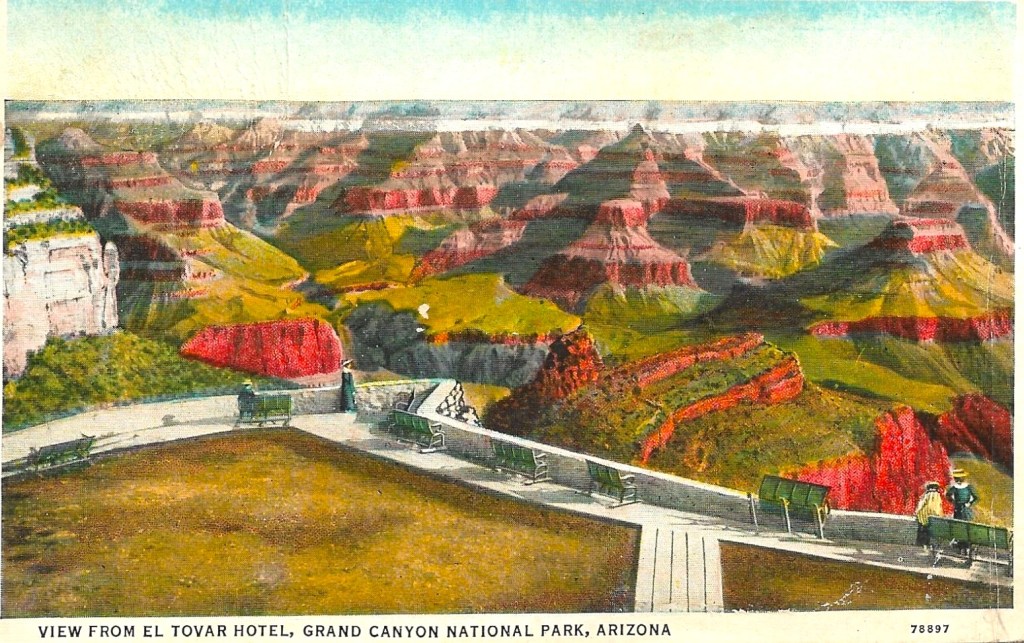
I’ve seen plenty of postcards from the Grand Canyon, and this one, postmarked 1937, didn’t truly excite me. Someone had removed the stamp, making it worth far less from a collector’s standpoint. Carefully looking things over, I wondered if the recipient and the sender might not be people of great interest. My prediction was correct.
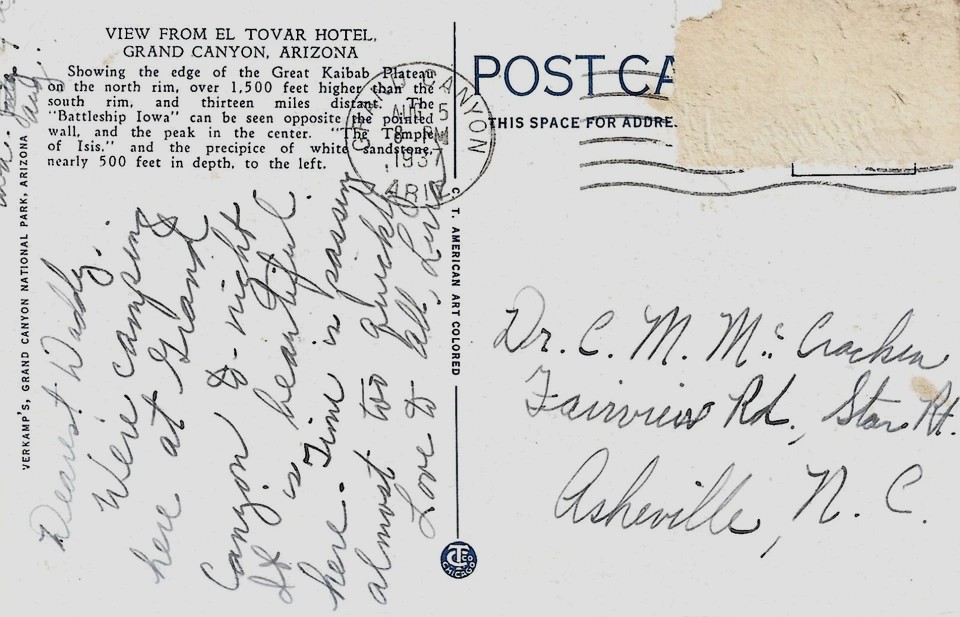
Someone named Lura sent it to Dr. C.M. McCracken, Fairview Road, Star Route, in Asheville, North Carolina. Going by the address alone, I knew it was a rural area. The message within immediately told me the sender was a child of Dr. McCracken:
“Dear Daddy,
We’re camping here at Grand Canyon to-night. It is beautiful. Time is passing almost too quickly. Love to all, Lura.”
The postmark date is August 5, 1937; thus, it would’ve still been quite warm for summer. According to the August 12, 1937, “Williams News” newspaper, it was 92 for a high and 57 for a low in Williams, Arizona. The distance is 56 miles from the Grand Canyon to Williams, and the temperature would have been very close to the same.
Researching Dr. McCracken, there was so much history to this country doctor that I was spellbound reading it all. The house where the McCrackens lived was special all in itself, at least now it is.
Rather than try to add a small amount of information to my article, I decided to take what was written in the National Historic Register, word by word, about Dr. Cicero McCracken, his family, and their dwellings. Miss Purdy, my AI helpmate, found a few typos and archaic sentence structures that she kindly took care of.
“The Dr. Cicero McAfee McCracken House, a well-preserved Foursquare-style frame dwelling erected in 1924, is important in the history of Fairview and Buncombe County as the residence of a long-time country doctor whose rural practice spanned a period of four-and-a-half decades in his adopted community of Fairview and the surrounding region.
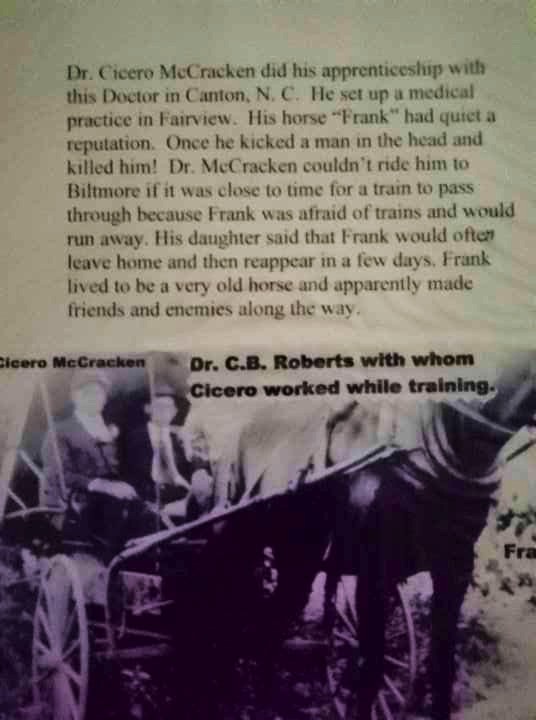
Dr. McCracken (1868-1942), a native of Haywood County and a member of the large McCracken family who resided in and around the Crabtree community, received his medical education in the then-typical combination of reading and work with a local physician, Dr. C. B. Roberts of Clyde, North Carolina, and study at Vanderbilt University Dental School and the North Carolina Medical College where he graduated in 1896.
In the summer of 1896, he located in the small village of Fairview on the Asheville-Charlotte Highway, where he opened his medical office and, in 1897, was married to Helen Lura Clayton (1878-1920). From at least the turn of the century until 1924, Dr. McCracken and his large family lived in houses in the village. For much of this period, he occupied a house immediately south of the Fairview Baptist Church: it was pulled down in the mid-1980s.
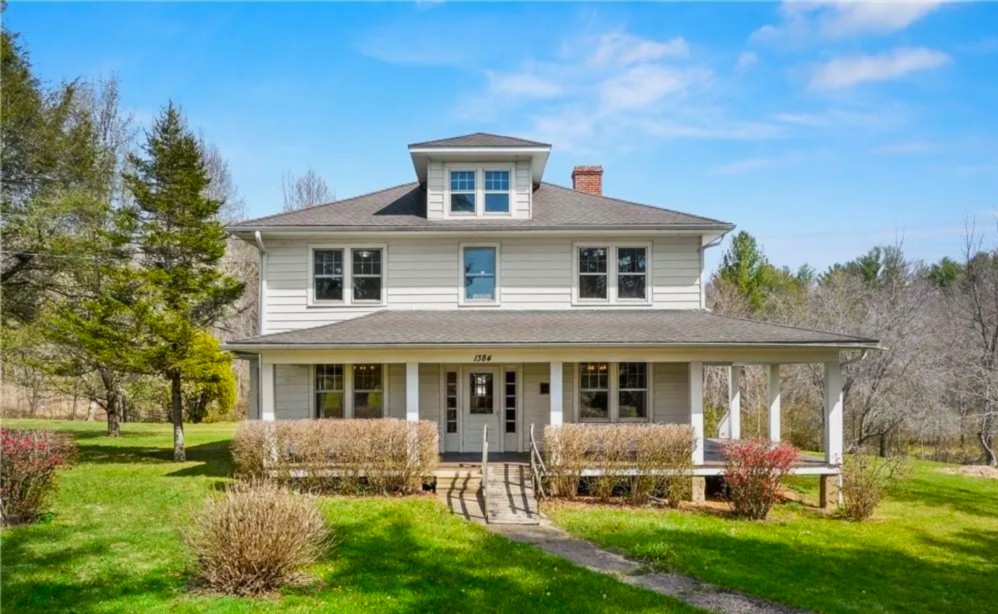
In 1924, a widower with seven children, Dr. McCracken, built and occupied a new house, office, and garage on the north side of the Charlotte Highway, opposite the Fairview School campus. Those buildings, surviving to the present, were his home and office until his death on 8 December 1942.
A member of the Fairview School Board (1913-1929) and the Buncombe County Board of Health (1918-1924), he was accorded the tribute of a biographical sketch in the Bulletin of the Buncombe County Medical Society in 1939 and the honor of a large public funeral in the auditorium of the Fairview School from whence his body was carried to Cane Creek Cemetery.
The Dr. Cicero McAfee McCracken House is eligible for listing in the National Register under Criterion B for its association with the productive life of Dr. McCracken and as the major surviving building associated with his career: his practice embraced a territory from Asheville to Rutherfordton and from Black Mountain into Henderson County.
The house is eligible for listing in the area of Health and Medicine for its association with the practice of a well-known and well-respected doctor whose career spanned four-and-a-half decades in Fairview and where he exercised parallel positions of leadership in his church, community, and profession.
Cicero McAfee McCracken (1868-1942), the builder and occupant of the house in Fairview which bears his name, was a member of the large McCracken family of Haywood County, North Carolina. The progenitor of that family, Joseph Cass McCracken (1776-1848), was born on 4 January 1776 in Habersham County, Georgia, the son of David E. McCracken (1750-1812).
On 15 March 1798, Joseph McCracken was married to Sarah Vaughan (1779-1867), the daughter of George and Dorcus Vaughan. The couple’s first child, a daughter named Carey (1799-1866), was born on 13 January 1799. According to family tradition, Joseph McCracken departed Georgia in 1800, together with his wife and young daughter, and removed to western North Carolina, where he settled on a farm on Crabtree Creek in what is now Haywood County.
Over the course of some forty-eight years, McCracken and his family prospered and expanded their holding, and for the remainder of the nineteenth century, the McCracken family would be associated with the Crabtree community. Twelve additional children were born to Joseph and Sarah McCracken between 1800 and 1821: ten of the thirteen children would remain in Haywood County, where they, too, would raise large families.
Russell McCracken (1806-1891), Cicero McCracken’s grandfather, was born in Haywood County on 24 October 1806, the fifth child and fourth son of Joseph and Sarah McCracken. He was married to Margaret Crocket Garrett (1810-1874) and, like his father, he, too, sired a large family. His eldest son, Joseph Franklin McCracken (1829-1913), was to become the father of Cicero McCracken.
Joseph Franklin McCracken was born on 25 April 1829, and on 19 October 1854, he married Julia Ann Howell. Fourteen children were born to Joseph Franklin and Julia Ann McCracken between 1855 and 1879: Cicero McCracken was the ninth child and the fourth son.
The nurturing influence of this large family proved to be important in Cicero McCracken’s life, and it was an influence that shaped both his professional practice and the life of the large family that he, in turn, sired and educated. Cicero McCracken was born on 19 September 1868 at Crabtree in Haywood County and spent his formative years on the family farm and in the companionship of dozens of cousins and other relatives.
He was educated in the local schools and at the Clyde Institute, a private school. In July 1890, he entered into a contract with the committeemen of District No. 5 of Haywood County to teach in the white public school at the rate of $25.00 per month; it is not known how long he served as a school teacher.
It appears that Cicero McCracken was disposed toward medicine from a relatively early age. An account of his medical training, published in a biographical sketch in the October 1939 number of the Bulletin of the Buncombe County Medical Society, outlines the combination of tutorial and formal study by which he gained his medical education:
In 1889, Dr. McCracken chose as his preceptor Dr. C. B. Roberts of Clyde, North Carolina, and for two years he read medicine in the office of Dr. Roberts and went with him on visits to his patients. In 1891, after two years with Dr. Roberts, Dr. McCracken entered Vanderbilt Medical College, Nashville, Tenn. He studied there for one year and then returned to Clyde, North Carolina, to practice with Dr. Roberts again for two years.
In 1894, he entered the North Carolina Medical College, then located at Davidson College, Davidson, North Carolina. He graduated from that school in the spring of 1896. In May 1896, he passed the State Board of Medical Examiners and was licensed to practice medicine. It is unclear at present why Cicero McCracken did not return to his native Haywood County to practice medicine; instead, he chose to locate his practice in the small, growing community of Fairview, then without a doctor, which was located a dozen or so miles to the southeast of Asheville in Buncombe County.
It may have been as well the attraction of the Fairview Academy, a private boarding school established there in 1888, where he saw the potential of educating his future family. Fairview was also located on the main road, passing through Rutherfordton, between Asheville and Charlotte, and was a stop on the stage line which connected the two principal cities in western North Carolina.
In August 1896, he is said to have opened an office in Fairview, presumably in rented quarters. Just over a year later, on 8 December 1897, he was married to Helen Lura Clayton (1878-1920), the daughter of R. C. Clayton of Cane Creek. On 3 March 1899, Elizabeth Ann McCracken (1899-1968) became the firstborn of eight children born to Dr. and Mrs. McCracken between 1899 and 1916.
The other seven children were: Beatrice Helen (1901-1966); Marvin Howell (1903-1974); Clayton Houston (1906-1983); Joseph Franklin (1908); Cicero McAfee, Jr. (b. 1909); Joseph Glenn (1913-1991); and Lura (born 1916).
On 16 March 1899, thirteen days after the birth of his daughter, Cicero McCracken purchased a one-acre tract of land in Fairview Township from Jason Ashworth. It was the first of some twenty-one tracts, mostly in Fairview Township, which McCracken acquired in the period up to 28 March 1917. An examination of the grantee and grantor indexes to deeds in Buncombe County indicates that McCracken was involved in a small real estate business in and around Fairview during the opening decades of the twentieth century, which supplemented his income as a physician.
Five of these tracts, adjoining each other, became the principal house tract of 101.60 acres on the Charlotte Highway (US 74) on which McCracken would build this house in 1924. Whether the parcel he purchased in 1899 was the tract on which he lived in the center of Fairview has not been determined; however, he occupied a two-story frame Victorian house immediately south of the Fairview Baptist Church from around the turn of the century until relocating this house in 1924. In February 1925, the grounds of the house were subdivided into lots. That house was eventually sold and stood into the mid-1980s when it was pulled down.
From the time of his arrival in Fairview in 1896 until he died in 1942—a period of forty-six years—Dr. Cicero McAfee McCracken was a respected leader in the community and a figure well-known throughout Buncombe County. During these four-and-a-half decades, he practiced medicine in now lost offices at Fairview, and later in a one-story frame building erected in 1924, which survives on this property.
Throughout this long period, approaching a half-century, he was one of a small but highly respected group of men known as “Country Doctors.” In the nineteenth century and through the opening decades of the twentieth century, such men were acknowledged as leaders in the community by virtue of their profession: together with ministers, they were the most respected members of their community.
Dr. McCracken and other men in this group were not only turned to for medical advice, but for their opinions on a variety of topics and for civic leadership. According to the biographical sketch published in 1939 and two obituaries in 1942, Dr. McCracken exercised leadership in his profession, his church, and his adopted community of Fairview for the long tenure of his residency there.
In part because of his own difficulty in gaining an education, he was a strong advocate for education in Fairview. The Fairview Academy, a private school, remained in operation until 1913: in 1904, a small frame public school was erected at Fairview for the sum of $525 by A. B. Clayton, possibly a kinsman of Mrs. McCracken.
In 1907, Fairview became the site of one of three high schools established in Buncombe County that year. In 1913, Dr. McCracken became a member of the Fairview School Board and served as a member until 1929. It was during this period that he built this house on the north side of the Charlotte Highway, directly opposite the Fairview School campus.
In 1918, he became a member of the Buncombe County Board of Health and served until 1924. He was a lifelong member of the Baptist Church and a member of the Fairview Baptist Church from the time of his arrival in the community until his death. He was also a member of the Biltmore Masonic Lodge.
With the birth of his eighth child and third daughter, Lura, in 1916, the McCracken household consisted of the doctor, Mrs. McCracken, three daughters, and four sons. Joseph Franklin McCracken, named for his paternal grandfather, was born and died in 1908.
For most, if not all, of the first two decades of the century, the family occupied the house standing south of the Fairview Baptist Church. On 5 June 1920, Helen Lura (Clayton) McCracken died at the age of forty-two; she was buried at the Cane Creek Cemetery at Fairview. For seven years, until his marriage in 1927, Dr. McCracken remained a widower and raised his family, presumably with the help of his two eldest daughters.
In about 1923, Dr. McCracken determined to erect a new house—this house—for his family on an assembled tract of just over one hundred acres which lay on the north side of the Charlotte Highway (US 74) directly across the road from the Fairview School. According to family tradition, this decision was made so that his youngest children would be closer to school.
The lumber for the house was cut from his acreage. Four local builders, Bob Oates, Andy Wright, George Fite, and Jay Hill, have been identified as the builders of the two-story frame Foursquare-style house. These builders also erected the frame office and the garage, now much overbuilt, which stands at the rear of the house. Following a center-hall, double-pile plan, the house is firmly in the American Foursquare tradition, well-built yet simply finished.
It is reasonable to ascribe the unusually plain finish of the interior of the house to the fact that it was built by men for a man, without the refinements that a wife might have encouraged in its construction. Except for the addition of aluminum siding in the mid-1950s, it survives today virtually as built in 1924.
Initially, electric power at the house and office was supplied by a Delco system acquired by Dr. McCracken. He also constructed a reservoir to provide running water for the house’s kitchen and two bathrooms.
On 10 August 1927, Dr. McCracken was married to Johnnie Ruth Turner (1897-1987) of Winnsboro, Fairfield County, South Carolina. She was a graduate of the Charlotte Sanatorium School of Nursing. A daughter, Ruth Brice McCracken, was born in 1928; the family circle was completed by the birth of two sons, John Turner McCracken in 1930 and Julian Woodburn McCracken in 1932.
The first years of the marriage were enjoyed in the prosperity that characterized life in many places in the 1920s; however, after the Crash of 1929, the condition of the McCracken finances worsened. During the late 1910s and 1920s, and the early 1930s, the education of his children was a great expense to the doctor.
His three daughters graduated from the University of North Carolina at Greensboro (then a Woman’s College of the University of North Carolina), and his four sons of the first marriage all attended Wake Forest University, and three graduated from the school. Most of them went on to take secondary degrees, and all took up professions in the fields of public education, medicine, and dentistry.
Although the family garden and certain farm crops would have supplied most of the necessary foodstuffs for the family, together with other items bartered in exchange for medical services, there was a high need for income to meet the educational fees of his children.
On 15 August 1931, the homeplace and its 101.60 acres were placed under mortgage for the sum of $1,500 to the Federal Land. Bank of Columbia, South Carolina. The principal and interest would not be paid off until April 1944, a year and a half after Dr. McCracken’s death.
These straitened circumstances of the McCracken family were not unusual in Buncombe County in the 1930s. The high life of Asheville’s 1920s boom was brought to a cruel, grinding halt in 1930. On 20 November 1930, the Central Bank and Trust Company of Asheville, with assets in excess of $52 million dollars, failed to open its doors, and other smaller banks likewise failed in this period.
Funds and investments of both the city of Asheville and Buncombe County disappeared in the collapse of the city’s banks, and many businesses likewise were forced to close their doors. The depression spread into Buncombe County and to Fairview. The McCracken family would never recover the financial position they enjoyed previously; however, they retained their house and a warm family life, and all of the children received good educations.
In the late 1930s, Dr. McCracken’s stamina began to weaken; however, he continued to practice medicine, and he sometimes saw patients in the northeast corner room of his residence. He became critically ill in the autumn of 1942 and died in the morning of 8 December 1942, survived by his widow and ten children who ranged in age from forty-two to ten years of age.
Obituaries in the Asheville TIMES, the city’s afternoon paper, and the Asheville CITIZEN, the morning newspaper, both lauded him as a “well-known physician” and reported the broad outline of his life. Because of the affection and esteem in which Dr. McCracken was held by Fairview, his funeral was held in the auditorium of the Fairview School, a public hall which could seat a larger number of mourners than the Baptist Church. He was buried beside his first wife at the local Cane Creek Cemetery.
Dr. McCracken’s death, in very reduced circumstances, would eventually force his family to give up their Fairview home. Now a widow, Mrs. McCracken relocated the medical office back to its present position near the house in 1943 and used it as a rental dwelling. During 1943, however, it became clear that she would not be able to remain in Fairview.
Early in 1944, she set about to relocate the family in Asheville. Final payments were made in April 1944 to satisfy the mortgage with the Federal Land Bank. Simultaneously, she sold this house and its 101.60 acres by deed of 28 March 1944 to J. M. and Bertha Anderson of Haywood County, North Carolina. That same year, she acquired property on Woodlawn Avenue in Asheville, and in 1945, she acquired additional property on Montford Avenue in the city.
In the 1944 ASHEVILLE CITY DIRECTORY, she is listed as a resident of 67 Cumberland Avenue. In the 1945-1946 edition of the ASHEVILLE CITY DIRECTORY, she is listed as the proprietor of the McCracken Nursing Home at 199 Montford Avenue. Her eldest stepson, Dr. Marvin Howell McCracken (1903-1974), had his medical offices a few blocks away at 346 Montford Avenue.
For three decades, from 1944 until 1974, the McCracken house was the residence of a series of owners who might also have rented the former medical offices as a dwelling. J. M. and Bertha Anderson held the property until 19 September 1950, when they sold the house and its reduced lot of 21.90 acres to L. H. and Janet R. Holmes.
On 26 May 1954, L. H. and Janet R. Holmes sold the house and its 21.90 acres to Lloyd and Helen Roberson. The property eventually passed into the ownership of Heritage, Inc., which subdivided the acreage that lay to the rear of the house. On 2 August 1974, Heritage, Inc. conveyed the McCracken house, the garage, Dr. McCracken’s former office, and its reduced grounds of 2.96 acres to Julian Woodburn McCracken and his wife, Sarah MaCrae McCracken.
For nine years, McCracken rented out the house. Julian Woodburn McCracken (born October 1932) had been a lad of ten when his father died and, at the age of twelve, he left his childhood home to live on Montford Avenue in Asheville. Like his elder brother, John, he was educated at Christ School, Arden. Following family tradition, he attended Wake Forest University; however, he transferred to Clemson University.
He was married to Sarah Woodward McRae in June 1955: two months later, in August, he graduated from Clemson University with a B.S. degree. He also received an M.B.A. degree from Pepperdine University in 1972. Julian McCracken entered the United States Army and retired in 1983 in the grade of colonel at Fort McPherson, Georgia, after a twenty-eight-year career of service. In September 1983, he and his wife returned to Fairview and occupied the house, which remains their residence to the present.
The historical significance of the Dr. Cicero McAfee McCracken House lies in its association with the life and medical career of Dr. McCracken (1868-1942), who practiced as a physician at Fairview from August 1896 until shortly before his death on 8 December 1942.
From the biographical account of his life published in October 1939 in the Bulletin of the Buncombe County Medical Society and the obituaries that appeared in the Asheville newspapers, it is evident that Dr. McCracken had a rural medical practice that was probably typical in most respects. With his office at Fairview, Dr. McCracken had a wide practice in the broad surrounding region stretching between Asheville and Rutherfordton and between Black Mountain and Henderson County.
His second wife, Johnie Ruth, was a trained nurse, and she assisted Dr. McCracken from the time of their marriage through the remainder of his career. Dr. McCracken prepared many of his medicines in his office and dispensed them to patients: this practice was a common one for rural physicians who were far removed from pharmacies in the state’s larger towns and cities. Consequently, his career cannot be lauded for notable achievements or discoveries in his profession, or for having been the attending physician to some notable personage.
Coming from relatively humble circumstances, he was born to neither privilege nor affluence nor family capital, which might have pointed his medical career in another direction. As a result, he was not one of many doctors in the towns and cities of North Carolina who, in the decades around the turn of the century, opened their own clinics or invested in hospitals.
Such men, including Dr. Richard Beverly Baker (1821-1906) of Hickory, are recalled by hospitals that bore their names before the advent of the corporate hospital industry. Instead, the significance of Dr. McCracken’s career exists as a representation of the lives and careers of a large number of rural doctors, known affectionately as the “Country Doctor.”
It was these men, located throughout rural North Carolina, who provided medical services to the largest part of the state’s population in the nineteenth and early twentieth centuries and who held positions of public esteem and trust in a manner that is absent in late modern life. During the period in the 1920s when there was still but one doctor per 1,210 inhabitants—an improvement over the ratio around the turn of the century—these men were critical to the health of their community, especially in a time when many lives were lost to typhoid fever and tuberculosis.
The medical society sketch of his life, quoted earlier in this report, described the means by which Dr. McCracken gained his medical education and secured a license to practice. That process was probably more typical—and likewise representative of the era—than that of men who might have been fortunate enough to have undertaken a full course of formal medical schooling.
The establishment of medical schools in North Carolina came late in the nineteenth century. A medical school was established at the University of North Carolina in 1879; the North Carolina Medical College was established in Charlotte in 1887, and Cicero McCracken was a student at the school in 1894-1896 while it was located at Davidson. However, these schools struggled in their early years and did not have the prestige of educational programs offered by certain schools, including the University of Pennsylvania, the Jefferson Medical College, and New York University, to which most of the state’s more affluent and ambitious medical students turned in the nineteenth century.
The role of the medical preceptor was a distinguished one in this state’s medical history, and it was these men who served as medical educators before medical schools were formally established in North Carolina. Even with the establishment of the two schools in 1879 and 1887, that important tradition of medical education continued to the turn of the century and probably beyond in the western reaches of the state.
Reading and working under a preceptor, such as Dr. C. B. Roberts of Clyde, not only provided training and insight into the profession and practice, but it also provided experience, which enabled students such as Cicero McCracken to reap the maximum benefit of formal schooling when he entered the Department of Dentistry at Vanderbilt University in 1891 and the North Carolina Medical College in 1894.
Cicero McAfee McCracken graduated from the North Carolina Medical College in the spring of 1896, and in May of that year, he passed the examination held by the North Carolina Board of Medical Examiners and was licensed to practice medicine. The sketch of his life, published in 1939 near the end of his career, recounted the broad outline of his practice in a few simple sentences that probably could have been used to describe the lives of many rural doctors in western North Carolina:
‘In August 1896, he located at Fairview, North Carolina, where he had practiced medicine for forty-three years—sometimes with horse and saddle, sometimes with horse and buggy, and sometimes on foot when the road came to a dead end and horse and buggy could go no farther, and only a path penetrated into the cove or up the mountainside. But good roads into this mountain section in recent years have wrought great changes, and Dr. McCracken has long dispensed with horse and buggy and is privileged to make his calls in an automobile.
Dr. McCracken has had to be his own pharmacist—carrying his medicine with him and often preparing the mixtures necessary for his patients. The Fairview section in recent years has become a popular resort for tourists, and these people have recognized the ability of Dr. McCracken and have not failed to avail themselves of his services when needed. The role and status of the “Country Doctor” in western North Carolina were not restricted to the practice of medicine but included civic leadership.
In the nineteenth and early-twentieth centuries, the country doctor was turned to, time and again, for his opinions on a wide variety of issues, which in Dr. McCracken’s case included local education, good roads, and the advancement of his adopted community of Fairview. His service on the Fairview School Board (1913-1929) and on the Buncombe County Board of Health (1918-1924) reflects the two principal poles of his civic and professional interests.
According to family tradition, Dr. McCracken also assisted young men from the region, with loans or grants, to pursue medical studies. In the absence of a modern history of Buncombe County and a like history of medicine in the county, a final assessment of his career in the context of other doctors remains to be confirmed. That said, however, the best critique of his life’s work might well be the concluding paragraph of the 1939 biographical sketch, which reflects the judgment of his peers.
Dr. McCracken has lived a full and useful life. By his untiring efforts for community progress and his devoted service to humanity, he has endeared himself to all. He has been justly honored by his professional associates and by the community as a capable physician, loyal friend, and good citizen.’
Lura McCracken Marr Roberts sent that postcard to her father in 1937, five years before he died, undoubtedly finding Arizona a place of splendor. Revisiting the Grand Canyon State in 2010, she passed away there at the age of 94. Lura was buried in North Carolina.
The Cicero McAfe McCracken family all went on to be highly educated people and professionals in their various careers. Their old home remained in the family up until 2013, when Courtney Stephens purchased it.
Perhaps one item the National History Register did not focus on as much as it should was the McCracken’s devoted worship habits, which especially included prayer. Their success in life did not come from hard work alone.


 I like to write junk...