
This postcard story begins in Athol, Kansas, and ends there. Athol is a small community located in Smith County, Kansas. Established in the late 1800s, it has remained a quiet rural community throughout its history.
Athol is known for its agricultural heritage and close-knit population, reflecting the charm of small-town life in the American Midwest. It is also close to being a ghost town, with a current population of 47.
Pictured on one side of the slightly damaged postcard is Main Street in Athol. A Ford Model T is driving in front of the local bank, with someone using an ink pen to write on the card that a hotel and the old post office are visible. The person writing this also mentions a dwelling being around back. Telephone poles are visible, giving some indication of modern technology.
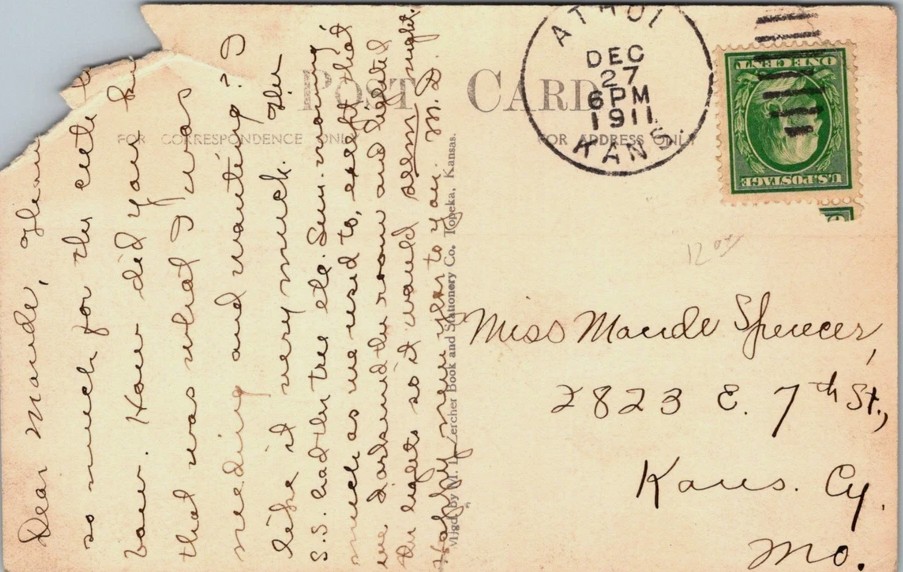
The postcard is dated December 27, 1911, and stamped 6 PM. Although not mentioned, the weekday was Wednesday. A one-cent Thomas Jefferson stamp is affixed to the card upside down.
One corner is missing, but I was able to figure out what I believe was there in transcribing the main message. This was only two days after Christmas. The initials S.S. within the letter I take to mean Sunday School.
“Dear Maude,
Thank you so much for the cute tree bow. How did you know that was what I was needing and wanting? I like it very much. The S.S. had their tree etc Sun. morning as much as we used to, except that we darkened the room and lighted the lights so it would seem night. Happy New Year to you. M.D.”
The recipient of the postcard was Miss Maude Spencer. 2823 E. 7th St., Kansas City, Missouri. I had no problem finding out who Maude Spencer was, yet M.D. was a different story. It took much research to come up with a name.
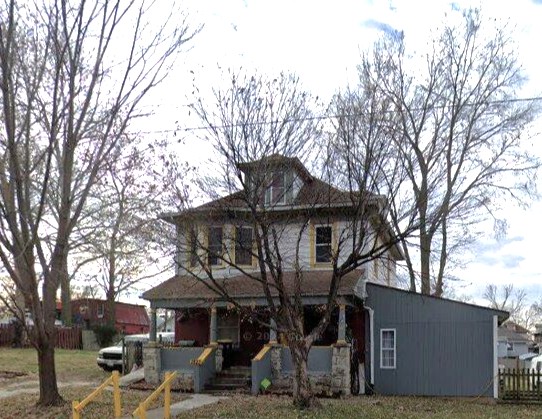
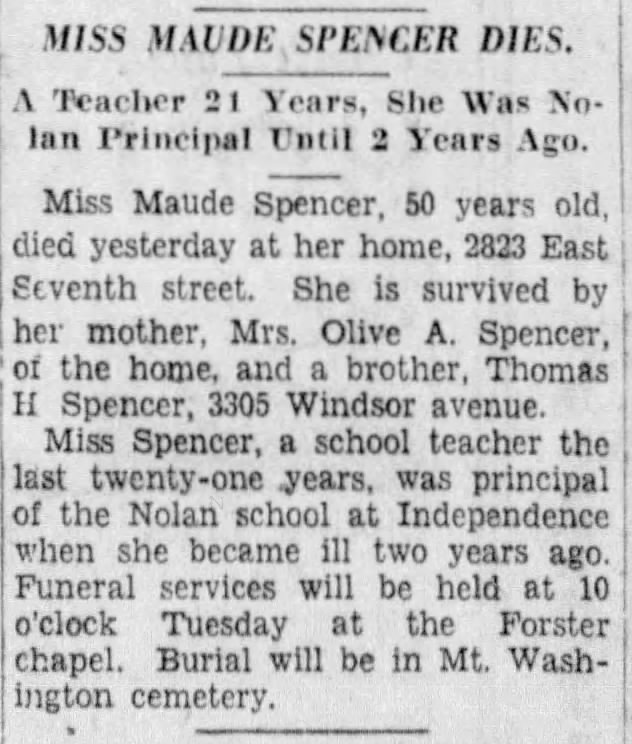
Maude was born on May 4, 1881, in Salina, Kansas. Spencer was her maiden name and remained that way for life. She lived with her dad, mom, and two brothers at the 7th St. address. Miss Spencer continued living there even after her father and mother passed away.
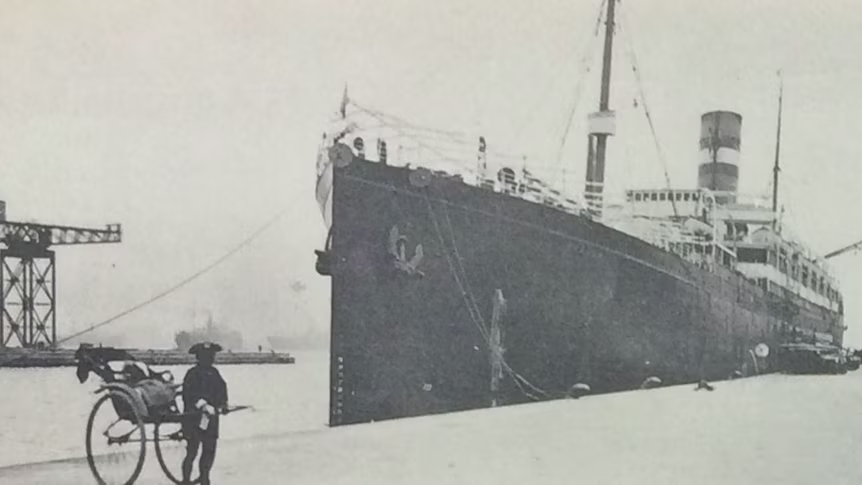
Maude Spencer created some controversy when she told a newspaper reporter in 1927 that co-ed travel was okay, even if some ‘petting’ did occur. Miss Spencer had just completed an 8-month semester cruise on the ship, SS Ryndam, to 35 countries and 90 cities. Maude was one of the older college students on this vessel at 46 years of age.
The SS Ryndam floating university was a trailblazing academic initiative of the late 1920s, providing students with a unique opportunity to learn as they traversed the globe by sea. On board the SS Ryndam, students from 143 colleges set sail for a semester-long cruise, visiting 35 countries and 90 cities.
This journey combined formal instruction with the vibrant experiences of travel, blending classroom learning with firsthand exposure to new cultures, histories, and ideas.
The floating university fostered a spirit of adventure and open-mindedness, challenging traditional educational boundaries. Notably, passengers like Maude Spencer participated in this international academic community, and the program even sparked social conversation—such as when Maude’s views on co-ed travel made headlines in 1927.
This voyage remains a remarkable chapter in the history of experiential learning, marking the early days of study-abroad programs and demonstrating the transformative power of learning beyond the traditional classroom.
Four years after her cruise, Maude passed away on August 31, 1931. During that time, up until her adventure, and for two years afterward, she’d been a teacher and a school principal. Miss Spencer was quite ill during the last two years of her life and was unable to perform either job.
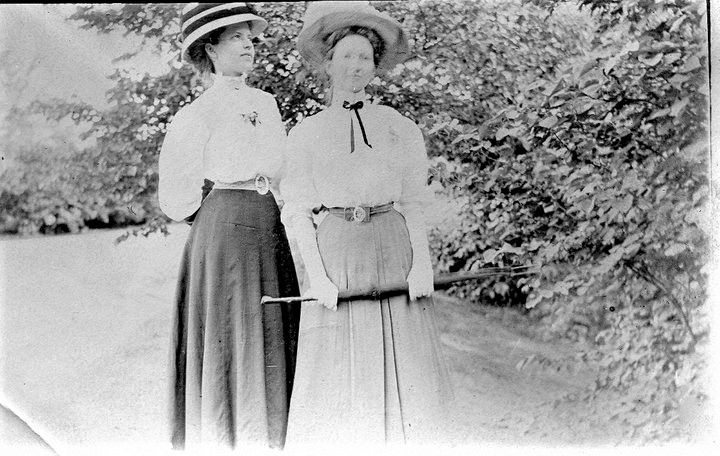
Margaret Belle Douglass (M.B.D.), it appears, was Maude’s friend living in Athol. Like Miss Spencer, she was also a teacher in her early working years, a Sunday School instructor, and worked as a bookkeeper for her father’s grain elevator.
Moving to Kensington, Kansas, in 1918, she worked there as a teller for 36 years at First National Bank. With the initials of M.D., Margaret Douglass seems to be the only acquaintance or family member of Miss Maude Spencer that fits the puzzle. Athol is only 7 miles away from Kensington.
While living in Kensington, Miss Douglass volunteered as a Sunday School teacher, church treasurer, and choir member at the Methodist church. Margaret Douglass was born on August 7, 1880, and died on October 31, 1954, at the age of 74. She’s buried in Athol.
It appears that the last big event to take place in Athol was the Centennial Days Parade in 1988. A large contingent of people from throughout the surrounding country turned out with clowns, displays, floats, old tractors, trucks, and cars.
The parade lasted for almost an hour, which is long-lasting for a small community. Since that time, quiet has enveloped the old town much like the peaceful silence at Pleasant View Cemetery, where Martha Douglass was laid to rest

 I like to write junk...