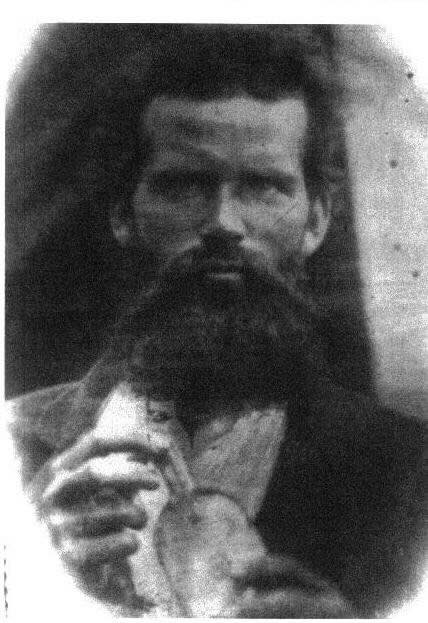
Digging into one’s family history can be both interesting and challenging at the same time. I was interested enough, early on, to ask my grandparents about their kin, but unfortunately, I didn’t retain it all. Thanks to modern genealogy research tools and old newspapers, I’m able to fill in some blanks, going all the way back to 1420.
I did a good amount of investigating on my own, but the majority of this digging was actually performed by my late Aunt Dora Hankins-Guyton, as she traveled to courthouses and old libraries to track information down. Thankfully, she passed this data along to my brother and me. Dora was helped by other relatives, including my Cousin Pat Wheeler-Smith.
The surname Hankins is a family name with deep historical roots, primarily found in English-speaking countries. Understanding the origins and evolution of the name Hankins provides insight into genealogy, migration patterns, and cultural history.
Hankins is generally considered to be of English origin. The name is a patronymic form, derived from “Hankin,” which itself is a diminutive of the Middle English personal name “Han” or “Hank.” The suffix “-kin” was commonly added in medieval England to indicate “little” or “son of,” so “Hankin” would mean “little Han” or “son of Han.” Over time, the patronymic “-s” was added, forming “Hankins,” which denotes “son of Hankin.”
The name Hankins began to appear in written records in England during the Middle Ages, especially in regions such as Gloucestershire, Warwickshire, and London. Surnames became increasingly necessary as populations grew and communities expanded, helping to distinguish individuals with common given names.
During the 17th and 18th centuries, bearers of the surname Hankins migrated to North America, Australia, and other parts of the British Empire, spreading the name further afield. In the United States, the name became established and can be found in census and vital records dating back to colonial times.
Variants of the surname include Hankin, Hankinson, Hankins, and Hanks. These names share similar origins and often appear in historical records in overlapping regions.
Today, the surname Hankins is most commonly found in the United States, the United Kingdom, Canada, and Australia. In the U.S., it is especially prevalent in the southern and midwestern states.
While not as common as some other surnames, Hankins has maintained a steady presence in public life, with bearers contributing to a variety of fields, including sports, academia, literature, and the arts.
The first Hankins in my direct line is William Hankins. Born in England in 1420, he died there at a relatively young age in 1460.
Reverend Thomas Hankins was the Vicar of Dymocke in the Church of England. Born in 1462, he died in 1538. Buried in England.
John Hankins was born in 1515. He died in 1597 in England.
William Hankins was born in 1545 in England, with the exact date of his death unknown. Buried in England.
William Daniel Hankins was born in 1565 and passed away in 1619. Buried in England.
Thomas William Hankins lived in England. He was born in 1590 and died in 1639. Buried in England.
Charles Richard Thomas Hankins is the first of my kin mentioned as being in America. Born in Berkshire, England, in 1610, he most likely came here around 1630. He died in Monmouth, New Jersey, in 1692.
Richard Hankins. Born in Virginia in 1652, he died in New Jersey in 1749.
Thomas John Hankins. Born in 1700, he died in 1748. Buried at the Hankins Cemetery in New Market, Tennessee.
Richard Hankins. Born in 1733, he died in 1800. Buried in the Hankins Cemetery in Lamar County, Alabama.
John Alvin Hankins. 1775 – 1843. Buried in Old Hankins Cemetery in Lamar County.
Stephen Green Hankins. Born in 1805, he had 13 children via two wives. Three of his eight sons died in the American Civil War. Stephen had a large plantation and owned slaves. After the war, he set them free and gave each a portion of land. Stephen died in 1870. Buried at Oakes Cemetery in Lamar County.
Shelby Allen Hankins. 1849 – 1922.
James Burton Hankins. 1869 – 1952. A deeply religious man, I was told by my parents that he often preached at a small church in Lamar County, Alabama. James died two years before I was born.
Houston Alexander Hankins (my initial grandfather on a list of 15). My father’s father. 1900 – 1966. Buried in Lamar County.
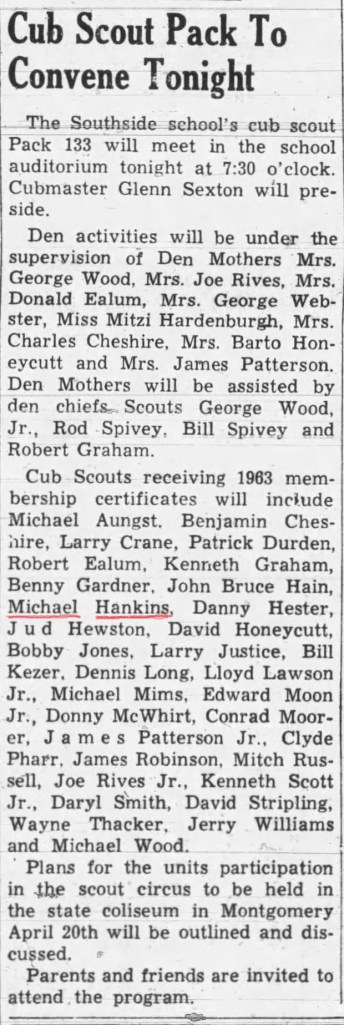
I have so much more information on our family, but I wasn’t trying to write a book here. On a side note, there was a time when I thought I was the only Michael Hankins in the US. Turns out there are 264 of us.





 I like to write junk...