DUNLAP, KANSAS

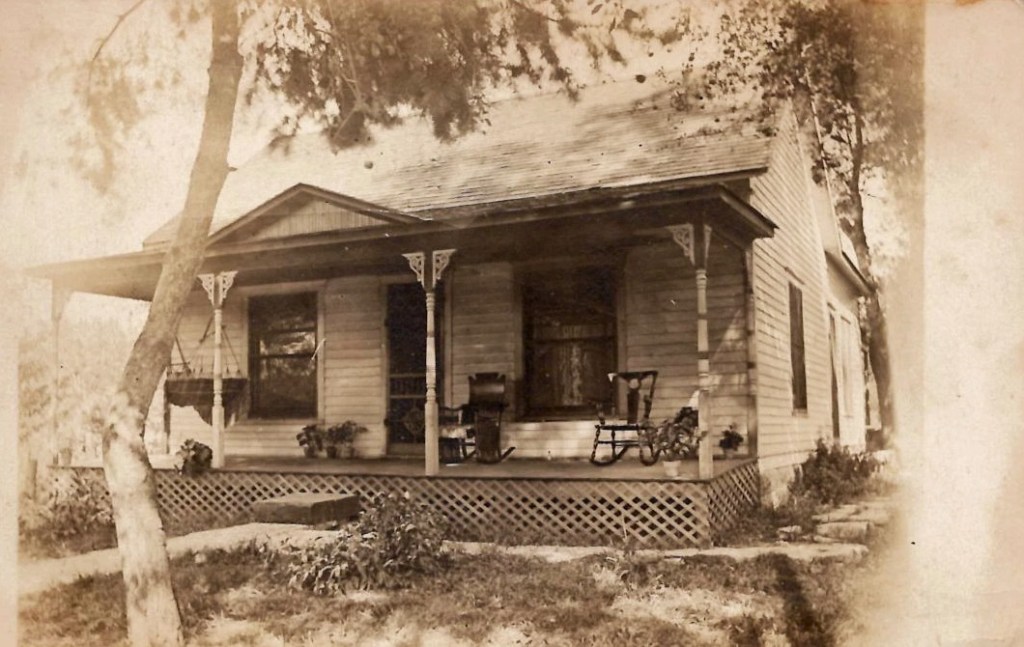
“A picture postcard mailed from Dunlap, on January 3, 1910, has a photograph of the residence of W.H. Robinson.”

William H. Robinson’s home in Dunlap, Kansas

Dunlap, Kansas, is a small, unincorporated community with a rich history marked by its role in post-Civil War migration and its unique place in the story of African American settlement in the Midwest. Located in Morris County, Dunlap’s legacy is intertwined with the Exoduster movement and the settlement of freed individuals seeking new opportunities after emancipation.

Dunlap was founded in the late 19th century, named after Joseph G. Dunlap, an early settler and entrepreneur who played a significant role in the community’s establishment. The area was originally part of the Great Plains, inhabited by various Native American tribes, including the Kansa and Osage, before white settlement began in the region.

The arrival of the Atchison, Topeka, and Santa Fe Railway in the 1870s spurred more rapid development. The railway provided crucial access to markets and transportation, encouraging settlement and economic growth in the area.

One of the most significant chapters in Dunlap’s history began in the late 1870s and early 1880s with the influx of African American settlers known as “Exodusters.” Fleeing racial violence and economic hardship in the post-Reconstruction South, many Black families migrated to Kansas, inspired by its reputation as a free state and the legacy of abolitionist John Brown.

Benjamin “Pap” Singleton, a prominent African American leader and former slave, played a pivotal role in encouraging this migration. He and others led groups of Exodusters to settle in Dunlap and surrounding Morris County, establishing one of the most significant Black farming communities in Kansas. These settlers built homes, churches, schools, and businesses, creating a thriving and resilient community despite facing significant social and economic challenges.

By the 1880s, Dunlap had become a vibrant town with a diverse population. The African American settlers established their own churches, including the St. Paul African Methodist Episcopal Church, and built schools such as the Dunlap Colored School, which provided education for Black children in the community.

The town supported several businesses, farms, and social organizations. Despite segregation and discrimination, the Exoduster community in Dunlap achieved a degree of self-sufficiency and prosperity, contributing to the broader story of Black migration and settlement in the American Midwest.

Dunlap’s fortunes began to decline in the early 20th century. Economic hardships, including the Great Depression and the Dust Bowl, led many residents to leave in search of better opportunities elsewhere. The consolidation of rural schools and the decline of the railroad also contributed to the town’s dwindling population.

By the mid-20th century, Dunlap had largely ceased to function as a distinct town, and many of its historic buildings were lost or fell into disrepair. However, the legacy of the Exodusters and their descendants remains an important part of the region’s history. Efforts to preserve and commemorate Dunlap’s past continue through historical societies, reunions, and educational initiatives.

Today, Dunlap is an unincorporated community, a ghost town, with only a few remaining residents and structures. The nearby cemeteries, such as the Dunlap Cemetery and the St. Paul AME Cemetery, serve as reminders of the town’s unique heritage and the enduring legacy of the African American pioneers who once called it home.

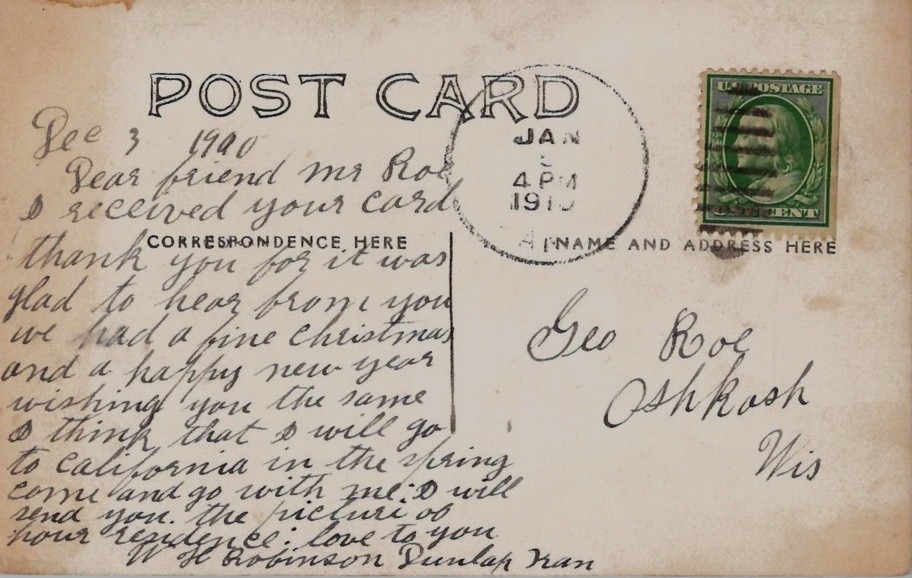
A picture postcard mailed from Dunlap, on January 3, 1910, has a photograph of the residence of W.H. Robinson. This card was sent to his friend, George Roe, in Oshkosh, Wisconsin. A nicely written message, transcribed as written, says:

“Dec 3 1900

Dear friend Mr. Roe

I received your card. thank you for it was glad to hear from you. we had a fine Christmas and a happy new year. wishing you the same. I think that I will go to California in the spring. come and go with me: I will send you the picture of our residence: love to you

W.H. Robinson Dunlap Kan

Mr. Robinson was somewhat confused, as the card was mailed in January, although it was supposedly written in December. He also corrected the date from 1900 to 1910.

William H. Robinson was born in Ohio in 1844. He married around 1885 to a woman from Illinois named Mary. The couple had two children, Arthur and Sarah. William was a farmer and horticulturist.

William and Mary moved to Long Beach, California, in 1919. William H. Robinson passed away in 1924, while his wife died in 1936.

George Roe, the postcard recipient, was born in England on November 22, 1882. He was a woodworker by trade, owning a small shop in Oshkosh. George married wife, Lydia, around 1917. They had three children, Evelyn, Rexford, and Lydia. George died in 1959, with Lydia passing away in 1983 at the age of 97.

Unlike the Robinsons, who moved to California from Kansas, the Roes stayed put in Wisconsin. Both are buried in the small city of Omro.
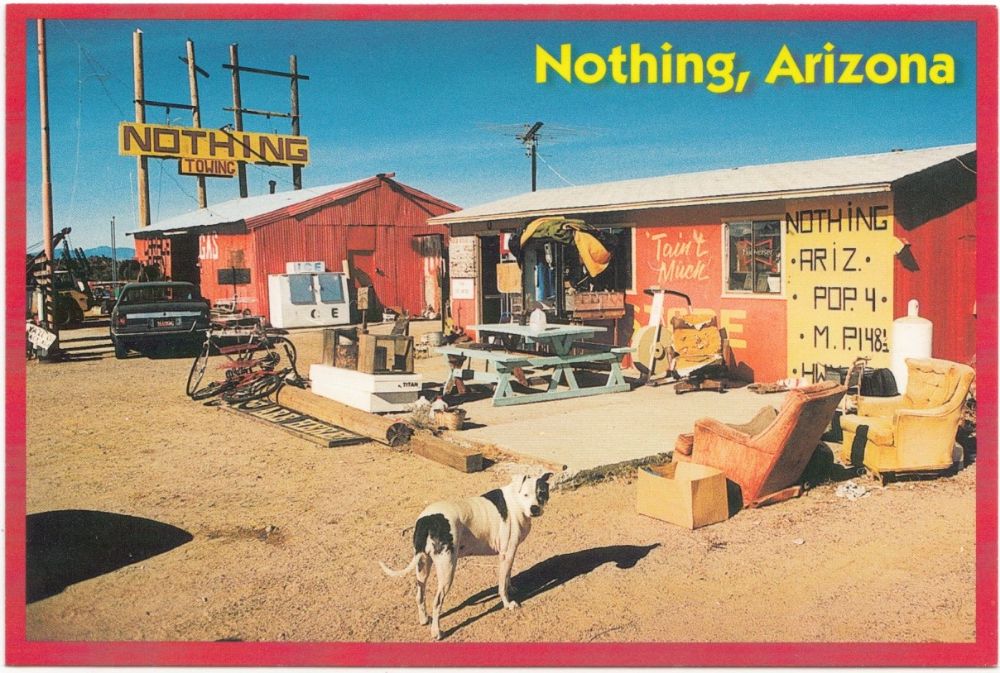
NOTHING, ARIZONA

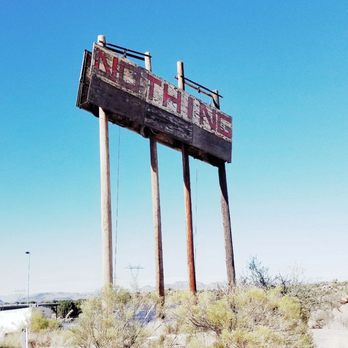
“The unusual name has made Nothing something of a pop culture curiosity.”

Nothing, Arizona

This is my 600th blog piece, and I wanted to make sure the subject matter was something of great significance. I could’ve picked from several areas, such as politics, religion, family, favorite restaurant, or even pets that I once owned. For whatever reason, I bypassed all of those and chose Nothing.

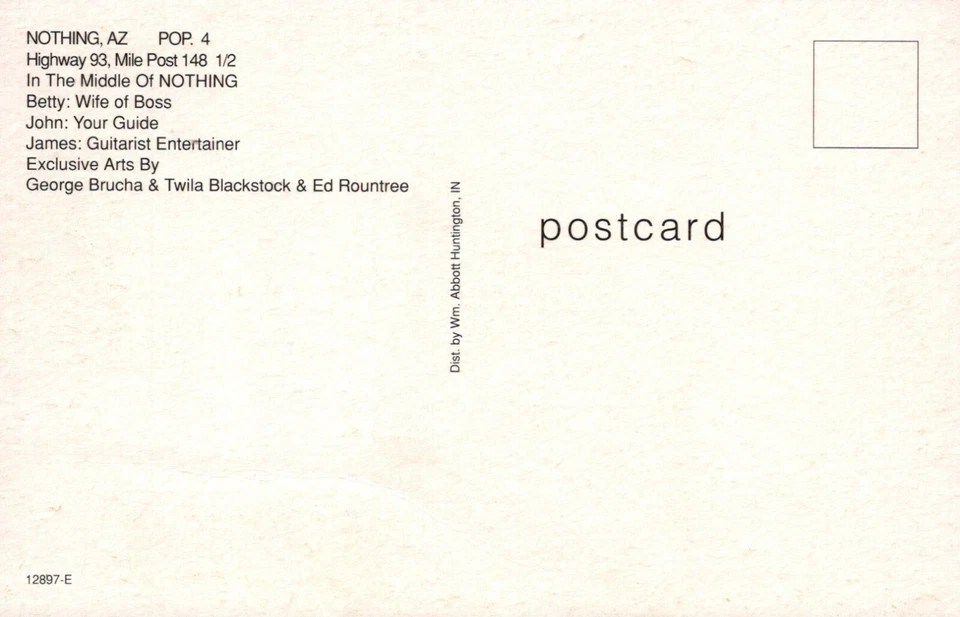
Nothing, Arizona is one of those places that ignite curiosity with its evocative name and mysterious reputation. While many have heard whispers about this peculiar locale, its story is a blend of fact, myth, and the American penchant for the unusual. That’s why I’m writing about an unposted postcard most likely purchased from a Nothing store when it was still open.

The name “Nothing” is emblematic of small, remote, and often overlooked towns that dot the American landscape. According to local tales, the area was so sparsely populated and off the beaten path that early settlers or travelers would joke that they were “going nowhere.” Eventually, the name stuck and became official through local usage and various maps.

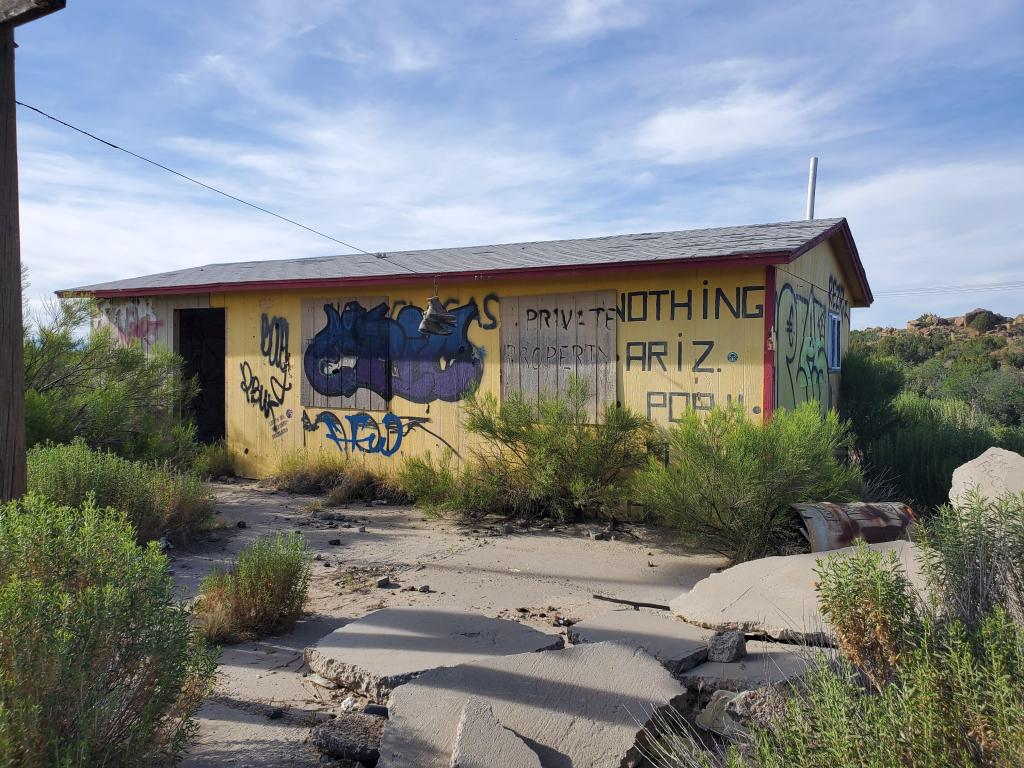
Nothing is an unincorporated community located in La Paz County, Arizona. It sits near the eastern end of Alamo Lake Road, not far from Alamo Lake State Park. The area is characterized by arid desert scenery, rugged terrain, and a sense of isolation that matches its name. Sadly, desert rats seem to use the outskirts of Nothing to dump large items, such as mattresses and appliances.

Unlike many towns in Arizona that began as mining camps or railway stops, Nothing never developed into a bustling settlement. There are no records of significant gold rushes, railroad construction, or agricultural booms that shaped the histories of other Arizona communities.

Instead, Nothing remained a quiet spot, occasionally serving as a waypoint for travelers and outdoor enthusiasts headed toward Alamo Lake. A towing service was available for vehicles that broke down along the way.

The unusual name has made Nothing something of a pop culture curiosity. It has appeared on lists of odd place names, inspired writers and road trippers, and become a favorite stop for those seeking novelty photographs with the town’s sign.

Stories about ghostly encounters, eccentric residents, and mysterious happenings abound, though many are the products of local legend rather than documented history.

Today, Nothing remains mostly a dot on the map, with few permanent residents or businesses. However, its proximity to Alamo Lake State Park brings occasional visitors, especially those interested in camping, fishing, and desert exploration. The spirit of Nothing endures as a symbol of the quirky, rugged, and sometimes lonely character of Arizona’s backcountry.

While Nothing, Arizona, doesn’t boast a rich tapestry of historical events, its very existence and the stories that have grown around it reflect the enduring American fascination with remote places and the power of a memorable name. Whether visited for curiosity or simply pondered from afar, Nothing truly is somewhere—at least in the imagination; a stretch of it at that!

The back of the postcard

FLAT, ALASKA

“Today, Flat stands as one of Alaska’s best-preserved ghost towns…”

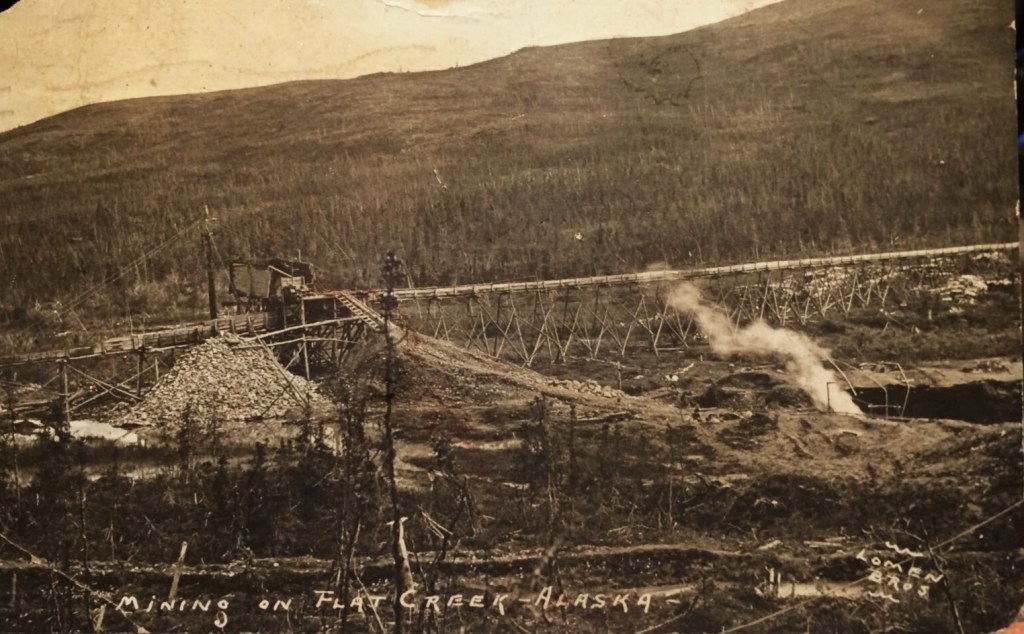
Gold mining just outside the town of Flat, Alaska

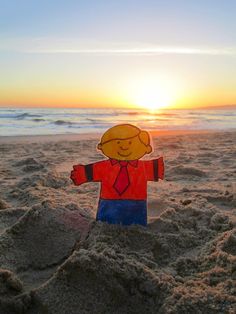
Flat, Alaska, is one of my favorite places to visit. There’s something about the name that intrigues me, almost as much as that affable character, Flat Stanley.

I’m not sure the thin-faced Glat Stanley has ever been to this ghost town, but perhaps he hitched a ride there on a plane, boat, dogsled team, or snowmachine at some time. There are no drivable roads to Flat, so he couldn’t have come via car or truck. For those not knowing who Flat Stanley is, let’s just say he’s a famous world traveler.

Once a bustling gold mining town, Flat sprang to life during the early 20th-century gold rush. Founded in 1908 after gold was discovered along Otter Creek, Flat quickly grew as prospectors and entrepreneurs flocked to the area in hopes of striking it rich.

At its peak, the town boasted several thousand residents, complete with schools, hotels, stores, and even its own newspaper. However, as the gold deposits dwindled and mining operations slowed, Flat’s population declined just as rapidly as it had risen.

Today, Flat stands as one of Alaska’s best-preserved ghost towns, offering a glimpse into the state’s gold rush era and the adventurous spirit of those who once called it home.

In 1920, H.J. Landwehr sent a picture postcard to Sidney Svensen in Fond du Lac, Wisconsin. This postcard shows mining on Flat Creek, which runs right beside the town. It appears they are thawing frozen tundra using wood fires to get at the rich paydirt.

The postcard was postmarked in Seattle on February 26, 1920. Mr. Landwehr possibly picked up the black and white card on a trip to Alaska. I hoped my research would show this as being true.

The short message reads”

“Feb 26/20

Dear friend, just a line to let you know I got your letter. Was shure glad to hear from you. I will write you a letter later.

H.J. Landwehr

2341 E Lake Seattle”

It took almost a day of careful searching to find out who Landwehr and Svensen were. Having last names like theirs, I figured they were of German and Norwegian descent. The problem I had was that there are different ways to spell each, and the handwriting was hard to read.

Heinrich Jacob “Henry” Landwehr was born in Iowa on July 28, 1876. His parents were from Germany, with H.A. and Louise Landwehr immigrating to America for a better life. Farming was their occupation.

Census records indicate that the youngest son, Henry, transitioned into a carpenter after working in a bar and being a policeman as well as a boomman. This final change in occupation might’ve had something to do with a December 25, 1920, newspaper article I found. Transcribed word-for-word, it reads like this.

“Raising a chair in the air, Tom Curtain, 39, recently released from the federal penitentiary at McNeil Island, smashed H.J. Landwehr, an employee of the Our House bar at 151 Washington St., into unconsciousness late Friday evening.

According to Landwehr’s statement to the police, the attack was brought on by Curtain’s belief that Landwehr had ‘squealed’ and sent him to the penitentiary.”

It’s possible, early on, that Henry had high aspirations to strike it rich in the gold fields of Alaska, perhaps even mining in Flat or Iditarod. After combing through archived newspapers, I found a record of the man being there.

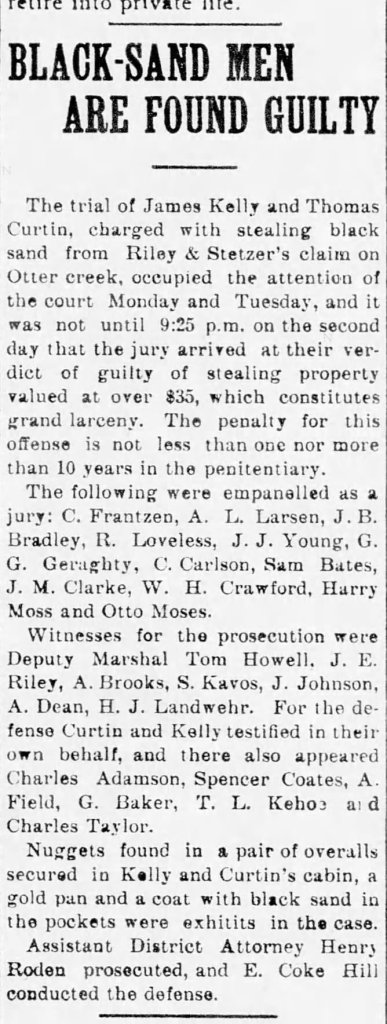
H.J. Landwehr is mentioned in the July 20, 1912, edition of the “Iditarod Pioneer” as a witness to individuals stealing gold-laden black sand from another prospector. After a proper trial, the men were found guilty by a jury, thanks in part to Henry Landwehr’s testimony.

Gold mining must not have been as prosperous as he thought it would be, with Henry returning home to Washington before 1920. Records show Henry Landwehr was a respected member of the Order of the Moose lodge in Seattle, with Mr. Landwehr passing away at the young age of 47 on March 21, 1924. It appears he was not married.

The postcard recipient, Sidney Svensen, is best described by his graphic obituary—as they don’t write them like this anymore. It goes into a little more detail than what I would see fit to print, especially the cause of death. I was correct once again in Svensen’s parents being of Norwegian descent.

“Longview Daily News, Monday, Sep 28, 1970:

Sidney Svensen, 81, of Puget Island, died Sept. 27 in a Longview hospital. He was born Aug. 16, 1889, on Puget Island.

Son of Sven and Servina Johnson Svensen, he married Esther Vog in 1914, was a commercial fisherman, lived at Rt 1 Box 55 Cathlamet, died in Cowlitz General Hospital of ventricular fibrillation with arrest, cancer of the duodenum with metastases, pulmonary emphysema due to asthma, per death certificate 20037, whose informant was his wife. Buried Sep 30, 1970.

He was a member of the First Lutheran Church on Puget Island, was a retired commercial fisherman, served three years as deputy sheriff, two years as town marshal of Cathlamet, and had been a fish buyer.

Surviving are his widow, Esther; two sons, Elroy of Puget Island and Eugene of Camano Island; two daughters, Mrs. Lorraine Bailey of Seattle, and Mrs. Selma Olsen of Longview; 14 grandchildren; six great-grandchildren; and a sister, Mrs. Garda Sherman of Portland.


Services will be at 2 pm on Wednesday at his church with Rev. Karl Berg officiating. Interment will be in Greenwood Cemetery.”

From the July 20, 1912, “Ididarod Pioneer”
“Flat Stanley” in Maui, Hawaii