
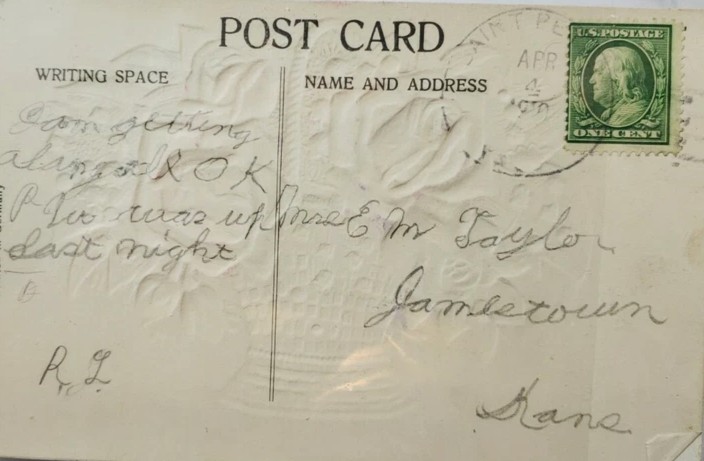
The earliest white settlers to Kansas came by covered wagon, settling in places close to water and having fertile ground to plant their crops. A postcard mailed from St. Peter, Kansas, to Jamestown, Kansas, in 1910, was sent by one of these earliest pioneers. The message this elderly woman wrote in shaky handwriting was very simple:
“I am getting along OK. I was up last night. R.L.”
The card recipient is Mrs. E.M. Taylor. She, too, was an early-day Kansas resident and one of the first families in Cloud County. I had no problem identifying Taylor, but the two initials took some Dick Tracy sleuthing to solve.
I finally nailed things down with only two people having those initials in the St. Peter area. One of them had died before 1910. I’ll fill you in on Mrs. E.M. Harris and R.L. after telling a bit about the towns they lived closest to.
Hoganville, or St. Peter, Kansas, is a small rural community located in Graham County in the northwestern part of the state. Like many towns in western Kansas, its history is deeply intertwined with the expansion of the American frontier during the late nineteenth century.
The area that would become Hoganville was settled by European immigrants, primarily of German-Russian origin, who were drawn to the region by the prospect of agricultural opportunities and the availability of land following the Homestead Act of 1862.
The community was officially established in the late 1800s, named Hoganville, with the founding of a Catholic parish—St. Peter’s Church—serving as the focal point for the settlement. The church provided not only spiritual guidance but also a sense of identity and unity for the early settlers.
As more families arrived, the town developed around the church, with homes, a school, and essential businesses forming the nucleus of the community. Hoganville was eventually changed to St. Peter.
In its early years, St. Peter thrived as an agricultural center. Wheat, corn, and other crops were cultivated, and farming remained the backbone of the local economy. The town’s population consisted mainly of farming families, and daily life revolved around the rhythms of planting and harvest, church services, and communal events. The schoolhouse played a vital role in educating the children of the area, preparing them for both farm life and the broader world.
St. Peter’s residents maintained strong cultural ties to their European roots, especially through religious festivals, traditional foods, and language. The community’s German-Russian heritage influenced everything from church architecture to holiday celebrations. Social gatherings, often centered around the church or school, provided opportunities for neighbors to support one another and foster a sense of camaraderie.
Like many rural communities in Kansas, St. Peter faced challenges such as droughts, economic downturns, and the gradual migration of younger generations to urban areas.
Over time, improvements in transportation and technology changed the way people lived and worked. As the population declined, some institutions—such as the local school—were consolidated or closed, but the church often remained as a symbol of continuity.
Today, St. Peter is a quiet, close-knit community that continues to honor its heritage. While the population is smaller than in its early days, the legacy of the original settlers endures through the enduring presence of St. Peter’s Church and the memories of generations who called the town home. St. Peter stands as a testament to the perseverance and faith of rural Kansans and remains a cherished part of Graham County’s history.
Jamestown, Kansas, located in Cloud County, was established in the late 19th century during a period of rapid settlement throughout north-central Kansas. The town was officially founded in 1878 and named after James P. Pomeroy, an early settler and prominent figure in the area’s development. Like St. Peter, Jamestown quickly grew as families arrived to farm the fertile prairie lands, with wheat and corn becoming staple crops that supported the local economy.
The construction of the railroad was a pivotal moment for Jamestown, boosting commerce and helping the town thrive as a center for trade and agriculture. The community developed around institutions such as churches, schools, and small businesses, all of which played vital roles in shaping daily life. Residents of Jamestown often gathered for social events, religious festivals, and communal activities, fostering a strong sense of unity and shared heritage.
Throughout its history, Jamestown faced challenges typical of rural Kansas, including droughts, fluctuating crop prices, and a gradual decline in population as younger generations moved to urban centers in search of new opportunities.
Despite these difficulties, the town has remained resilient, adapting to changes in technology and transportation. Today, Jamestown continues to honor its agricultural roots and community spirit, standing as a testament to the perseverance of its residents and the enduring legacy of small-town Kansas.
Mrs. E.M. Harris was Hulda Sarah Beatty-Harris. Her husband was Edwin Maxwell. Edwin, born in 1848 in Mansfield, Ohio, came to Kansas in 1871 with his brother. In 1874, Edwin married Hulda Sarah.
The newlyweds moved to the Jamestown area in 1878. Like most settlers, they undoubtedly lived in a sod house at first until finally constructing a simple one of wood.
Despite the hardships inflicted upon them by drought, weather, and pests such as grasshoppers eating their crops, the couple endured, raising six children. Edwin Harris was out working in his garden one day with one of his daughters when he fell dead of apoplexy or a cerebral hemorrhage. The most common name, stroke, is most often used here. This incident happened on April 3, 1906. Edwin’s buried in the Fairview Cemetery.
Edwin’s wife, Hulda, was born on September 9, 1844, in West Virginia, before her family relocated to Iowa. It was only five years later, on May 4, 1911, that she too passed away, leaving the children to run the farm. This was only one year after receiving the postcard.
R.L. is Rachel Bennett Lank. Several history books show it as Lang, but they’re incorrect. Rachel was married to Elza Samuel Lank. Elza was born on September 28, 1856, in Dallas, Iowa. He married Rachelle Bennett somewhere around 1883. The Lank’s are on a list of the first white settlers coming to the Hoganville/St. Peter’s area. An Iowa connection is probably how the Taylors and Lank’s knew each other.
Rachel was born in Dunkirk, Ohio, in October 1857, although the exact date is unknown. She died on April 8,1936, at the age of 79, while her husband, Elza, had passed 12 years earlier, on April 21, 1924. The couple had four children, two of them died during their early years: Blanche at two years of age and Kenneth at three.
There aren’t many people living in St. Peter today, with the latest count showing 47. There are a few vacant and crumbling buildings left, including the St. Anthony Catholic Church. A once beautiful building, neglect, and a leaking roof have doomed the structure.
Unless the St. Anthony Church of St. Peter Preservation Society is successful, it will eventually be razed like hundreds of other Kansas churches of all denominations have suffered. Should that happen, all that will be left of this town are memories and a few picture postcards.


 I like to write junk...